Archive for the ‘Tasting notes’ Category
Mountain red
 Achaia 2010, Grand Cave, Domain Mega Spileo/Cavino ($28.85, 13110137)
The estate is named after a nearby monastery that once owned the vineyard. Most of the technical info comes from the back label and kudos to the winery for that. A 60-40 blend of Mavrodaphne and Mavro Kalavrytino (aka Black of Kalavryta) from vines rooted in sandy clay soil in a relatively cool-climate mountain vineyard between 780 and 880 metres above sea level and located near the village of Kalavryta. No chemical insecticides, herbicides or fertilizers are used. Manually harvested. Destemmed. Prefermentation maceration at low temperatures for 24-48 hours. Long and gentle alcoholic fermentation in small temperature-controlled tanks. Malolactic fermentation and maturation on the lees in new oak barrels (80% French, 20% American) for 16 months. Lightly filtered. Not cold stabilized. Bottle-aged 24 months before release. 6,500 bottles made. 13.5% ABV. Quebec agent: Divin Paradis.
Heady nose of plum, prune, leather, burned earth, sweet spice, coffee, hints of blood and chocolate. More medium- than full-bodied and very dry. The ripe but not jammy or forward fruit is complemented by a full set of tertiary flavours (old wood, leather, cigar box, dried herbs and earth) and a swirl of inky minerals, framed by smooth but animating acidity and soft tannins that show their mettle on the long, lightly astringent finish. Sandalwood, terracotta and dried cherry linger. Savoury, balanced and at peak. Fairly priced for a seven-year-old wine of this quality. Fairly cries out for grilled lamb. (Buy again? Yep.)
Rosé de beauté
 Corse Calvi 2016, Rosé, Pumonte, Domaine d’Alzipratu ($31.75, 12829182)
100% Sciacarello from vines planted on the high granitic slopes of the Pumonte lieu-dit on the Île de Beauté. No pesticides or herbicides are used. Manually harvested. Half the wine is made using the saignée method and the other half is direct-pressed. Fermented with selected indigenous yeasts in temperature-controlled stainless steel tanks. Lightly filtered before bottling. 13.5% ABV. Quebec agent: oenopole.
Pink grapefruit, sun-baked rock, faint dried herbs and a whiff of vodka-marinated cherries, becoming more effusive as its breathes, gaining floral and spice notes. Slightly oily – or maybe honeyed – in the mouth. The subtle, elegant fruit (strawberry, peach, grapefruit) is set against a backdrop of quartzy minerals. Dry but not bone-dry, with acidity that keeps things fresh but doesn’t draw attention to itself. Turns aromatic at the back of the palate. A stream of bitterness and astringency surfaces on the long finish, while umami, cherry and seashells linger. Impressive. Not an aperitif wine: a rosé gastronomique if ever there were one. Revisited the next day, the tail end of the bottle tasted flat and alcoholic, so maybe not a keeper. (Buy again? Yes, especially as I missed out on the Fiumeseccu.)
Alois and Eloi
The only connection between the wines in the last flight was that both were bigger reds that had caught my attention, the Trebulanum because it is made from a grape I’d never heard of, let alone tasted, the Trévallon because it was reportedly excellent and I’d been giving the wine a pass since an unhappy encounter with the 2007. The wines were double-carafed about four hours before we tasted them.
Terre del Volturno 2011, Trebulanum, Casavecchia, Alois ($44.00, 12628604)
Contrary to what SAQ.com claims, this is not made by the Piedmontese Azienda Agricola Casavecchia but by the Campanian estate Vini Alois, which is based in Pontelatone. 100% Cassavecchia from organically farmed wines averaging 20 to 25 years old and rooted in the mineral-rich volcanic soil of the 1.5 ha Cesone vineyard. Manually harvested. Alcoholic fermentation and maceration on the skins with regular pump-overs took place in stainless steel tanks and lasted 20 days. Transferred to large botti for 18 months, during which time it underwent complete malolactic fermentation. Racked into large botti for 12 months’ further maturation. Aged in bottles for six months. Reducing sugar: 1.8 g/l. 13% ABV. Quebec agent: Diamond Estates.
Wafting nose of ink, old leather, Chambord, “peat” and “smoke.” Dark and dense on the plate, rich in black raspberry fruit and slatey minerals. Tannins confer a velvet astringency, acidity a certain freshness. Finishes long. Spice and leather linger. Powerful, earthy and “too young” but not hot or harsh. Speaks of its place and, despite the modern wine-making, of an older time. (Buy again? Yes, and not just for curiosity’s sake.)

Alpilles 2013, Domaine de Trévallon ($85.25, 13269359)
Now in his mid-60s, Eloi Dürrbach began making wine in 1973, when he gave up architecture to manage a vacation property and a few vines his parents had bought. This, then, is his 40th vintage. A 50-50 blend of Cabernet Sauvignon and Syrah from organically farmed vines rooted in limestone and clay. The whole clusters were fermented with indigenous yeasts with regular punch-downs and pump-overs. Matured 24 months on the lees in foudres (95%) and barrels (5%). Fined with egg whites. Unfiltered. No added sulphur. 13% ABV. Quebec agent: LVAB.
An initially disconcerting nose of peas, “ketchup maison,” “beets” and beef bouillon gives way to plum, cassis, blackberry and garrigue. Rich and satiny in the mouth. The balance between the layered fruit, fleshy tannins and racy acidity is something to behold. Overtoned with black olive and leather, the minerally, bitter-edged finish seems to go on forever. Accessible yet capable of long ageing. One of the great wines of Provence. (Buy again? If I can scrape together the bucks…)
MWG June 22nd tasting: flight 7 of 7
Francs et graves
Côtes de Bordeaux Francs 2014, Emilien, Château le Puy ($28.15, 00709469)
A blend of Merlot, Cabernet Sauvignon and Carménère (typically 85%, 14% and 1% respectively) from biodynamically and organically farmed 50-year-old vines. The grapes are fully destemmed. Fermentation in open, temperature-controlled vats with indigenous yeasts and no chaptalization lasts two to four weeks. Matured 14 months in large foudres and 11 months in third- to fifth-fill oak casks. Bottled unfiltered with only a small dose of sulphur. Reducing sugar: 1.9 g/l. 12.5% ABV. A few 500 ml bottles of the 2012 can also be found ($20.75, 00896399). Quebec agent: A.O.C.
Intriguing nose that gets the aroma-namers going: plum, “edamame,” “nigella,” “pickled turnip juice.” Medium-bodied. The pure fruit and graphite underlay are nicely structured by fine, firm tannins and bright acidity. Finishes long and clean with faint notes of tobacco and spice. This perennial favourite is true to form in 2014: a savoury, refreshing, eminently drinkable wine that everybody always enjoys. The QPR is high on this one. (Buy again? Yep.)

Graves 2015, Clos 19 Bis/Vincent Quirac ($31.05, private import, 6 bottles/case)
Founded in the late 2000s, the tiny (1.5 hectare) estate makes a Sauternes and a red Graves. The latter is a blend of Merlot (around 50%), Cabernet Franc and Cabernet Sauvignon from organically farmed vines averaging 40 years old and rooted in gravelly soil over a clayey-calcareous base. Manually harvested. The varieties are vinified separately. The Merlot is cold-macerated before fermentation for a week, the Cabernets are directly fermented. Fermentation at low temperatures with indigenous yeasts, punch-downs and pour-overs (using buckets, not pumps) lasts 10 days. The wine is then left on it skins for another eight to 10 days. 12.5% ABV. Quebec agent: Vini-Vins.
Cherry, cassis, “cocoa powder and ashes” and a strong whiff of volatile acidity. Quite disjointed in the mouth, with a harsh verging on acrid note, a problem that airing and swirling didn’t resolve. Bears little resemblance to the fresh, clean, juicy-fruited, mineral-laden, roundly structured, medium-bodied wine enjoyed a few days earlier. Clearly defective and, as such, a disappointment. (Buy again? Based on the earlier bottle, yes.)
MWG June 22nd tasting: flight 6 of 7
Barrel-aged, new moon, off-track
Based in Mittelbergheim in the Bas-Rhin department, André Rohrer has run his eponymous eight-hectare estate since 1988, when he took the helm from his father. The estate, which has been in the family for eight generations, has holdings in three communes: Eichoffen, Mittelbergheim (including 18 ares in the Zotzenberg grand cru) and Barr. Though it abandoned herbicides in the 1960s and chemical insecticides in the 1980s, the estate has been certified organic only since 2001. In recent years, Rohrer has been exploring new wine-making paths, including a line of natural wines, one of which we tried. The estate doesn’t have a website and technical information is non-existent on the Web, though it’s probably safe to assume that the wines are fermented with indigenous yeasts and made with minimal intervention.
Alsace 2015, Pinot Noir, Élevé en Barrique, Domaine André Rohrer (ca. $23, importation valise)
100% Pinot Noir from organically farmed vines. Matured in oak barrels. 13.5% ABV.
Faintly candied nose of cherry-chocolate, red wine-poached pears and a little band-aid. Medium-bodied, dry and fruity, with streaming acidity and fine tannins mostly apparent on the longish, faintly astringent finish. The oak is less present on the palate than on the nose. “A bit rustic,” as one taster notes, not that there’s anything wrong with that. (Buy again? Sure, especially at the local price.)
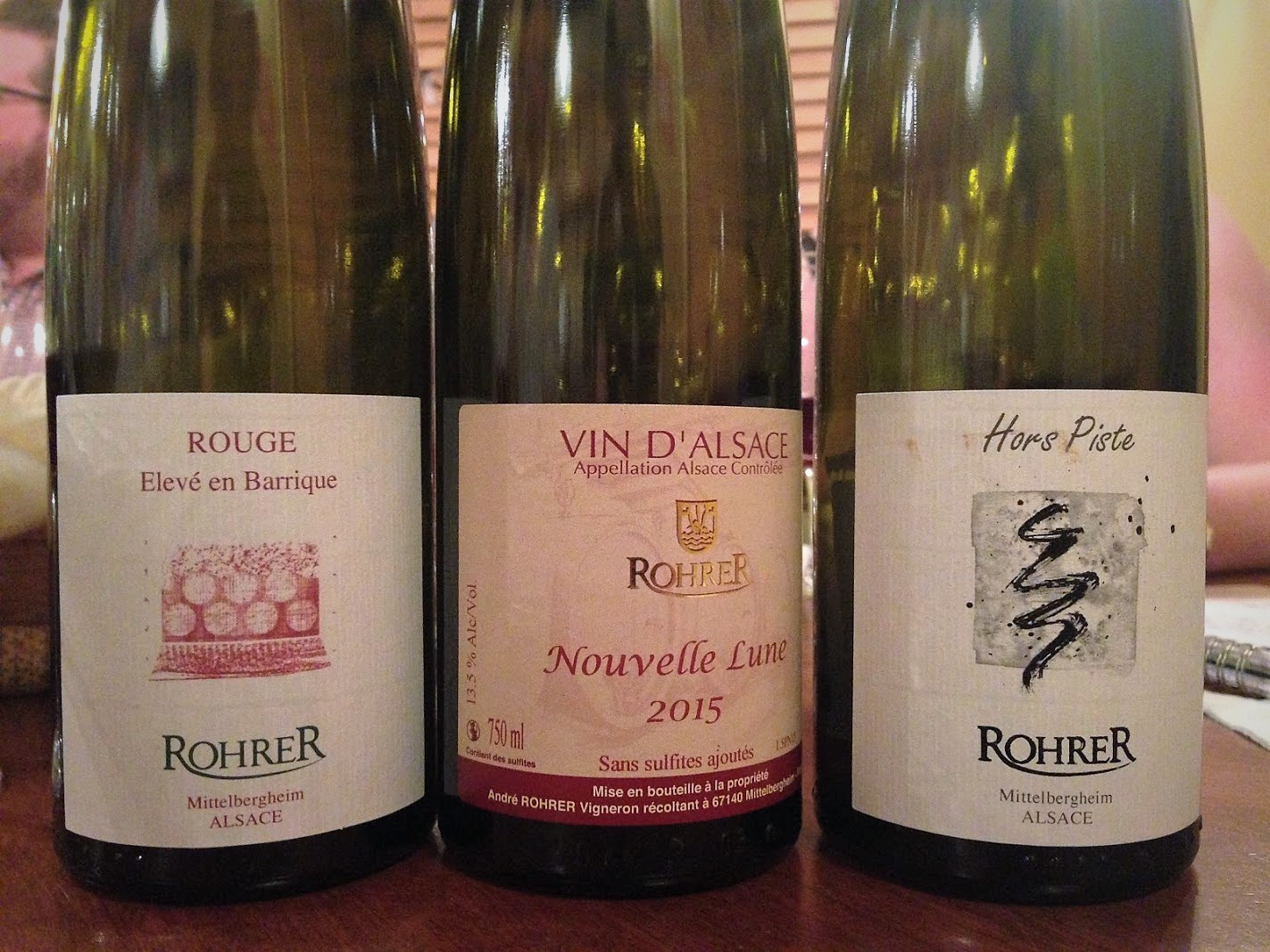
Alsace 2015, Pinot Noir, Nouvelle Lune, Domaine André Rohrer (ca. $26, importation valise)
100% Pinot Noir from organically farmed vines. Unfiltered and unfined. No added sulphur. 13.5% ABV.
Intriguing, involving nose of camphor, red berries and cherry taking on notes of game stew. Rich though medium-bodied, packed with ripe, almost juicy fruit. Velvety tannins and sleek acidity provide welcome structure. Nicely sustained finish. There was some discussion as to whether the bottle was a little corked; the consensus was no, it just needed time to sort itself out. (Buy again? Sure.)

Alsace 2015, Pinot Gris, Hors Piste, Domaine André Rohrer (ca. $25, importation valise)
100% Pinot Gris from organically farmed vines. Vinified like a red wine, with extended skin maceration. As Pinot Gris grape skins are dark pink in colour, so is the wine. Matured in neutral barrels. 14% ABV.
Intriguing nose of rose hip, peppermint, “nutmeg” and eventually honey. Lightweight yet possessed of a slightly unctuous texture. A tasty mouthful of spicy, strawberry-overtoned fruit, structured by lacy tannins, buoyed by acidity and underlain with minerals. The alcohol is well-nigh invisible. A savoury, refreshing, very drinkable wine quite unlike any other. (Buy again? Yes.)
MWG June 22nd tasting: flight 5 of 7
It’s a white! It’s a red! It’s Brutal!!!
Brutal!!! 2015, Partida Creus (ca. €10-15/$15-20 in Barcelona, importation valise)
Apparently, the wine is sin denominación, demoninationless. In any case, it’s a blend of several Catalan grape varieties (probably Vinyater, Subirat Parent, Xarel·lo, Cartoixa Vermell and Blanc de Sumoll) from biodynamically farmed vines planted in clayey-calareous soil. Manually harvested. The varieties are vinified separately and blended before bottling. Fermented with indigenous yeasts. Matured seven months in stainless steel tanks. Unfiltered, unfined. No added sulphur. 11% ABV.

Cloudy pink to the eye. Spicy/funky nose of dough, distant sweet berries, “pink peppercorns” and an evanescing whiff of volatile acidity that one taster describes as “latex gloves.” A bit spritzy in the mouth. Lightly fruity and quite dry but tangy like “kambucha” and “hibiscus.” The tannins are light while the acidity is electric. So refreshing and drinkable and such energy! Like nothing else I’ve tasted yet also like an instant old friend. Wow. (Buy again? By the case.)
On the Raw Wine website, Partida Creus describes themselves thus: “We are winegrowers and winemakers in the Massis de Bonastre terroir of Catalunya, working with our own production of grapes and with rescued ancient vineyards with interesting native variety of grape. All the vines are organic farming, our organic and natural wines express the terroir with its variety typicity. We try to put in the bottles our deep respect and love for wild and Mediterranean landscape, nothing else. A tribute to nature and biodiversity, our work is a way of life making wine. Certified organic by CCPAE Consell catalá de la Producció Agraria Ecologica.”
Partida Creus is represented in Quebec by Vinealis. A Brutal inquiry to the agency’s prime mover, André Papineau, elicited the following reply: “Oui je bosse avec Partida Creus depuis presque 4 ans maintenant. Quantités confidentielles au départ et de bons volumes maintenant. Par contre le Brutal a longtemps été seulement disponible pour le Bar Brutal; il est un peu cher, se vendrait @ ± 36 $ la bouteille le carton de 6, alors j’hésite un peu. Par contre j’aurai beaucoup de différents vins en août : VN blanco et tinto, BN blanco, TN Tinto, et les grandes cuvées de Vinyater, Cartoixa Vermell, Xarel-lo. Toutes les bulles sont réservées pour le groupe Joe Beef…” [Yes, I’ve been working with Partida Creus for nearly four years. Tiny quantities at the start and good volumes now. However, the Brutal!!! was available only at the Bar Brutal [in Barcelona] for the longest time. It’s kind of expensive, going for around $36 a bottle, case of six, so I’m hesitant. On the other hand, I’ll have a bunch of other Partida Creus wines in August: VN blanco and rojo, BN (white), TN (red) and the top wines, made from Vinyater, Cartoixa Vermell and Xarel-lo. All the sparklers are reserved for the Joe Beef group…”]
MWG June 22nd tasting: flight 4 of 7
Rosés de Provence
Coteaux d’Aix-en-Provence 2016, Château Vignelaure ($24.50, 12374149)
Grenache (40%), Cabernet Sauvignon (30%) and Syrah (30%) from organically farmed vines averaging 25 years old and rooted in pebbly clayey-calcareous soil. Manually harvested. Saignée method after two hours’ maceration for the Grenache; direct pressing for the Cab and Syrah. The must is chilled to 10°C and allowed to settle for 48 hours. Fermented at low temperature (17°C) and matured in stainless steel tanks except for 7% of the Cab, which is aged in a 400-litre new oak barrel. Maturation on the lees with regular stirrings lasts three months. Reducing sugar: <1.2 g/l. 13% ABV. Quebec agent: LBV International.
Rubber bands, straw, yogurt, background minerals and a hint of chile; look for it and you’ll find some stone fruit and red berries. Clean, pure and very dry on the palate, with low-key fruit, good acidity, a long bitter-edged, pink grapefruity finish and a lingering pastry note. Not particularly complex – and not quite the equal of the impressive 2014 – but tasty enough. (Buy again? Sure.)

Bandol 2016, Rosé, Domaine du Gros ’Noré ($32.25, 12931021)
Mourvèdre (50%), Cinsault (35%) and Grenache (15%) from vines averaging 30 years old. Farming is organic though not certified as such. Manually harvested. The Cinsault and Grenache are macerated 24 hours at 10°C, then pressed. The juice is combined with direct-pressed Mouvèdre juice and fermented. Reducing sugar: 2.1 g/l. 13.5% ABV. Quebec agent: oenopole.
Saltine crackers, “far-away Creamsicle” and lipstick give way to garrigue and minerals. “Fresh and dewy” in the mouth. Veils more than layers of fruit, sleek acidity, mineral depth and a a long, faintly bitter finish. “A bit more moreish than the Vignelaure,” notes one taster. Drinkable indeed. Will almost certainly gain complexity and presence with a year or two in the cellar. (Buy again? Yes.)
Côtes de Provence 2015, Rosé, Cuvée Clarendon, Domaine Gavoty ($27.65, 11231867)
This saignée method rosé is a blend of Grenache (70%), Cinsault (15%) and Syrah (15%) from vines rooted in clay and limestone. The grapes, which were vinified separately, were macerated in a vat for three to six hours. The free-run juice was drawn off and combined with the first-pressing juice, chilled and racked into stainless steel tanks for temperature-controlled (17°C) fermentation, which lasted two to four weeks. The various batches were sampled and selected in January 2016 and blended, with the best lots set aside for the Clarendon. Reducing sugar: 2.7 g/l. 13% ABV. Quebec agent: Vini-Vins.
Closed, minerally nose that, with coaxing, gives up notes of flan and red berries. Sweeter and flabbier than its flightmates, though improving with time in the glass. Fruitier too, bringing nectarine and strawberry to mind. A stronger acidic and mineral backbone would be welcome. Decent finish. Maybe time in the cellar or a carafe will help? At this point, not up to earlier vintages. (Buy again? Maybe.)
MWG June 22nd tasting: flight 3 of 7
Two misses and a hit
Bandol 2016, Blanc, Domaine de l’Olivette ($26.05, 10884559)
Clairette (80%), Rolle (aka Vermentino, 10%) and Ugni Blanc (aka Trebbiano, 10%). Manually harvested. After destemming, the grapes are cold-macerated on their skins, then pressed. Fermentation in oak vats is at low temperatures for about two weeks. The resulting wine is chilled and allowed to clarify by settling. Reducing sugar: 2.2 g/l. 13% ABV. Quebec agent: Vins de Châteaux.
Complex nose: “sweaty” (per another taster) with notes of fired minerals, dried flowers (linden), almond pastry cream, “straw fruit,” “celery salt” and more. Rich and round in the mouth and “a bit reductive.” The combination of highish extract and lowish acidity means the wine comes across as lethargic, a little flabby, “kind of flat” and “gassy.” The appealing nose and minerality aside, not a strong showing. A disappointment then, especially as I and others in the group have enjoyed earlier vintages. (Buy again? Meh.)

Bandol 2015, Blanc, Domaine la Suffrene ($26.45, 11903491)
A 50–50 blend of Clairette and Ugni Blanc from vines averaging 35 to 40 years old. Manually harvested. To increase flavour extraction, the crushed grapes are kept on their skins for 12 hours at 8°C before pressing. After clarification by settling, the juice is fermented in stainless steel tanks for around 15 days at around 19°C, then racked into other tanks for fining and maturation. Filtered before bottling. Reducing sugar: 1.8 g/l. 13.5% ABV. Quebec agent: Les Sélections Vin-Coeur.
Lemon and peach blossom, apple and honey. Rich on the palate but more fluid than the Olivette. Quite dry and minerally though turning fruitier on the long finish. Soft-glow acidity and a lingering bitterness complete the picture which, unfortunately, became less interesting as the wine breathed and warmed. Again, a wine that doesn’t seem equal to earlier vintages. (Buy again? Maybe.)
Bandol 2016, Blanc, Domaine du Gros’Noré ($34.00, 12206989)
A 70-30 blend of Ugni Blanc and Clairette from organically (uncertified) farmed vines averaging 30 years old. The must is macerated on the skins for 24 hours, then fermented at low temperatures with indigenous yeasts. Sees only stainless steel until bottling. Unfiltered and unfined. 13.5% ABV. Quebec agent: oenopole.
Lovely, wafting nose of white grapefruit, fired quartz, lemon flower and a “kaffir-like herbaceous note.” Clean and fluid with smooth acidity. Very minerally, especially on the finish. Dry, layered, long and savoury. “Apple seed bitterness” linger. Became better as it warmed and breathed. We have a winner. Try this with the winemaker’s recommended pairing: grilled mussels with rosemary (Buy again? Yep.)
MWG June 22nd tasting: flight 2 of 7
Chenintastic
The first in a series of notes from a recent mostly new arrivals tasting that featured several impressive wines purchased abroad and shared by travelling Mo’ Wine Group members.
Saumur 2010, Entre Deux Voyes, Le P’tit Domaine (ca. $30, importation valise)
Based in Varrains and Ecoert certified in 2012, the tiny estate (around two hectares of vines) is owned and operated by Richard Desouche, the manager at Château de Chaintres. It makes three wines: two reds and a white. This 100% Chenin Blanc, the fifth vintage of the wine, comes from organically farmed old vines rooted in clayey-calcareous soil. Fermented with indigenous yeasts in stainless steel tanks. Matured in old barrels. 12% ABV.
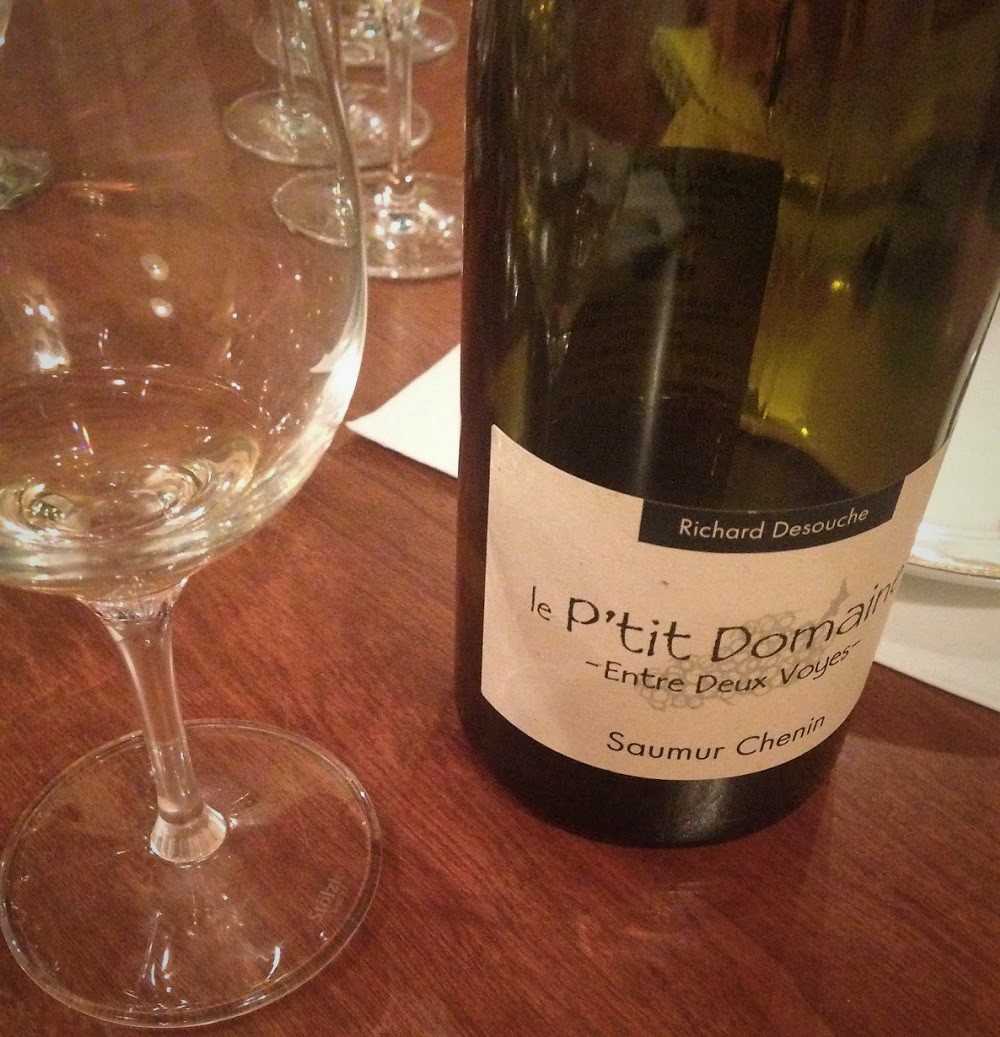
Intriguingly evolved nose of quartz dust, ham fat, lemon and hazelnut. Medium-bodied and ever so faintly spritzy. Ripe, almost sweet-seeming, but actually dry and very saline. The level of extract gives the wine a certain density and a bordering-on-waxy texture, a prefect foil for the trenchant acidity and super minerality. “Like a green apple with salt,” notes one taster. The depth and breath are sustained through the very long, bitter-, lemon- and almond-noted finish. A treat. (Buy again? If only…)
MWG June 22nd tasting: flight 1 of 7
Dâo wow
Dâo 2014, Quinta da Ponte Pedrinha ($18.25, 11895321)
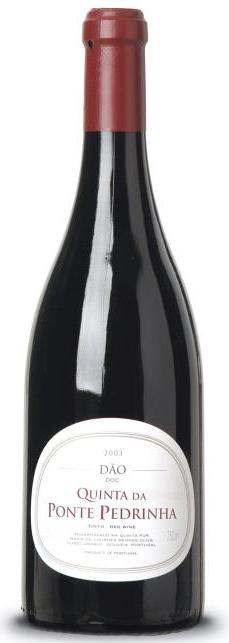 Everyone seems to agree this contains Tinta Roriz (aka Tempranillo) and Jaen (aka Mencia); some add Touriga Nacional and Alfrocheiro to the mix. The vines, which are reportedly around 30 years old, are rooted in granitic soil. The manually harvested grapes are given extended maceration. Fermented in temperature-controlled stainless steel tanks. Reducing sugar: 2.4 g/l. 13% ABV. Quebec agent: Bergeron-les-vins.
Fresh nose of red and black fruit, spice, faint red and black licorice, distant tar and a whiff of barnyard. Medium-bodied and very dry. The flavourful, ripe-sweet fruit is nicely soured by bright acidity (the hallmark of a good Dâo) and framed by light but firm tannins that assert themselves on the finish. A complex of leather, dark minerals, tobacco, undergrowth and old wood flavours adds savour and lingers long. Classic, refreshing, straightforward and even elegant, this food-friendly wine illustrates why Dâo is my favourite Portuguese region for dry reds. The estate recommends chilling the wine to 16-18°C and I couldn’t agree more. (Buy again? Definitely.)

 Brett happens