Turbulent time
Crémant du Jura 2015, Les Turbulents, Domaine Labet ($29.75, 11549162)
A 50-50 blend of Pinot Noir and Chardonnay from organically farmed 28- to 60-year-old vines rooted in the calcareous soil of the Les Varrons lieu-dit. Fermented with indigenous yeasts. Matured seven months in stainless steel tanks on the initial fermentation lees and eight months in the bottle after secondary fermentation. Unfiltered. Reducing sugar: 7.2 g/l. 12% ABV. Quebec agent: oenopole.

Not a lot of foam. Appealing nose of yeast, barley sugar, almond, apple and lemon. Softly effervescent in the mouth, with medium bubbles. The zingy acid is rounded by the extract. The fruit – pearish on the mid-palate – fades fades fast but mineral (chalk and quartz), lemon zest and “a little fennel” linger. A sparkler that has lots going for it, especially a lively energy, yet somehow isn’t a coup de cœur for anyone around the table, which a couple of the more experienced and analytical tasters attribute to heavy dosage (“trop dosé,” “dosage trop évident”). Additional time in the bottle may do it some good. (Buy again? A bottle or two to lay down and revisit in a year or two.)
MWG February 8th tasting: flight 1 of 5
A ramble round Vittoria
In Italian, cerasuolo means cherry-red. The word also appears in the names of two appellations. Cerasuolo d’Abrruzo is a Multepulciano-based rosé from central Italy. Cerasuolo di Vittoria is a red wine from southeast Sicily, specifically the province of Ragusa and parts of Caltanissetta and Catania.
Though Cerasuolo di Vittoria has been made since the 17th century, it wasn’t granted DOC status until 1974. Since 2004, it has been Sicily’s only DOCG. By law, Cerasuolo di Vittoria must be a blend of Nero d’Avola and Frappato, with the former constituting between 50 and 70%. Within the DOCG is a large zone, centred around Vittoria and including the original DOC, whose wines are entitled to the Classico designation provided they have been matured 18 months or longer.

Cerasuolo di Vittora 2015, Planeta ($24.00, 10553362)
A 50-50 blend of Nero d’Avola and Frappato from vines rooted in sandy top soil over tufa. The two vineyards are at 70-80 metres above sea level. Manually harvested. Destemmed. Macerated on the skins for 14 days. Fermented in temperature-controlled (23°C) stainless steel vats. Gently pressed in a vertical press. Matured in stainless steel tanks. Reducing sugar: 2.8 g/l. 13% ABV. Quebec agent: La Céleste Levrue.
Bright nose of red berries, pine forest floor, fresh oregano, “turnip” and “pepper oil” that takes on candied notes as the wine breathes. A medium-bodied mouthful of red berries and red peppercorns. Smoothed-edge acidity brightens the fruit while a mineral streak adds a modicum of depth. The tannins are soft on surface, more sinewy underneath. A bitter thread runs though the caramel-overtoned finish. Best, by which I mean freshest and most lively, just after opening. With time in the glass, the wine loses nuance and buoyancy, becoming more fruit-forward and sweet-seeming, even cloying. (Buy again? Meh.)
Cerasuolo di Vittoria 2015, Classico, COS ($36.50, 12484997)
A 60-40 blend of Nero d’Avola and Frappato from organically and biodynamically farmed vines averaging 25 years old. Elevation: 230 m. Fermented in stainless steel tanks on the skins and with indigenous yeasts. Matured 15 months in 20- and 40-hectolire Slavonian oak foudres and several months in bottle. Unfiltered. Reducing sugar: 2.0 g/l. 13% ABV. Quebec agent: oenopole.
Nuanced, complex, savoury nose: red fruit, cured wood, dark minerals and spice. Fluid, silky and on the lighter side of medium-bodied. The gossamer fruit is grounded in a mineral substrate and structured by lacy tannins and pronounced but seamlessly integrated acidity. Finishes long and clean. A balanced, complete and enchanting wine. Not remarkably deep but a here-now pleasure to drink. (Buy again? Yes.)
Cerasuolo di Vittoria 2014, Classico, Gulfi ($41.50, 13477828)
A 70-30 blend of Nero d’Avola and Frappato from organically farmed vines from a single vineyard near Ragusa. Elevation: 400-500 m. The varieties are vinified separately. The manually harvested grapes are given a short cold-maceration, followed by fermentation in stainless steel for about two weeks. After pressing, the base wines are blended and matured a few months in stainless steel tanks. Reducing sugar: 3.4 g/l. 14% ABV. Quebec agent: Bambara Sélection.
The nose of blackberry, sandalwood, old wood and leafmould is darker, richer and sweeter than the others but also jammier. In the mouth, it’s bordering on full-bodied and possessed of a satiny texture. Minerals darken the very ripe fruit. Structure is provided by smooth though resilient tannins and sufficient acidity, depth by layers of flavour. A bitter note chimes through the decent finish. Remains fresh despite the density. An enjoyable, even elegant wine albeit one that’s atypically rich – more southern and solar, less like a Burgundy and more like a Languedoc – for the appellation. (Buy again? Sure.)
Mo’ Wine Group November 23rd tasting: flight 6 of 6
Garage music
Vermont 2016, House Music, La Garagista ($42.25, private import, 6 bottles/case)
An ancestral method red sparkler made from a field blend of Marquette, Saint Croix, La Crescent, Frontenac Gris, Frontenac Blanc, and Frontenac Noir. Co-fermented with indigenous yeasts. Unfiltered and unfined. No added sulphur. 11.5% ABV. Quebec agent: Les Vins Dame-Jeanne.
Protean nose of red berries (and “blueberry pie” per one taster), earth, “good canola,” shoe cream and a not unattractive whiff of barnyard. Lightly fizzy and dry, smooth and fleet. The fruit is sweet-tart, the acidity bright, the slender tannins relegated to the background. A slatey vein extends into the lip-smacking finish. Fresh, juicy and well-neigh irresistible. (Buy again? Def.)

Vermont 2015, Damejeanne, La Garagista ($42.54, private import, 6 bottles/case)
Damejeannes are better known in English as demijohns or carboys, the glass vessels most of La Garagista’s wines are fermented and sometimes matured in. This is a blend of Marquette (90%) and La Crescent (10%). Fermented on the skins with indigenous yeasts, matured one year. Unfiltered and unfined. No added sulphur. 12.5% ABV. Quebec agent: Les Vins Dame-Jeanne.
Wild red berries including cranberry, earthy notes of slate and beet, spice, an evanescent touch of volatile acidity and an orange-almond note reminiscent of the Vinu Jancu. Denser and rounder than its flightmate, a mouthful of sweet and sour-edged fruit that has me thinking of pomegranates, cherries and red plums, among other things. A mineral base provides foundation for a structure of lightly raspy acid and supple if sinewy tannins tannins. Long, clean, tart finish. (Buy again? Yep.)
Whatever else the assembled tasters thought about the La Garagista wines, everyone agreed they had an energy and a vibrancy – a closeness to the fruit and terroir – that are rare for any wine, let alone ones made from hybrid grapes grown in a harsh climate. The buzz around the table in the tasting room and the Vins Dame-Jeanne booth at the Salon des Quilles was palpable. People, myself included, were stoked about the wines themselves but also about realizing that truly exciting wines unlike any others can be made in our part of the world. Quebec vintners should take note.
Mo’ Wine Group November 23rd tasting: flight 5 of 6
Orange zeal
Vermont 2015, Vinu Jancu, La Garagista ($45.76, private import, 6 bottles/case)
Vinu Jancu means “orange wine” in a Sicilian dialect. 100% La Crescent. Spontaneously fermented on the skins in glass demijohns. Overwintered on the lees. Unfiltered and unfined. 12.5% ABV. Quebec agent: Les Vins Dame-Jeanne.
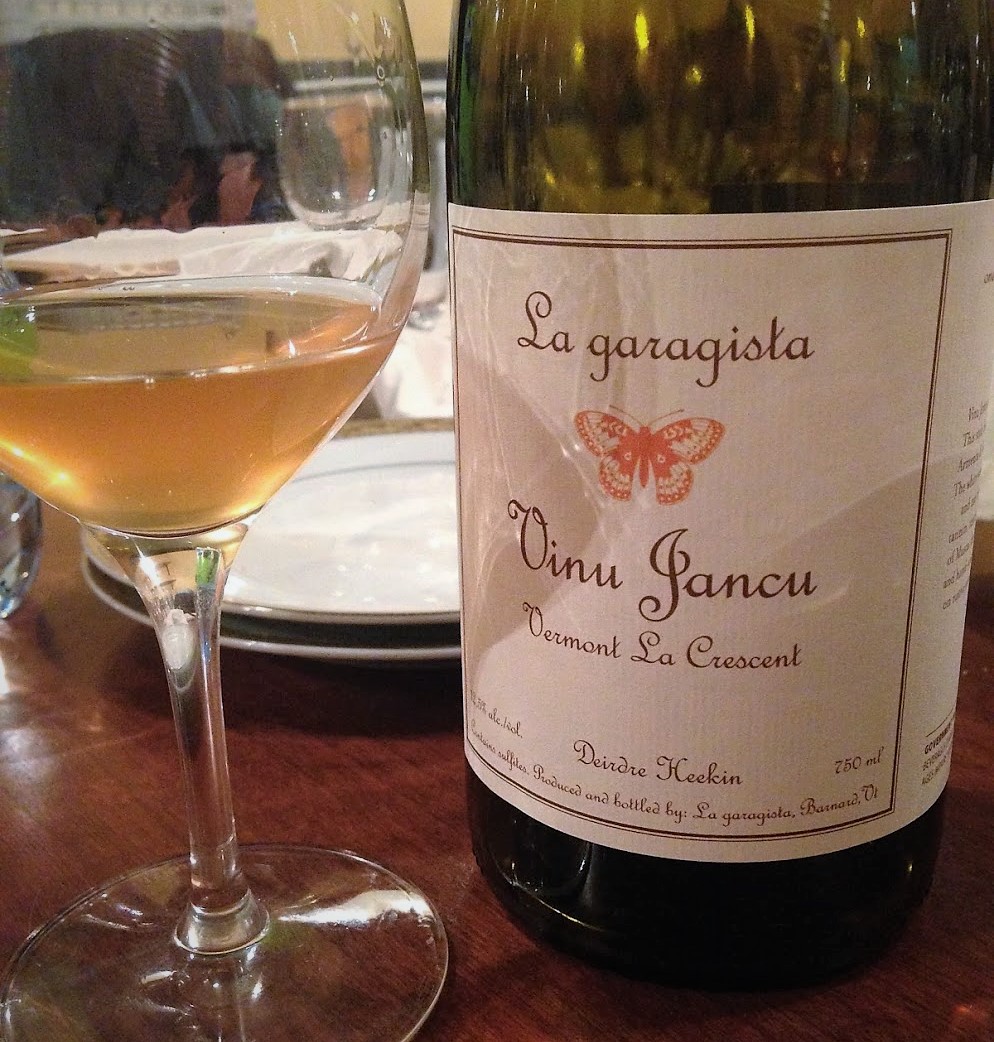
Hazy bronze-orange. Effusive nose: floral, choco-orange, wax, tamarind, cinnamon, hints of caraway, “grappa” and honeycomb. Almost too intense on the attack, “like strong chestnut honey,” but mild-mannered more nuanced on the mid-palate. Fruity, even muscaty (the grape’s Muscat of Hamburg parentage comes through) but dry, with smooth acidity and faint tannins. Focus and you’ll find a mineral vein running throughout. The finish – “really pithy,” “like clementine pith” – lasts for minutes. Fascinating. Like nothing else I’ve encountered, orange or otherwise. (Buy again? A bottle to revisit and contemplate.)
Mo’ Wine Group November 23rd tasting: flight 4 of 6
Brianna split
Located near the Killington ski resort, on the slopes of Mount Hunger in Barnard, Vermont, and run by Deirdre Heekin and Caleb Barber, La Garagista Farm + Winery traces its roots back to 1999, when the couple began farming to provide produce for Osteria Pane e Salute, their restaurant in nearby Woodstock. (The osteria closed in 2017 when the cooking operations were moved to Hart Tavernetta Forestiera + Bar à Vin on the winery grounds.) The estate also has two vineyards at the western edge of the state, overlooking Lake Champlain.
Experimental plantings aside, cold-hardy hybrids – crosses between vinifera grapes and native American species – are the only varieties grown: La Crescent, Marquette, Frontenac Gris, Frontenac Blanc, Frontenac, Brianna and St. Croix. When I asked Caleb if they winter-proofed the vines (for example, by burying them), he said no. When I asked whether that was a problem during the harsh cold spells we’ve had in recent winters, he said, “quite the opposite.” The vines had no trouble coping with the cold but the same couldn’t be said about insect and other pests, so the vines thrived the following summers.
Commercial wine- and cider-making is relatively new at the estate, the first vintage being the 2010. From the start, all farming has been organic and biodynamic. The fruit is picked by hand and crushed by foot. Fermentations are spontaneous, relying solely on indigenous yeasts and bacteria. Fermentation and maturation take place in glass demijohns and old barrels, though amphorae and cement eggs are on the couple’s wish list. Filtering and fining are avoided. Sulphur additions, if any, are minimal.
Production is tiny – only a few thousand bottles a year – though plans are to ramp that up to 10,000 or even 20,000. In Montreal, the latest arrival sold out in a flash and personal allocations were limited to a bottle or two, if that, of a given cuvée. Here, then, your best bet for trying La Garagista wines is to visit a wine bar or restaurant that focuses on natural wines. Alternatively, head south, where bottles can sometimes be found on store shelves and restaurant wine lists in Vermont, Boston and New York City.
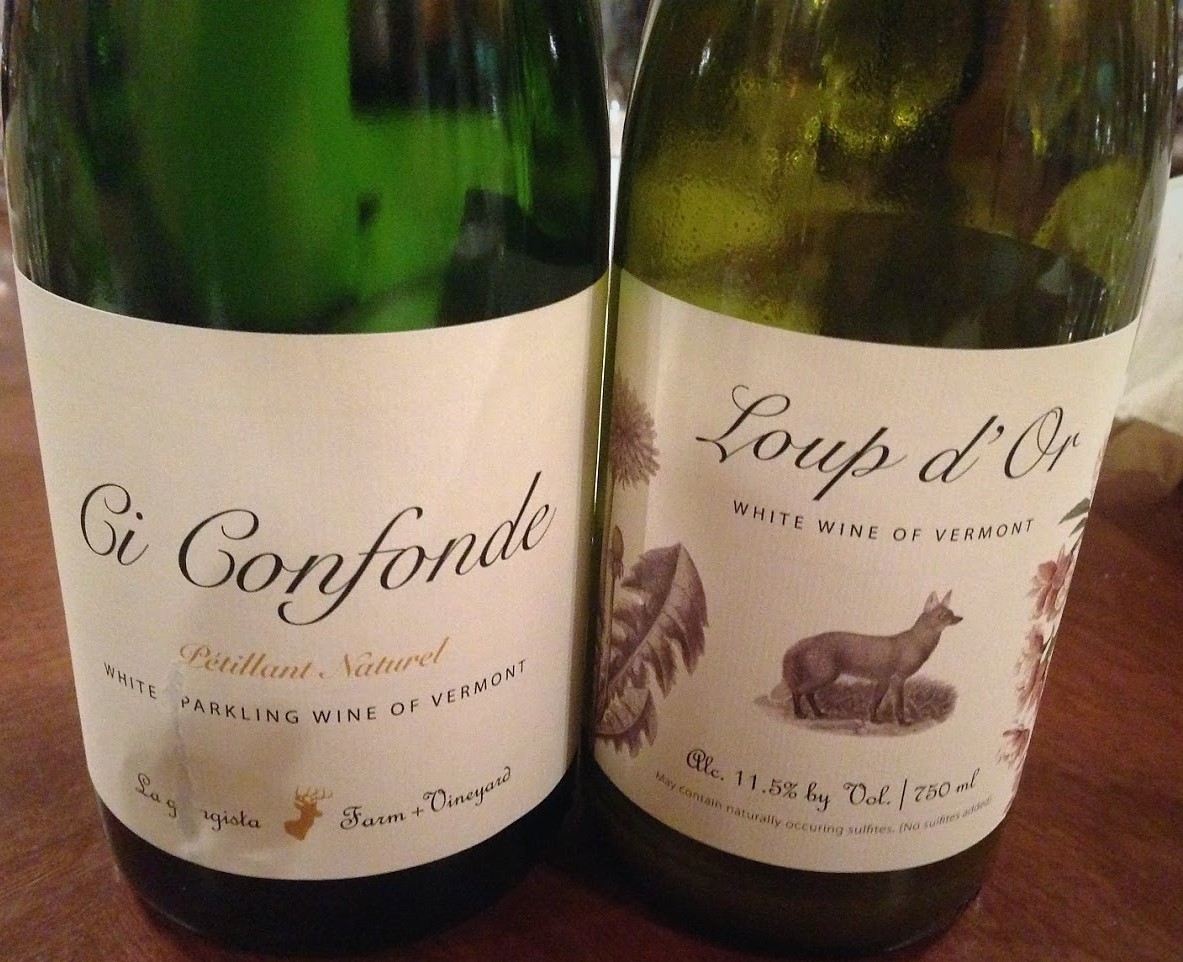
Vermont 2016, Pétillant Naturel, Ci Confonde, La Garagista ($42.25, private import, 6 bottles/case)
100% Brianna. An ancestral method sparkler. Not disgorged. No added sulphur. 11% ABV. Quebec agent: Les Vins Dame-Jeanne.
No head to speak of but a few lazy streams of tiny bubbles. Complex nose with notes of ham, lees, Belgian beer yeast, apple, lemon, white spice and “apricot buckwheat pastry.” Somewhat mead-like in the mouth. Very dry, with lightly souring acidity and a real mineral component. Flavours? Beeswax, drying hay and “passion fruit,” as one taster notes, though it’s by no means a fruity wine. Which isn’t to say it lacks intensity, especially as it breathes and warms. The effervescence mostly disappears by the time the finish rolls around. Chamomile and a hint of honey linger. (Buy again? Gladly, though not without wishing it were $10 cheaper.)
Vermont 2016, Loup d’Or, La Garagista ($42.25, private import, 6 bottles/case)
100% Brianna. Made in glass demijohns. 11.5% ABV. Quebec agent: Les Vins Dame-Jeanne.
The first glasses poured were clear pale yellow-green; due to the deposit, the last glasses were translucent beige verging on opaque tan. For that reason if no other, this is a wine to carafe before serving. And as my sludgy glass was that last one poured, I didn’t spend a lot of time being analytical about it. A complex nose once again: white grape skin, distant stone fruit, spice chest, flowers and a note one taster not disapprovingly describes as “tennis ball.” Fortunately, a neighbour lets me take a couple of sips from his glass, the first one poured. They reveal a textured white with plenty of extract to balance the fine-edged acidity, savoury fruit and mineral flavours set against a leesy backdrop and a satisfying finish. On the whole, an even more accomplished wine than the Ci Confonde and one I look forward to re-encountering in a more pristine state. (Buy again? Ditto, but such is the law of supply and demand.)
Mo’ Wine Group November 23rd tasting: flight 3 of 6
Cava art
Founded in 1924 and still located in the town of Sant Sadurni d’Anoia, Cavas Recaredo today owns 46 hectares of vineyards in the Alt Penedès region. The vines, some of them nearly 80 years old, are unirrigated. All farming is organic and biodynamic (certified since 2010). Harvesting is manual. Only vintage-dated, totally dry sparkling wines are made and only from estate-grown grapes. All vinification is done in house. The musts from the oldest Xarel-lo vines are fermented and matured in oak barrels; some of the base wines are matured several months in oak as well. Immediately after bottling, the bottles are sealed with cork stoppers, not crown caps. Riddling is performed by hand. All disgorging is manual and done at cellar temperature; contrary to the practice of many sparkling wine producers, the necks of the bottles are not frozen before disgorging. None of the wines is dosed.
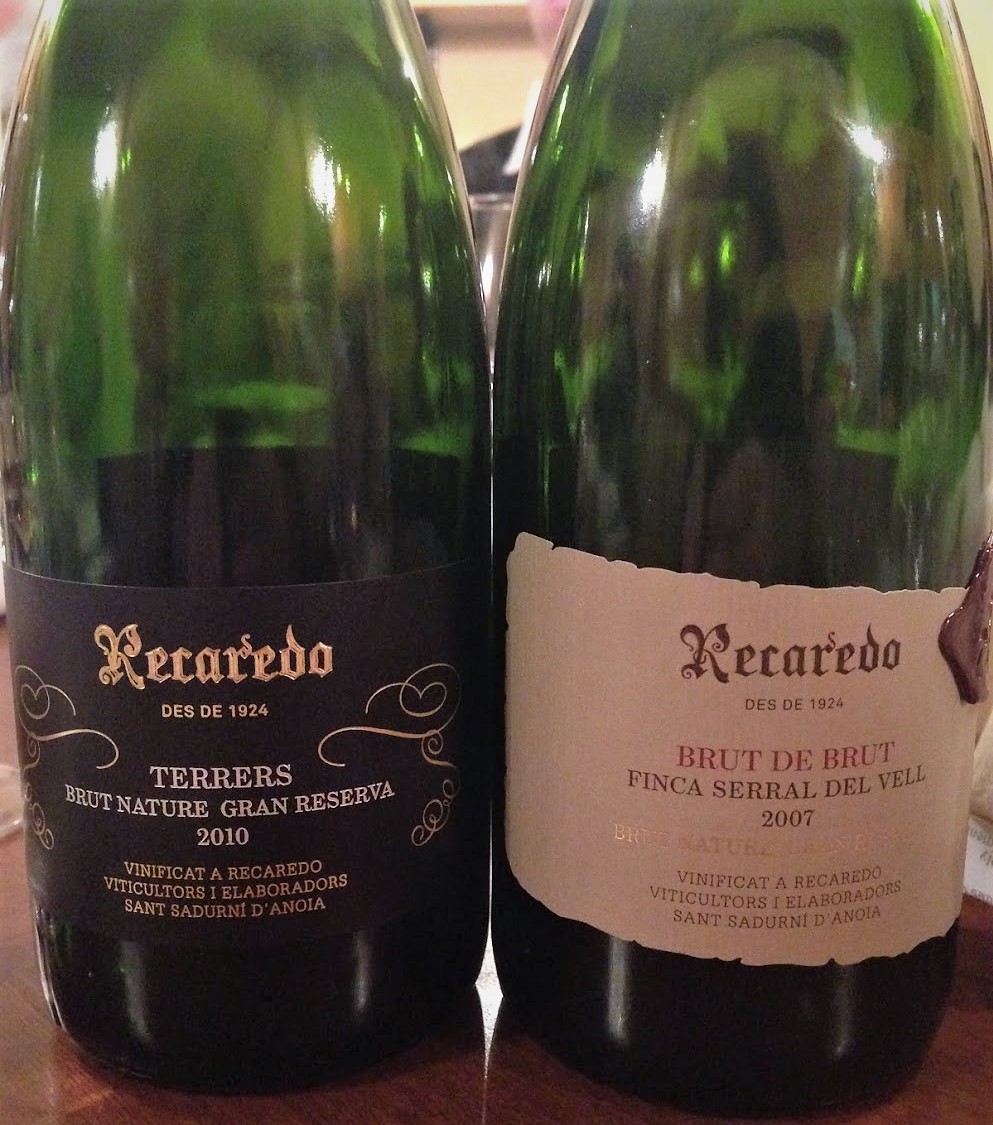
Cava 2010, Brut Nature Gran Reserva, Terrers, Recaredo ($36.00, 13319715)
Macabeo (54%), Xarel-lo (42%) and Parellada (4%) from organically and biodyanmically farmed vines rooted in highly calcareous, loamy soil. Whole-cluster fermented with indigenous yeasts in stainless steel tanks. Around 10% of the blend was aged in oak casks. Bottled with neutral Saccharomyces cerevisiae yeast for second fermentation and matured five years on the lees. 190,000 bottles made. Reducing sugar: <1.2 g/l. 12% ABV. Quebec agent: La QV.
Fast-disappearing, snow-white foam. Fine bead. Elegant nose of lemon peel, straw, sea shells, marzipan and white blossom. Equally elegant in the mouth, the subdued flavours bringing apple-custard turnovers to mind. “Saliva-inducing” acidity and soft bubbles provide liveliness and lift. A mineral underlay lasts through the long finish, lending a “baking powder bitterness” to the lingering, faintly nutty flavours. All the elements are in place and in perfect balance. (Buy again? Yes.)
Cava 2007, Brut Nature Gran Reserva, Brut de Brut, Finca Serral del Vell, Recaredo ($49.75, 13202568)
The first vintage of Recaredo’s Brut de Brut made from a single estate, in this instance the Serral del Vall. Xarel-lo (51%) and Macabeo (49%) from organically farmed vines 16 to 28 years old and rooted in extremely calcareous, loamy soil with an abundance of stone and gravel. The wine-making was as for the Terrers with two exceptions: before blending, all the Xarel-lo was matured in oak casks and the blended wine is bottle-matured eight years. 50,000 bottles made. 12% ABV. Quebec agent: La QV.
Intriguing nose of white lily, minerals, apple, coffee, “angelica,” yeast and lees. Similar to but deeper than the Terrers, a tad heftier and even more refined. Here the subtle fruit – apple, tropical and faint citrus – takes a back seat to the chalky minerals. Very dry and yet fresh, surely a function of the fine-edged acidity and lilting effervescence. Complexities include a “tinge of bay leaf,” “cinnamon brioche” and a honey note that marks the long, savoury finish. Impeccable. (Buy again? Yes.)
If you’re not a fan of cava, these probably won’t make a believer out of you. If you are, you’ll have a hard time finding anything better at the price. Incidentally, Recaredo’s high-end cuvées – the 2004 Reserva Particular ($107.00, 11458228) and the recently sold-out 2000 Turó d’en Mota Reserva Brut ($135.00, 11587118) – are formidable, meditation-worthy wines that, while unmistakably cavas, can easily stand comparison with similarly priced champagnes.
Mo’ Wine Group November 23rd tasting: flight 2 of 6
Cider house jewels
The most recent edition of the Salon des Quilles, the trade-focused wine expo held alongside the late October/early November Salon des vins d’importation privée, was filled with delights familiar and un-. In the latter category, the two stand-outs for me were unexpected: Switzerland’s Cidrerie du Vulcain and Vermont’s La Garagista. Fortunately, the Mo’ Wine Group was able to secure bottles from each estate for inclusion in a new arrivals tasting.
Run by 40-something Jacques Perritaz, Cidrerie du Vulcain (vulcain is the French name for the red admiral butterfly, which feeds on the juice of fallen apples) is located in Le Mouret, in the canton of Fribourg, Switzerland. While working as a freelance biologist specializing in the management and preservation of natural habitats and rare native plants, Perritaz decided to try his hand at cider-making, initially as a hobby. In his work, he had noticed old apple and pear trees in the fields of many dairy farmers. The trees, remnants of the once-thriving local cider industry, were trimmed à haute tige, with the lower branches removed, the better to protect the cows from the elements and prevent the beasts from eating the unfallen fruit. When asked, the farmers said they did nothing with the fruit and Perritaz was free to harvest it. He bought a small press and, in 2000, began making cider, his annual production eventually increasing to about 250 cases.
In 2006, while vacationing in Normandy, he encountered cider-maker extraordinaire Éric Bordelet, who took him under his wing. Perritaz soon invested in a larger facility and bottling line and went commercial. The fruit he uses come from around 200 trees, some of them leased. When I inquired whether he was planning to buy any trees, Perritaz said he would like to but land prices in Switzerland made that impossible, though he was open to acquiring land elsewhere, including in France or possibly even Quebec.
Most of the old Swiss varieties Perritaz uses are low in tannin, which makes natural clarification difficult. As a result, he is more interventionist in the cellar than he might otherwise be, adding an enzyme derived from natural mushroom extract (approved for organic uses) to encourage precipitation. All fermentations are with indigenous yeasts. However, as initial fermentation are over-vigorous, at the two-week point he lightly filters the fermenting juice through diatomaceous earth to “tire” and slow the yeast, thereby ensuring enough sugar remains for the second, in-bottle fermentation. The only other intervention is the addition of a small amount of sulphur dioxide at bottling.
The MWG’s late November new arrivals tasting began with three ciders, two from Cidrerie du Vulcain and one from La Garagista, which estate I’ll profile in the third instalment of this report.

Cidre demi-sec 2016, Transparente, Cidrerie du Vulcain ($19.66, private import, 12 bottles/case)
Made from a blend of Transparente de Croncels, Reinette de Champagne, Pomme Raisin and Rose de Berne apples. Usually demi-sec but can be sec, depending on the vintage. Added sulphur is limited to about 20 mg/l. 4.2% ABV. Quebec agent: Planvin.
Engaging nose of apple blossom and skins, “kind of like bottle caps candy” (quoting another taster). Off-dry and softly effervescent. The “juicy” yet ethereal – transparent? – fruit has a slightly bruised and browning quality. There’s just enough acidity is to brighten and freshen. A trickle of salt and white spice surfaces on the long finish. “Like being in an orchard.” Delightful now but I’m saving my other bottles for refreshment on hot summer days. (Buy again? Yes.)
Cidre 2016, Trois Pépins, Cidrerie du Vulcain ($24.81, private import, 12 bottles/case)
A blend of apple, pear and quince in equal proportions. 5% ABV. Quebec agent: Planvin.
A nose more subdued, complex and savoury with a mastic note. “Ça me fait penser au boudin noir” notes one taster. In the mouth, it’s dry, minerally and not particularly fruity. Soft round bubbles and smooth acidity provide lift, a salty mineral underlay some depth. Ghostly tannins appear on the bitter-edged finished. Opens up with time in the glass. Layered and faceted enough to be absorbing on its own but also excellent with pre-meal nibbles and substantial and savoury enough to accompany raw or cooked white fish and shell fish and mild cheeses. Wow. (Buy again? A case or two at least.)
Cidre Mousseux Vintage No. 1, Bouleverser, La Garagista ($29.89, private import, 6 bottles/case)
This is a blend of 17 varieties of biodynamically farmed apples, mostly American heirloom varieties, grown on the estate, which is located in Bethel, Vermont. Most of the juice is from 2015 fruit, though some is from earlier vintages going back to 2010, in a kind of solera system. Both fermentations use indigenous yeasts. The sugar for the second, in-bottle fermentation was provided by the addition of 2015 juice. 7% ABV. Quebec agent: Les Vins Dame-Jeanne.
An initial odd note of vinyl and “new shoes” blows off, leaving a nose dominated by apples, though not to the exclusion of a whole set of savoury aromas including straw and fresh mushrooms. Dry and saline on the palate, electric with bubbles and acidity, complicated by a faint sourness and showing real depth of flavour. Finishes long and clean with a tang that virtually demands you take another sip. Less airy and alpine than the Vulcains, somehow closer to an ale or wine, this is stupendous. (Buy again? Definitely.)
Mo’ Wine Group November 23rd tasting: flight 1 of 6
Sausage love, 2018 edition

Forget those overpriced Valentine meals prepared by bored chefs and served by jaded waiters in stuffy restaurants. On February 14, sausage lovers, wine lovers and just plain lovers will be heading to Nouveau Palais for a hit of Pork Futures goodness (sausage sandwiches with french fries and “piccante” hot sauce on the side) and glass after delicious glass of wine poured by oenopole.
The Eighth Annual Valentine’s Sausage Party
“For the love of sausage”
Wednesday, February 14, 2018
17:30 to 23:30 (or until they run out)
Nouveau Palais
281 Bernard St. West, Montreal
RSVP: info@nouveaupalais.com or 514 273-1180
Piedmontissimo
Located in Monforte d’Alba, the approximately seven-hectare Cascina Disa estate has been in the Sandri family since 1965, the year of current owner/winemaker Elio Sandri’s birth. Elio has been in charge since 2000 and his is the only name now shown on the wines’ front labels. Only six wines – all red and resolutely traditional in style – are made: Dolcetto d’Alba, Barbera d’Alba, Langhe Nebbiolo, Marapika (a Langhe blend of the three varieties), Barolo and Barolo Riserva. The farming is organic but uncertified. Pruning is about the only intervention in the vineyard. The wine-making is similarly non-interventionist: spontaneous fermentation, minimal manipulation, extended maturation in neutral botti and no filtering or fining. The only addition is tiny amounts of sulphur dioxide at bottling. Sandri is sometimes ranked alongside Bartolo Mascarello and Rinaldi; to go by our tasting, it’s easy to see why.

Langhe Rosso 2013, Marapika, Elio Sandri ($25.95, private import, 12 bottles/case)
A blend of Barbera and Dolcetto, in equal proportion, with a small dollop of Nebbiolo from younger vines planted on north- and east-facing slopes. 12.5% ABV. Quebec agent: Labelle Bouteille/oenopole.
Bitter cherry, including the pits, along with minerals and a bit of spice. A medium-bodied mouthful of ripe-sweet fruit, silky smooth acidity and fine tannins that become more assertive with chewing. Dark minerals provide some depth. Finishes longish, clean and bitter-tinged. Definitely gluggable. (Buy again? Yes.)
Dolcetto d’Alba 2015, Elio Sandri ($25.95, private import, 12 bottles/case)
100% Dolcetto from vines planted in 1977. Vinified in cement tanks. 13% ABV. Quebec agent: Labelle Bouteille/oenopole.
Textbook nose of mulberry, bitter cherry and leafmould. Quite elegant in the mouth with its core of vibrant fruit, lively acidity, fine bitey tannins and long minerally finish. A touch of astringency lingers. Gorgeous. (Buy again? Def.)
Barbera d’Alba Superiore 2015, Elio Sandri ($38.00, private import, 6 bottles/case)
100% Barbera from vines rooted in ferrous sandstone and planted in 1945 and 1976. Manually harvested. Partially destemmed. Matured eight months in very old Slovenian oak botti, six months in the bottle. 14.5% ABV. Quebec agent: Labelle Bouteille/oenopole.
Deep nose of ripe blackberry, slate and graphite with clove overtones. Medium-bodied and supremely fluent. Very dry though ripe-sweet on the attack. Built around an intense core of dark fruit wrapped in wiry tannins, aglow with fine acidity and shot through with minerals. Long, complete and elegant. Accessible now but ageable, too. Pricey Barberas from other producers are often New Worldishly fruit- and oak-driven. This takes another, more authentic and much more enjoyable path. (Buy again? Oh, yes.)
Barolo 2010, Perno, Elio Sandri ($71.50, private import, 6 bottles/case)
100% Nebbiolo from vines planted in 1937. Macerated, with a submerged cap, for 28 days. Matured six years in neutral Slavonian oak botti. Total production: 3,500 bottles. 14% ABV. Quebec agent: Labelle Bouteille/oenopole.
Subtle, perhaps somewhat closed nose of red and black fruit and turned earth with telltale hints of tar and violet. Medium- to full-bodied. The fruit is remarkably pure, the structure what you’d expect from a traditionally styled Barolo: robust attack, sleek acidity, firm yet pliable tannins, a deep mineral foundation and an impressively sustained, somewhat astringent finish. A flawless wine with great energy, focus and balance, every dimension and soul. Young and promising but also surprisingly accessible. (Buy again? Yes.)
MWG November 10th tasting: flight 5 of 5
Could-be Chiantis
The daughter of an oenologist, Giovanna Morganti studied oenology and then began working for San Felice, where she focused on preserving some 300 old Tuscan grape varieties. When her father gave her the three-hectare Podere le Boncie, an olive-growing estate in Castelnuovo Berardenga, Giovanna created a vineyard, populating it with Sangiovese and her favourite old varieties – Ciligiolo, Foglia Tonda, Mammolo and Prugnolo – planted very densely (7,000 vines per hectare). She has since acquired another 1.3 hectares nearby. The farming is mostly biodynamic. Fermentation, with indigenous yeasts, takes place in traditional open-topped wood tanks. Two wines are produced: the flagship Le Trame and a “second” wine, Il Cinque, a young-vines cuvée that was originally sold only at the winery.
Located in Carmignano, Italy’s smallest wine appellation and one of its oldest (granted special protections as far back as 1716), Fattoria di Baccherto has been in the hands of the Tesi family since 1920. Currently run by Rossela Bencini Tesi, the estate is centred around a former Medici hunting lodge. In 2001, unhappy with the quality of her wines and the condition of her soil, Rossela switched to natural wine-making: organic and eventually biodynamic farming, no additions in the cellar other than a tiny shot of sulphur dioxide at bottling, spontaneous fermentations, no temperature control, no filtering and no fining. Sangiovese, Cabernet Sauvignon (long present in the appellation and possibly introduced in the 16th century by Catherine de’ Medici), Canaiolo, Trebbiano Toscano and Malvasia del Chinati are the main grape varieties. Annual production is around 10,000 bottles of red wine, 2,000 bottles of white wine and 1,000 bottles of vin santo as well as olive oil, honey and figs.

IGT Toscana 2015, Cinque, Podere le Boncie ($33.50, private import, 12 bottles/case)
Sangiovese (70%) with Mammolo, Colorino, Foglia Tonda and Ciliegolo making up the balance. Manually harvested. Destemmed. Fermented with indigenous yeasts in stainless steel tanks. Matured 12 months in barrels and six months in the bottle. Unfiltered and unfined. 14% ABV. Quebec agent: oenopole.
Wafting nose of ripe plum, sawed wood, spice, moldering leaves, ink and tobacco. Medium-bodied, silky textured and oh, so flavourful. The ripe, almost juicy fruit is grounded in a earthy mineral substrate. Bright acidity and wiry tannins provide a light but tensile structure. Finishes long and clean. Accessible now and best drunk over the next two or three years, methinks. (Buy again? Done!)
Carmignano 2014, Terre a Mano, Fattoria di Bacchereto ($50.75, private import, 6 bottles/case)
75% Sangiovese, 10% Canaiolo Nero, 15% Cabernet Sauvignon from vines planted in 1979, 1994 and 2004. Manually harvested. Destemmed. Alcoholic fermentation takes place in glass-lined concrete tanks and lasts 15 days. The wine is then transferred to used 350-litre Allier oak barrels for malolactic fermentation and maturation, typically lasting 18 to 24 months. Unfiltered and unfined. 13.5% ABV. Quebec agent: oenopole.
Pure cherry faceted with plum, dried herbs, sun-baked earth and a hint of leather. Medium- to full-bodied. Ideal balance between ripe, savoury, satiny fruit and a lovely airframe structure comprising robust tannins, bright acidity and real mineral depth. A floral note creeps in on the long finish. The touch of rusticity in no way detracts from the wine’s overall elegance. (Buy again? Yes.)
IGT Toscana 2014, Le Trame, Podere le Boncie ($54.50, private import, 6 bottles/case)
Sangiovese (90%), Foglia Tonda, Colorino and Mammolo (10% combined) from vines averaging 20 years old. Manually harvested. Destemmed. Fermented 20 days in small wood vats with indigenous yeasts and twice-daily punch-downs. Matured 26 months in large barrels and six months in the bottle. Annual production: around 6,000 bottles. 13.5% ABV. Quebec agent: oenopole.
Echt-Sangiovese nose of cherry, sawdust, terracotta and sandalwood with earthy overtones of mushroom and humus. Rich, the fleshiest of the three but in no way heavy. Glowing acidity enlightens the sweet-ripe, somewhat dusky fruity. Round tannins add a light, drying rasp. Dark minerals abound, including a ferrous rumble that lasts well into the long finish. Red fruit, terracotta, spice and a hint of mint linger. Already showing considerable complexity, not to mention superb depth and balance, this will age beautifully for another five or 10 years. (Buy again? Done!)
MWG November 10th tasting: flight 4 of 5

 Brett happens