Posts Tagged ‘Affordable’
Nativi di Lazio
Based in Cori, founded in 1947 and named after Lucius Quinctius Cincinnatus, Cincinnato is a well-run cooperative that makes a wide range of red, white, sparkling and dessert wines from local varieties as well as grappa and olive oil. The 255 members farm 550 hectares, 100 of which are worked organically.
Lazio 2014, Cesanese, Arcatura, Cincinnato ($21.70, 13096689)
100% Cesanese from vines rooted in volcanic-clay soil. The manually harvested grapes are destemmed and soft-pressed. Fermentation on the skins in temperature-controlled (24°C) tanks lasted around 11 days. Underwent malolactic fermentation. Half was matured in French oak barrels (first, second and third fill) for eight months and half in stainless steel tanks for nine months. Filtered before bottling. Aged in the bottle for six months before release. Reducing sugar: 4.8 g/l. 13.5% ABV. Quebec agent: Valmonti.
The first bottle is corked. The backup has an intriguing nose of “buckwheat honey,” cocoa, sweet spices, background plum, “copper, like pennies” and, eventually, leafmould. In the mouth, it’s fluid, medium-bodied and super smooth. The ripe fruit, soft acidity and round tannins. Decent finish. A little overshadowed by its flightmate, though that could be due to its being popped and poured. (Buy again? Sure.)

Lazio 2013, Nero Buono, Ercole, Cincinnato ($23.25, 12557754)
100% Nero Buono, a teinturier (red-fleshed) grape, from 15- to 20-year-old vines rooted in volcanic-clay soil. The manually harvested grapes were destemmed and soft-pressed. Fermentation on the skins in temperature-controlled (23°C) stainless steel tanks lasted around 15 days. Underwent malolactic fermentation. Matured in French oak barrels (first, second and third fill) on the lees for 12 months and in the bottle for eight months. Filtered before bottling. Reducing sugar: 4.8 g/l. 13.5% ABV. Quebec agent: Valmonti.
Not carafed but allowed to breath for a couple of hours before serving. Dark – verging on black – in the glass. Extroverted nose of dark berries, “dried banana,” “old leather,” tobacco, “baking spices” and a hint of orange chocolate. Richer than the Cesanese. The intense core of fruit is overtoned with spice. Smooth acidity and velvety tannins are pretty sotto voce yet present enough to provide buoyancy and tone. The oak is obvious but not obnoxious. Orange chocolate returns on the credible finish. A bit New Worldish and far from deep, complex or subtle but authentic and likeable all the same. (Buy again? Yes.)
MWG October 26th tasting: flight 4 of 6
Three Rieslings/countries/price points
Rheingau 2015, Riesling Trocken, Von Unserm, Weingut Balthasar Ress ($20.65, 12510788)
100% Riesling from vines planted in clayey limestone soil in Hattenheim and Rüdesheim. Manually harvested. Direct pressed. Fermented in temperature-controlled stainless steel tanks. Clarified by settling. Screwcapped. Reducing sugar: 4.1 g/l. 12% ABV. Quebec agent: Balthazard.
Classic Riesling nose of lemon/lime, green apple, white slate and a hint of peach yogurt. A faint spritz is detectable on the palate. Welterweight build. Dry but fruity: apple and lime set on river stones. The acidity stays underground until surfacing on the decent finish. A bit simple but fresh and likeable. (Buy again? Sure.)

Alsace 2014, Riesling, Le Kottabe, Josmeyer & Fils ($31.00, 12713032)
100% Riesling from organically and biodynamically farmed 40-year-old vines rooted in the gravelly, sandy, pebbly soil of Herrenweg. Manually harvested. The whole clusters were pneumatically pressed over five to eight hours. Spontaneous fermentation lasted from one to four months. The resulting wine was matured in a mix of stainless steel tanks and century-old oak foudres. Reducing sugar: 2.4 g/l. 11.5% ABV. Quebec agent: Symbiose.
Appealing nose of lemon pound cake, icing sugar and eventually white spice. Medium-bodied and super dry. The pure fruit (“crab apple” with hints of citrus and peach) is brightened by relatively low-Watt acidity. The long, taut, saline finish has a bitter edge. Tasty. (Buy again? Sure, though not without wishing it was $5 cheaper.)
Alto Adige Valle Iscaro 2014, Riesling, Brixner Eisacktaler, Weingut Köfererhof ($49.00, 12958013)
Founded in 1940, the five-hectare estate is located in the South Tyrol at the foot of the Dolomites, near Italy’s border with Austria. 100% Riesling from vines planted in 1998 and rooted in gravely silt and sand at 650-700 metres above sea level. The grapes are manually harvested in two passes; half when fully ripe and the other half two or three weeks later. The two harvests are vinified separately and blended before bottling. The clusters are not systematically destemmed. Fermentation takes place in temperature-controlled (20°C) stainless steel tanks and matures on the lees for six months. Sulphur is added only at bottling and then in minute quantities. 13% ABV. Quebec agent: Le Maître de Chai.
A whiff of sulphur blows off, leaving a complex nose of chalk, “papaya,” clean sweat and “lemon grape” that’s like walking through a balsam forest after a rain. Time in the glass produces floral and herbal notes. Equally interesting in the mouth: a dry, structured, dimensional wine of great precision and purity. The ripe fruit, deep minerality and lively acidity are in perfect balance from the clean attack through the long finish. Loses none of its qualities after warming to room temperature, always a good sign. Austere but delicious and absolutely world-class. Wow. (Buy again? Yes.)
MWG October 26th tasting: flight 3 of 6
Atlantic Brancos
Vinho Regional Lisboa 2015, Fossil, Vale da Capucha ($21.30, 13286992)
The estate is located about 50 km north of Lisbon and about 8 km east of the Atlantic coast in an area with a relatively cool and wet climate. Fernão Pires (aka Maria Gomez, 45%), Arinto (45%) and Gouveio (10%) from organically farmed vines rooted in marine fossil-rich clay and limestone. (A red Fossil is also made from Touriga Nacional, Tinta Roriz and Syrah.) Manually harvested. The whole clusters are quickly chilled to 4°C and direct pressed. Fermented in temperature-controlled (15-18°C) stainless steel tanks with indigenous yeasts. Matured eight months in stainless steel tanks, including a portion on the fine lees. Unfiltered and unfined. No added sulphur. Reducing sugar: 1.4 g/l. 13.5% ABV. Quebec agent: Boires.
Reduced, sulphurous nose on opening that evolves into an odd mix of “kimchi,” chalk, white spice and “brown banana.” Medium-bodied, waxy textured and very dry. The stone fruit and citrus come with quite a load of minerals and an “asafoetida” note. While there’s enough acidity to keep things fresh and lively, it’s hard to shake the impression that the wine’s a bit simple and short on follow-through – at least for now: maybe this naturalish, just-off-the-boat bottle is suffering from travel shock? (Buy again? A bottle to lay down for a few months.)

Beira Atlântico 2015, Vinhas Velhas, Luis Pato ($19.50, 13212598)
Bical (34%) grown in chalky-clay soil and Cercial (aka Cerceal Branco, 33%) and Sercialinho (a rare cross of Sercial or maybe Vital with Alvahrinho, 33%) grown in sandy soil. (Pato also makes a red Vinhas Velhas from Baga.) Fermented and matured in stainless steel tanks. Reducing sugar: 2.5 g/l. 12.5% ABV. Quebec agent: Pot de Vin.
Attractive nose of “spruce,” “rosemary,” “green apple” and “pineapple water,” becoming fruity and “floral” as it breathes and warms. Clean in the mouth. Built around a core of sweet-tart fruit with a savoury undercurrent. The acidity is smooth but there’s not a lot of it. Fair length. For now an easy drinker, though it might gain structure and depth with a year or two in the bottle. (Buy again? Sure.)
MWG October 26th tasting: flight 2 of 6
Istragram
Primorska 2013, Refošk, Rojac ($24.75, private import, 6 bottles/case)
Located on Slovenia‘s Istrian peninsula and just inland from the Adriatic coast, the Rojac estate has been making wine since the 17th century. The young Uroš Rojac took the reins in 2005, when his father unexpectedly passed away. 100% Refošk (aka Refosco d’Istria) from 13-year-old organically farmed vines rooted in sandy soil. Manually harvested. Fermented (with indigenous yeasts) and macerated in open vats for 10 to 15 days. Matured 18 months in oak and six months in stainless steel. Unfiltered and unfined. Vegan compatible. Around 20,000 bottles were produced. 13.5% ABV. Quebec agent: Vadim Fonta.

Fresh nose of blackberry, slate and distant spice. Medium-bodied. The very forward, juicy, sweet-tart red and black fruit is brightened by incandescent acidity, darkened by minerals. Pliable tannins add texture as much as structure. There’s not a lot of depth but good length. A few around the table were unenthusiastic but several of us found it had an earthy appeal. Would gladly make this straightforward and tasting wine a weeknight regular. (Buy again? Yes.)
MWG October 13th tasting: flight 8 of 9
Tripel header
New Lang Syne 2017, Extra Strong Beer, Beau’s (MSRP: $16.00)
A limited-release Belgian-style Tripel, number 59 in the brewery’s Wild Oats series. Ingredients: local spring water, organic barley malts (Pilsner, acidulated, carafoam), organic cane sugar, organic hops (Strisselspalt, perle, magnum), yeast. A portion was brewed during the summer and aged in Pinot Gris barrels for four months. In the fall, the aged ale was blended with freshly brewed batches. Initial fermentation was with Belgian strong ale yeast; champagne yeast was added on bottling to create natural carbonation. 9% ABV. IBUs: 33. Original gravity: 19° P. Final gravity: 3.4° P.
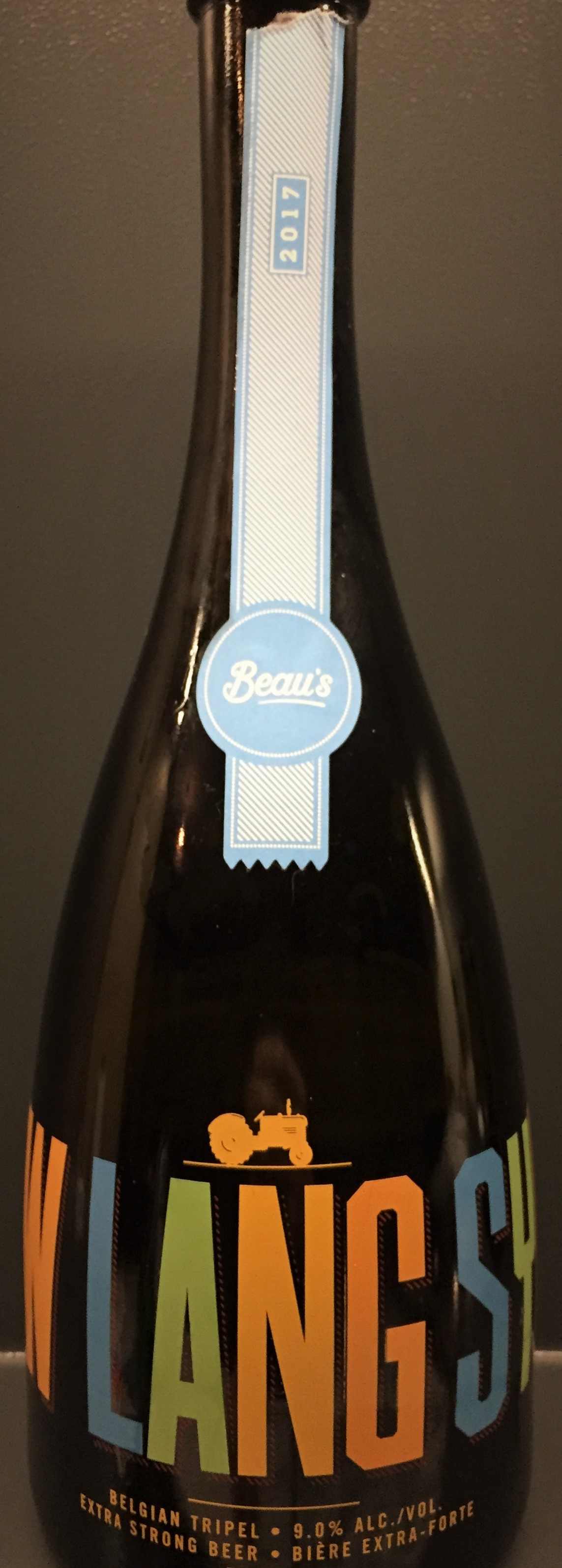 Impressive packaging: a sleek, heavy bottle with bold, multi-coloured lettering, a long neck runner that bears the vintage, a champagne cork and cage and a tag listing, among other things, the batch and bottle number and the bottling date. My sample – no. 3395 from batch no. 6479 – was bottled on August 28, 2017. I tasted the beer with two friends, one of whom is a serious amateur brewer and has done a tour of Belgian breweries for a national magazine.
Hazy amber-bronze in the glass, with ample, long-lasting, rocky white foam (“can’t believe the head,” notes the brewer).
Appealing, complex nose: spicy and malty with notes of apple, butterscotch, “coriander seed” and wheat berries. “You get the esters but they’re spicy, not banana,” though a touch of dried banana does eventually appear.
The first sip prompts an “Oh, that’s nice” and indeed it is. So smooth and creamy (“the texture may be the most remarkable thing about it”) yet also deeply hoppy. There’s great complexity of flavour, an almost fruity (“pineapple juice”) maltiness and an undercurrent of sourish acidity. The hops kick in on mid-palate and make their presence felt, even to the point where one of the other tasters says the “bitterness masks so much.” A woody “barrel character” – a faint smoky overtone – appears on appears on the transition to the finish but there’s no clear line between where the bitterness stops and the tannins start. Finishes long with “prickly bitters, especially on the aftertaste.”
The bottom line: a fine, imposing, gastronomic ale that, while enjoyable now (provided you’re not allergic to hops), will surely benefit from spending a few months to a couple of years in a cool, dark place. (Buy again? “Yes.” “A bottle or two to cellar.” For sure.)
What would you serve with it? Cheese. “Fried chicken and cornbread.” I also like the brewery’s suggestion of blackened salmon. Oddly enough, a piece of dark chocolate studded with toffee malt followed by a swig of the ale didn’t clash and completely tamed the hoppiness, so maybe Beau’s suggested pairing of pineapple upside-down cake isn’t as off the mark as it seems.
Released on November 9, 2017. A number of stores in Montreal and Quebec stock Beau’s products (see map) and some are reportedly carrying the New Lang Syne.
Disclaimer: The brewery provided this sample for review purposes with the understanding that I would be free to critique it however I saw fit.
Update (2017-11-27): After some searching and reaching out to Beau’s, I finally found bottles at Le Marché des Saveurs du Québec (Jean Talon Market) and at Dépanneur Peluso Beaubien (though oddly not at the original Rachel Street Peluso), where it goes for a heafty $19.99 a bottle.
Mainlining Assyrtiko
Santorini 2013, Pure, Volcanic Slopes Vineyards ($45.50, 13109697)
Run as a separate operation, Volcanic Slopes Vineyards is a second label of sorts of Argyros Estate. It is the brainchild of Argyros’ winemaker and commercial director, Stefanos Georgas. The idea is to make as pure an expression of Santorini Assyrtiko as possible using a hands-off approach. This 2013 is the first vintage of what is, so far, its only cuvée. Assyrtiko (100%) from 80- to 150-year-old ungrafted vines in two parcels: one with pumice soil in Episkopi Gonias, the other with basalt soil in Megalochori. Manually harvested. Half of the must is free-run juice, the other half is juice from gently pressed whole clusters. Fermented with indigenous yeasts. Matured 14 months on the lees with frequent stirring in a naturally temperature-controlled underground concrete tank in the old Argyros winery. 13.5% ABV. Quebec agent: oneopole.
Multifaceted nose that prompts descriptors like lemon, quartz dust, “sour fuzzy peach,” “distant honey,” bay leaf and lingering apple. Imposing and enthralling from the first sip: a “decadent” yet austere amalgam of clementine and incredible minerality and salinity. The rich extract and electric acidity are in breathtaking balance. There’s great breadth, depth and length – every dimension, in fact. Pure is no exaggeration, no marketing gimmick. A stunning wine, “like mainlining Assyrtiko.” It will be fascinating to see how this evolves over the next three to five years and maybe beyond. Surely one of the great white wines of Europe and, as such, more than fairly priced. The 2013 is almost sold out. Tasted at the winery in July 2016, two days after it had been bottled, the 2014 seemed every bit its equal. (Buy again? Imperatively – even the group’s white wine skeptic felt compelled to run out and acquire a couple of bottles.)

Santorini 2016, Assyrtiko, Hatzidakis ($28.50, 11901171)
The estate’s entry-level bottling. Sadly, 2016 was Haridimos Hatzidakis’s last vintage. 100% Assyrtiko from organically farmed, ungrafted vines up to a century old in Pyrgos, Megalochori, Akrotiri and Vourvoulos. The manually harvested grapes were direct-pressed. The must was clarified by settling, then fermented with indigenous yeasts in temperature-controlled (18°C) tanks. Stayed on the lees for 40 days. Matured in stainless steel tanks. Lightly filtered and dosed with sulphur dioxide before bottling. Reducing sugar: 1.9 g/l. 13.5% ABV. Quebec agent: oneopole.
Lemony, “ferny” nose with notes of “modelling clay,” peach and distant sea shore. In the mouth, the dense extract and unctuous texture are counterpointed by crystalline minerals, vibrant verging on trenchant acidity and a fundamental dryness. Fruitier (lemon and quince) than in some earlier vintages. The saline finish brings some dried herb notes. Not as deep, broad or long as the (older and much more expensive) Pure, though hardly lacking dimension. Almost too rich for an aperitif; probably best thought of as a food wine (to date, it has made a matchless match for spaghetti with leeks, olive oil, lemon juice and zest and bottarga and for oysters on the half shell). (Buy again? Multiples.)
MWG September 28th tasting: flight 4 of 7
Antipodal Savagnins
Côtes du Jura 2015, Savagnin, Les Sarres, Domaine Rijckaert ($29.95, 12951356)
The estate avoids herbicides and insecticides and limits its use of synthetic chemicals to treatments against mildew and odium. All the estate’s wines are made in barrels. 100% Savagnin from the Les Sarres vineyard located in Buvilly. Fermented with indigenous yeasts. Underwent full malolactic fermentation. Matured two years on the lees in neutral French oak barrels with no stirring. Kept topped up, so not oxidized. Reducing sugar: 1.9 g/l. 13% ABV. Quebec agent: La QV.
Slightly hazy pale electrum to the eye. Minerally nose of lemon and grapefruit with hints of potpourri and almond. In the mouth, it’s clean and tonic. The fruit (lemon, yellow plum) is sweet-seeming on the attack, though the wine is actually very dry. There’s a real mineral depth, including a shot of salinity. The bright acidity combines with a faint bitterness on the long finish to provide a bit of grip. Less electric than some Savagnins but still a fine example of what the grape can do. (Buy again? Sure.)

Adelaide Hills 2016, Skin n’ Bones White, BK Wines ($35.00, importation valise)
The South Australian estate was founded in 2007 by Brendon and Kristy Keys. This monovarietal is made using Savagnin from organically farmed 10-year-old vines rooted in limestone and sandstone over deep clay in Lobethal in the cool-climate Lenswood subregion. The grapes were manually harvested and fully destemmed but not crushed. Spent one month on the skins with twice-daily pump-overs, then was pressed and racked into neutral French oak barrels with regular stirring for nine months. Alcoholic and full malolactic fermentation were spontaneous. Total production: 200 cases. 11.8% ABV. Represented in western Canada by Calgary-based Crush Imports.
One-of-a-kind nose of “smoked fish,” “sushi” and “barbecued corn” (quoting other tasters) as well as dried apricot and, with time, green fruit (kiwi, melon) and herbal notes. Dry, fluid and layered. Nicely structured with pervasive but smooth acidity, a current of white minerals and ghostly tannins that last well into the long finish. Grape skins and apricot pit linger. As unusual and engaging as it is savoury and delicious. (Buy again? Gladly.)
MWG September 28th tasting: flight 3 of 7
Native whites
Gaillac 2016, Les Pierres Blanches, Domaine De Brin ($24.85, 13314666)
A blend of Mauzac (60%) and Len de l’El (40%) from organically farmed vines rooted in stony calcareous-clay soil. Manually harvested. The grapes are direct-pressed and the must is chilled and clarified by settling. Vinification – including sponatneous alcoholic and complete malolactic fermentation – and maturation take place in neutral barrels and last nine to 12 months. Unfiltered and unfined. No added anything except possibly a tiny amount of sulphur at bottling. Reducing sugar: < 1.2 g/l. 12.5% ABV. Quebec agent: Ward & associés.
The first sniff brings a hint of reduction and volatile acidity followed by an odd mix of apple, flowers and sauerkraut. In the mouth, it’s clean, fresh and sleekly acidic, dry but full of applely fruit and quartzy minerals with a bitter undertow. Fair depth and good length. Not bad but not the revelation I was expecting. A taster who had enjoyed an earlier bottle didn’t peg our bottle, which was served double-blind, as the same wine. Nor did the wine match the description of the trustworthy SAQ advisor who recommended it. In other words, probably an off bottle. (Buy again? Yes, especially to give it another chance.)

Terre Siciliane 2016, Versante Nord, Uve Bianche, Eduardo Torres Acosta ($35.00, private import, 6 bottles/case)
Born in the Canary Islands, Acosta headed to southeast Sicily in 2012 to intern with Arianna Occhipinti. He later did a stint as a winemaker at Passopisciaro, eventually renting and farming a few parcels and making wine under his own name. His first commercial vintage was 2014. The grapes are grown in the Etna appellation but the wines are made at Occhipiniti’s facilities in Vittoria. That and the fact that at least some of the vineyards are higher than the allowed 800 metres of altitude are why the wines qualify only for the broad Terre Siciliane IGT designation and not the Etna DOC. This blend of Minella (60%) and other local varieties is made using grapes grown in six plots on the north face of Mount Etna. The organically farmed vines average 45 to 50 years old and are rooted in soils with a high volcanic ash content. The grapes are manually harvested, crushed and macerated on the skins for five days in concrete tanks with no temperature control. Fermented with indigenous yeasts. Matured eight months in neutral oak botti. The 2016 is the first vintage of the wine. Total production: 2,000 bottles. 12% ABV. Quebec agent: oenopole.
Complex nose, initially of “garlic sausage,” summer savoury and poblano chile, then more lemon and quartz. Dense and apricoty in the mouth, with citrusy acid and a mineral structure beyond the obvious current of salinity. The very long brings a lingering pithy bitterness. A multifaceted, engaging wine if not exactly a charmer. Probably better viewed as an accompaniment to dinner than an aperitif. Nearly the entire shipment was snatched up by Montréal Plaza restaurant, where it’s currently on the list for $76 and would make a smart match for many of their super-savoury dishes. (Buy again? Yes.)
MWG September 28th tasting: flight 2 of 7
Toro solo
Toro 2015, 4mil cepas, Cuatro Mil Cepas ($24.95, private import, 6 bottles/case)
Founded in 2008 by 11 friends, the estate now comprises 7.5 hectares in three plots in the Toro DO. It also makes wine in the Sierra de Salamanca PDO. I’ve not succeeded in finding any information about this bottling, which is 100% Tinta de Toro (aka Tempranillo) and comes from sustainably farmed vines. It is probably fermented in stainless steel tanks and matured in barrels (likely a mix of American and Hungarian oak). 14% ABV. Quebec agent: Vinealis.

Black and red fruit, old wood, graphite, sandalwood, Chambord, leafmould. Full-bodied. The flavour is a mix of ripe but not jammy fruit and a layer of spicy but unaggressive oak. Firm yet pliable tannins and sleek acidity confer a velour-like texture. Balanced, fluid, long. Young but delicious and delivering high QPR. If in the mood for an affordable, oak-inflected Toro, this will do just fine. (Buy again? Not really my style but if it’s yours, go for it.)
WMG September 14th tasting: flight 8 of 9
Three sure bets
Côtes du Rhône Villages – Valréas 2010, Clos Bellane ($26.25, private import, 12 bottles/case)
A 50-50 blend of Grenache and Syrah from biodynamically and organically farmed vines more than a quarter century old and rooted in clay and limestone. At 410 metres elevation, the vineyard is the highest and one of the coolest in the southern Rhône. Manually harvested. Partially destemmed. Fermented with indigenous yeasts and “Burgundy-style” punch-downs in temperature-controlled stainless steel tanks. Pneumatically pressed. Matured in stainless steel tanks (70%) and used barrels (30%). To minimize handling by machines, the winery is gravity-fed. 14.5% ABV. Quebec agent: Vinealis.
Our bottle was opened 24 hours before we got around to it. Wafting nose of plum, raspberry, spice, oyster bed, red gummy bears and garrigue. In the mouth, it’s full-bodied but restrained. What’s more, the alcohol is not at all noticeable. Flavourwise, it’s remarkably clean, pure and well balanced, with rich fruit, freshening acidity, mostly resolved though still bitey tannins and as much breadth as depth. Black pepper and herbes de Provence overtone the long finish. The estate’s elegant rosé is among the best values at the SAQ, so it’s not surprising the CDRV (the 2015 version of which is also available at the monopoly) is similarly tasty and affordable. (Buy again? Sure.)


Corbières 2014, Prioundo, Les Clos Perdus ($34.60, 6 bottles/case)
A blend of Grenache (80%) and Cinsault (20%) from biodynamically and organically farmed, 32-year-old vines rooted in limestone and clay. Twenty percent of the grapes are left in whole clusters, the rest destemmed but uncrushed. Given three days’ maceration before fermentation in stainless steel tanks with indigenous yeasts. Basket pressed after 21 days on the skins. Matured on the fine lees in stainless steel tanks for nine months. Unfined and lightly filtered. Sulphur use is minimal. 14.5% ABV. Quebec agent: Vinealis.
Lovely, subtle, savoury nose: blackberries and red fruit, minerals, spice and a bit o’ barnyard. Pure, open and sweet on the attack yet dry and savoury. Finely structured with supple tannins and smooth acidity. Full-bodied, round, fresh – what the French call digeste, which is kind of surprising for a 14.5% wine. (Buy again? Sure.)
Vacqueyras 2014, Fruit Sauvage, Clos de Caveau ($65.00/1500 ml, private import, 3 bottles/case)
A 60-40 blend of Grenache and Syrah from 10- to 45-year-old organically farmed vines at the foot of the Dentelles de Montmirail. Manually harvested. Fermented with indigenous yeasts. Matured 12 months, half in tronconic tanks, half in concrete tanks 14.5% ABV. Quebec agent: Vinealis.
Elegant nose of plum and red berries, black tea and background minerals and garrigue. As for the palate, the word smooth appears three times in my notes, though suave might be the better descriptor. Full-bodied and lush yet fresh and energetic. Satiny texture. The ripe, juicy fruit is structured by round tannins and sleek acidity. Minerals rumble softly underneath. Finishes long and clean and with not a hint of heat. Unexpectedly easy-going, especially for a Vacqueyras. (Buy again? Sure.)
WMG September 14th tasting: flight 7 of 9

 Brett happens