Posts Tagged ‘Affordable’
Château Landra, take three
Ventoux 2016, Pur Jus Rouge, Château Landra ($25.86, private import, 12 bottles/case)
Syrah (60%) and Grenache (30%) and Cinsualt (10%) from 45-year-old vines rooted in gravelly alluvial deposits with lots of smooth pebbles and stones. Destemmed, crushed. Fermented (with indigenous yeasts) and matured in stainless steel. Unfined and probably unfiltered. No added sulphur. 14% ABV. Quebec agent: WINO.

Intriguing nose: cherry, black raspberry, “pink peppercorn,” “fresh-cut grass,” “asafoetida” (all per other tasters) and more. Medium-bodied, juicy and, alcohol notwithstanding, unhot. Packed with sweet fruit but far from a bomb. The extract and fine but present tannins give it a plush texture but the streaming acidity eliminates any possibility of heaviness. Long, clean, black pepper-dusted finish. A fresh, dry, savoury, uncomplicated red whose only drawback is that, at 14%, it’s dangerously drinkable. (Buy again? Sure.)
MWG July 13th tasting: flight 8 of 9
Cab Franc three ways
Though they don’t come from a wine-making family, brothers Fabien and Cyril Boisard founded Domaine du Mortier in 1996 when they both were in their teens. Their holdings comprise around 12 hectares of vineyards in Saint-Nicolas-de-Bourgueil and a recently acquired three hectares in Bourgueil. Farming is organic-leaning-biodynamic, harvesting is by hand and none of the wines is chaptalized.
Saint-Nicolas-de-Bourgueil 2015, Les Sables, Domaine du Mortier ($27.23, private import, 12 bottles/case)
100% Cabernet Franc from seven parcel of mostly young vines in sandy soil. Whole-bunch fermentation takes place in 70 hl concrete vats. Lees from earlier vintages are used to start the fermentation. Pump-overs with minimum oxygen uptake are performed for five or 10 minutes a day. Matured on the lees for about six months. Unfiltered and unfined. A tiny amount of sulphur (16 mg/l) is added at bottling. 12.27% ABV. Quebec agent: WINO.
Red and black berries, coffee, dried meat, slate, pepper, distant barnyard. Medium-bodied and so very drinkable. A mouthful of tart fruit, dark minerals, lively acidity, super-supple tannins. Dry and wonderfully pure. Nothing deep or complex (a function of soil and vine age), just good, clean fun. The easiest-drinking Cabernet Franc I’ve encountered in a coon’s age. (Buy again? Done!)

Saint-Nicolas-de-Bourgueil 2014, Dionysos, Domaine du Mortier ($32.89, private import, 6 bottles/case)
100% Cabernet Franc from 30-year-old vines rooted in gravel over tuffeau. Manually harvested. Gently destemmed, gently pressed and given around 25 days’ maceration on the skins. Barrel-fermented using indigenous yeasts. Matured eight months in old oak barrels. 13.35% ABV. Quebec agent: WINO.
Darker nose of red berries and slate with meat and vegetal notes. Full and round in the mouth, packed with remarkably juicy fruit. Firm tannins bestow a velour-like texture, bright acidity a bit of a bite. The bedrock minerality rumbles through the long, spicy finish. The winemakers feel this often needs a couple of years before it hits its stride and drinks well for six to eight years beyond that. (Buy again? Yes.)
Vin de France 2014, 180 jours, Domaine du Mortier ($63.79, private import, 6 bottles/case)
VdF because the brothers feel it wouldn’t be accepted by the AOC authorities and because it leaves them free to supplement Saint-Nicolas grapes with fruit from their holdings in Bourgueil. Cabernet Franc from 60- to 70-year-old vines in tuffeau. Whole-bunch fermented and macerated in old barrels for 180 days, with the barrel being tightly closed, not topped-up and turned once daily during fermentation; after 180 days, the barrel is taken apart so the wine and skins can be transferred to the press. After pressing, the wine is matured in new barrels for another 180 days. Unfiltered and unfined. No added sulphur. 13.5% ABV. Due to the small quantities made, the wine is normally sold only at the winery, a limit of 12 bottles per customer is imposed and, reportedly, none is exported. Bravo to Martin Landry for scoring a few cases for Quebec. Quebec agent: WINO
Much darker and denser than its flightmates. Complex, funky nose: old wood, dark fruit and minerals, “animale,” “green olives,” “the stuff you scoop out of a squash” and more. Rich and dark yet somehow fresh. So complex and layered, so plush and chewy. Superbly structured with velvety tannins, glowing acidity and mineral depth. Great length. Complete, elegant, accessible. A big wine but so not the overextracted monster I was fearing it would be. Just wow. (Buy again? Just yes.)
MWG July 13th tasting: flight 7 of 9
Gamay de soif
Touraine 2015, Gamay, Domaine Courtault Tardieux ($22.45, private import, 12 bottles/case)
After stints as a university student and briefly as a social worker, winemaker Simon Tardieux, who had spent time as a teenager working at the late, lamented Clos Roche Blanche, teamed up with Alain Courtault, a neighbour who had vines and was converting to organic agriculture. Located due east of the Thésée post office and less than a mile from the Cher river, the 15-hecatre estate specializes in vins de soif, thirst quenchers made from Cabernet Franc, Côt, Gamay, Pineau d’Aunis and Sauvignon Blanc. This 100% Gamay comes from organically farmed 50-year-old vines. Manually harvested. Whole-bunch maceration and fermentation took place in stainless steel tanks with indigenous yeasts. A small amount of sulphur dioxide was added at bottling. Bottled in March 2016. 12% ABV. Quebec agent: WINO.
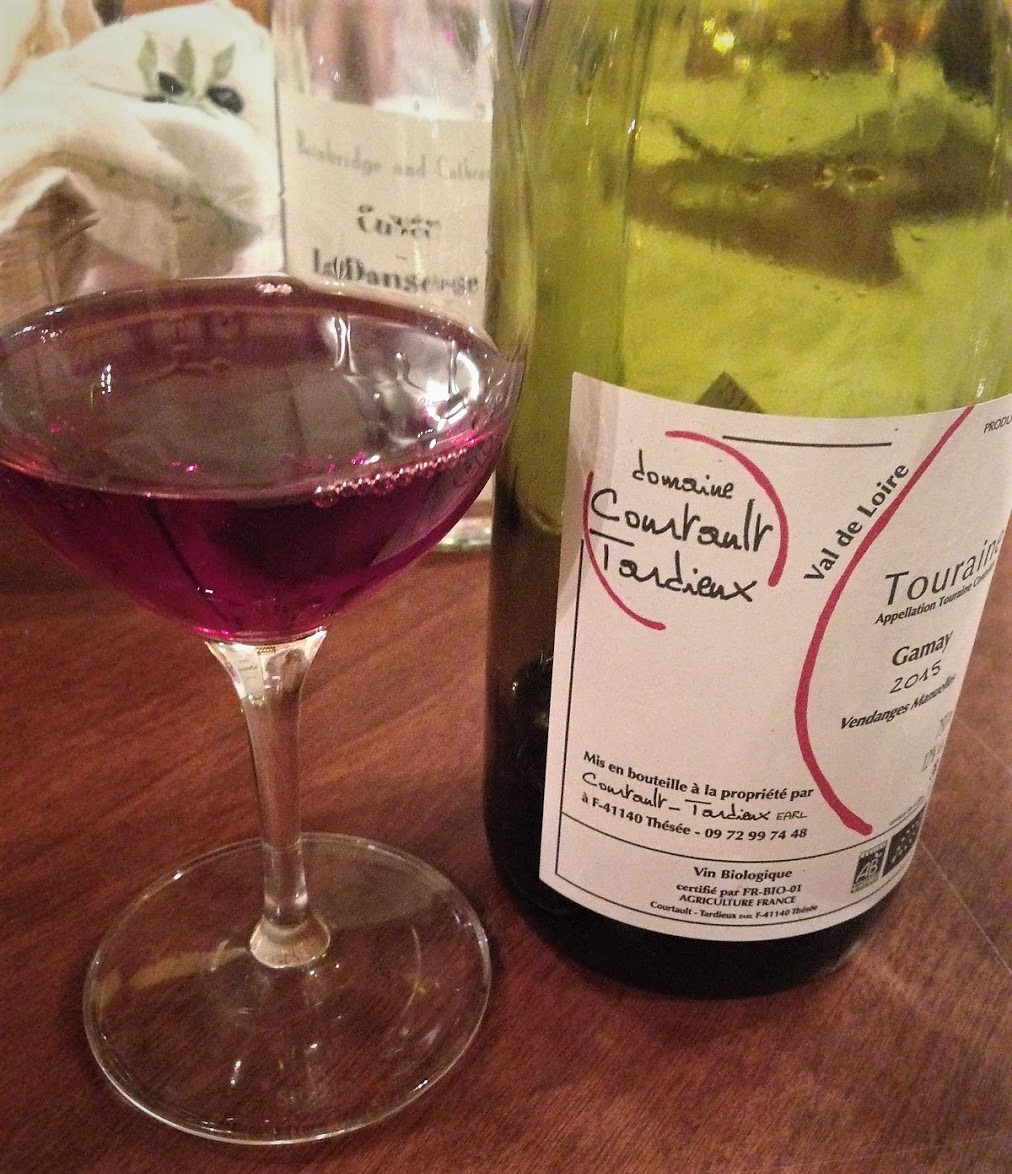
Light, winey, floral nose showing some sour berries and leaves and background funk. Light- to medium-bodied, gauzy tannined and acid bright. Not as plush-fruity as, say, a Morgon, but remarkably minerally and fluid, especially on the mid-palate. A faint lactic note on the finish prompts “cherry yogurt” from one of the assembled. Fresh, clean, tasty and so, so drinkable. Definitely a Gamay but definitely not a Beaujolais. (Buy again? Um, it’s irresistible.)
MWG July 13th tasting: flight 6 of 9
Château Landra, take two
Ventoux 2016, Pur Jus Rosé, Château Landra ($25.86, private import, 12 bottles/case)
Cinsault (70%) and Grenache (30%) from organically farmed vines averaging 15 years old; the blend sometimes includes Syrah but not, it appears, in 2016. Manually harvested. Direct pressed. Fermented with indigenous yeasts at low-temperatures and matured in stainless steel tanks. Lightly filtered. Unfined. No added sulphur. 12% ABV. Quebec agent: WINO.

Watermelon pink. Hard-to-pin-down and initially subdued nose of quartz, “hibiscus,” “pink grapefruit or blood orange,” “Swedish berries” and strawberry. On the palate it’s rich (“really meaty” per one taster) yet fluid, a mouthful of, yes, juicy fruit and crunchy minerals buoyed by smooth acidity. The complex set of savoury flavours, including what I pegged as yeast but another called “a cured meat nuttiness,” lasts well into the finish. Likeable. (Buy again? Sure.)
MWG July 13th tasting: flight 5 of 9
Neo Naoussa
 Naoussa 2014, Domaine Thymiopoulos ($23.85, 13288218)
A new cuvée that, in price and sophistication, sits between the Jeunes vignes and the Terre et Ciel (the Xinomavro Nature, available through the private import channel, stands apart in more ways than one). 100% Xinomavro from organically farmed, 30-year-old vines rooted in volcanic and limestone soil and located between 180 and 500 metres above sea level. Manually harvested. Fermented with indigenous yeasts. After alcoholic and malolatic fermentation, the wine was transferred into 500-litre oak barrels for 12 months’ maturation. Unfiltered. Reducing sugar: 2.4 g/l. 12.5% ABV. Quebec agent: oenopole.
Protean nose of, among other things, black cherry, wild strawberry, black olive, balsamic vinegar, old leather, earth and violet. Medium-bodied and, despite the fine, firm tannins, supple. Fruity but dry, with freshening acidity, flavours that echo the nose and a slatey underlay. Any oak is very sotto voce. The finish is savoury, while earth and sweet-spicy notes linger. Clean, pure and eminently drinkable. Food-friendly too. May be the most elegant Xinomavro I’ve tasted. Unsurprisingly, the limited quantities are disappearing fast. (Buy again? Of course.)
Mountain red
 Achaia 2010, Grand Cave, Domain Mega Spileo/Cavino ($28.85, 13110137)
The estate is named after a nearby monastery that once owned the vineyard. Most of the technical info comes from the back label and kudos to the winery for that. A 60-40 blend of Mavrodaphne and Mavro Kalavrytino (aka Black of Kalavryta) from vines rooted in sandy clay soil in a relatively cool-climate mountain vineyard between 780 and 880 metres above sea level and located near the village of Kalavryta. No chemical insecticides, herbicides or fertilizers are used. Manually harvested. Destemmed. Prefermentation maceration at low temperatures for 24-48 hours. Long and gentle alcoholic fermentation in small temperature-controlled tanks. Malolactic fermentation and maturation on the lees in new oak barrels (80% French, 20% American) for 16 months. Lightly filtered. Not cold stabilized. Bottle-aged 24 months before release. 6,500 bottles made. 13.5% ABV. Quebec agent: Divin Paradis.
Heady nose of plum, prune, leather, burned earth, sweet spice, coffee, hints of blood and chocolate. More medium- than full-bodied and very dry. The ripe but not jammy or forward fruit is complemented by a full set of tertiary flavours (old wood, leather, cigar box, dried herbs and earth) and a swirl of inky minerals, framed by smooth but animating acidity and soft tannins that show their mettle on the long, lightly astringent finish. Sandalwood, terracotta and dried cherry linger. Savoury, balanced and at peak. Fairly priced for a seven-year-old wine of this quality. Fairly cries out for grilled lamb. (Buy again? Yep.)
Francs et graves
Côtes de Bordeaux Francs 2014, Emilien, Château le Puy ($28.15, 00709469)
A blend of Merlot, Cabernet Sauvignon and Carménère (typically 85%, 14% and 1% respectively) from biodynamically and organically farmed 50-year-old vines. The grapes are fully destemmed. Fermentation in open, temperature-controlled vats with indigenous yeasts and no chaptalization lasts two to four weeks. Matured 14 months in large foudres and 11 months in third- to fifth-fill oak casks. Bottled unfiltered with only a small dose of sulphur. Reducing sugar: 1.9 g/l. 12.5% ABV. A few 500 ml bottles of the 2012 can also be found ($20.75, 00896399). Quebec agent: A.O.C.
Intriguing nose that gets the aroma-namers going: plum, “edamame,” “nigella,” “pickled turnip juice.” Medium-bodied. The pure fruit and graphite underlay are nicely structured by fine, firm tannins and bright acidity. Finishes long and clean with faint notes of tobacco and spice. This perennial favourite is true to form in 2014: a savoury, refreshing, eminently drinkable wine that everybody always enjoys. The QPR is high on this one. (Buy again? Yep.)

Graves 2015, Clos 19 Bis/Vincent Quirac ($31.05, private import, 6 bottles/case)
Founded in the late 2000s, the tiny (1.5 hectare) estate makes a Sauternes and a red Graves. The latter is a blend of Merlot (around 50%), Cabernet Franc and Cabernet Sauvignon from organically farmed vines averaging 40 years old and rooted in gravelly soil over a clayey-calcareous base. Manually harvested. The varieties are vinified separately. The Merlot is cold-macerated before fermentation for a week, the Cabernets are directly fermented. Fermentation at low temperatures with indigenous yeasts, punch-downs and pour-overs (using buckets, not pumps) lasts 10 days. The wine is then left on it skins for another eight to 10 days. 12.5% ABV. Quebec agent: Vini-Vins.
Cherry, cassis, “cocoa powder and ashes” and a strong whiff of volatile acidity. Quite disjointed in the mouth, with a harsh verging on acrid note, a problem that airing and swirling didn’t resolve. Bears little resemblance to the fresh, clean, juicy-fruited, mineral-laden, roundly structured, medium-bodied wine enjoyed a few days earlier. Clearly defective and, as such, a disappointment. (Buy again? Based on the earlier bottle, yes.)
MWG June 22nd tasting: flight 6 of 7
Barrel-aged, new moon, off-track
Based in Mittelbergheim in the Bas-Rhin department, André Rohrer has run his eponymous eight-hectare estate since 1988, when he took the helm from his father. The estate, which has been in the family for eight generations, has holdings in three communes: Eichoffen, Mittelbergheim (including 18 ares in the Zotzenberg grand cru) and Barr. Though it abandoned herbicides in the 1960s and chemical insecticides in the 1980s, the estate has been certified organic only since 2001. In recent years, Rohrer has been exploring new wine-making paths, including a line of natural wines, one of which we tried. The estate doesn’t have a website and technical information is non-existent on the Web, though it’s probably safe to assume that the wines are fermented with indigenous yeasts and made with minimal intervention.
Alsace 2015, Pinot Noir, Élevé en Barrique, Domaine André Rohrer (ca. $23, importation valise)
100% Pinot Noir from organically farmed vines. Matured in oak barrels. 13.5% ABV.
Faintly candied nose of cherry-chocolate, red wine-poached pears and a little band-aid. Medium-bodied, dry and fruity, with streaming acidity and fine tannins mostly apparent on the longish, faintly astringent finish. The oak is less present on the palate than on the nose. “A bit rustic,” as one taster notes, not that there’s anything wrong with that. (Buy again? Sure, especially at the local price.)
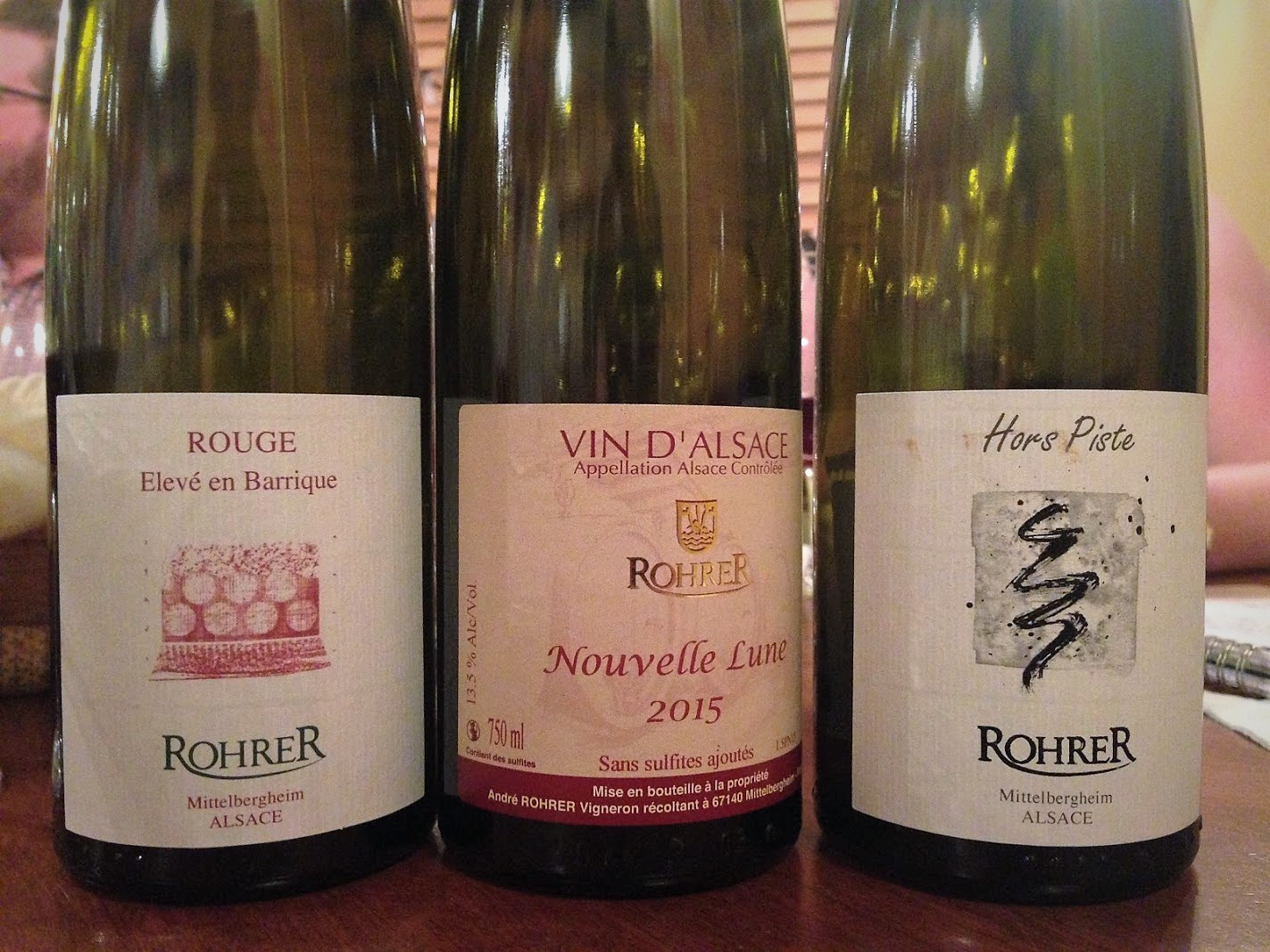
Alsace 2015, Pinot Noir, Nouvelle Lune, Domaine André Rohrer (ca. $26, importation valise)
100% Pinot Noir from organically farmed vines. Unfiltered and unfined. No added sulphur. 13.5% ABV.
Intriguing, involving nose of camphor, red berries and cherry taking on notes of game stew. Rich though medium-bodied, packed with ripe, almost juicy fruit. Velvety tannins and sleek acidity provide welcome structure. Nicely sustained finish. There was some discussion as to whether the bottle was a little corked; the consensus was no, it just needed time to sort itself out. (Buy again? Sure.)

Alsace 2015, Pinot Gris, Hors Piste, Domaine André Rohrer (ca. $25, importation valise)
100% Pinot Gris from organically farmed vines. Vinified like a red wine, with extended skin maceration. As Pinot Gris grape skins are dark pink in colour, so is the wine. Matured in neutral barrels. 14% ABV.
Intriguing nose of rose hip, peppermint, “nutmeg” and eventually honey. Lightweight yet possessed of a slightly unctuous texture. A tasty mouthful of spicy, strawberry-overtoned fruit, structured by lacy tannins, buoyed by acidity and underlain with minerals. The alcohol is well-nigh invisible. A savoury, refreshing, very drinkable wine quite unlike any other. (Buy again? Yes.)
MWG June 22nd tasting: flight 5 of 7
Rosés de Provence
Coteaux d’Aix-en-Provence 2016, Château Vignelaure ($24.50, 12374149)
Grenache (40%), Cabernet Sauvignon (30%) and Syrah (30%) from organically farmed vines averaging 25 years old and rooted in pebbly clayey-calcareous soil. Manually harvested. Saignée method after two hours’ maceration for the Grenache; direct pressing for the Cab and Syrah. The must is chilled to 10°C and allowed to settle for 48 hours. Fermented at low temperature (17°C) and matured in stainless steel tanks except for 7% of the Cab, which is aged in a 400-litre new oak barrel. Maturation on the lees with regular stirrings lasts three months. Reducing sugar: <1.2 g/l. 13% ABV. Quebec agent: LBV International.
Rubber bands, straw, yogurt, background minerals and a hint of chile; look for it and you’ll find some stone fruit and red berries. Clean, pure and very dry on the palate, with low-key fruit, good acidity, a long bitter-edged, pink grapefruity finish and a lingering pastry note. Not particularly complex – and not quite the equal of the impressive 2014 – but tasty enough. (Buy again? Sure.)

Bandol 2016, Rosé, Domaine du Gros ’Noré ($32.25, 12931021)
Mourvèdre (50%), Cinsault (35%) and Grenache (15%) from vines averaging 30 years old. Farming is organic though not certified as such. Manually harvested. The Cinsault and Grenache are macerated 24 hours at 10°C, then pressed. The juice is combined with direct-pressed Mouvèdre juice and fermented. Reducing sugar: 2.1 g/l. 13.5% ABV. Quebec agent: oenopole.
Saltine crackers, “far-away Creamsicle” and lipstick give way to garrigue and minerals. “Fresh and dewy” in the mouth. Veils more than layers of fruit, sleek acidity, mineral depth and a a long, faintly bitter finish. “A bit more moreish than the Vignelaure,” notes one taster. Drinkable indeed. Will almost certainly gain complexity and presence with a year or two in the cellar. (Buy again? Yes.)
Côtes de Provence 2015, Rosé, Cuvée Clarendon, Domaine Gavoty ($27.65, 11231867)
This saignée method rosé is a blend of Grenache (70%), Cinsault (15%) and Syrah (15%) from vines rooted in clay and limestone. The grapes, which were vinified separately, were macerated in a vat for three to six hours. The free-run juice was drawn off and combined with the first-pressing juice, chilled and racked into stainless steel tanks for temperature-controlled (17°C) fermentation, which lasted two to four weeks. The various batches were sampled and selected in January 2016 and blended, with the best lots set aside for the Clarendon. Reducing sugar: 2.7 g/l. 13% ABV. Quebec agent: Vini-Vins.
Closed, minerally nose that, with coaxing, gives up notes of flan and red berries. Sweeter and flabbier than its flightmates, though improving with time in the glass. Fruitier too, bringing nectarine and strawberry to mind. A stronger acidic and mineral backbone would be welcome. Decent finish. Maybe time in the cellar or a carafe will help? At this point, not up to earlier vintages. (Buy again? Maybe.)
MWG June 22nd tasting: flight 3 of 7
Two misses and a hit
Bandol 2016, Blanc, Domaine de l’Olivette ($26.05, 10884559)
Clairette (80%), Rolle (aka Vermentino, 10%) and Ugni Blanc (aka Trebbiano, 10%). Manually harvested. After destemming, the grapes are cold-macerated on their skins, then pressed. Fermentation in oak vats is at low temperatures for about two weeks. The resulting wine is chilled and allowed to clarify by settling. Reducing sugar: 2.2 g/l. 13% ABV. Quebec agent: Vins de Châteaux.
Complex nose: “sweaty” (per another taster) with notes of fired minerals, dried flowers (linden), almond pastry cream, “straw fruit,” “celery salt” and more. Rich and round in the mouth and “a bit reductive.” The combination of highish extract and lowish acidity means the wine comes across as lethargic, a little flabby, “kind of flat” and “gassy.” The appealing nose and minerality aside, not a strong showing. A disappointment then, especially as I and others in the group have enjoyed earlier vintages. (Buy again? Meh.)

Bandol 2015, Blanc, Domaine la Suffrene ($26.45, 11903491)
A 50–50 blend of Clairette and Ugni Blanc from vines averaging 35 to 40 years old. Manually harvested. To increase flavour extraction, the crushed grapes are kept on their skins for 12 hours at 8°C before pressing. After clarification by settling, the juice is fermented in stainless steel tanks for around 15 days at around 19°C, then racked into other tanks for fining and maturation. Filtered before bottling. Reducing sugar: 1.8 g/l. 13.5% ABV. Quebec agent: Les Sélections Vin-Coeur.
Lemon and peach blossom, apple and honey. Rich on the palate but more fluid than the Olivette. Quite dry and minerally though turning fruitier on the long finish. Soft-glow acidity and a lingering bitterness complete the picture which, unfortunately, became less interesting as the wine breathed and warmed. Again, a wine that doesn’t seem equal to earlier vintages. (Buy again? Maybe.)
Bandol 2016, Blanc, Domaine du Gros’Noré ($34.00, 12206989)
A 70-30 blend of Ugni Blanc and Clairette from organically (uncertified) farmed vines averaging 30 years old. The must is macerated on the skins for 24 hours, then fermented at low temperatures with indigenous yeasts. Sees only stainless steel until bottling. Unfiltered and unfined. 13.5% ABV. Quebec agent: oenopole.
Lovely, wafting nose of white grapefruit, fired quartz, lemon flower and a “kaffir-like herbaceous note.” Clean and fluid with smooth acidity. Very minerally, especially on the finish. Dry, layered, long and savoury. “Apple seed bitterness” linger. Became better as it warmed and breathed. We have a winner. Try this with the winemaker’s recommended pairing: grilled mussels with rosemary (Buy again? Yep.)
MWG June 22nd tasting: flight 2 of 7

 Brett happens