Posts Tagged ‘biodynamic’
Cabgamay Franc
Santa Ynez Valley 2015, Cabernet Franc, Coquelicot Vineyard, Lo-Fi Wines ($44.95, private import, 6 bottles/case)
100% Cabernet Franc from organically farmed vines in the Coquelicot vineyard (fluvial sandy loam and gravel) near Solvang. Manually harvested. The whole clusters – neither destemmed nor crushed – were placed in a vat, which was filled with carbon dioxide gas and covered. Once a day for 14 days, the free-run juice was pumped over, then the vat was covered and gassed again. When alcoholic fermentation (with indigenous yeasts) was complete, the wine was pressed into tanks, settled and racked into neutral barrels (85% in 228-litre French oak barriques, 15% in a 600-litre demi-muid) for eight months’ maturation. Underwent full malolactic fermentation. Racked twice prior to bottling. Unfiltered and unfined. A small shot of sulphur dioxide was added at bottling. 12.2% ABV. Quebec agent: La QV.
Earthy, slightly jammy red fruit with hints of sandalwood and black olive. Dark-fruity and Asian-spicy in the piehole, the brighter colours darkened by an earthy substratum. Structured – if that’s the word for such a fuzzy wine – by smooth acidity and stealth tannins that make their presence felt only on the long, leathery/earthy finish. However original and interesting an interpretation of Cabernet Franc this may be, the QPR – as with so many California wines in Quebec – is seriously out of whack. (Buy again? Irrespective of price, sure.)

Saint-Nicolas de Bourgueil 2015, Hurluberlu, Sébastien David ($27.30, private import, 12 bottles/case)
100% organically and biodynamically farmed Cabernet Franc. Manually harvested, fermented with indigenous yeasts. Vinified Beaujolais style – using carbonic maceration – and given a very short maturation in tanks, with bottling occurring early in the new year following harvest. Unfiltered. No added sulphur. 12% ABV. Quebec agent: La QV.
Red fruity, cedary and a little poopy. From a hot vintage so richer, rounder, more extracted and conventional, less “like health juice” than some earlier versions. Still refreshing due to its bright acidity, supple tannins and pure fruit. Good, ultradrinkable juice, just a little less special than before. The shapely clear glass bottle is a beaut, especially in magnums. (Buy again? Sure.)
Coteaux Bourguignons 2015, Gamay, Domaine Bouillot Salomon ($29.95, private import, 12 bottles/case)
100% Gamay from biodynamically farmed vines rooted in clayey-calcareous soil. Manually harvested. Non-interventionist wine-making with no added anything, including sulphur. Matured in stainless steel and cement tanks. 12% ABV. Quebec agent: La QV.
Attractive nose of slightly candied red berries, spice, cola and background barnyard. A bit spritzy (carafing would have eliminated the gas). Fleet, fresh, fruity and dry with bright verging on tart acidity and a rumbling mineral bass line. The longish finish brings an appetizing bitter note. Would be interesting to taste this alongside some cru Beaujolais; I suspect the difference in terroirs would be noticeable. (Buy again? Yes.)
MWG June 8th tasting: flight 5 of 6
Notes from the edges
Vin de Sologne 2014, Quartz, Domaine Étienne Courtois ($39.25, private import, 6 bottles/case)
Located in the Sologne, Étienne and his father Claude make wines exclusively using ancestral methods and sometimes run afoul of authorities. Farming is strictly organic and biodynamic. This 100% Sauvignon Blanc comes from 15-year-old vines. Manually harvested, destemmed and gently pressed. Fermented (with indigenous yeasts) and matured in oak barrels for 12 to 24 months. 11.7% ABV. Quebec agent: La QV.
Striking, complex nose of turpentine, “eucalyptus,” “wild ginger,” California bay leaf, dried lemon, quartz crystals and parafin. A core of fruit (“candied lemon”) and more (“braised fennel”) wrapped in salt, energized by bright acidity. Good balance and length and real mineral depth. “The best Sauvignon Blanc I’ve ever had,” declares one taster. That said, I don’t imagine most people tasting it double-blind would guess it’s a Sauvignon Blanc. Whatever. It’s spellbinding. (Buy again? Oh, yes.)

Bourgogne Aligoté 2015, Troma-Onirique, François Écot ($38.15, private import, 12 bottles/case)
Based in Mailly-le-Château in the Yonne department of northeastern Burgundy, François Écot not only runs, with his American wife, a natural wine agency in New York City, he makes wines using grapes from an abandoned one-hectare vineyard that he resurrected. This 100% Aligoté, however, comes from purchased biodynamically and organically farmed (though not certified) grapes. Manually harvested. Vinified and matured eight months in foudres, fûts and amphorae. No added anything, including sulphur. Unfiltered and unfined. 12.5% ABV. Quebec agent: La QV.
The nose prompts comments along the lines of chalk quarry, “match stick,” “waxy” and lemon juice. A sip reveals a rich and minerally wine with a mouthfeel as much like a Chardonnay’s as an Aligoté’s. There’s some surprisingly juicy fruit, bright but smooth acidity, impressive purity and depth and a long, minerally finish. It’s still a surprise to see a $40 price tag on an Aligoté, but that’s what the top wines go for these days. And this is definitely a top wine. (Buy again? Yes.)
Coteaux Bourguignons 2015, Pinot Beurot, Domaine Bouillot Salomon ($32.20, private import, 12 bottles/case)
This admirable northern Rhône estate recently acquired 2.7 hectares of vineyards west of Dijon. 100% Pinot Beurot (aka Pinot Gris) from biodynamically farmed vines rooted in clayey-calcareous soil. Manually harvested. Non-interventionist wine-making with no added anything, including sulphur. Matured in stainless steel and cement tanks. 13.5% ABV. Quebec agent: La QV.
Pear, minerals and more than a hint of reduction, which other tasters describe as “durian” and “cow piss and camomile.” Smooth, round and dry in the mouth. Soft acidity enlivens the verging-on-unctuous texture and brings welcome freshness. There’s a certain minerality and some white spice and butter on the long finish. Not a wine that will have Alsace quaking in its boots but more than just a curiosity. Carafe it at least a couple of hours before serving if drinking now or hide it in the cellar for a two or three years. (Buy again? Sure.)
MWG June 8th tasting: flight 4 of 6
White orange
Vipavska Dolina 2015, Bela, Burja ($37.60, private import, 6 bottles/case)
A blend of Istrian Malvasia (30%), Welschriesling (30%), Ribola Gialla (30%) and unspecified other varieties from biodynamically farmed vines grown in the Vipava Valley and ranging from 25 to 75 years in age. Macerated on the skins for eight days before pressing. Fermented with indigenous yeasts in stainless steel tanks. Matured in 25 to 50 hl Slavonian oak barrels. 13.5% ABV. Quebec agent: La QV.
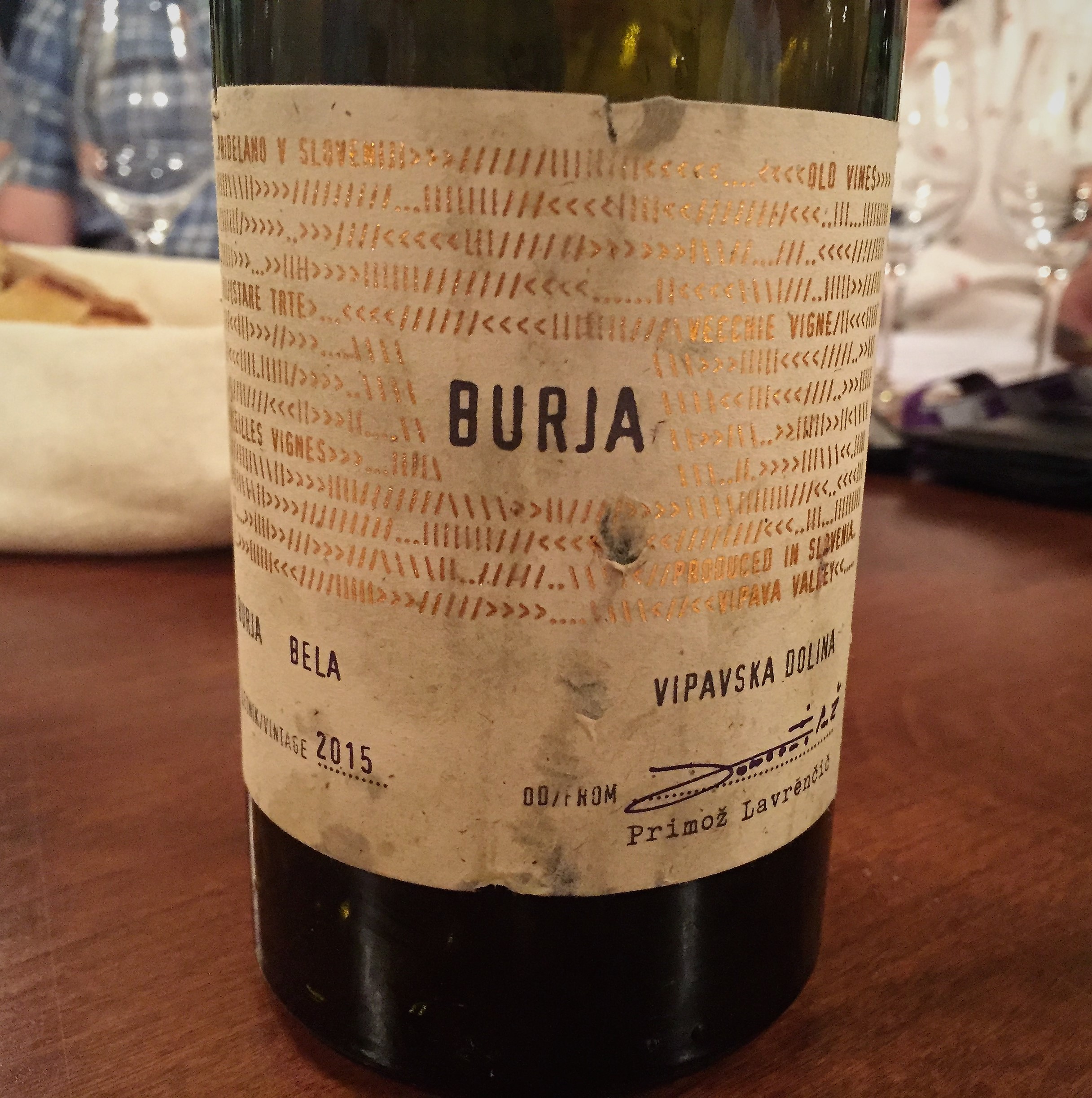
To all appearances, not an orange wine; the skin contact may add complexity and depth but the colour is lighter and more golden than, say, the Konkret Weiss, the nose is aromatic without being particularly estery/phenolic and if tannins are to be found, they escaped my notice. So, what are the aromatics? Preserved lemon, white pepper, quartz, maybe a floral note. In the mouth, the wine is very dry and savoury. The fruit takes a back seat to the minerals and a surprisingly intense salinity while sleek if sustained acidity counters the oily texture. The finish is long and vapourous. A food wine if ever there were one and probably a bottle that won’t suffer from a few years in the cellar. (Buy again? Yes.)
MWG June 8th tasting: flight 2 of 6
Meinklangers
The Mo’ Wine Group’s latest agency tasting was led by La QV’s head honcho Cyril Kérébel. The wine-up featured a particularly high proportion of whites, all with great minerality and a saline edge, as well as a wowser rosé and a handful of super-drinkable reds. We began with a trio of new-to-most whites from one of our favourite producers.
Burgenland 2015, Burgenlandwhite, Meinklang ($23.00, private import, 12 bottles/case)
A blend of Grüner Veltliner (50%), Welschriesling (40%) and Muscat Ottonel (10%) from biodynamically farmed vines. Manually harvested. Fermented (with indigenous yeasts) and matured in stainless steel tanks. Screwcapped. Residual sugar: 4.9 g/l. 12% ABV. Quebec agent: La QV.
Hay, straw, white flowers, chalk, distant “chives” and dried orange peel. Round in the mouth, the acidity smooth, the texture verging on waxy. The upfront fruit and underlying minerals give ways to a long savoury, saline finish with a lingering white pepper note. “Building spiciness underneath rosewater,” proclaims one taster. A perfect summer white is the general consensus. (Buy again? Yep.)

Somló 2015, H15, Meinklang ($37.65, private import, 6 bottles/case)
100% Hárslevelü from biodynamically farmed vines grown at the base of the extinct Somló (pronounced shom-low) volcano in southwest Hungary, not far from the Austrian border. The must is passed through a coarse filter before fermentation. The wine-making – which takes place at the estate’s Burgenland winery – is non-interventionist, with no additions except, possibly, a tiny squirt of sulphur at bottling. Matured in stainless steel tanks and old oak barrels for 12 months. Residual sugar: 4.2 g/l. 12% ABV. Quebec agent: La QV.
Complex, aromatic nose dominated by honey, spice and yellow fruit. Dense and weighty (not heavy) on the palate, the fruit wrapped around a softly glowing core of acidity. The complex of flavours turns impressively savoury/salty/sweaty on the mid-palate. Very long. Less tense and minerally, more stone-fruity and unctuous than some earlier vintages but no less engaging. (Buy again? Yep.)
Burgenland 2014, Konkret Weiss, Meinklang ($65.75, private import, 6 bottles/case)
A field blend of three Gewürztraminers, specifically Red Traminer, Yellow Traminer and plain old Gewürztraminer. Macerated on the skins for 21 days. Vinified in egg-shaped concrete tanks. No added anything, including sulphur. Residual sugar: 1.6 g/l. 12% ABV. Quebec agent: La QV.
For once, an orange wine that actually has an orange cast. One taster describes the complex nose of gardenia, cedar, spice and a funky whiff as “like the old lady in front of me on the bus, eating a grapefruit.” Dazzlingly complex and layered on the palate. Rich yet fluid. Dry but not austerely so. Structured by bright acidity and light tannins. The endless finish is awash in umami. (Buy again? Yep, wincing only slightly at the price.)
And Cyril shared some good Meinklang news with us: the SAQ will be including their impressive “Graupert” Pinot Gris in its Opération vins oranges release this fall and will also be carrying their fine ancient grains beer.
MWG June 8th tasting: flight 1 of 6
A global quartet of organic Pinot Noirs
Patagonia 2015, Pinot Noir, Barda, Bodega Chacra ($29.65, 11517515)
Located in the Rio Negro region of northern Patagonia, the estate was founded by Piero Incisa della Rocchetta, the grandson of the creator of Sassacaia. All its vines are ungrafted and biodynamically farmed. 100% Pinot Noir from the estate’s youngest vines, planted in 1990. Low-temperature fermentation with indigenous yeasts took place in cement tanks. Matured 10 months in French oak barrels. Unfiltered. Reducing sugar: 2.0 g/l. 13% ABV. Quebec agent: Réserve et Sélection/Trialto.
Classic nose of red berries, spice and a hint of vanilla caramel. Fruit forward but medium-bodied and balanced, with bright acidity, light tannins and a raw youthful astringency on the strong finish. Not what you’d call deep but easy enough to drink and something of a crowd-pleaser. (Buy again? If in the mood for a civilized New World Pinot, sure.)
Niagara Peninsula 2012, Pinot Noir, Réserve du Domaine, Domaine Queylus ($47.25, 12456494)
The estate is owned by a consortium of Quebecers (including Champlain Charest) and managed by Thomas Bachelder, who also serves as head winemaker. 100% organically farmed Pinot Noir from the Twenty Mile Bench and Lincoln Lakeshore sub-appellations. The grapes were picked by hand, sorted and destemmed but not crushed. A short cold maceration was followed by fermentation with indigenous yeasts. The fermented wine stayed on its skins for several days, then was pressed. Matured 16 to 20 months in French old barrels, a third of which were new. 5,300 bottles made. Reducing sugar: 1.8 g/l. 13% ABV. Quebec agent: Vins Philippe Dandurand.
Smoke and sweat then sandalwood with fruit and oak in the background. The palate is a suave mix of rich fruit, moderate tannins, sleek acidity and a minerally/tarry depth. Unfortunately, the oak becomes obvious on the finish, masking the beautiful fruit and robbing the wine of refreshment. While another year or two in the bottle may rectify that, for now I prefer the 2014 Tradition bottling ($31.00, 13276137), even without taking the Réserve’s somewhat wacky QPR into account. (Buy again? Maybe.)

Willamette Valley 2014, Pinot Noir, Red Cap, Montinore Estate ($29.50, 13186609)
100% biodynamically farmed Pinot Noir from various vineyards. At least some of the manually harvested grapes were given a cold soak. Fermented with indigenous yeasts. Spent ten months in French and Hungarian oak barrels, around 20% of which new. Reducing sugar: 3.4 g/l. 13.5% ABV. Quebec agent: La QV.
Cranberry, black raspberry, spice and sawed wood. Medium-bodied. The texture is more velvety than silky, the fruit pure, the oak in the background. Round tannins frame while sleek acidity nips on the long finish. Not particularly deep but, hey, it’s under $30. Several in the group bought earlier vintages of this when it was a private import; opened last year, a 2011, like this a bit rustic in its youth, had evolved into a silky Pinot Noir with definite Burgundian qualities. (Buy again? Yes.)
Bourgogne 2015, Garance, Domaine Montanet-Thoden ($34.75, private import, 12 bottles/case)
The eight-hectare estate was founded in 1990 by Catherine Montanet (of Domaine de la Cadette) and Tom Thoden. The original vineyards were part of Cadette’s holdings that had a higher proportion of clay and thus produced distinctive wines. Cadette’s oenologist and Catherine’s son, Valentin, now makes the wines. 100% Pinot Noir from a organically farmed two-hectare plot of vines between 20 and 25 years old. Manually harvested. Whole-cluster fermentation with indigenous yeasts takes place in temperature-controlled wood vats, initially with punch-downs and later with pump-overs. After about two weeks, the wine is pressed and transferred to large barrels until fermentation is finished. Matured in used 228-litre barriques (80%) and 114-litre feuillettes (20%). Unfined. 12.5% ABV. Quebec agent: oenopole.
Initially shy nose of red fruit and papier d’Arménie. Becomes more expressive with time in the glass, gaining red berry, leafmould, cola and spice notes. In the mouth, it’s medium-bodied, fluid and very dry. The tart red fruit is underlain with minerals, balanced by lithe tannins and lifting acidity. A faint, spicy bitterness lingers. Remarkably pure, this wine pushes all the Burgundy lover’s buttons, so it’s not surprising that local restaurateurs quickly snapped up the entire shipment. Accessible now but probably singing in one or two years. (Buy again? If only I could…)
MWG May 18th tasting: flight 6 of 6
So similar, so different
Stellenbosch 2014, Chenin Blanc, Organic, Reyneke ($26.60, 13123608)
100% Chenin Blanc from biodyanmically farmed vines around 45 years old and rooted in granitic loam over clay. Manually harvested. Whole-cluster pressed. The must was allowed to settle then fermented with indigenous yeasts in 300-litre second-fill French oak barrels and a 2,500-litre foudre. Matured on its lees for 10 months then racked into a stainless steel tank for another month. Reducing sugar: 1.9 g/l. 13% ABV. Quebec agent: Univins.
Intriguing, even mysterious nose of white spice, chalk, lemon, roasted white meat and “garum.” In the mouth, it’s round from start to finish, honeyed yet dry, packed with ripe fruit and minerals. A stream of acidity adds backbone and life. Faint bitter saline notes mark the nicely sustained finish. One of those wines that seems as Old World as New, this had several fans around the table. While I found it a little two-dimensional, especially in comparison to its flightmate, I’ll readily admit those dimensions are lovely. (Buy again? Sure.)

Jasnières 2015, Sec, Domaine de la Roche Bleue ($27.90, 12856228)
100% Chenin Blanc from organically farmed 10- to 25-year-old vines planted in clayey, flinty topsoil over a limestone base. Manually harvested. Whole-cluster pressed. The must was allowed to settle, then fermented (slowly due to the cool cellar temperatures) with indigenous yeasts, 60% in fourth- to sixth-fill barrels (wine from older vines) and 40% in stainless steel tanks (wine from younger vines). Matured four months in sixth-fill barrels. Reducing sugar: 3.0 g/l. 13% ABV. Quebec agent: Boires.
Complex, winey nose of linden flowers, “sake,” quince, lime and, eventually honey. Sleek and spicy on the palate, alive with acidity. The tart fruit (citrus and stone mainly) is dusted with chalk and gunflint. Sugar levels notwithstanding, this seems significantly drier – not to mention leaner, more crystalline and better delineated – than the Reyneke. Pure, long and delicious. (Buy again? Yes.)
MWG May 18th tasting: flight 3 of 6
Hit and miss
Crémant du Jura, Rosé, Domaine Désiré Petit ($24.00, 12399717)
100% Pinot Noir from vines averaging 20 years old and rooted in calcareous topsoil over red marl. Sparkled using the traditional method. Reducing sugar: 12 g/l. 11.5% ABV. Quebec agent: Tannins.
Engaging nose dominated by cherry and almond. Softly effervescent. Dry. Fruity attack, savoury mid-palate. Lots of minerals. Crisp acidity adds cut and freshness. Spice and “pink grapefruit pith” mark the fair finish. Parabolic in that it got better as it breathed but then became a little one-note as it warmed. That said, this would make a fine starter at a backyard barbecue and you could keep going with it if you had some salmon on the grill. (Buy again? Sure.)

Crémant du Jura, Rosé, Domaine André et Mireille Tissot ($30.75, 13236670)
Pinot Noir (50%), Poulsard (25%) and Trousseau (25%) from biodynamically farmed vines around a quarter of a century old and rooted in clay and limestone. Half the grapes were direct pressed, the other half pressed after a short maceration. Fermented and matured in stainless steel tanks. Once malolactic fermentation was completed, the wine was bottled and sparkled using the traditional method. 12.5% ABV. Quebec agent: LVAB.
Yeasty/briochey nose of red berries, yellow plum and, a bit disconcertingly, “ketchup maison.” Very dry on the palate (I suspect this may be a zero dosage sparkler). Fine effervescence with bubbles one taster describes as “crunchy.” Minerals galore, peekaboo strawberry and soft but sufficient acidity. Sadly, all that takes a backseat to an overwhelming bitterness. Improved slightly with time in the glass, though never enough to win over a single taster. Tissot is one of our favourite Jura producers and this was the first Tissot rosé any of us had tasted, so the letdown was huge. Didn’t smell or taste like an off bottle. Just off the boat so maybe suffering from travel shock? (Buy again? Only to give it a second chance.)
MWG May 18th tasting: flight 1 of 6
Brand new and old
The April 21st tasting featured wines represented in Quebec by Glou and was led by the agency’s prime mover, Jack Jacob. We started with a flight of four fine Alsatians.
Created in 1950 and based in Ergersheim, Domaine Brand sits in the middle of La Couronne d’or, a swath of vineyards stretching from Strasbourg to Marienheim. The estate’s 10 hectares of vineyards are in the communes of Ergersheim, Osthoffen and Wolxheim. Farming has been organic since 2001 and certified biodynamic (Demeter) since 2015.
Current winemaker Philippe Brand took the helm in 2008, following stints at Domaine de Montchovet in Burgundy and wineries in the Peloponnese (Greece) and Barossa Valley (Australia). He soon imposed a regime of non-interventionist wine-making where the only additive, if any, is small amounts of sulphur dioxide. The estate makes a separate line of unsulphured natural wines under the Apollinaire moniker whose labels feature calligrams by the eponymous artist.

Alsace 2013, Riesling, Kefferberg, Brand & Fils ($33.06, private import, 6 bottles/case)
100% Riesling from the Kefferberg vineyard. Manually harvested. The whole clusters are gently pressed. Fermented (with indigenous yeasts) and matured in large barrels. 12.5% ABV. Quebec agent: Glou.
Gold bronze to the eye. Complex nose of apple, pear and chalk with hints of petrol and “Meyer lemon” (quoting another taster). Rich but not heavy in the mouth, the fruit tending toward baked apple. Dry and very minerally. The combination of acidity and minerals lends an almost “tannic bite” to the long finish. (Buy again? Sure.)
Alsace 2015, La Chimère, Charles et Philippe Brand ($34.76, private import, 6 bottles/case)
One of the estate’s Apollinarie wines. 100% Riesling from the Osthoffen vineyard. Manually harvested. The whole clusters are gently pressed. Fermentation with indigenous yeasts and 12 months’ maturation take place in third- and fourth-fill barrels. Unfiltered and unfined. No added sulphur. 13% ABV. Quebec agent: Glou.
Paler. Faintly funky nose of white flowers, lemon peel, flint, barley sugar and a pungent note some described as bubble gum and others as camphor. A bit spritzy on the palate. Less rich and extracted, more crystalline than the Kefferberg. Bone dry (0.5 g/l residual sugar). Lingering green mango. I like. (Buy again? Yes.)
Alsace 2015, Fleurs, Charles et Philippe Brand ($37.64, private import, 6 bottles/case)
One of the estate’s Apollinaire wines. 80% Pinot Gris, 20% Riesling. Manually harvested. The whole clusters are gently pressed. Fermentation with indigenous yeasts and 12 months’ maturation take place in third- and fourth-fill barrels. Unfiltered and unfined. No added sulphur. Residual sugar: 1.0 g/l. 13.5% ABV. Quebec agent: Glou.
Engaging nose of white peach, white spice and slate with honey and lactic notes. Very dry yet with an “implied sweetness.” Buoyant acidity. Faint spritz. Pearish with bergamot overtones. Mineral-rich. Long bitter-edged finish. Complex. Impressive. (Buy again? Gladly. And I’m really looking forward to trying the orange version.)
Alsace 1999, Riesling, Kefferberg, Brand & Fils ($56.34, private import, 6 bottles/case)
100% Riesling from the Kefferberg. Manually harvested. The whole clusters are gently pressed. Fermented (with indigenous yeasts) and matured in large barrels. 12% ABV. Quebec agent: Glou.
A deep bronze colour approaching that of iced tea. Complex, unfathomable nose: dried apple, brown sugar, smoke, hints of petrol and “spicy green” or “dried mint” and more. Equally complex in the mouth, the flavours echoing the nose and resonating on their own. Super dry. Smooth acidity. Considerable depth. Endless finish with, once again, a hint of something camphor-like. The price is more than reasonable for a wine of this age and quality. (Buy again? Oh, yes.)
MWG April 21st tasting: flight 1 of 6
Stone wine
Robola de Céphalonie 2015, Vino di Sasso, Domaine Sclavos ($26.95, 12485877)
100% Robola from organically and biodynamically farmed, ungrafted old vines on the Ionian island of Cephalonia. Vino di sasso means “wine of stone,” a reference to the island’s rocky cliffs and outcrops and the vineyard, composed mainly of calcerous pebbles at an elevation ranging up to 850 metres. The manually harvested grapes are directly pressed. The must is fermented at low temperatures with indigenous yeasts and matured eight months on the lees. Sees only stainless steel until bottling. Bottled unfiltered, unfined and with only a tiny squirt of sulphur dioxide. Reducing sugar: 1.4 g/l. 12.5% ABV. Quebec agent: oenopole.

Limestone dust, dried hay, yellow apple, faint peach, dried herbs, almonds and smoke. A striking combination of minerality and richness. Bone dry. Seems built around an acid-mineral core. A saline current runs under the ethereal orchard fruit and tangs the long, fruity, almondy, smoky finish. A unique, fascinating wine, more enigmatic and involving than the 2014. The price of admission is more than fair. (Buy again? Yes, including a couple of bottles to cellar for a year or two.)
Just in time for asparagus season
Wachau 2014, Grüner Veltliner, Terrassen, Nikolaihof ($21.65, 13166181)
Austria’s oldest estate and one of its most storied. This is the first Nikolaihof wine to be sold at the SAQ. 100% Grüner Veltliner from organically and biodynamically farmed estate vines between 10 and 45 years old planted in the Wachau on the south shore of the Danube. Fermented with indigenous yeasts. Alcoholic fermentation and three months’ maturation on the lees took place in very large barrels. Malolactic fermentation was avoided. The wine was later matured in tanks before being lightly filtered (but not fined) and bottled. The only addition was a squirt of sulphur dioxide at bottling. Screwcapped. Reducing sugar: 3.3 g/l. 12.5% ABV. Quebec agent: Ward & associés.

Textbook nose: white pepper, stone, lime (fruit and pith), herb salad, turned earth, sea brine and the faintest hint of honey. Texture somewhere between waxy and buttery. Savoury and quite dry. The fruit and greens are swirled with an intense minerality (quartz, saline). The pervasive acidity is softened by the not inconsiderable extract. The long finish brings a white pepper note and a Szechuan pepper numbingness. Not as crystalline, layered, dimensional or commanding as a top GV but punching well above its weight. A natural with river fish and white meats accompanied by cabbage and, like many GVs, unfazed by asparagus. (Buy again? Yes, though unfortunately there’s not much left in the system.)

 Brett happens