Posts Tagged ‘Greece’
Buy again? Repeatedly.
Santorini 2015, Assyrtiko, Domaine Hatzidakis ($27.25, 11901171)
100% Assyrtiko. No maceration. After clarification, the must is fermented at 18ºC with indigenous yeasts. Matured on the lees for 40 days. Aged in stainless steal tanks. Lightly filtered and dosed with sulphur dioxide before bottling.1.9 g/l. 13.5% ABV. Quebec agent: oenopole.
Sandy beach, preserved lemon and a note that trills between petrol and resinous herbs. A mouthful of minerals, dusted with dried lemon zest and salt, infused with tincture of dried peach peel. Acidity would be glaring were it not for the mellowing extract, chalk and quartz. A thread of dried honey twines through the long finish. This has paired deliciously with dishes as varied as grilled chicken (recipe after the jump), veal scalloppini finished with lemon juice and parsley and, of course, oysters on the half shell. It also makes a deluxe aperitif. The price hikes are unfortunate (the 2011 retailed for $21.95) but inevitable: the world has discovered Santorini wines and grape prices on the island are skyrocketing. That doesn’t make this overpriced – far from it – just less of an incredible bargain than it used to be. (Buy again? Repeatedly.)
Greek winery tour: Papagiannakos (Attica)
[Hover over pics to display captions and credits; click to embiggen.]

Located a 20-minute drive southeast of Athens International Airport, the Papagiannakos Winery sits on the northwestern edge of Porto Rafti in Markopoulo. Shoebox-shaped with a sloping roof and prominent girders that, in profile, look like a giant Π (pi, the first letter of the family name), the current structure was built in the mid-2000s. It is, in a word, gorgeous: clean and modern in design, integrated into the surroundings, eco-friendly and featuring extensive use of local materials, in particular stones. The equipment is state of the art, the compact barrel cellar houses Allier and Nevers oak casks. A glass wall under a large overhang faces south providing ample daylight while, on the north side, a row of clerestory windows runs above the tall stone wall ensuring good airflow and an escape route for warm air. At the far (west) end of the building are found, on the lower level, a large tasting room and, on the upper level, a beautiful, high-ceilinged event space with a sweeping view over the valley to the ridge separating the region from Athens, with the airport’s control tower just visible over the intervening hills. Carefully chosen artwork adorns the walls. In short, it’s a feel good place.
The Papagiannakos family has been growing grapes and making wine in Markopoulo since 1919. In the 1960s, the second generation upgraded the winery and improved the quality of its output. The current, third-generation owner-winemaker, Vassilis, took over in 1992, and almost immediately began the process of bringing the winery into the 21st century.
 It may be a conceit but I’ve often found winemakers to resemble the wines they make. In any case, it’s true for Vassilis: classy yet down-to-earth, generous yet reserved, rooted in the past yet forward-looking, attached to a place yet also aware of the world. Speaking about his wines, he rightly said “they don’t shout,” but he could equally have been talking about himself (or his winery’s handsome labels, for that matter).
Papagiannakos has several vineyards, some around the winery and others – including ones under contract – scattered throughout the environs. Though the soil varies from parcel to parcel, it is generally rocky and infertile over a limestone base. The area receives no rain to speak of from May or June through October, so the vines are grown in low bushes; rot isn’t a problem here, in contrast to, say, the Peleponnese, where grape vines are usually trained on wires. The dry, breezy conditions also mean there is no need for insecticides or fungicides. On the other hand, irrigation (drip to conserve water) is a necessity, especially for young vines.
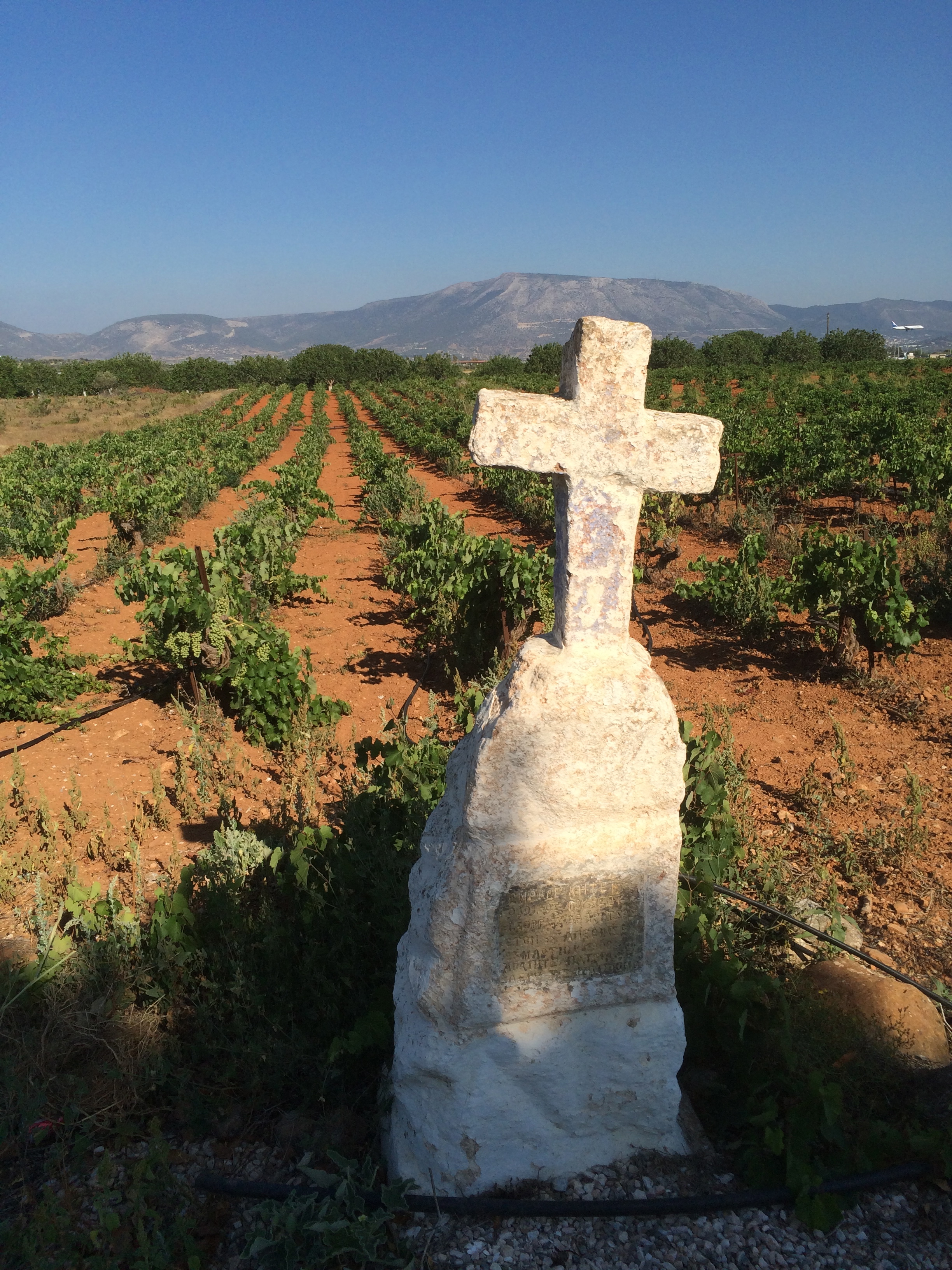 The winery has specialized in Savatiano since its founding. Actually, it was the only grape variety grown at the estate until Vassilis took the helm. He soon began playing with the newly resuscitated Malagousia variety and then red grapes. He also has several experimental plots, one of them Greco di Tufo, the first real vintage of which will be the 2016. “Italian grapes,” I exclaimed, unable to hide the surprise in my voice. With a shrug of the shoulders and a wry smile came the reply: “Well, as the name implies, it’s probably Greek.”
After a tour of the building, we gathered in the event room for a technical tasting with Vassilis and members of his family, including his children, affable, knowledgeable and articulate young adults who will eventually take the reins from their father. You’ll find my tasting notes after the jump.
For details about where we stayed, where and what we ate and what we saw, including some of Papagiannakos’s vineyards, see the Day One report on carswelliana.
INTRODUCTION
♦ PAPAGIANNAKOS (ATTICA)
TSELEPOS (ARCADIA)
MERCOURI (ELIS)
TETRAMYTHOS (ACHAEA)
THYMIOPOULOS (MACEDONIA)
ARGYROS (SANTORINI)
Greek winery tour: Introduction
In early July, a group of seven Montreal wine and food geeks, including me, travelled to Greece to visit six wineries in as many regions in seven days. The trip was arranged and paid for by the wineries concerned with assistance from the European Union and the Greek government; I offer all of them – especially the wineries – my warmest thanks.
In the weeks to come, I’ll be posting reports here on the estates visited and many wines tasted and on where we stayed, where and what we ate and what we saw on my other blog, where a first post offers a few travel tips.
♦ INTRODUCTION
PAPAGIANNAKOS (ATTICA)
TSELEPOS (ARCADIA)
MERCOURI (ELIS)
TETRAMYTHOS (ACHAEA)
THYMIOPOULOS (MACEDONIA)
ARGYROS (SANTORINI)
Sweet Greek
Attiki 2013, Melias, Domaine Papagiannakos
The third vintage of this wine. 100% Malagousia from dry-farmed vines rooted in limestone soil. The north-facing vineyard is located at an elevation of 100 metres in southeast Attica, not far from the Athens International Airport. An amount of must equivalent to 40% of the final wine is boiled down to concentrate it and the sugar it contains. Successive doses of fermenting unboiled must are then added. 13% ABV. Residual sugar is quoted as pushing 120 g/l. The elegant, svelte bottle holds 500 ml.
Golden to the eye. Beguiling nose redolent of green grape, peach/apricot and a touch of light honey. Sweet but not saccharine or cloying. The pineappley fruit tastes pure, fresh, uncooked. Bright acidity balances the sugar and lightens the unctuous texture. Long. A charmer with real presence. (Buy again? If only!)
I’m cheating a little here. It had been a long day and, as the wine tasted identical to the one tasted at the winery in early July, I decided just to sit back and enjoy it and not write a tasting note. Instead, I’m using the note I wrote in Greece, which will soon reappear on this blog as part of a series of reports on the trip. Our bottle was a gift from Vassilis Papagiannakos, and I wasn’t the only person around the table grateful to him for it.
MWG August 12th tasting: flight 8 of 8
Among the great Mediterranean reds
The technical information for these two wines is identical. The fruit comes from organically farmed, 70- to 90-year-old, dry-farmed, low-yielding, ungrafted vines grown on the Ziros plateau in eastern Crete. The must is fermented with indigenous yeasts in cement vats and matured in old French oak barrels. The wines are bottled unfiltered, unfined and with only a tiny shot of sulphur dioxide.
Since the late 1990s, the Sitia appellation has required reds to be a blend of Liatiko and Mandilaria. As the 2006 is all Liatiko, it had to take the broader Crete appellation. Economou doesn’t release wines until he thinks they are ready; that said, this isn’t the first shipment of the 2006 to arrive in Quebec.
Both wines were carafed two or three hours before serving and both benefited enormously from it.
Crete 2006, Liatiko, Domaine Economou ($56.75, private import, 6 bottles/case)
100% Liatiko. 13.5% ABV. Quebec agent: oenopole.
The room fell silent as the wines were poured and people started smelling them. Aside from oohs and ahs, the first utterance was in reference to this: “I could drown in it.” An in-pulling, umami-rich nose of plum and cherry, Mediterranean scrub and the earth it’s rooted in, sea breeze, obsidian dust, violets and more. In the mouth, the wine is medium-bodied and possessed of a fluid texture. Ripe but not jammy fruit, smooth but very present acidity and fine but sturdy tannins are all in perfect equilibrium. Dark minerals run like an underground river. Flavours and aromas echoing the nose unfurl from the mid-palate though the long finish. Still vibrant and vigorous at ten years of age. A beauty. (Buy again? Yes.)
Sitia 1999, Domaine Economou ($78.00, private import, 6 bottles/case)
A blend of 80% Liatiko and 20% Mandilaria. 13.5% ABV. Quebec agent: oenopole.
More subdued and, if anything, more involving. Evolved, profound nose: mushroom and truffle, leather, dark fruit, cocoa, hints of violets and dried orange peel. Dense and velvety yet medium-bodied. The fruit is a mixture of fresh and dried plums and cherries, the acidity is fluent and sustained, the tannins are resolved but still structuring. Strata of minerals, earth, tar and old wood provide ballast and depth. The finish goes on and on, like the afterglow of a perfect summer day. A magnificent, transporting wine that I suspect is near or at peak, though most definitely not on its last legs. (Buy again? If the opportunity ever presents itself again, yes.)
I repeat what I wrote two years ago: these are among the great Mediterranean reds. While neither wine could come from anywhere but Crete, Economou’s training at top estates in Bordeaux and Barolo is apparent in both.
MWG August 12th tasting: flight 7 of 8
A rocky landscape shimmering in a summer haze
Crete 2014, Rosé de Liatiko, Domaine Economou ($32.50, private import, 6 bottles/case)
100% Liatiko from organically farmed, ungrafted old vines. After a short maceration on the skins, the grapes are pressed and the must is fermented with indigenous yeasts. Maturation is in old barrels. Unfiltered and unfined. Minimal added sulphur and then only at bottling. 13% ABV. Quebec agent: oenopole.
Wafting, complex nose: pumice, dried herbs, distant red fruit and a touch of animale. In the mouth, it’s both mysterious and present, like a rocky landscape shimmering in a summer haze. Dried strawberry and stony, sun-baked earth are carried on a stream of acidity. The gauzy layers include garrigue, salt and dried flowers. Dry and long. A rosé with the colour and weight of a Poulsard but aromas and flavours that transport you to a Mediterranean mountainside. A profoundly beautiful wine. (Buy again? Yes.)
MWG August 12th tasting: flight 4 of 8
White gold
The centrepieces of the August 12th tasting were five newly arrived wines from one of the stars in the Greek wine firmament, Domaine Economou. We began with the whites. Reliable technical information for Economou wines is hard to come by. As far as I can ascertain, both wines are made in a similar way: fermented with indigenous yeasts in stainless steel tanks, matured in assorted containers (possibly including old casks, stainless steel tanks, fibreglass vats and underground cement tanks) and bottled unfiltered and unfined with a tiny shot of sulphur dioxide.
Sitia 2013, Vilana/Thrapsathiri, Domaine Economou ($51.25, private import, 6 bottles/case)
A blend, typically 70-30, of Vilana and Thrapsathiri from organically farmed, ungrafted, estate-grown vines. 13.5% ABV. Quebec agent: oenopole.
Fascinating, nuanced nose: honey, almond, sea salt, distant apple, pear and maybe even pumpkin, a not unappealing hint of rancid butter. Dry, rich and savoury with a slightly oily texture. Fresher than the 2009 due, I think, to sustained acidity and discreeter oxidative notes, which give the white fruit a yellow facet, as if it were poached with apricot and dried orange peel. The smooth, underlying minerality has me thinking of river stones. Long, layered and profound though not as deep as its flightmate. Unique and involving. (Buy again? Yes.)
Crete 2013, Assyrtiko, Domaine Economou ($51.25, private import, 6 bottles/case)
100% Assyrtiko from organically farmed, ungrafted vines. Assyrtiko not being a permitted variety in the Sitia PDO, the wine qualifies only for the broader Crete PGI designation. 13.5% ABV. Quebec agent: oenopole.
“Round nose, like a Bâtard-Montrachet,” notes one taster. If there’s fruit, it’s poached pear intertwined with threads of pine tar, salt-rimed stone and an scent I peg as oak but the aforementioned taster characterizes as “roasted chestnuts.” In the mouth, the wine is weighty, structured, complex, deep and glowingly acidic. There’s an oxidized edge though not a distracting one, as it allows notes of lemon, honey, white nuts and anise seed to come through. Possessed of a long, uniquely savoury finish with a delectably bitter aftertaste. Different from its high-end Santorini counterparts – rounder, richer and less crystalline – but fully worthy of standing alongside them. (Buy again? Yes.)
In a discussion about the Assyrtiko, agent Theo Diamantis drew an analogy with a grand cru Riesling. He also wondered about food pairings. My ideas: fine white fish in a rich sauce, butter-poached lobster, grilled lamb chops, beef tartare (don’t knock it till you’ve tried it).
MWG August 12th tasting: flight 3 of 8
Maverick Malagousia
Achaia 2014, Malagousia, Domaine Tetramythos ($18.50, 12910335)
100% organically farmed Malagousia from vines grown at just under 1,000 m. Manually harvested. Destemmed. Macerated on the skins for 30 hours. Only the free-run juice is used. Fermented in temperature-controlled (18°C) stainless steel tanks with indigenous yeasts for 100 days. Undergoes full malolactic fermentation. Reducing sugar: 1.8 g/l. 12.5% ABV. Quebec agent: oenopole.
Aromatic but not exaggeratedly so: floral (jasmine, lily), fruity (pineapple, peach, lemon), minerals (chalk, quartz) and a hint of green herbs. Fresh and lively in the mouth. Very dry. Most present on the attack, the fruit quickly gives way to crystalline minerals. The long citric finish has a lingering bitterness and touch of heat that I don’t recall from a bottle tasted at the winery six weeks earlier. A bit more rustic than I remember, too, not that there’s anything wrong with that. Well chilled, an aperitif wine par excellence; slightly warmer, a fine accompaniment to grilled prawns with a herby pineapple salsa. (Buy again? Done!)
More subdued, acidic and minerally than is usual for this grape, a fact the winemaker attributes above all to the vineyard’s altitude.
MWG August 12th tasting: flight 1 of 8
Bargain Agioritiko
IGP Peleponese 2013, Agiorgitiko, Pathos, Tsantali ($12.00, 12698531)
As for the Pathos white, technical info is short on the ground. 100% Agiorgitiko given a short maceration on the skins and short maturation on the lees. Reducing sugar: 2.1 g/l. 12.8% ABV. Quebec agent: Amphora.
Plum and black cherry, a bit jammy, with light spice and what comes across as a hint of oak. Develops musky marzipan notes as it breathes. Medium-bodied. The ripe fruit up front is backed by darker mineral and earth flavours and a faint swirl of caramel. The acidity is fleet, the tannins slim but springy. Remarkably dry from the mid-palate on, an impression only reinforced by the light astringency that comes to the fore as the fruit fades. Lingering cherry pit and ash. Not deep or complex and certainly not enthralling but clean, sound and drinkable – no excuses need be made. Is there a better SAQ red at the price? (Buy again? Yes.)
Like the white, was $11.35 until the SAQ’s latest round of price hikes. In this case, that works out to a nearly 6% increase.
Bargain Moschofilero
IGP Peleponese 2014, Moschofilero, Pathos, Tsantali ($12.00, 12700354)
Technical information is hard to come by for this wine; the producer provides no details on its website and the agency doesn’t even list it on theirs. Are the grapes purchased or estate-grown? Organically farmed? Is the wine fermented with native yeasts? Allowed to undergo malolactic fermentation? Filtered and fined? Your guess is as good as mine. Pathos (παθος), Greek for passion, is the name of this new and apparently Quebec-only line. A drawing of Aristotle adorns the front label. 100% Moschofilero. Short maceration on the skins. Short maturation on the lees. Sees only stainless steel until bottling. Reducing sugar: 2.0 g/l. 12.8% ABV. Quebec agent: Amphora.
A bit musky and honeyed on the nose, with faint lemon and grapefruit aromas. In the mouth, it’s smooth, clean and very dry with a somewhat honeyed texture. The mild flavours tend to apple, pear, citrus and eventually peach, all infused with chalky minerals and buoyed by soft acidity. A light astringent sourness adds interest to the fair, butter-afternoted finish. Not a ton of personality (see Tselepos, among others, for that) but enjoyable enough and very drinkable. Despite the SAQ’s recent price hike (was $11.35 until a week or two ago), the QPR is high on this one. (Buy again? Yes.)

 Brett happens