Posts Tagged ‘Mid-priced’
Three Rieslings/countries/price points
Rheingau 2015, Riesling Trocken, Von Unserm, Weingut Balthasar Ress ($20.65, 12510788)
100% Riesling from vines planted in clayey limestone soil in Hattenheim and Rüdesheim. Manually harvested. Direct pressed. Fermented in temperature-controlled stainless steel tanks. Clarified by settling. Screwcapped. Reducing sugar: 4.1 g/l. 12% ABV. Quebec agent: Balthazard.
Classic Riesling nose of lemon/lime, green apple, white slate and a hint of peach yogurt. A faint spritz is detectable on the palate. Welterweight build. Dry but fruity: apple and lime set on river stones. The acidity stays underground until surfacing on the decent finish. A bit simple but fresh and likeable. (Buy again? Sure.)

Alsace 2014, Riesling, Le Kottabe, Josmeyer & Fils ($31.00, 12713032)
100% Riesling from organically and biodynamically farmed 40-year-old vines rooted in the gravelly, sandy, pebbly soil of Herrenweg. Manually harvested. The whole clusters were pneumatically pressed over five to eight hours. Spontaneous fermentation lasted from one to four months. The resulting wine was matured in a mix of stainless steel tanks and century-old oak foudres. Reducing sugar: 2.4 g/l. 11.5% ABV. Quebec agent: Symbiose.
Appealing nose of lemon pound cake, icing sugar and eventually white spice. Medium-bodied and super dry. The pure fruit (“crab apple” with hints of citrus and peach) is brightened by relatively low-Watt acidity. The long, taut, saline finish has a bitter edge. Tasty. (Buy again? Sure, though not without wishing it was $5 cheaper.)
Alto Adige Valle Iscaro 2014, Riesling, Brixner Eisacktaler, Weingut Köfererhof ($49.00, 12958013)
Founded in 1940, the five-hectare estate is located in the South Tyrol at the foot of the Dolomites, near Italy’s border with Austria. 100% Riesling from vines planted in 1998 and rooted in gravely silt and sand at 650-700 metres above sea level. The grapes are manually harvested in two passes; half when fully ripe and the other half two or three weeks later. The two harvests are vinified separately and blended before bottling. The clusters are not systematically destemmed. Fermentation takes place in temperature-controlled (20°C) stainless steel tanks and matures on the lees for six months. Sulphur is added only at bottling and then in minute quantities. 13% ABV. Quebec agent: Le Maître de Chai.
A whiff of sulphur blows off, leaving a complex nose of chalk, “papaya,” clean sweat and “lemon grape” that’s like walking through a balsam forest after a rain. Time in the glass produces floral and herbal notes. Equally interesting in the mouth: a dry, structured, dimensional wine of great precision and purity. The ripe fruit, deep minerality and lively acidity are in perfect balance from the clean attack through the long finish. Loses none of its qualities after warming to room temperature, always a good sign. Austere but delicious and absolutely world-class. Wow. (Buy again? Yes.)
MWG October 26th tasting: flight 3 of 6
Red devil
Vallée d’Aoste 2015, Enfer d’Arvier, Danilo Thomain ($37.75, private import, 6 bottles/case)
Located in a steep, south-facing ampitheatre in the Valle d’Aosta, the five-hectare Enfer d’Arvier subzone, which gained DOC status in 1971 but has since been incorporated into the valley-wide DOC, is named enfer (“hell” in French) due to the intensity of the light and summer heat and the aridity and hardness of the soil. The Thomain estate, which was founded in 1920 by Danilo’s grandfather, comprises one hectare and is the appellation’s only independent winemaker. Farming is not organic though use of chemicals is kept to a minimum. The wine-making is artisanal. Production averages around 5,000 bottles a year. This, the only wine made, is a blend of Petit Rouge (90%) with 10% Pinot Noir, Gamay and Gamaret from 35- to 40-year-old vines rooted in sandy glacial moraine. Manually harvested. Destemmed. Alcoholic fermentation with indigenous yeasts takes place in 1.5-ton fibreglass tanks and lasts around two weeks. The wine is then transferred to barrels for nine months for malolactic fermentation and maturation on the lees. Clarification is by settling; the wine is unfiltered and unfined. 13% ABV. Quebec agent: Vadim Fonta.

The first bottle seems lightly corked, which is confirmed when we open a backup. Appealing, earthy nose of sour cherry and choke cherry with hints of green and tarragon/licorice. In the mouth, it’s medium-bodied, dry and oh, so pure. The intense berry fruit tastes more wild than cultivated. Structure comes in the form of smooth but lively acidity, wiry tannins and a mineral underlay. The finish is long and a faint bitterness lingers. Tasty and very drinkable. Had this been available for purchase, we would have taken a case or two. (Buy again? Yes.)
MWG October 13th tasting: flight 7 of 9
L’Aietta trio
In 2001, Francesco Mulinari, then a 17-year-old high school student, decided to make wine from some abandoned Sangiovese vines growing on a 2.5-hectare plot of land that his parents had acquired as a picnicking spot and natural playground for their children. Located just outside the wall surrounding Montalcino, the spot, known as L’Aietta, had been the site of an army encampment during the 1555 siege of the city. When applying for a production permit, he – well, actually his mother, as he was underage – learned that the parcel lay within the Brunello di Montalcino appellation. His first vintage, the 2001 and officially a Brunello, consisted of 720 bottles.
In 2004, Mulinari replaced the old vines with bush vines, as the hard rock would have made installing posts difficult. The land is so steep – the tiny parcel is divided into 18 terraces – that all work is done by hand. In 2002, he acquired another hectare of Sangiovese vines in nearby Castelnuovo dell’Abate, eventually replacing them with bush vines too. He more recently took over a 2.5-hecatre plot in Monecucco, from whose grapes he makes a Chianti-style blend (Sangiovese, Canaiolo and Colorino) and a raisinated sweet white (Malvasia di Candia, Vermentino and Zibibbo). He works this last vineyard with a horse.
Farming is rigorously organic (certified in 2013); harvesting is manual; wine-making is non-interventionist. The winery, the smallest in Montalcino, has very little technology and only tanks and barrels. All farming and wine-making is done by Mulinari by himself. Current production is around 7,000 bottles a year.
Vino Spumante 2013, Brut, Metodo Classico, L’Aietta ($55.25, private import, 6 bottles/case)
100% Sangiovese Grosso from organically farmed vines averaging 15 years old and located in the Castelnuovo dell’Abate vineyard. The grapes are harvested based on their acidity, not their maturation, and before their colour is fully developed (green harvest fruit, in other words). Macerated and fermented (with indigenous yeasts) for 30 days in stainless steel tanks. The still wine is matured for one year in large Slavonian oak barrels. Secondary fermentation and one year’s maturation take place in the bottle. Unfiltered and unfined. 11.5% ABV. Around 700 bottles made. Quebec agent: Vadim Fonta.

Pale pink. Initially closed nose with notes of cheese, modelling clay, bread dough and eventually red berries. Light effervescence. Smooth despite the bright acidity. More savoury than fruity. The mineral underlay lasts well into the long, saline finish with its peekaboo berry notes. Elegant, tasty, unusual and rare, though is that enough to justify the champagne-rivaling price? (Buy again? If feeling flush.)
Rosso di Montalcino 2015, L’Aietta ($37.75, private import, 6 bottles/case)
100% Sangiovese Grosso from organically farmed vines averaging 15 years old and located in the Castelnuovo dell’Abate vineyard. The grapes are macerated and fermented (with indigenous yeasts) in stainless steel tanks for 30 days. Matured one year in large Slavonian oak barrels and one year in the bottle. Unfiltered and unfined. 2,600 bottles made. 14.5% ABV. Quebec agent: Vadim Fonta.
Classic nose of cherry, tobacco, herbs and graphite. Velvety smooth on the palate. The ripe fruit is illuminated by soft-glow acidity, shaded by minerals. Stealth tannins turn more assertive on the spicy finish. Will probably be even better in a year or two. Lovely though one of those wines that shows better at the dining table than at a tasting. (Buy again? Yes.)

Brunello di Montalcino 2012, L’Aietta ($71.25, private import, 6 bottles/case)
100% Sangiovese Grosso from organically farmed vines averaging 15 years old and located in the L’Aietta vineyard. The grapes are macerated and fermented (with indigenous yeasts) in stainless steel tanks for 21 days. Matured two years in large Slavonian oak barrels and one year in the bottle. Unfiltered and unfined. 2,200 bottles made. 14% ABV. Quebec agent: Vadim Fonta.
Complex, evolving nose of red and black berries, smoke, graphite, tobacco, leather, oak, spice and maybe mint. Fuller, rounder, deeper and longer than the Rosso. Satin-textured. The beautifully pure ripe fruit is structured by round, firm tannins and fluent acidity. Dark minerals, nose-echoing tertiary flavours and Asian spice overtones add complexity and interest. Very long. A noble wine that’s delicious now but still a youngster. Probably a stunner in five to 10 years. (Buy again? Yes.)
MWG October 13th tasting: flight 6 of 9
Northern exposure
Terre Siciliane 2015, Versante Nord, Eduardo Torres Acosta ($35.00, 13387380)
Nerello Mascalese with 20% other varieties, including Nerello Capuccio and possibly Alicante Bouschet and Grenache from vines in two co-planted parcels (Pietramarina and Crasa, totalling 1.5 ha) at 550 to 750 metres in elevation on the north-facing side of Mount Etna, hence the bottling’s name. The vines average 45 to 50 years old, with the oldest being about 80. The manually harvested grapes were transported to Arianna Occhipinti’s winery in Vittoria. Some clusters were destemmed, others left whole. Fermented with indigenous yeasts and macerated on the skins for 15 days in a cement tank with no temperature control. Matured 16 months in 750-litre Slavonian oak botti. Minimally sulphured. The 2015 is the second vintage of the wine. Total production: 6,000 bottles. 13.5% ABV per the label, 12% ABV per the SAQ. Quebec agent: oenopole.
The expected cherry and plum plus cedar, blood and stone. No more than medium-bodied. Structured by silky acidity and gossamer tannins, the fruit seems shot through with minerals. The sustained finish brings a light astringency and a dusty aftertaste. So pure and savoury, so effortlessly complex. A pleasure to drink. (Buy again? Yes.)

Terre Siciliane 2015, Pirrera, Eduardo Torres Acosta ($59.00, 13387371)
The blend is similar to the Versante Nord but with 90% Nerello Mascalese. All grapes come from the high-altitude (850 metres) Pirrera vineyard on the north slope of Mount Etna, which had been abandoned until Acosta began rehabilitating it. The vines average 50 years old and the soil is sandy with volcanic ash and stones. The wine-making was identical to that for the Versante Nord. The 2015 is the second vintage of the wine. Total production: 1,100 bottles. 13.5% ABV per the label, 12% ABV per the SAQ. Quebec agent: oenopole.
Inexhaustible nose of spice, cedar, old wood, forest floor, background dried cherry, floral and balsamic notes and more. Richer than the Versante but still medium-bodied and silky. There’s a pure core of fruit, racy but integrated acidity, an airframe tannic structure, minerals galore, a feathery astringency and a very long, subtly inflected cherry marzipan finish. More serious than its flightmate yet still so fresh. A flawless, complex, engaging, delicious wine. (Buy again? Yes.)
Soon after the wines’ release, a MWG member who was wondering which if any to buy asked a well-regarded SAQ wine advisor for input. The advisor said he was enamoured with the Versante Nord but felt the Pirrera wasn’t worth the extra outlay. The member bought some of the Versante and gave the Pirrera a pass. At the tasting a few days later, our experience was more the opposite: both wines were delightful but the Pirrera was the standout. The member made a beeline to the SAQ and scored a couple of bottles.
MWG September 28th tasting: flight 7 of 7
Ontario’s red grape?
Niagara Peninsula 2015, Cabernet Franc, Sans Soufre, Norman Hardie ($35.00 at the winery)
100% Cabernet Franc from organically farmed vines. Manually harvested. Fully destemmed. Fermented with indigenous yeasts in one-ton fermenters. Pressed in a basket press. Matured 10 months in 225-litre French oak barrels. Unfiltered and unfined. No added sulphur. 12.5% ABV.
Entertaining nose: a mix of dark fruit (cherry, blackberry) and umami (meat, mushroom) that prompts peanut gallery descriptors like “floral,” “spices,”“earthy,” “kelp” and “creosote.” Medium-bodied and fluid. Seems sweet on entry but turns appetizingly dry. Full of crunchy ripe fruit framed by soft tannins and enlivened by a stream of acidity. The complex of flavours includes minerals and herbal notes but absolutely no greenness. Finishes long and clean. So fresh, so drinkable. Enjoyable now and over the next two or three years if not longer. (Buy again? Yes.)

Canada 2015, Cabernet Franc, The Old Third ($55.00 at the winery, around $34 on preorder)
100% Cabernet Franc from the estate’s organically farmed Closson Road terrace vineyard in Prince Edward County. Fermented in stainless steel tanks with indigenous yeasts, then racked into French oak barrels, where it matured for about a year and a half. Unfiltered, unfined and minimally sulphured. Bottled in July 2017. 12.5% ABV.
Raspberry and black currants along with “black tea,” “pencil shavings,” “nut cake” and “prune.” Richer, rounder and denser than its flightmate, velour to Hardie’s satin. The ripe fruit is structured by smooth tannins and smooth acidity. Balanced, layered, long and full of potential: a complete wine. If there’s an issue now, it’s that the wine is a bit monolithic and the oak a little too obvious – nothing four or five years in the cellar won’t take care of. Late spring frost made 2015 a difficult vintage for many Prince Edward County producers though not for The Old Third and that’s totally apparent here. (Buy again? Yes, especially at the preorder price.)
World-class wines like these make a convincing argument that Cabernet Franc is Ontario’s red grape.
MWG September 28th tasting: flight 6 of 7
Vibrant, tasty, companionable
Adelaide Hills 2016, Skin n’ Bones Pinot Noir, BK Wines ($38.00, importation valise)
100% Pinot Noir from organically farmed vines grown in the cool-climate Lenswood subregion of the Adelaide Hills of South Australia. Manually harvested. After sorting, 70% of the clusters were left whole and 30% destemmed. All the fruit was then placed in French oak barrels (10% new, 90% neutral), leaving a generous amount of head space to be filled by the carbon dioxide gas resulting from fermentation. The barrels were sealed and the wine was allowed to spontaneously ferment and macerate for 100 days, after which the barrels were broken apart and the wine pressed. Bottled unfiltered and unfined. 12.8% ABV. Represented in western Canada by Calgary-based Crush Imports.
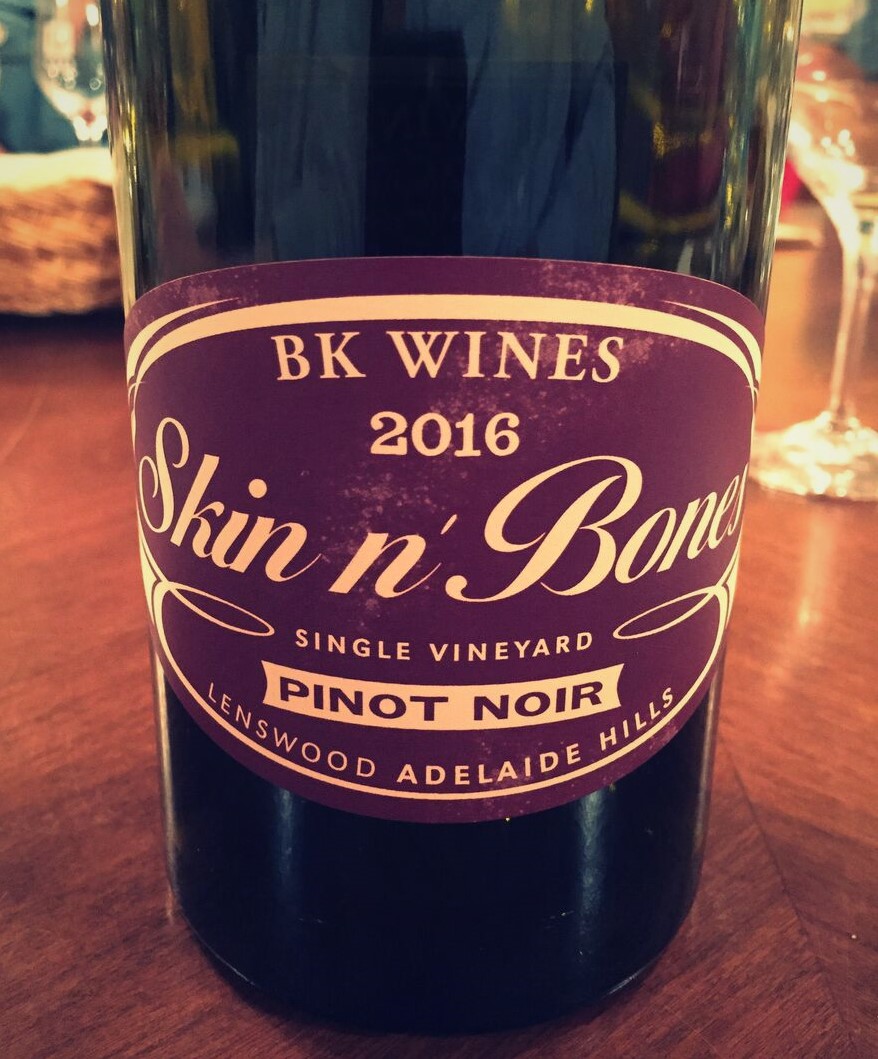
Fragrant, engaging nose: raspberry and cherry along with sandalwood, cedar, “tomato sauce” and graphite. Light- to medium-bodied. Juicy but not a bomb. Actually, there’s lots of detail, great precision and real energy. The sweet silky fruit is framed by fresh acidity and light though very present tannins. Chewing reveals unsuspected depth and structure. The spice-overtoned finish is clean and well sustained. A vibrant, tasty, companionable Pinot Noir that, while accessible now, has the potential to develop over the next few years. (Buy again? Yep.)
Based on this and the same estate’s Savagnin, some enterprising agency needs to be bringing these wines into Quebec.
MWG September 28th tasting: flight 5 of 7
Antipodal Savagnins
Côtes du Jura 2015, Savagnin, Les Sarres, Domaine Rijckaert ($29.95, 12951356)
The estate avoids herbicides and insecticides and limits its use of synthetic chemicals to treatments against mildew and odium. All the estate’s wines are made in barrels. 100% Savagnin from the Les Sarres vineyard located in Buvilly. Fermented with indigenous yeasts. Underwent full malolactic fermentation. Matured two years on the lees in neutral French oak barrels with no stirring. Kept topped up, so not oxidized. Reducing sugar: 1.9 g/l. 13% ABV. Quebec agent: La QV.
Slightly hazy pale electrum to the eye. Minerally nose of lemon and grapefruit with hints of potpourri and almond. In the mouth, it’s clean and tonic. The fruit (lemon, yellow plum) is sweet-seeming on the attack, though the wine is actually very dry. There’s a real mineral depth, including a shot of salinity. The bright acidity combines with a faint bitterness on the long finish to provide a bit of grip. Less electric than some Savagnins but still a fine example of what the grape can do. (Buy again? Sure.)

Adelaide Hills 2016, Skin n’ Bones White, BK Wines ($35.00, importation valise)
The South Australian estate was founded in 2007 by Brendon and Kristy Keys. This monovarietal is made using Savagnin from organically farmed 10-year-old vines rooted in limestone and sandstone over deep clay in Lobethal in the cool-climate Lenswood subregion. The grapes were manually harvested and fully destemmed but not crushed. Spent one month on the skins with twice-daily pump-overs, then was pressed and racked into neutral French oak barrels with regular stirring for nine months. Alcoholic and full malolactic fermentation were spontaneous. Total production: 200 cases. 11.8% ABV. Represented in western Canada by Calgary-based Crush Imports.
One-of-a-kind nose of “smoked fish,” “sushi” and “barbecued corn” (quoting other tasters) as well as dried apricot and, with time, green fruit (kiwi, melon) and herbal notes. Dry, fluid and layered. Nicely structured with pervasive but smooth acidity, a current of white minerals and ghostly tannins that last well into the long finish. Grape skins and apricot pit linger. As unusual and engaging as it is savoury and delicious. (Buy again? Gladly.)
MWG September 28th tasting: flight 3 of 7
Native whites
Gaillac 2016, Les Pierres Blanches, Domaine De Brin ($24.85, 13314666)
A blend of Mauzac (60%) and Len de l’El (40%) from organically farmed vines rooted in stony calcareous-clay soil. Manually harvested. The grapes are direct-pressed and the must is chilled and clarified by settling. Vinification – including sponatneous alcoholic and complete malolactic fermentation – and maturation take place in neutral barrels and last nine to 12 months. Unfiltered and unfined. No added anything except possibly a tiny amount of sulphur at bottling. Reducing sugar: < 1.2 g/l. 12.5% ABV. Quebec agent: Ward & associés.
The first sniff brings a hint of reduction and volatile acidity followed by an odd mix of apple, flowers and sauerkraut. In the mouth, it’s clean, fresh and sleekly acidic, dry but full of applely fruit and quartzy minerals with a bitter undertow. Fair depth and good length. Not bad but not the revelation I was expecting. A taster who had enjoyed an earlier bottle didn’t peg our bottle, which was served double-blind, as the same wine. Nor did the wine match the description of the trustworthy SAQ advisor who recommended it. In other words, probably an off bottle. (Buy again? Yes, especially to give it another chance.)

Terre Siciliane 2016, Versante Nord, Uve Bianche, Eduardo Torres Acosta ($35.00, private import, 6 bottles/case)
Born in the Canary Islands, Acosta headed to southeast Sicily in 2012 to intern with Arianna Occhipinti. He later did a stint as a winemaker at Passopisciaro, eventually renting and farming a few parcels and making wine under his own name. His first commercial vintage was 2014. The grapes are grown in the Etna appellation but the wines are made at Occhipiniti’s facilities in Vittoria. That and the fact that at least some of the vineyards are higher than the allowed 800 metres of altitude are why the wines qualify only for the broad Terre Siciliane IGT designation and not the Etna DOC. This blend of Minella (60%) and other local varieties is made using grapes grown in six plots on the north face of Mount Etna. The organically farmed vines average 45 to 50 years old and are rooted in soils with a high volcanic ash content. The grapes are manually harvested, crushed and macerated on the skins for five days in concrete tanks with no temperature control. Fermented with indigenous yeasts. Matured eight months in neutral oak botti. The 2016 is the first vintage of the wine. Total production: 2,000 bottles. 12% ABV. Quebec agent: oenopole.
Complex nose, initially of “garlic sausage,” summer savoury and poblano chile, then more lemon and quartz. Dense and apricoty in the mouth, with citrusy acid and a mineral structure beyond the obvious current of salinity. The very long brings a lingering pithy bitterness. A multifaceted, engaging wine if not exactly a charmer. Probably better viewed as an accompaniment to dinner than an aperitif. Nearly the entire shipment was snatched up by Montréal Plaza restaurant, where it’s currently on the list for $76 and would make a smart match for many of their super-savoury dishes. (Buy again? Yes.)
MWG September 28th tasting: flight 2 of 7
Bulles de Germain
Saumur, Brut, Bulles de Roche, Thierry Germain/Michel Chevré ($33.25, 13059706)
Best known for his Domaine des Roches Neuves bottlings, Thierry Germain also produces wines with his long-time associate and vineyard manager Michel Chevré, who has acquired his own vineyards. The wines are made in the Roches Neuves cellars. This traditional method sparkler is a blend of Chenin Blanc (90%), Cabernet Franc (5%) and Chardonnay (5%) from 60-year-old biodynamically farmed vines rooted in limestone and clay. The still wine is fermented with indigenous yeasts and then matured three months in 228-litre used oak barrels. The bottled wine spends nine months on lattes prior to disgorgement. No dosage. 12.5% ABV. Quebec agent: Balthazard.

Pale gold with tiny bubbles and quickly disappearing foam. Expressive nose of quartz, candied apple, raisin brioche and honey. Medium-bodied, intense and very dry, with a fine, caressing, evanescing effervescence. Shot through with minerals (“lots of salinity”) and vibrant acidity, the ripe fruit (apple and pear mainly) lasts well into the long, bitterish finish. Intense. Some tasters detected a vague “stemmy” or “something vegetal” note but, if there was one, it was very low key. There’s been considerable variation in the four bottles of this I’ve tasted, some coming across as mineral-driven, others as more about the fruit. In all iterations, however, it’s been a wine with real presence and a lot of class. (Buy again? Yep.)
MWG September 28th tasting: flight 1 of 7
Three sure bets
Côtes du Rhône Villages – Valréas 2010, Clos Bellane ($26.25, private import, 12 bottles/case)
A 50-50 blend of Grenache and Syrah from biodynamically and organically farmed vines more than a quarter century old and rooted in clay and limestone. At 410 metres elevation, the vineyard is the highest and one of the coolest in the southern Rhône. Manually harvested. Partially destemmed. Fermented with indigenous yeasts and “Burgundy-style” punch-downs in temperature-controlled stainless steel tanks. Pneumatically pressed. Matured in stainless steel tanks (70%) and used barrels (30%). To minimize handling by machines, the winery is gravity-fed. 14.5% ABV. Quebec agent: Vinealis.
Our bottle was opened 24 hours before we got around to it. Wafting nose of plum, raspberry, spice, oyster bed, red gummy bears and garrigue. In the mouth, it’s full-bodied but restrained. What’s more, the alcohol is not at all noticeable. Flavourwise, it’s remarkably clean, pure and well balanced, with rich fruit, freshening acidity, mostly resolved though still bitey tannins and as much breadth as depth. Black pepper and herbes de Provence overtone the long finish. The estate’s elegant rosé is among the best values at the SAQ, so it’s not surprising the CDRV (the 2015 version of which is also available at the monopoly) is similarly tasty and affordable. (Buy again? Sure.)


Corbières 2014, Prioundo, Les Clos Perdus ($34.60, 6 bottles/case)
A blend of Grenache (80%) and Cinsault (20%) from biodynamically and organically farmed, 32-year-old vines rooted in limestone and clay. Twenty percent of the grapes are left in whole clusters, the rest destemmed but uncrushed. Given three days’ maceration before fermentation in stainless steel tanks with indigenous yeasts. Basket pressed after 21 days on the skins. Matured on the fine lees in stainless steel tanks for nine months. Unfined and lightly filtered. Sulphur use is minimal. 14.5% ABV. Quebec agent: Vinealis.
Lovely, subtle, savoury nose: blackberries and red fruit, minerals, spice and a bit o’ barnyard. Pure, open and sweet on the attack yet dry and savoury. Finely structured with supple tannins and smooth acidity. Full-bodied, round, fresh – what the French call digeste, which is kind of surprising for a 14.5% wine. (Buy again? Sure.)
Vacqueyras 2014, Fruit Sauvage, Clos de Caveau ($65.00/1500 ml, private import, 3 bottles/case)
A 60-40 blend of Grenache and Syrah from 10- to 45-year-old organically farmed vines at the foot of the Dentelles de Montmirail. Manually harvested. Fermented with indigenous yeasts. Matured 12 months, half in tronconic tanks, half in concrete tanks 14.5% ABV. Quebec agent: Vinealis.
Elegant nose of plum and red berries, black tea and background minerals and garrigue. As for the palate, the word smooth appears three times in my notes, though suave might be the better descriptor. Full-bodied and lush yet fresh and energetic. Satiny texture. The ripe, juicy fruit is structured by round tannins and sleek acidity. Minerals rumble softly underneath. Finishes long and clean and with not a hint of heat. Unexpectedly easy-going, especially for a Vacqueyras. (Buy again? Sure.)
WMG September 14th tasting: flight 7 of 9

 Brett happens