Posts Tagged ‘Mid-priced’
Ward & associés tasting (7/9)
Badischer Landwein 2013, Tschuppen, Weingut Ziereisen ($65.78/1500 ml, private import, 6 bottles/case)
100% Blauer Spätburgunder (aka Pinot Noir) from estate-owned, organically farmed 15- to 25-year-old vines rooted in limestone soil. Manually harvested. Spontaneous fermentation and maceration lasted six to eight weeks and were followed by gentle pressing. The must was transferred to used 225-litre German wood barrels (30% new) for 22 months’ maturation on the lees with occasional racking. Unfiltered and unfined. The first screwcapped magnum I’ve encountered. 12.5% ABV. Quebec agent: Ward & associés.
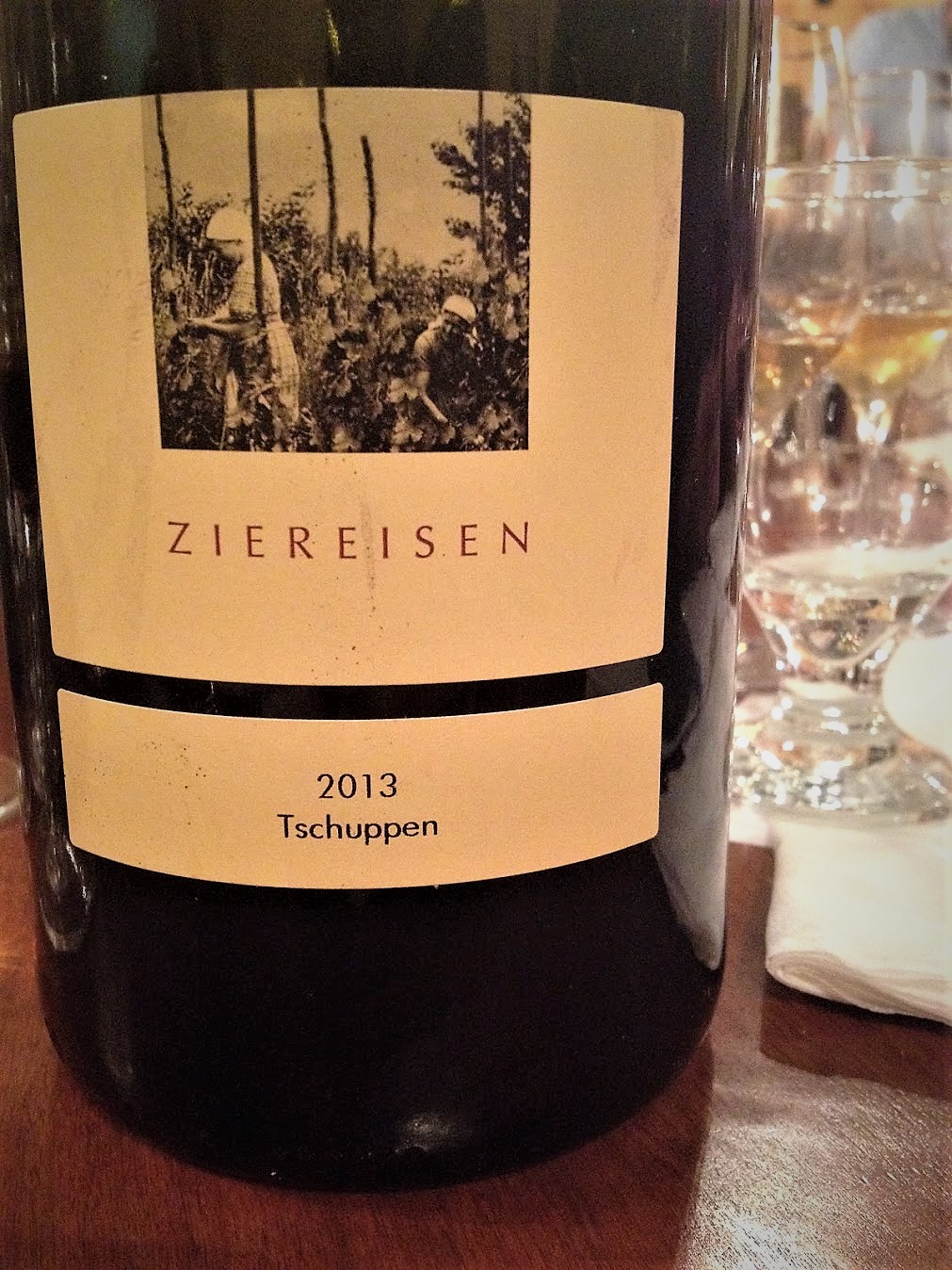
Complex nose: cherry, “purple Popsicle,” “Swiss chard and arugula,” slate, dried rose, a dash of kirsch, distant lime and even celery salt. A dry, medium-bodied red with a silky surface, sleek acidity, fruit-cloaked tannins, underlying minerals and a long, lightly astringent finish. Neither Burgundian nor New Worldish but, in its weight, structure and blend of red berry and earth flavours, definitely Pinot Noir. Impressive QPR. Another hit of the tasting – the group ordered two cases on the spot. (Buy again? Yes.)
MWG February 2, 2017, tasting: flight 7 of 9
Ward & associés tasting (5/9)
Burgunland 2015, Gemischter Satz, Alexander Koppitsch ($40.98, private import, 6 bottles/case)
The estate is located in Neusiedl am See, a village and district on the north shore of Lake Neusidel, southeast of Vienna. As implied by the Gemischter Satz moniker (though I don’t believe the wine qualifies for the Weiner Gemischter Satz appellation), this is a field blend of co-planted white varieties, including Grüner Veltliner, Brauner Veltliner, Pinot Blanc, Zimttraube, Ochsenauge, Isabellatraube, Neuburger, Traminer, Muskat and Sauvignon Blanc. Planted in 1934, the vines are estate-owned and biodynamically farmed. Vinified as an orange wine, spending 14 days on the skins. Fermented with indigenous yeasts. Matured in old barriques. Unfiltered and unfined, with no added sulphur. 12.5% ABV. Quebec agent: Ward & associés.
Slightly hazy bronzy rose-gold in the glass. Savoury, spicy and not particularly fruity nose with notes of preserved lemon and browning apple as well as a whiff of volatile acidity. In the mouth, it’s medium weight, fluently acidic, faintly tannic and somewhat inscrutable, like “mineral water” or “weak tea” along with lemon, a suggestion of stone fruit and minerals. Actually quite complex, if subtly so, and long. Smoothed out and unfurled nicely after three hours. Will be interesting to see what gives in three or four years. (Buy again? A bottle gladly.)


Burgunland 2015, Rot No. 7, Alexander Koppitsch ($23.19, private import, 6 bottles/case)
55% Zweigelt, 20% Blaufränkisch, 20% St. Laurent and 5% Syrah from estate-owned, biodyanmically farmed vines. Fermented with indigenous yeasts and matured in large oak barrels and stainless steel tanks. Lightly filtered. Unfined. A tiny amount of sulphur dioxide is added at bottling. Screwcapped. 12% ABV. Quebec agent: Ward & associés.
Outgoing nose of “clove,” “nutmeg,” candied raspberry, “frankincense incense” and a bit of poop. Medium-bodied and satin-textured. The bright supple fruit has a certain sweetness, though the wine is definitely dry, and an umami quality prompt descriptors like “soy sauce.” Sinewy tannins and a dusting of minerals only add to the interest. The finish is long but more felt than tasted. Nothing profound but eminently drinkable and something of a bargain. (Buy again? Yes.)
MWG February 2, 2017, tasting: flight 5 of 9
Ward & associés tasting (4/9)
Moravie 2014, Klasika, Hibernal, Milan Nestarec ($31.33, private import, 12 bottles/case)
100% Hibernal from estate-owned, organically farmed, 14-year-old vines grown in southern Moravia in the Czech Republic. Fermented and matured for 13 months in 600-litre barrels, one-third of which were new. No clarification or filtration. 11.5% ABV. Quebec agent: Ward & associés.

Rich gold-bronze in the glass. Refulgent nose that, notes of “sesame oil” and “dried orange peel” notwithstanding, you could be forgiven for thinking belonged to a sweet Tokaji. Dry and unctuous on the palate, the lively acidity softened by the dense extract. Flavours are a beguiling mix of “canned peaches,” “apricot jam” yellow apple and dusty minerals. Great breadth, good length and not a lot of depth, making this a here-now wine. Unique and memorable, especially for the bouquet. (Buy again? Yes.)
MWG February 2, 2017, tasting: flight 4 of 9
Ward & associés tasting (1/9)
In early February, David Ward paid the Mo’ Wine Group a visit to present some of his eponymous agency’s new arrivals. “Drinkability first” is the agency’s credo and all the wines poured emphatically met that criterion. The tasting also featured winemakers, grapes and even regions that most of us had little if any experience with. No surprise then that a large order followed. Note that while some of the wines are still available, others are in very short supply.
We began with one of the less unconventional wines in the lineup.
Bourgogne Aligoté 2015, Sarnin-Berrux ($32.89, private import, 12 bottles/case)
With the exception of one cuvée, all Sarnin-Berrux wines are made from purchased grapes. The firm works closely with the growers, insisting on organic methods and often picking the grapes themselves. The wine-making is non-interventionist and based on the lunar calendar. The grapes for this 100% Aligoté are manually harvested. After slow pneumatic pressing, the must is clarified by settling. Fermentation with indigenous yeasts lasts four to six months. Unfiltered and unfined. No additives other than a tiny shot of sulphur. 11.5% ABV. Quebec agent: Ward & associés.

Somewhat muted nose: faint lemon/citronella, quartz and “pear flower.” Quite dry and buttery textured with lively but not trenchant acidity. Russet apples and honey up front, minerals (flint and chalk) on the finish. A white pepper note – as much a sensation as a flavour – lingers. Subtly complex and very civilized. If only it were a few dollars less. Then again, Ente’s 2014 Bourgonge Aligoté currently lists for $33 at the SAQ while De Villaine’s 2014 Bouzeron Aligoté runs a buck shy of $40, so maybe it’s not so pricey after all. (Buy again? Hmm…)
MWG February 2, 2017, tasting: flight 1 of 9
Santorini siblings
Santorini 2015, Assyrtiko, Argyros ($25.25, 11639344)
100% Assytriko from 60- to 70-year-old ungrafted vines trained into low-lying nests and rooted in the island’s rocky, sandy pumice soil. Fermented and matured in stainless steel tanks. 13.5% ABV. Quebec agent: oenopole. Also available at the LCBO ($22.95, 387365).
Somewhat reticent nose that, with coaxing, reveals stones, lemon, brine and, according to one taster, “olive.” Very dry. True to the Assyrtiko grape, which is to say as much about minerals as fruit. The acidity would be trenchant were it not blunted by the slightly viscous texture. Finishes long on an appealing briny/sulphurous note. Bracing, savoury and ready to roll, though the winemaker says it can age for up to eight years. (Buy again? Yes and yes again.)
Santorini 2015, Assyrtiko, French Oak Fermented, Argyros ($32.00, 12338800)
100% Assyrtiko from ungrafted vines more than 150 years old and located in Episkopi. Spent six months in second- and third-fill 500-litre French oak barrels. Reducing sugar: 3.8 g/l. 13.5% ABV. Quebec agent: oenopole.
Softer nose that smells a little sweeter than its sibling’s, with the oak relegated to the background. On the palate, too, the oak is discreet, evident more as gras than, say, vanilla, caramel or toast. It, along with the richer extract, explain the rounder texture; even so, the wine is tighter and more closed than its flightmate. The brilliant acidity, complex minerals and fruity heft are in ideal balance. The finish is long and saline. Already complete, this will only improve with age. If any wine can convince me that oak isn’t beside the point with Assyrtiko, this is it. (Buy again? Yes.)
Technical info is minimal because the estate’s website is offline, probably so it can be overhauled in conjunction with the launch of the estate’s impressive new winery and visitors centre, which opened just in time for the 2016 harvest.
MWG January 12, 2017, tasting: flight 3 of 7
Gamay/Poulsard, Gewürz, Gamay
Cerdon, Méthode Ancestrale, Demi-sec, Gérald Dubreuil ($30.00, private import, 6 bottles/case)
An ancestral method sparkler made from Gamay and Poulsard. The estate uses no pesticides, favours green cover over herbicides and turns to fungicides only on an as-needed basis. Immediately after harvest, the grapes are pressed and the must is fermented in tanks with indigenous yeasts. When the alcohol level reaches about 6%, the wine is chilled to near freezing, then filtered and bottled. Fermentation resumes as the wine warms, with the by-product carbon dioxide creating the sparkle. Residual sugar: 55 g/l. 8% ABV. Quebec agent: Mon Caviste.
Exuberantly fruity nose of “strawberry and strawberry greens” with a bit of black pepper. In the mouth, it’s smooth and softly effervescent, full of tart fruit, dusty minerals and bright acidity but no tannins to speak of. Not exactly dry but far from sweet. Long. A fun summer sipper that can also work as an aperitif, accompany lightly sweetened fruit-based desserts and pair beautifully with mild- to medium-hot Punjabi dishes. Would love to try the “sec,” which has 20% less residual sugar. (Buy again? Irrespective of price, yes, though maybe not when I can get single bottles of the excellent Renardat-Fâche for $6 less.)
Alsace 2012, Gewürztraminer, Tradition, Domaine Pfister ($39.00, private import, 6 bottles/case)
100% Gewürztraminer from two parcels in the Silberberg lieu-dit. 12.5% ABV. Quebec agent: Mon Caviste.
Classic nose and palate, marked by rose, litchi, candied orange peel and white spice. Technically a demi-sec but quite light on its feet and not too sweet. Stone fruit and minerals add complexity to the palate, with soft-glow acidity deftly balancing the residual sugar. The clean, faintly honeyed finish has Gewürztraminer’s telltale bitter edge. Impressive for its purity, balance and pleasurability though the price of admission seems a tad high. (Buy again? Sure.)
Coteaux Bourguignons 2014, Philippe Gavignet ($31.00, private import, 6 bottles/case)
The Coteaux Bourguignons AOC replaced the Bourgogne Grand Ordinaire AOC in 2011. The estate is based in Côtes-de-Nuits. 100% Gamay from 40-year-old vines; farming is close to organic. The juice is macerated on the skins for four or five days. Fermentation in tanks is followed by 12 months’ maturation. 12% ABV. Quebec agent: Mon Caviste.
Served last in the tasting after all the champagnes and a semi-sweet Gewürztraminer, which didn’t make sense until we took a sip and found it woke up the palate like a slap to the face. Red and black berries, minerals and a whiff of sap. Medium-bodied yet fleshy/chewy. Clean and bright fruit with darker mineral shadings. Lively acidity, light but firm tannins (had I not been told otherwise, I would have guessed there was some Pinot Noir in the blend). So focused and energetic. One of the most vibrant Gamays I’ve tasted in ages. (Buy again? Absolutely.)
MWG November 10, 2016, tasting: flight 9 of 9
A Pinot Blanc-Auxerrois blend
Alsace 2013, Pinot Blanc, Domaine Pfister ($31.00, private import, 6 bottles/case)
Actually a blend of Pinot Blanc and Auxerrois, probably in near equal proportion, from several small plots of 25-year-old vines on marly Osthoffen hillsides. The estate’s viticultural practices lean organic. The grapes are manually harvested. The juice from the crushed fruit is gravity-fed into stainless steel tanks for fermentation with indigenous yeasts, which can last from three to eight weeks depending on the vintage. Temperature control is limited to avoiding heat spikes. Small doses of sulphur are applied at pressing, post fermentation and at bottling. 12.5% ABV. Quebec agent: Mon Caviste.
Dried white peach, Meyer lemon zest, white flowers. Mouth-filling, even chewy, yet also graceful. Pure-fruited yet also dry and savoury, with mineral underpinnings and crisp but rounded acidity. There’s more depth than one usually associates with this grape and good length too. Delightful if a bit pricey (a while back the wine went for around $23 at the LCBO). The estate appears to be one worth keeping an eye on. (Buy again? Yes.)
MWG November 10, 2016, tasting: flight 6 of 9
Sparkling PN rosés from Alsace and Champagne
Crémant d’Alsace, Brut, Rosé, Domaine Pfister ($39.00, private import, 6 bottles/case)
100% Pinot Noir. No technical information is to be found about this traditional method sparkler, which is absent from the producer’s website and little mentioned on the Web. 12.5% ABV. Quebec agent: Mon Caviste.
Pale coppery pink with a very fine bead. Leesy nose of red berries, faint orange peel and “a hint of sweet prosciutto” (per another taster). In the mouth, it’s very dry and glowingly acidic. The subtle fruit allows the mineral underlay to come clearly through. The bitter-edged finish is nicely sustained. Serious without being severe and standing up to comparison with its more prestigious flightmate. Probably excellent with food. (Buy again? Yes.)
Champagne, Brut, Rosé, Prestige, Pierson-Cuvelier ($53.00, private import, 6 bottles/case)
100% Pinot Noir. The colour for this traditional method sparkler comes from maceration on the skins; no other technical information is to be found. 12% ABV. Quebec agent: Mon Caviste.
Two shades darker than the Pfister with bigger bubbles and lots of foam. Outgoing nose of brioche and raspberry. Rounder, fruitier (red berries, pomegranate) and less dry than the crémant with zingy acidity and a pronounced mineral component. Enjoyable enough but a little overshadowed by the other sparkling rosés in the tasting. (Buy again? Maybe.)
MWG November 10, 2016, tasting: flight 2 of 9
Red and white (OK, maroon and gold) Heredias
Rioja 2004, Reserva, Viña Tondonia, R. Lopez de Heredia ($49.25, 116679010)
Estate-grown Tempranillo (75%), Garnacha (15%) and Graciano (5%) and Mazuelo (aka Carignan, 5%). Manually harvested. Fermented with indigenous yeasts. Matured in estate-made American oak barrels for six years, with twice yearly racking. Fined with egg whites. Bottled unfiltered. 13% ABV. Quebec agent: Rézin.
Straightforward but beautiful nose of plum, cut wood, spice, papier d’Arménie, raspberry cordial, blackberry tea, hay and a touch of vanilla. Medium-bodied, savoury and ready to go. The combination of velvety fruit, dark minerals, wood, smooth acidity and supple if lightly raspy tannins is engaging though more structure, complexity and depth wouldn’t be unwelcome, especially at the price point. The slow-fade finish brings balsam and leather to mind. Maybe it’s passing through a phase but this seems less special, more earthbound than in earlier vintages. (Buy again? Hmm.)
Rioja 2006, Crianza, Viña Gravonia, R. Lopez de Heredia ($30.50, 11667927)
100% Viura (aka Macabeo) from old vines. Manually harvested, gently destemmed and immediately crushed. The must is transferred into 60-hectolitre oak vats, where it ferments spontaneously. Matured in 225-litre American oak barrels for four years, with racking twice a year. Unfiltered but fined with egg whites before bottling. Reducing sugar: 2.4 g/l. 13% ABV. Quebec agent: Rézin.
The layered, faintly oxidized but still fresh nose generated a wide range of descriptors from the assembled tasters: honey, oak, “a coniferous thing,” “raw almond,” “green almond,” vanilla, “basement concrete,” “vegetal but not, like a tree,” “elm,” ground cherry, “almost Muscat,” white spice and more. Hefty but not heavy in the mouth. The fruit – mainly preserved lemon and stone fruit – is wrapped in a gauze of oak, enlivened by soft acidity and tethered to a chalky saline substrate. Toffee and nougat notes overtone the long finish. Perhaps a shade less complex than earlier vintages but still unique and delicious. The price is astounding for a 10-year-old wine of this quality. (Buy again? Absolutely.)
MWG October 27, 2016, tasting: flight 7 of 7
Very Volpaia
Chianti Classico 2013, Volpaia ($26.65, 10858262)
Sangiovese (90%) and Merlot (10%) from organically farmed vines. Manually harvested. Destemmed and lightly crushed. Alcoholic fermentation with indigenous yeasts and twice-daily punch-downs in temperature controlled (80-86F) tanks lasted 14 days. The wine was then left to macerate on the skins for seven more days. After malolactic fermentation, the wine was transferred to Slavonian oak botti for 14 months’ maturation. Lightly filtered. Reducing sugar: 1.6 g/l. 13% ABV. Quebec agent: Rézin.
Textbook Chianti nose of cherry, dried leaves, tobacco and terracotta. Medium-bodied and silky textured. Lean fruit, bright acidity, Burgundian tannins, a mineral substrate and a drying, bitter-edged finish give it an appealing austerity. Balanced and approachable. (Buy again? Sure.)
Chianti Classico 2013, Riserva, Castello di Volpaia ($36.75, 00730416)
100% Sangiovese from organically farmed vines grown in five vineyards. The grapes from each parcel are vinified separately and the best barrels are blended to make this bottling. Manually harvested. Destemmed and lightly crushed. Alcoholic fermentation with indigenous yeasts and twice-daily punch-downs in temperature controlled (80-86F) tanks lasted 14 days. The wine was then left to macerate on the skins for seven more days. After malolactic fermentation, the wine was matured for two years, 80% in used Slavonian oak botti and French oak casks and 20% in new French oak cask, then blended and lightly filtered. Reducing sugar: 2.0 g/l. 13.5% ABV. Quebec agent: Rézin.
Closed at first but eventually gorgeous: cherry, leather, sandalwood, “terracotta tiles” (per another taster). Lusher than the Volpaia though still medium-bodied. Ripe but not heavy fruit, animating acidity, wonderful minerals and real depth. Quite tannic yet balanced. The oak is discreet (more so than in some earlier vintages, if memory serves), not that I’m complaining. Very long mineral-, leather- and tobacco-scented finish. Pure and structured, rich yet austere in that way that few non-Chianti reds can be. Even better in five to 10 years. (Buy again? Oh, yes.)
MWG October 27, 2016, tasting: flight 6 of 7

 Brett happens