Posts Tagged ‘Mo’ Wine Group’
Thirst-quencher
The November agency tasting was led by our good friend, oenopole’s Theo Diamantis. We wet our whistles with a new addition to the agency’s portfolio, its first commissioned product, a made-to-spec beer that had been available only through the private import channel since its launch last spring but can now be purchased at the brewery’s boutique and is about to make the jump to the SAQ.
Bière de soif, Grisette de Dunham, Brasserie Dunham ($10.15, 13593360)
A Belgian-inspired blond ale, specifically a “grisette saison brewed with Barbe Rouge and Cashmere hops and fermented with our saison blend.” Refermented in the bottle. Crown cap. 5.2% ABV. Quebec agent: oenopole.

Hazy yellow-gold with fine bubbles and a compact, long-lasting, lacy white head. The nose is marked by fruity esters with clear citrus, spice, floral and yeast notes. In the mouth, it’s on the lighter side of medium-bodied, dry, smooth and fruity (citrus, stone fruit, faint banana). Mild malt, light hops, crisp but not aggressive acidity and ticklish carbonation mean it’s super refreshing. A fine bitterness colours the clean finish. Very easy drinking, as befits a bière de soif. (Buy again? Def.)
MWG November 10th tasting: flight 1 of 5
Lumpps in our throats
Givry Premier Cru 2015, A Vigne Rouge, Domaine François Lumpp ($58.75, 13366829)
100% Pinot Noir from a 2.45-hectare vineyard planted in the early 2000s. The soil is mainly limestone and clay. The farming is generally organic though synthetic products are sometimes used if warranted by the weather conditions. Manually harvested. Destemmed. Given five to 10 days’ cold maceration prior to fermentation, which takes place in stainless steel tanks with light punch-downs and lasts around three weeks. Matured in French oak barrels, around 70% of which are new. Racked and filtered before bottling. All wine-making operations are done according to the lunar calendar. 12% ABV. Quebec agent: Réserve & Sélection.
Fairly closed nosed of cherry, slate, spicy oak and dried leaves; it’s very true to type though it doesn’t yet pinote (sing like only Pinot can do). Medium-bodied and satin-textured. The pure fruit seems more cranberry- than cherry-like, partly a function of the tart acidity. The fine tannins show not a trace of greenness. An earthy depth provides ballast that lasts well into the bitter cherry-inflected finish. The combination of richness, structure, energy and precision seems more like a Côte de Beaune’s. It’s a bit austere for now but probably won’t be in a couple of years. (Buy again? Yes.)

Givry Premier Cru 2015, Crausot, Domaine François Lumpp ($59.50, 13061857)
100% Pinot Noir from a 0.92-hectare vineyard planted in the early 1990s. The soil tends to limestone interspersed with fine marl. The wine-making is more or less as for the A Vigne Rouge. 13% ABV. Quebec agent: Réserve & Sélection.
Even more closed and stemmy: oak, coconut and Christmas spice have the upper hand for now. In the mouth, it’s bigger, denser and even more primary. The beautifully pure fruit (mainly cherry) is overtoned with tea and brightened by acidity. The tannins are impressive but tight and unyielding from start through the long finish. “Dries your mouth right up,” notes one taster. Needs five or 10 years to knit together and open up. The $60 question: will the fruit still be vibrant when the tannins finally resolve? Probably but only time will tell. (Buy again? If in a gambling mood.)
MWG October 26th tasting: flight 6 of 6
Peerless
Dolcetto d’Alba 2015, Cantina Bartolo Mascarello ($34.00, private import, 6 bottles/case)
100% Dolcetto from organically farmed vines. Fermented with indigenous yeasts in non-temperature-controlled concrete tanks with no pump-overs but with the skins and seeds kept submerged in the must. Matured one year in neutral, Slavonian oak botte. Lightly filtered before bottling. 14% ABV. The lovely label features a painting done by Bartolo when he was in his 70s. Quebec agent: oenopole.
Closed nose that, with coaxing, gives up mullbery, coffee, turned earth, “vanilla Coke,”Asian spice and “florals.” So dense, tannic, tight and primal in the mouth and yet so beautiful. The ripe fruit, which includes “black olive,” is carried on an underground river of acidity over a deep mineral substrate. The finish is endless. Balanced, profound, even mysterious, and full of potential: clearly a great wine. Give this monolith five years or longer to open up, then prepare to be wowed. (Buy again? Whenever the opportunity presents itself.)

Dolcetto d’Alba 2015, Giuseppe Rinaldi ($33.50, private import, 6 bottles/case)
100% Dolcetto from organically farmed vines. Fermented with indigenous yeasts in large wood vats. Matured in neutral Slavonian oak botte. 13.5% ABV. Quebec agent: oenopole.
Constantly evolving nose of, among other things, bitter cherry, sweet spice, leafmould, slate, incense and cascara. Medium- to full-bodied. Packed with fruit (mainly black cherry) and minerals. Structured by bright, smooth acidity and firm yet pliable tannins that another taster describes as “silty.” The long, silky finish is overtoned with earth and spice. A complete wine. Accessible, especially compared with the Mascarello, though capable of ageing a decade or even longer. (Buy again? Definitely.)
MWG October 26th tasting: flight 5 of 6
Nativi di Lazio
Based in Cori, founded in 1947 and named after Lucius Quinctius Cincinnatus, Cincinnato is a well-run cooperative that makes a wide range of red, white, sparkling and dessert wines from local varieties as well as grappa and olive oil. The 255 members farm 550 hectares, 100 of which are worked organically.
Lazio 2014, Cesanese, Arcatura, Cincinnato ($21.70, 13096689)
100% Cesanese from vines rooted in volcanic-clay soil. The manually harvested grapes are destemmed and soft-pressed. Fermentation on the skins in temperature-controlled (24°C) tanks lasted around 11 days. Underwent malolactic fermentation. Half was matured in French oak barrels (first, second and third fill) for eight months and half in stainless steel tanks for nine months. Filtered before bottling. Aged in the bottle for six months before release. Reducing sugar: 4.8 g/l. 13.5% ABV. Quebec agent: Valmonti.
The first bottle is corked. The backup has an intriguing nose of “buckwheat honey,” cocoa, sweet spices, background plum, “copper, like pennies” and, eventually, leafmould. In the mouth, it’s fluid, medium-bodied and super smooth. The ripe fruit, soft acidity and round tannins. Decent finish. A little overshadowed by its flightmate, though that could be due to its being popped and poured. (Buy again? Sure.)

Lazio 2013, Nero Buono, Ercole, Cincinnato ($23.25, 12557754)
100% Nero Buono, a teinturier (red-fleshed) grape, from 15- to 20-year-old vines rooted in volcanic-clay soil. The manually harvested grapes were destemmed and soft-pressed. Fermentation on the skins in temperature-controlled (23°C) stainless steel tanks lasted around 15 days. Underwent malolactic fermentation. Matured in French oak barrels (first, second and third fill) on the lees for 12 months and in the bottle for eight months. Filtered before bottling. Reducing sugar: 4.8 g/l. 13.5% ABV. Quebec agent: Valmonti.
Not carafed but allowed to breath for a couple of hours before serving. Dark – verging on black – in the glass. Extroverted nose of dark berries, “dried banana,” “old leather,” tobacco, “baking spices” and a hint of orange chocolate. Richer than the Cesanese. The intense core of fruit is overtoned with spice. Smooth acidity and velvety tannins are pretty sotto voce yet present enough to provide buoyancy and tone. The oak is obvious but not obnoxious. Orange chocolate returns on the credible finish. A bit New Worldish and far from deep, complex or subtle but authentic and likeable all the same. (Buy again? Yes.)
MWG October 26th tasting: flight 4 of 6
Three Rieslings/countries/price points
Rheingau 2015, Riesling Trocken, Von Unserm, Weingut Balthasar Ress ($20.65, 12510788)
100% Riesling from vines planted in clayey limestone soil in Hattenheim and Rüdesheim. Manually harvested. Direct pressed. Fermented in temperature-controlled stainless steel tanks. Clarified by settling. Screwcapped. Reducing sugar: 4.1 g/l. 12% ABV. Quebec agent: Balthazard.
Classic Riesling nose of lemon/lime, green apple, white slate and a hint of peach yogurt. A faint spritz is detectable on the palate. Welterweight build. Dry but fruity: apple and lime set on river stones. The acidity stays underground until surfacing on the decent finish. A bit simple but fresh and likeable. (Buy again? Sure.)

Alsace 2014, Riesling, Le Kottabe, Josmeyer & Fils ($31.00, 12713032)
100% Riesling from organically and biodynamically farmed 40-year-old vines rooted in the gravelly, sandy, pebbly soil of Herrenweg. Manually harvested. The whole clusters were pneumatically pressed over five to eight hours. Spontaneous fermentation lasted from one to four months. The resulting wine was matured in a mix of stainless steel tanks and century-old oak foudres. Reducing sugar: 2.4 g/l. 11.5% ABV. Quebec agent: Symbiose.
Appealing nose of lemon pound cake, icing sugar and eventually white spice. Medium-bodied and super dry. The pure fruit (“crab apple” with hints of citrus and peach) is brightened by relatively low-Watt acidity. The long, taut, saline finish has a bitter edge. Tasty. (Buy again? Sure, though not without wishing it was $5 cheaper.)
Alto Adige Valle Iscaro 2014, Riesling, Brixner Eisacktaler, Weingut Köfererhof ($49.00, 12958013)
Founded in 1940, the five-hectare estate is located in the South Tyrol at the foot of the Dolomites, near Italy’s border with Austria. 100% Riesling from vines planted in 1998 and rooted in gravely silt and sand at 650-700 metres above sea level. The grapes are manually harvested in two passes; half when fully ripe and the other half two or three weeks later. The two harvests are vinified separately and blended before bottling. The clusters are not systematically destemmed. Fermentation takes place in temperature-controlled (20°C) stainless steel tanks and matures on the lees for six months. Sulphur is added only at bottling and then in minute quantities. 13% ABV. Quebec agent: Le Maître de Chai.
A whiff of sulphur blows off, leaving a complex nose of chalk, “papaya,” clean sweat and “lemon grape” that’s like walking through a balsam forest after a rain. Time in the glass produces floral and herbal notes. Equally interesting in the mouth: a dry, structured, dimensional wine of great precision and purity. The ripe fruit, deep minerality and lively acidity are in perfect balance from the clean attack through the long finish. Loses none of its qualities after warming to room temperature, always a good sign. Austere but delicious and absolutely world-class. Wow. (Buy again? Yes.)
MWG October 26th tasting: flight 3 of 6
Atlantic Brancos
Vinho Regional Lisboa 2015, Fossil, Vale da Capucha ($21.30, 13286992)
The estate is located about 50 km north of Lisbon and about 8 km east of the Atlantic coast in an area with a relatively cool and wet climate. Fernão Pires (aka Maria Gomez, 45%), Arinto (45%) and Gouveio (10%) from organically farmed vines rooted in marine fossil-rich clay and limestone. (A red Fossil is also made from Touriga Nacional, Tinta Roriz and Syrah.) Manually harvested. The whole clusters are quickly chilled to 4°C and direct pressed. Fermented in temperature-controlled (15-18°C) stainless steel tanks with indigenous yeasts. Matured eight months in stainless steel tanks, including a portion on the fine lees. Unfiltered and unfined. No added sulphur. Reducing sugar: 1.4 g/l. 13.5% ABV. Quebec agent: Boires.
Reduced, sulphurous nose on opening that evolves into an odd mix of “kimchi,” chalk, white spice and “brown banana.” Medium-bodied, waxy textured and very dry. The stone fruit and citrus come with quite a load of minerals and an “asafoetida” note. While there’s enough acidity to keep things fresh and lively, it’s hard to shake the impression that the wine’s a bit simple and short on follow-through – at least for now: maybe this naturalish, just-off-the-boat bottle is suffering from travel shock? (Buy again? A bottle to lay down for a few months.)

Beira Atlântico 2015, Vinhas Velhas, Luis Pato ($19.50, 13212598)
Bical (34%) grown in chalky-clay soil and Cercial (aka Cerceal Branco, 33%) and Sercialinho (a rare cross of Sercial or maybe Vital with Alvahrinho, 33%) grown in sandy soil. (Pato also makes a red Vinhas Velhas from Baga.) Fermented and matured in stainless steel tanks. Reducing sugar: 2.5 g/l. 12.5% ABV. Quebec agent: Pot de Vin.
Attractive nose of “spruce,” “rosemary,” “green apple” and “pineapple water,” becoming fruity and “floral” as it breathes and warms. Clean in the mouth. Built around a core of sweet-tart fruit with a savoury undercurrent. The acidity is smooth but there’s not a lot of it. Fair length. For now an easy drinker, though it might gain structure and depth with a year or two in the bottle. (Buy again? Sure.)
MWG October 26th tasting: flight 2 of 6
Clean, crisp and elegant
Champagne, Brut, 7 Crus, Agrapart & Fils ($69.75, 12632275)
For background on the Avise-based estate, see here. A blend of Chardonnay (90%) and Pinot Noir (10%) from two vintages (40% 2012 and 60% 2013 per the Agrapart website). The grapes came from vineyards in seven villages. After alcoholic fermentation, the still wine underwent malolactic fermentation. Half of the 2012 wine was matured in oak barrels. Bottled unfiltered and unfined in May 2014. Matured in bottle on the lees for three years. Riddled manually. Disgorged on an as-needed basis 60 days before being released to market. Dosage was limited to 7 g/l of sugar and 50 g/l of sulphur dioxide. 12% ABV. Quebec agent: Bella Vita.
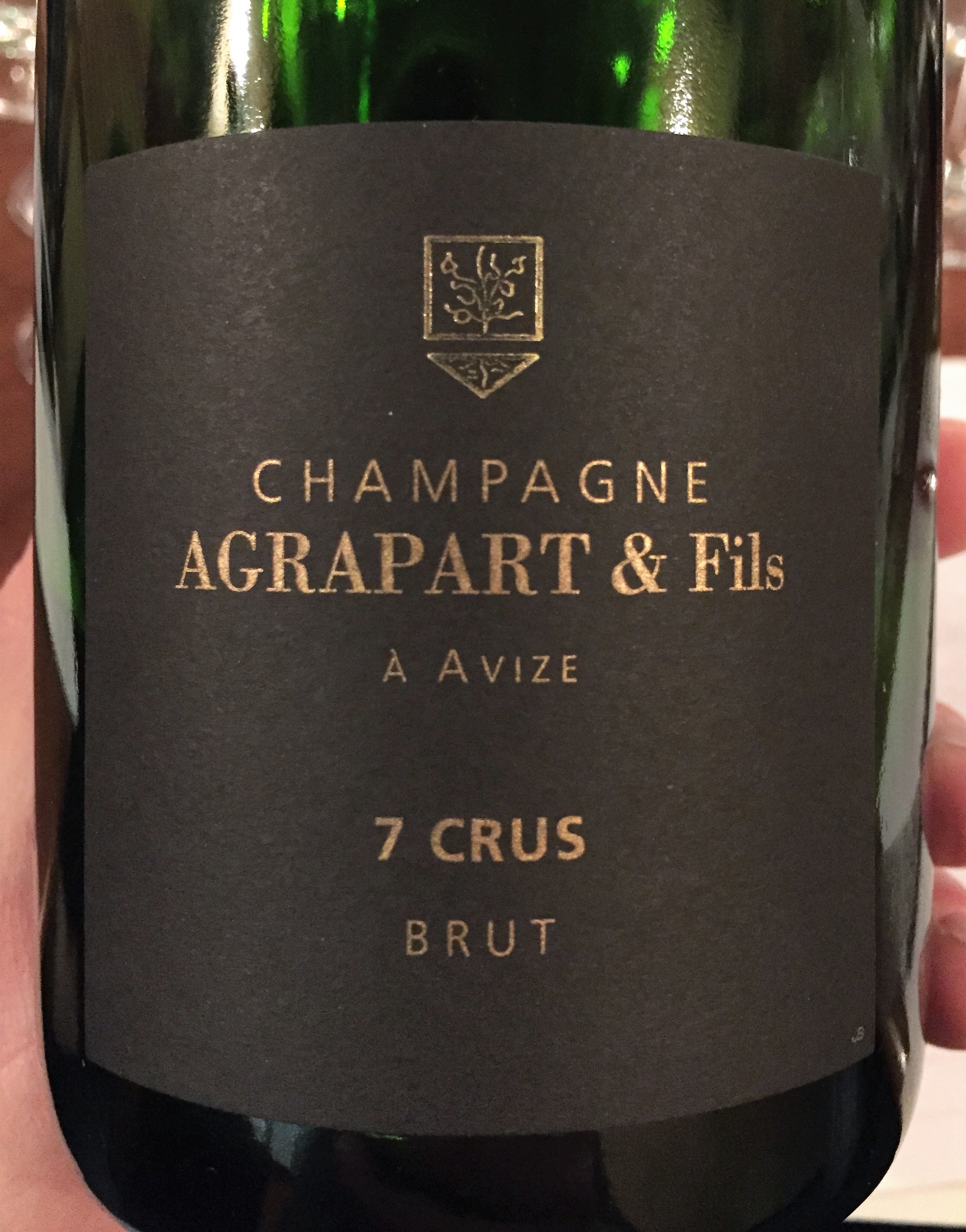
Not much foam but lots of tiny bubbles. Lovely nose of pear, apple and minerals with background yeast, vanilla, honey, toast, white flowers and a lactic note. In the mouth, it’s as minerally as it is fruity, the minerals tending to chalk, the fruit to lemon and green apple. Fundamentally a lightweight yet the underlying wineyness gives it a depth not often found in champagnes at this price point. The fine, tickling effervescence adds texture and lift, while the long finish brings “des beaux amères” (a beautiful bitterness, quoting another taster). Remarkably clean, crisp and elegant, this is a superb aperitif champagne. (Buy again? Yes.)
MWG October 26th tasting: flight 1 of 6
Step up, Riesling!
While the Melsheimer winery, which is located in the village of Reil, has been owned by the family of the same name for 200 years, their vineyards have been cultivated for far longer than that. Documentation for one goes back to the 12th century. The current wine-maker Thorsten Melsheimer began the switch to organic and biodynamic farming in 1995. The estate makes a broad range of Rieslings and little else. Annual production is around 60,000 bottles, about 40% of which is exported, with Denmark being a primary market.
Mosel 2015, Reiler Mullay-Hofberg, Kellerchen, Melsheimer ($48.25, private import, 6 bottles/case)
100% Riesling from biodynamically farmed vines averaging 30 years of age and rooted in the slate and quartz of the Mullay-Hofberg vineyard. Manually harvested. Macerated on the skins for 30 days. Fermented with indigenous yeasts. Matured one year in neutral 500-litre Slavonian oak barrels and one year in bottle. Unfiltered and unfined. 12.5% ABV. Quebec agent: Vadim Fonta.
Wafting nose of white flowers, yellow apple, quartz/chalk and background lemon/lime. Fine, clean and engaging in the mouth. The bright – not sharp – acidity gives the ripe fruit a sweet-and-sour quality. Dusty minerals add another layer of flavour and texture. Finishes long and dry. A lovely wine that was slightly overshadowed by its flightmate though that may no longer be the case in five years, when both wines should reach the plateau of maturity. (Buy again? Yes.)

Mosel 2015, Vade Retro, Melsheimer ($48.25, private import, 6 bottles/case)
The estate’s flagship wine. Its name derives from a medieval Catholic phrase used in exorcisms, Vade retro satana (“Step back, Satan”), perhaps a wry nod to the wine’s lack of fire and brimstone, er, added sulphur. 100% Riesling from biodynamically farmed vines in some of the Mosel’s steepest vineyards. Manually harvested. Spontaneously fermented on the skins in large oak barrels and no pumping. No filtering or added sulphur. 11% ABV. Quebec agent: Vadim Fonta.
Smoky, minerally, fruity nose with hints of nuts and lees. Rich yet fleet in the mouth. It’s dry (reportedly about 1 g/l of residual sugar) and full of minerals though it’s the fruit (mostly stone, some apple, a little citrus) that holds your attention. The acidity is pervasive but very well integrated. Layered, deep, long and pure. A baby but a beautiful one. Entirely consistent with a bottle – one of the stars in a stellar evening of wine and food – enjoyed a few weeks earlier at Candide. (Buy again? Yes.)
MWG October 13th tasting: flight 9 of 9
Istragram
Primorska 2013, Refošk, Rojac ($24.75, private import, 6 bottles/case)
Located on Slovenia‘s Istrian peninsula and just inland from the Adriatic coast, the Rojac estate has been making wine since the 17th century. The young Uroš Rojac took the reins in 2005, when his father unexpectedly passed away. 100% Refošk (aka Refosco d’Istria) from 13-year-old organically farmed vines rooted in sandy soil. Manually harvested. Fermented (with indigenous yeasts) and macerated in open vats for 10 to 15 days. Matured 18 months in oak and six months in stainless steel. Unfiltered and unfined. Vegan compatible. Around 20,000 bottles were produced. 13.5% ABV. Quebec agent: Vadim Fonta.

Fresh nose of blackberry, slate and distant spice. Medium-bodied. The very forward, juicy, sweet-tart red and black fruit is brightened by incandescent acidity, darkened by minerals. Pliable tannins add texture as much as structure. There’s not a lot of depth but good length. A few around the table were unenthusiastic but several of us found it had an earthy appeal. Would gladly make this straightforward and tasting wine a weeknight regular. (Buy again? Yes.)
MWG October 13th tasting: flight 8 of 9
Red devil
Vallée d’Aoste 2015, Enfer d’Arvier, Danilo Thomain ($37.75, private import, 6 bottles/case)
Located in a steep, south-facing ampitheatre in the Valle d’Aosta, the five-hectare Enfer d’Arvier subzone, which gained DOC status in 1971 but has since been incorporated into the valley-wide DOC, is named enfer (“hell” in French) due to the intensity of the light and summer heat and the aridity and hardness of the soil. The Thomain estate, which was founded in 1920 by Danilo’s grandfather, comprises one hectare and is the appellation’s only independent winemaker. Farming is not organic though use of chemicals is kept to a minimum. The wine-making is artisanal. Production averages around 5,000 bottles a year. This, the only wine made, is a blend of Petit Rouge (90%) with 10% Pinot Noir, Gamay and Gamaret from 35- to 40-year-old vines rooted in sandy glacial moraine. Manually harvested. Destemmed. Alcoholic fermentation with indigenous yeasts takes place in 1.5-ton fibreglass tanks and lasts around two weeks. The wine is then transferred to barrels for nine months for malolactic fermentation and maturation on the lees. Clarification is by settling; the wine is unfiltered and unfined. 13% ABV. Quebec agent: Vadim Fonta.

The first bottle seems lightly corked, which is confirmed when we open a backup. Appealing, earthy nose of sour cherry and choke cherry with hints of green and tarragon/licorice. In the mouth, it’s medium-bodied, dry and oh, so pure. The intense berry fruit tastes more wild than cultivated. Structure comes in the form of smooth but lively acidity, wiry tannins and a mineral underlay. The finish is long and a faint bitterness lingers. Tasty and very drinkable. Had this been available for purchase, we would have taken a case or two. (Buy again? Yes.)
MWG October 13th tasting: flight 7 of 9

 Brett happens