Posts Tagged ‘Mo’ Wine Group’
L’Aietta trio
In 2001, Francesco Mulinari, then a 17-year-old high school student, decided to make wine from some abandoned Sangiovese vines growing on a 2.5-hectare plot of land that his parents had acquired as a picnicking spot and natural playground for their children. Located just outside the wall surrounding Montalcino, the spot, known as L’Aietta, had been the site of an army encampment during the 1555 siege of the city. When applying for a production permit, he – well, actually his mother, as he was underage – learned that the parcel lay within the Brunello di Montalcino appellation. His first vintage, the 2001 and officially a Brunello, consisted of 720 bottles.
In 2004, Mulinari replaced the old vines with bush vines, as the hard rock would have made installing posts difficult. The land is so steep – the tiny parcel is divided into 18 terraces – that all work is done by hand. In 2002, he acquired another hectare of Sangiovese vines in nearby Castelnuovo dell’Abate, eventually replacing them with bush vines too. He more recently took over a 2.5-hecatre plot in Monecucco, from whose grapes he makes a Chianti-style blend (Sangiovese, Canaiolo and Colorino) and a raisinated sweet white (Malvasia di Candia, Vermentino and Zibibbo). He works this last vineyard with a horse.
Farming is rigorously organic (certified in 2013); harvesting is manual; wine-making is non-interventionist. The winery, the smallest in Montalcino, has very little technology and only tanks and barrels. All farming and wine-making is done by Mulinari by himself. Current production is around 7,000 bottles a year.
Vino Spumante 2013, Brut, Metodo Classico, L’Aietta ($55.25, private import, 6 bottles/case)
100% Sangiovese Grosso from organically farmed vines averaging 15 years old and located in the Castelnuovo dell’Abate vineyard. The grapes are harvested based on their acidity, not their maturation, and before their colour is fully developed (green harvest fruit, in other words). Macerated and fermented (with indigenous yeasts) for 30 days in stainless steel tanks. The still wine is matured for one year in large Slavonian oak barrels. Secondary fermentation and one year’s maturation take place in the bottle. Unfiltered and unfined. 11.5% ABV. Around 700 bottles made. Quebec agent: Vadim Fonta.

Pale pink. Initially closed nose with notes of cheese, modelling clay, bread dough and eventually red berries. Light effervescence. Smooth despite the bright acidity. More savoury than fruity. The mineral underlay lasts well into the long, saline finish with its peekaboo berry notes. Elegant, tasty, unusual and rare, though is that enough to justify the champagne-rivaling price? (Buy again? If feeling flush.)
Rosso di Montalcino 2015, L’Aietta ($37.75, private import, 6 bottles/case)
100% Sangiovese Grosso from organically farmed vines averaging 15 years old and located in the Castelnuovo dell’Abate vineyard. The grapes are macerated and fermented (with indigenous yeasts) in stainless steel tanks for 30 days. Matured one year in large Slavonian oak barrels and one year in the bottle. Unfiltered and unfined. 2,600 bottles made. 14.5% ABV. Quebec agent: Vadim Fonta.
Classic nose of cherry, tobacco, herbs and graphite. Velvety smooth on the palate. The ripe fruit is illuminated by soft-glow acidity, shaded by minerals. Stealth tannins turn more assertive on the spicy finish. Will probably be even better in a year or two. Lovely though one of those wines that shows better at the dining table than at a tasting. (Buy again? Yes.)

Brunello di Montalcino 2012, L’Aietta ($71.25, private import, 6 bottles/case)
100% Sangiovese Grosso from organically farmed vines averaging 15 years old and located in the L’Aietta vineyard. The grapes are macerated and fermented (with indigenous yeasts) in stainless steel tanks for 21 days. Matured two years in large Slavonian oak barrels and one year in the bottle. Unfiltered and unfined. 2,200 bottles made. 14% ABV. Quebec agent: Vadim Fonta.
Complex, evolving nose of red and black berries, smoke, graphite, tobacco, leather, oak, spice and maybe mint. Fuller, rounder, deeper and longer than the Rosso. Satin-textured. The beautifully pure ripe fruit is structured by round, firm tannins and fluent acidity. Dark minerals, nose-echoing tertiary flavours and Asian spice overtones add complexity and interest. Very long. A noble wine that’s delicious now but still a youngster. Probably a stunner in five to 10 years. (Buy again? Yes.)
MWG October 13th tasting: flight 6 of 9
Collio rodeo II
Collio 2010, Jakot, Franco Terpin ($45.75, private import, 6 bottles/case)
Franco Terpin created his eponymous estate in San Floriano del Collio in 1994. Today he farms 12 hectares on both sides of the Italian-Slovenian border. The estate makes three lines of wines; this is from the mid-range Terpin line. 100% Friulano (formerly called Tokaj, which, spelled backwards, is the cuvée’s name) from organically farmed 60-year-old vines rooted in ponka (poor, stony, friable marl and sandstone). Manually harvested. Destemmed. Macerated and spontaneously fermented 10 days in stainless steel. Matured two months in French oak barriques, 18 months in large oak barrels and one year in the bottle. Unfiltered and unfined. 13% ABV. Quebec agent: Vadim Fonta.
Hazy orange, just a tad paler than the Organic Anarchy. Savoury nose of yellow fruit, “eggplant,” old wood and faint honey. Dense but not heavy in the mouth and very dry. Dried stone fruit and orange are layered with spice and cookie flavours. Fluent acidity keeps things lively while ghostly tannins add texture. Blond tobacco joins the persistent fruit on the long, saline finish. Such an appetizing wine! (Buy again? Yes, especially to pair with fish and cheese.)


Collio 2011, Ribolla Gialla, La Castellada ($53.00, private import, 6 bottles/case)
Founded in the mid-1950s, the estate is located in Oslavia in the Gorizia hills close to the Slovenian border. 100% Ribolla Gialla. The organically farmed vines average 35 years old. Spontaneous fermentation with 60 days’ maceration. Spent one year in stainless steel, two years in Slavonian oak barrels. Unfiltered and unfined. 12.5% ABV. Quebec agent: Vadim Fonta.
Coppery orange with salmon glints: definitely an orange wine. Subdued nose with faint honey overtones and, eventually, stone fruit and minerals. Smooth and elegant on the palate. Subtle layers of flavour (dried apricot, minerals, faint vanilla). Sleek acidity banishes any notion of heaviness. A cheese note surfaces on the long finish. Tasty and satisfying. (Buy again? Yes.)
MWG October 13th tasting: flight 5 of 9
Orange anarchy
Based in Šentjur, in eastern Slovenia, about 20 km northwest of Zagreb, Aci Urbajs became interested in wine-making in 1969 when, as a boy, he worked in a vineyard his parents had acquired. In 1987, he received, as a present for graduating from university, a small vineyard on the Rifnik hill, where unearthed Roman artifacts pointed to a long wine-making tradition on the site. A disciple of organic farming from early on, he was soon attracted to biodynamics and joined the Slovenian Demeter association in 1999. In the cellar, his approach is resolutely minimalist: spontaneous fermentation, no racking, no filtering, no fining. Two lines of wines are made: one with a small amount of added sulphur (20 to 30 g/l vs. the allowed 250 g/l), the other a “natural” line with no added sulphur. Chardonnay, Kerner, Pinot Gris, Welschriesling, Blaufränkisch and Pinot Noir are grown. Production is tiny, only a few thousand bottles a year.
Posavje 2012, Organic Anarchy, Aci Urbajs ($59.25, private import, 6 bottles/case)
A blend of Chardonnay, Kerner and Laški Rizling (“Italian Riesling” aka Welschriesling) from vines planted in 1988 and rooted in marble-rich soil. Two weeks’ maceration on the skins. Fermented in open barrels using indigenous yeasts. Matured one year (in used barrels, I’d guess). Unfiltered and unfined. No added sulphur. Vegan-friendly. 12.5% ABV. Quebec agent: Vadim Fonta.
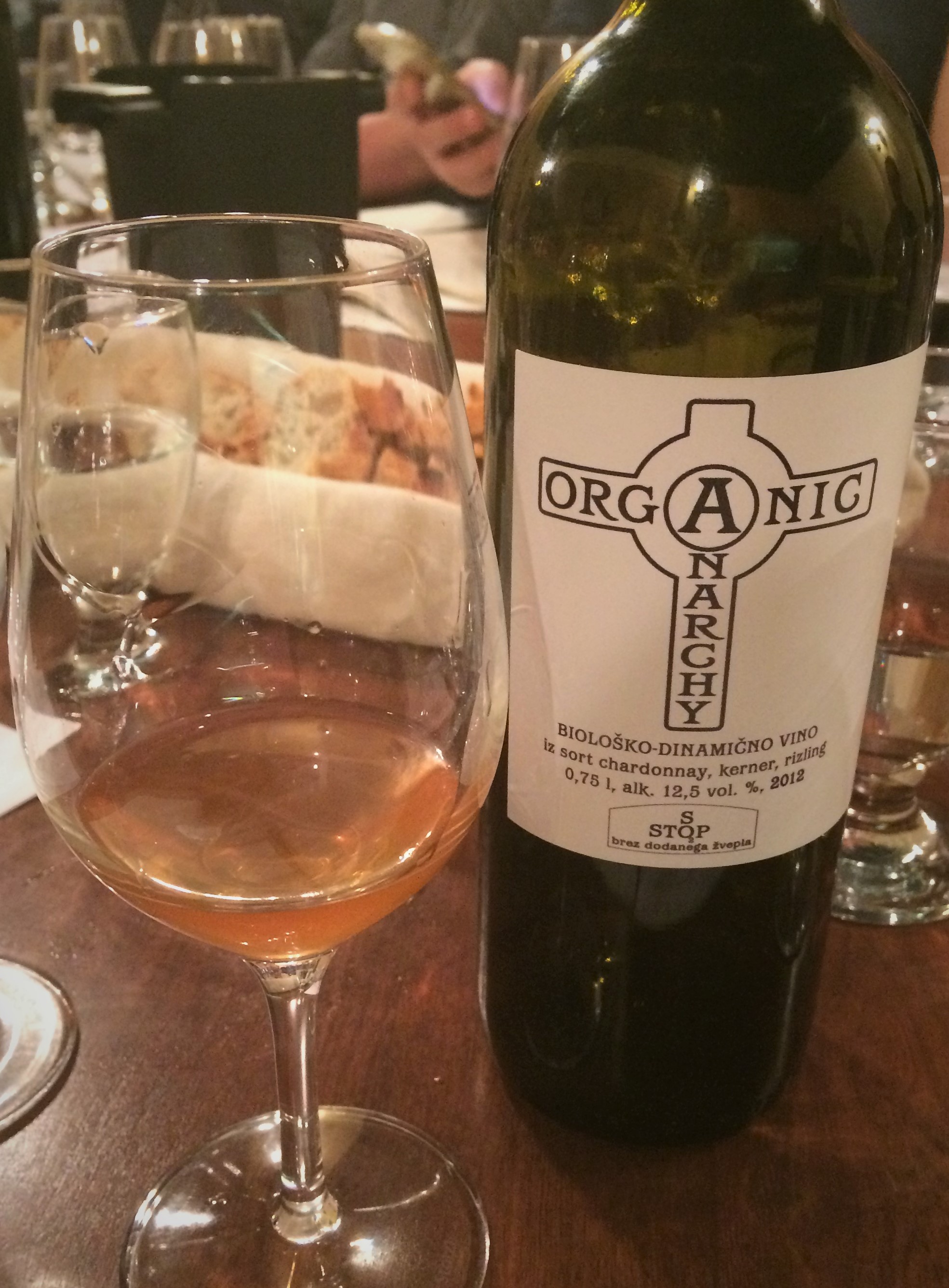
Hazy orange. Surprising, evolving nose: spicy, “kind of soapy,” “lit cigar,” dried orange peel and a hint of honey, among other things. Medium-bodied. Surprisingly fresh and vibrant for a five-year-old orange wine. The mineral-dusted fruit (stone fruit mainly) is almost sweet and yet so savoury. A hint of botrytis only increases the already complex set of flavours and aromas. Tingling acidity and a tannic rasp turn the silky texture a little raw-silky. The long finish is marked by pepper and nut notes. The way the wine developed in the glass suggests carafing an hour or two may be a good idea. Very impressive. I look forward to encounters with Urbajs’s other wines. (Buy again? The high price notwithstanding, yes, a bottle to savour at leisure.)
MWG October 13th tasting: flight 4 of 9
Orange crush
Located in Šempas in the western Vipava valley, about 20 kilometres east of Gorizia on the Italian border, the family-run Batič estate can trace its roots back to the late 16th century. It is known locally for its organically grown fruits and increasingly for its wines made from local and international varieties.
Primorska 2015, Zaria, Batič ($44.75, private import, 6 bottles/case)
A blend of Pinela (55%), Zelen (20%) Rebula (aka Ribolla Gialla, 5%), Vitovska (3%), Rumeni Mušat (aka Muscat Blanc à Petits Grains, 2%) and Chardonnay (1%) from biodynamically farmed vines planted in 1982 and rooted in marl soil of the Zaria vineyard. Manually harvested. Spontaneous co-fermentation on the skins in non-temperature-controlled open vats. Matured in Solvenian oak barrels. Unfiltered, unfined. No added sulphur. 13% ABV. Quebec agent: Vadim Fonta.

Hazy orange-bronze. A whiff of volatile acidity gives way to white spice, “cake,” yeast, minerals, peach and orange aromas. Lighter-bodied than expected (based on the appearance and nose) yet also very present. Complex and intensely flavoured with fruit, spice and minerals vying for attention. Light tannins and bright acidity give it some bite. The long, saline finish brings a hint of nuttiness and “lingering tortillas.” Characterful, engaging, satisfying, food-friendly and relatively affordable: what’s not to like? (Buy again? Yep.)
MWG October 13th tasting: flight 3 of 9
Primo Malvasia
Uroš Klabjan’s eponymous estate is located on the Istrian peninsula in Slovenia just south of the Italian border and three kilometres inland from the Gulf of Trieste. The around 10 hectares of vineyards are devoted mainly to indigenous varieties, primarily Malvasia and Refosco. Most of the vines are several decades old though one plot of ungrafted Malvasia is well past the 100-year mark. The estate is certified organic and the wine-making practices are traditional and non-interventionist. Annual production is typically in the 30,000-bottle range.
Primorska 2013, Malvazija Maceracija, Klabjan ($53.00, private import, 6 bottles/case)
As far as I can tell, Klabjan makes two Malvasias: the fresh and easy-going white label and this, the more savoury and complex black label. 100% Malvasia from dry-farmed old vines. Manually harvested. Macerated 10 days on the skins. Spontaneous fermentation. Underwent malolactic fermentation. Matured 30 months on the lees in oak barrels. Unfiltered and unfined. No added sulphur (total sulphites: 35 mg/l). Vegan-friendly. 14% ABV. Quebec agent: Vadim Fonta.

Hazy straw-bronze. Inexhaustibly protean nose of orange, apple, apricot, “rye whisky” and hints of vanilla and smoke that eventually heads into earthy mushroom territory. Smooth textured and possessed of a certain weight, layered and enveloping. The complex set of flavours echoes the nose and adds lees and minerals. Luminous acidity throws it all in relief, a effect sustained through the very long finish. Perfectly accessible now but also capable of ageing for years. Vibrant and engaging, this spellbinding wine was a favourite of just about everyone around the table. Despite the high price, we would have taken a couple of cases had any been available. (Buy again? Gladly. And I’ll make a beeline for any Klabjan wines I run across in the future.)
MWG October 13th tasting: flight 2 of 9
Collio rodeo
For its October agency tasting, the Mo’ Wine Group welcomed the personable Vadim Fonta, whose currently nameless wine agency – unofficially Agence sans nom – is usually referred to by his name. A couple of years ago, Vadim gave up a career in finance for one in wine, a field he felt far more passionate about. His primary focus is on a niche not particularly well represented in Quebec: organic, biodynamic and natural wines from Slovenia, the Balkans and eastern Europe as well as Italy, especially the northeast.
Once again the wines weren’t exactly in flights, though I’ve arranged them into such for reporting purposes.
Collio 2015, Bianco, Edi Keber ($40.50, private import, 6 bottles/case)
The estate, which has 10 hectares of vineyards, is located a short distance from the Slovenian border. The family has been making wines for more than three centuries though Keber’s first bottled vintage was 1957. This, the only wine it makes, is a blend of Friulano (aka Sauvignon Vert, usually around 70%), Malvasia and Ribolla Gialla from organically farmed vines averaging 40 years old and rooted in “ponka” – poor, stony, friable marl – soil. Manually harvested. Direct pressed (no skin contact). Fermentation in stainless steel tanks with selected, non-aromatic yeasts lasts three to four weeks. Matured one year in concrete tanks except for 20% of the Friulano, which spent six months in neutral tonneaux. Clarified by settling and fining with bentonite. Total production: 60,000 bottles. 13% ABV. Quebec agent: Vadim Fonta.
A bit reductive on opening, then dried lemon and limestone with some Sauvignon Blanc overtones. Rich and dense – not heavy – in the mouth. So clean and pure. Layers of yellow fruit (apple, peach), minerals, spice (anise), “almond blossom” and more make for an engagingly complex palate. Gleaming acidity keeps things fresh. The finish is long and bitter-edged, with herbal notes chiming in toward the end. (Buy again? Yes.)

Collio 2011, Bianco, La Castellada ($53.00, private import, 6 bottles/case)
Founded in the mid-1950s, the estate is located in Oslavia in the Gorizia hills close to the Slovenian border. A blend of Pinot Grigio (50%), Chardonnay and Malvasia from organically farmed vines averaging 35 years old rooted in ponka (see above). The Pinot Gris was direct pressed; the Chardonnay and Malvasia were macerated on the skins for four days. Spontaneous fermentation. Matured one year in stainless steel, one year in 200-litre Slavonian oak barrels, one year in neutral oak barrels and one year in the bottle. Unfiltered and unfined. 14% ABV. Quebec agent: Vadim Fonta.
Upfront minerals (including, per another taster, “plaster dust”) along with yellow tropical fruits and a shot of creamy vanilla. Richer and more honeyed than the Keber yet also “very savoury.” Great breadth, depth and length. The complex of fruit and minerals is sweetened by oak, lightly soured by acidity and complicated by a light but pervasive bitterness. Several tasters found this a little too rich and oaky, though nearly all conceded they might feel differently if it were served with a fancy seafood dish. (Buy again? A bottle for experimenting with food pairings.)
MWG October 13th tasting: flight 1 of 9
Ontario’s red grape?
Niagara Peninsula 2015, Cabernet Franc, Sans Soufre, Norman Hardie ($35.00 at the winery)
100% Cabernet Franc from organically farmed vines. Manually harvested. Fully destemmed. Fermented with indigenous yeasts in one-ton fermenters. Pressed in a basket press. Matured 10 months in 225-litre French oak barrels. Unfiltered and unfined. No added sulphur. 12.5% ABV.
Entertaining nose: a mix of dark fruit (cherry, blackberry) and umami (meat, mushroom) that prompts peanut gallery descriptors like “floral,” “spices,”“earthy,” “kelp” and “creosote.” Medium-bodied and fluid. Seems sweet on entry but turns appetizingly dry. Full of crunchy ripe fruit framed by soft tannins and enlivened by a stream of acidity. The complex of flavours includes minerals and herbal notes but absolutely no greenness. Finishes long and clean. So fresh, so drinkable. Enjoyable now and over the next two or three years if not longer. (Buy again? Yes.)

Canada 2015, Cabernet Franc, The Old Third ($55.00 at the winery, around $34 on preorder)
100% Cabernet Franc from the estate’s organically farmed Closson Road terrace vineyard in Prince Edward County. Fermented in stainless steel tanks with indigenous yeasts, then racked into French oak barrels, where it matured for about a year and a half. Unfiltered, unfined and minimally sulphured. Bottled in July 2017. 12.5% ABV.
Raspberry and black currants along with “black tea,” “pencil shavings,” “nut cake” and “prune.” Richer, rounder and denser than its flightmate, velour to Hardie’s satin. The ripe fruit is structured by smooth tannins and smooth acidity. Balanced, layered, long and full of potential: a complete wine. If there’s an issue now, it’s that the wine is a bit monolithic and the oak a little too obvious – nothing four or five years in the cellar won’t take care of. Late spring frost made 2015 a difficult vintage for many Prince Edward County producers though not for The Old Third and that’s totally apparent here. (Buy again? Yes, especially at the preorder price.)
World-class wines like these make a convincing argument that Cabernet Franc is Ontario’s red grape.
MWG September 28th tasting: flight 6 of 7
Vibrant, tasty, companionable
Adelaide Hills 2016, Skin n’ Bones Pinot Noir, BK Wines ($38.00, importation valise)
100% Pinot Noir from organically farmed vines grown in the cool-climate Lenswood subregion of the Adelaide Hills of South Australia. Manually harvested. After sorting, 70% of the clusters were left whole and 30% destemmed. All the fruit was then placed in French oak barrels (10% new, 90% neutral), leaving a generous amount of head space to be filled by the carbon dioxide gas resulting from fermentation. The barrels were sealed and the wine was allowed to spontaneously ferment and macerate for 100 days, after which the barrels were broken apart and the wine pressed. Bottled unfiltered and unfined. 12.8% ABV. Represented in western Canada by Calgary-based Crush Imports.
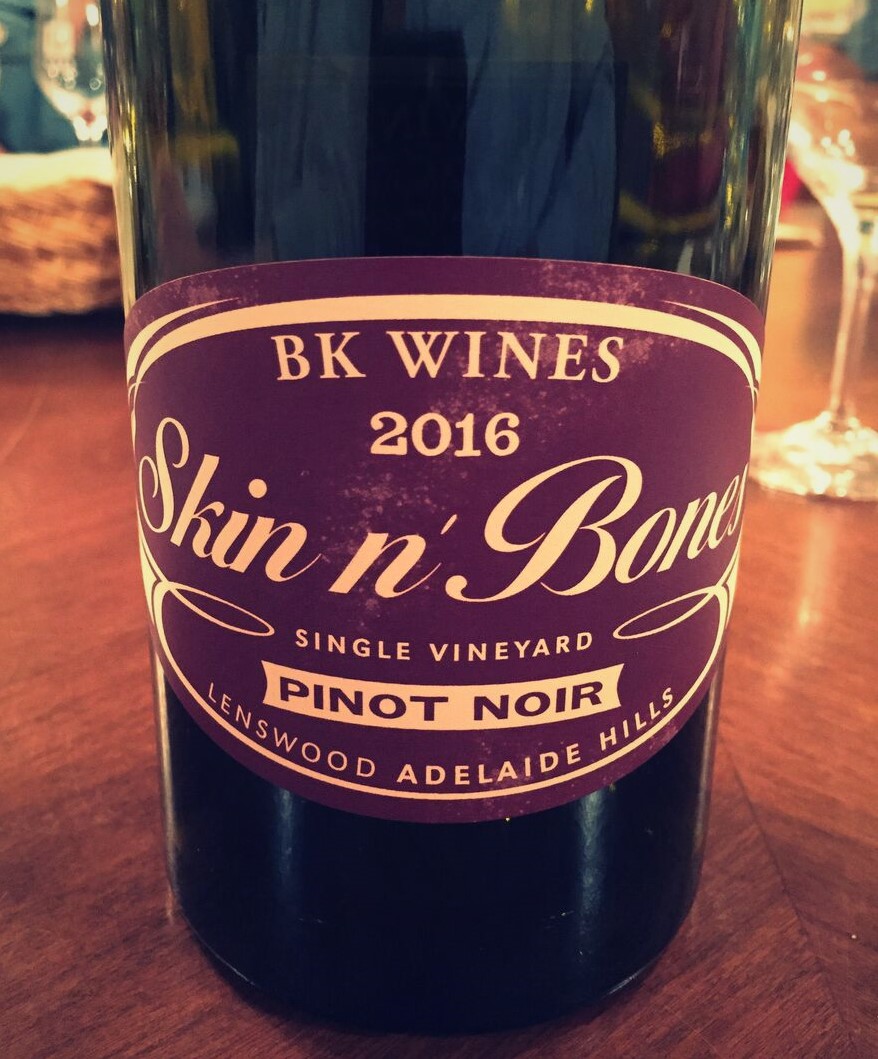
Fragrant, engaging nose: raspberry and cherry along with sandalwood, cedar, “tomato sauce” and graphite. Light- to medium-bodied. Juicy but not a bomb. Actually, there’s lots of detail, great precision and real energy. The sweet silky fruit is framed by fresh acidity and light though very present tannins. Chewing reveals unsuspected depth and structure. The spice-overtoned finish is clean and well sustained. A vibrant, tasty, companionable Pinot Noir that, while accessible now, has the potential to develop over the next few years. (Buy again? Yep.)
Based on this and the same estate’s Savagnin, some enterprising agency needs to be bringing these wines into Quebec.
MWG September 28th tasting: flight 5 of 7
Mainlining Assyrtiko
Santorini 2013, Pure, Volcanic Slopes Vineyards ($45.50, 13109697)
Run as a separate operation, Volcanic Slopes Vineyards is a second label of sorts of Argyros Estate. It is the brainchild of Argyros’ winemaker and commercial director, Stefanos Georgas. The idea is to make as pure an expression of Santorini Assyrtiko as possible using a hands-off approach. This 2013 is the first vintage of what is, so far, its only cuvée. Assyrtiko (100%) from 80- to 150-year-old ungrafted vines in two parcels: one with pumice soil in Episkopi Gonias, the other with basalt soil in Megalochori. Manually harvested. Half of the must is free-run juice, the other half is juice from gently pressed whole clusters. Fermented with indigenous yeasts. Matured 14 months on the lees with frequent stirring in a naturally temperature-controlled underground concrete tank in the old Argyros winery. 13.5% ABV. Quebec agent: oneopole.
Multifaceted nose that prompts descriptors like lemon, quartz dust, “sour fuzzy peach,” “distant honey,” bay leaf and lingering apple. Imposing and enthralling from the first sip: a “decadent” yet austere amalgam of clementine and incredible minerality and salinity. The rich extract and electric acidity are in breathtaking balance. There’s great breadth, depth and length – every dimension, in fact. Pure is no exaggeration, no marketing gimmick. A stunning wine, “like mainlining Assyrtiko.” It will be fascinating to see how this evolves over the next three to five years and maybe beyond. Surely one of the great white wines of Europe and, as such, more than fairly priced. The 2013 is almost sold out. Tasted at the winery in July 2016, two days after it had been bottled, the 2014 seemed every bit its equal. (Buy again? Imperatively – even the group’s white wine skeptic felt compelled to run out and acquire a couple of bottles.)

Santorini 2016, Assyrtiko, Hatzidakis ($28.50, 11901171)
The estate’s entry-level bottling. Sadly, 2016 was Haridimos Hatzidakis’s last vintage. 100% Assyrtiko from organically farmed, ungrafted vines up to a century old in Pyrgos, Megalochori, Akrotiri and Vourvoulos. The manually harvested grapes were direct-pressed. The must was clarified by settling, then fermented with indigenous yeasts in temperature-controlled (18°C) tanks. Stayed on the lees for 40 days. Matured in stainless steel tanks. Lightly filtered and dosed with sulphur dioxide before bottling. Reducing sugar: 1.9 g/l. 13.5% ABV. Quebec agent: oneopole.
Lemony, “ferny” nose with notes of “modelling clay,” peach and distant sea shore. In the mouth, the dense extract and unctuous texture are counterpointed by crystalline minerals, vibrant verging on trenchant acidity and a fundamental dryness. Fruitier (lemon and quince) than in some earlier vintages. The saline finish brings some dried herb notes. Not as deep, broad or long as the (older and much more expensive) Pure, though hardly lacking dimension. Almost too rich for an aperitif; probably best thought of as a food wine (to date, it has made a matchless match for spaghetti with leeks, olive oil, lemon juice and zest and bottarga and for oysters on the half shell). (Buy again? Multiples.)
MWG September 28th tasting: flight 4 of 7
Antipodal Savagnins
Côtes du Jura 2015, Savagnin, Les Sarres, Domaine Rijckaert ($29.95, 12951356)
The estate avoids herbicides and insecticides and limits its use of synthetic chemicals to treatments against mildew and odium. All the estate’s wines are made in barrels. 100% Savagnin from the Les Sarres vineyard located in Buvilly. Fermented with indigenous yeasts. Underwent full malolactic fermentation. Matured two years on the lees in neutral French oak barrels with no stirring. Kept topped up, so not oxidized. Reducing sugar: 1.9 g/l. 13% ABV. Quebec agent: La QV.
Slightly hazy pale electrum to the eye. Minerally nose of lemon and grapefruit with hints of potpourri and almond. In the mouth, it’s clean and tonic. The fruit (lemon, yellow plum) is sweet-seeming on the attack, though the wine is actually very dry. There’s a real mineral depth, including a shot of salinity. The bright acidity combines with a faint bitterness on the long finish to provide a bit of grip. Less electric than some Savagnins but still a fine example of what the grape can do. (Buy again? Sure.)

Adelaide Hills 2016, Skin n’ Bones White, BK Wines ($35.00, importation valise)
The South Australian estate was founded in 2007 by Brendon and Kristy Keys. This monovarietal is made using Savagnin from organically farmed 10-year-old vines rooted in limestone and sandstone over deep clay in Lobethal in the cool-climate Lenswood subregion. The grapes were manually harvested and fully destemmed but not crushed. Spent one month on the skins with twice-daily pump-overs, then was pressed and racked into neutral French oak barrels with regular stirring for nine months. Alcoholic and full malolactic fermentation were spontaneous. Total production: 200 cases. 11.8% ABV. Represented in western Canada by Calgary-based Crush Imports.
One-of-a-kind nose of “smoked fish,” “sushi” and “barbecued corn” (quoting other tasters) as well as dried apricot and, with time, green fruit (kiwi, melon) and herbal notes. Dry, fluid and layered. Nicely structured with pervasive but smooth acidity, a current of white minerals and ghostly tannins that last well into the long finish. Grape skins and apricot pit linger. As unusual and engaging as it is savoury and delicious. (Buy again? Gladly.)
MWG September 28th tasting: flight 3 of 7

 Brett happens