Posts Tagged ‘oenopole’
Tasting champagnes with Pascal Doquet (3/4)
Champagne, Grand Cru, Blanc de Blancs, Diapason, Pascal Doquet ($73.25, 12946063)
100% Chardonnay from organically farmed old vines in vineyards in Le Mesnil-sur-Oger (poor clay over chalk). A blend of wines from the 2006 (84%) and 2005 (16%) vintages. Vinified in a enamelled stainless steel tanks (80%) and small, neutral oak barrels (20%). Fermented with indigenous yeasts. Aged 96 months on lattes. Dosage (with rectified grape must): 4.5 g/l. Disgorged in April 2015. Reducing sugar: 5.4 g/l. 12.5% ABV. Quebec agent: oenopole.
A shade golder than the other wines in the tasting. Engaging nose of lees, yeast and subdued white fruit faintly overtoned with white spice and powdered ginger. Dry yet richer than its predecessors. The soft bubbles, sleek acidity and ideal extract confer a beguiling texture. Chalky minerals and subtle, slightly browning fruit last well into the slow-fade finish with its lingering lemon and flint notes. Balanced and complete. Suggesting resonance and harmony, the cuvée name is most appropriate. (Buy again? Yes.)
Tasting champagnes with Pascal Doquet (2/4)
Champagne, Brut, Blanc de Blancs, Horizon, Pascal Doquet ($55.00, 11528046)
100% Chardonnay from organically farmed vines rooted in old chalk and grey marl clay in vineyards in Bassuet and Bassu. A blend of wines from the 2011 and 2010 vintages (two-thirds and one-third respectively). Fermented with indigenous yeasts in enamelled stainless steel tanks. Matured on the lees for four to five months. Bottled unfiltered. Aged 30 months on lattes (the bottles are stacked on their sides with thin strips of wood – think laths – laid between them to stabilize the stacks and minimize damage in the event a bottle explodes). Dosage was with rectified concentrated must. Disgorged in September 2015. Reducing sugar: 7.0 g/l. 12.5% ABV. Also available in magnums ($119.00/1.5 L, 11787304). Quebec agent: oenopole.
Pale straw with green and gold glints, a very fine bead and not much foam. Appealing nose of cookie dough, chalk, faint lemon and a hint of honey. Clean and dry in the mouth, the flavours tending to apple and pear. Acidity and extract are in ideal proportion. There’s fair depth and complexity and a marked mineral component, especially on the long, dry finish. (Buy again? Sure.)
Champagne, Premier Cru, Blanc de Blancs, Brut Nature, Arpège, Pascal Doquet ($64.25, 12024253)
100% Chardonnay from organically farmed vines in vineyards in Vertus (deep clay over chalk), Villeneuve (clayey topsoil over chalk) and Mont-Aimé (sand and chalk). A blend of wines from the 2010 and 2011 vintages (62% and 38% respectively). Fermented and matured on the lees in tanks for four to five months with occasional stirring. Transferred to oak barrels (45%) and stainless steel tanks (55%) for an additional 11 months before bottling. Aged 30 months on lattes. Undosed. Disgorged in February 2016. Reducing sugar: 1.5 g/l. 12.5% ABV. Quebec agent: oenopole.
Similar in appearance to the Horizon, though with a slightly greener cast. Complex, evolving nose: citrusy, malic and leesy gaining straw/hay, seashell and preserved lemon notes as the wine breaths. Less fruity and more minerally than its flightmate. Bone dry from start to finish. Sustained but not sharp acidity. Long, rainwatery finish with lingering chalk, flint, lemon and seashells. Lovely. (Buy again? Yes.)
Tasting champagnes with Pascal Doquet (1/4)
In the run-up to the holidays, oenopole invited a number of wine critics, journalists, restaurateurs, sommeliers and bloggers, including me, to a tasting of champagnes from the house of Doquet. The tasting was led by the soft-spoken if loquacious owner-winemaker Pascal Doquet.
Based in Vertus, Pascal has been a winemaker since 1982. After taking the helm of the family estate (Doquet-Jeanmarie at the time), he bought out his sisters’ shares in the estate and created – with his wife Laure – Champagne Pascal Doquet in 2004. Comprising a little under nine hectares of vines, the estate has been certified organic since 2007. Pascal describes his approach to wine-growing as sustainable. The life of the soil is a primary concern, as evidenced by his careful application of homemade compost, avoidance of chemical weed-killers, use of lightweight straddle tractors and manual working of the topsoil around the vine rows.
In the cellar, pressing – always with a pneumatic press – is adapted to the characteristics of each vintage. Only the juice from the first two pressings is used. Fermentation is with indigenous yeasts. After alcoholic and malolactic fermentation, the wines are matured on their lees for, on average, four or five months, then naturally clarified and sometimes lightly filtered before bottling, which happens in spring for the non-vintage cuvées and in late summer or early fall for the vintage cuvées. Dosage is done with concentrated grape must, which Pascal feels is closer to the grape’s natural sugar. The wines tend to be shipped six to 12 months after disgorging.
The tasting began with the house’s rosé.
Champagne, Rosé, Brut, Premiers crus de la Côte des blancs, Pascal Doquet ($66.75, 12024296)
A blend of Chardonnay (85%) and Pinot Noir (15%) from vineyards around the village of Vertus. The soil is mostly deep clay over chalk. The grapes are entirely destemmed. The colour comes from briefly macerating the juice on the skins. Fermented with indigenous yeasts in stainless steel tanks. Matured 12 months on the lees in large barrels and 24 months in the bottle. Unfiltered. Disgorged in February 2014. Dosage was 6 or 7 g/l, which Pascal intends to lower to 5 g/l in the future. Reducing sugar: 7 g/l. 12.5% ABV. Quebec agent: oenopole.
Salmon-orange with a fine bead and head. Yeasty nose of red berries, hard candies and hints of chalk and resinous herbs. In the mouth, it’s fruity yet delicate, ripe-sweet yet fundamentally dry. The effervescence is soft and structuring. Bright acidity swells on the mid-palate. Turns even direr on the long finish with its lingering fruit and mineral flavours. Not a throat-grabber but elegant, refreshing and delicious. (Buy? Yes.)
Greek winery tour: Papagiannakos (Attica)
[Hover over pics to display captions and credits; click to embiggen.]

Located a 20-minute drive southeast of Athens International Airport, the Papagiannakos Winery sits on the northwestern edge of Porto Rafti in Markopoulo. Shoebox-shaped with a sloping roof and prominent girders that, in profile, look like a giant Π (pi, the first letter of the family name), the current structure was built in the mid-2000s. It is, in a word, gorgeous: clean and modern in design, integrated into the surroundings, eco-friendly and featuring extensive use of local materials, in particular stones. The equipment is state of the art, the compact barrel cellar houses Allier and Nevers oak casks. A glass wall under a large overhang faces south providing ample daylight while, on the north side, a row of clerestory windows runs above the tall stone wall ensuring good airflow and an escape route for warm air. At the far (west) end of the building are found, on the lower level, a large tasting room and, on the upper level, a beautiful, high-ceilinged event space with a sweeping view over the valley to the ridge separating the region from Athens, with the airport’s control tower just visible over the intervening hills. Carefully chosen artwork adorns the walls. In short, it’s a feel good place.
The Papagiannakos family has been growing grapes and making wine in Markopoulo since 1919. In the 1960s, the second generation upgraded the winery and improved the quality of its output. The current, third-generation owner-winemaker, Vassilis, took over in 1992, and almost immediately began the process of bringing the winery into the 21st century.
 It may be a conceit but I’ve often found winemakers to resemble the wines they make. In any case, it’s true for Vassilis: classy yet down-to-earth, generous yet reserved, rooted in the past yet forward-looking, attached to a place yet also aware of the world. Speaking about his wines, he rightly said “they don’t shout,” but he could equally have been talking about himself (or his winery’s handsome labels, for that matter).
Papagiannakos has several vineyards, some around the winery and others – including ones under contract – scattered throughout the environs. Though the soil varies from parcel to parcel, it is generally rocky and infertile over a limestone base. The area receives no rain to speak of from May or June through October, so the vines are grown in low bushes; rot isn’t a problem here, in contrast to, say, the Peleponnese, where grape vines are usually trained on wires. The dry, breezy conditions also mean there is no need for insecticides or fungicides. On the other hand, irrigation (drip to conserve water) is a necessity, especially for young vines.
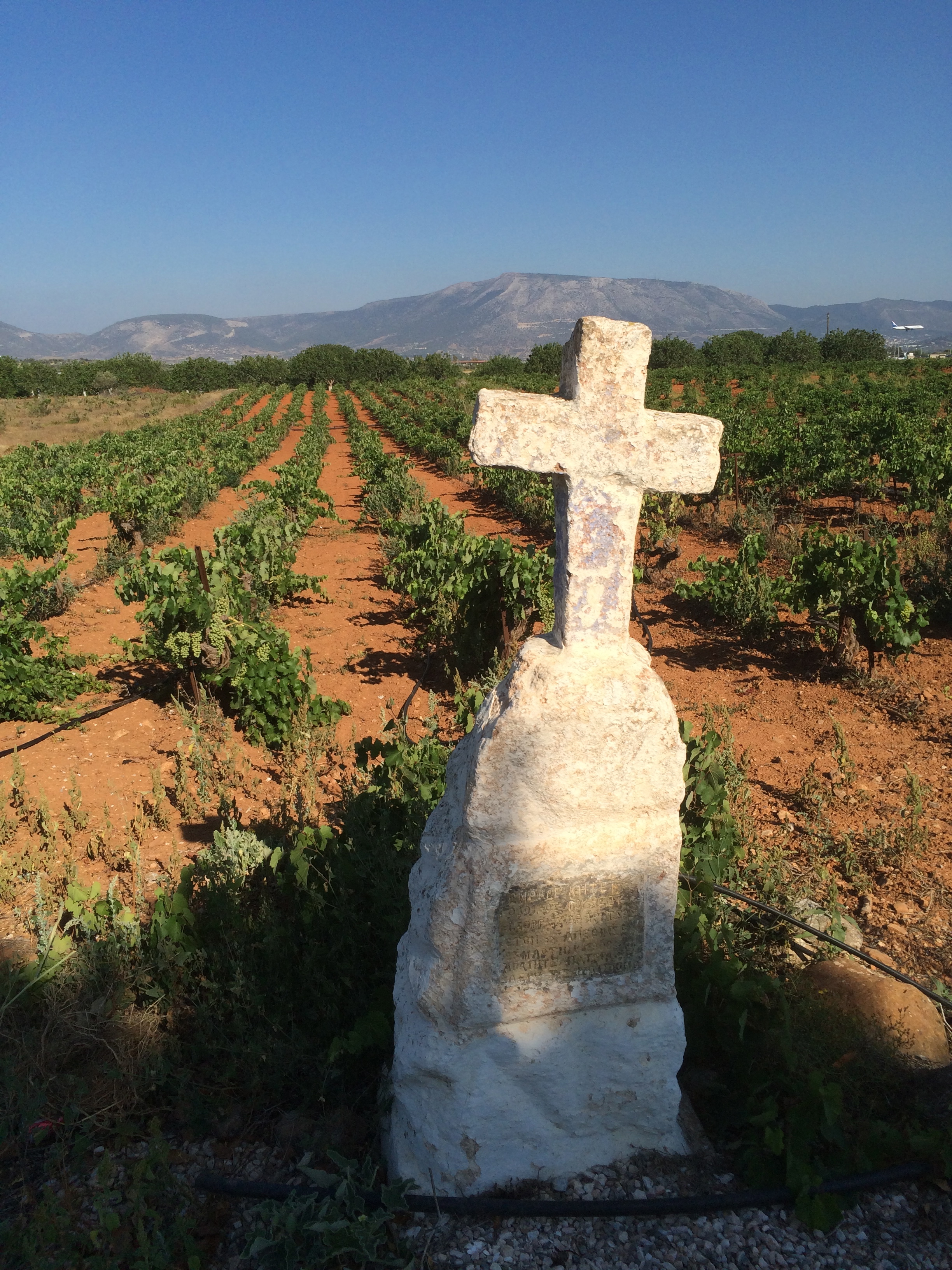 The winery has specialized in Savatiano since its founding. Actually, it was the only grape variety grown at the estate until Vassilis took the helm. He soon began playing with the newly resuscitated Malagousia variety and then red grapes. He also has several experimental plots, one of them Greco di Tufo, the first real vintage of which will be the 2016. “Italian grapes,” I exclaimed, unable to hide the surprise in my voice. With a shrug of the shoulders and a wry smile came the reply: “Well, as the name implies, it’s probably Greek.”
After a tour of the building, we gathered in the event room for a technical tasting with Vassilis and members of his family, including his children, affable, knowledgeable and articulate young adults who will eventually take the reins from their father. You’ll find my tasting notes after the jump.
For details about where we stayed, where and what we ate and what we saw, including some of Papagiannakos’s vineyards, see the Day One report on carswelliana.
INTRODUCTION
♦ PAPAGIANNAKOS (ATTICA)
TSELEPOS (ARCADIA)
MERCOURI (ELIS)
TETRAMYTHOS (ACHAEA)
THYMIOPOULOS (MACEDONIA)
ARGYROS (SANTORINI)
Tre vermut eccezionali
It has been great to see artisanal vermouths becoming available in Quebec in recent years, first through the private import channel and now, with the arrival of this Piedmontese paragon (among others), at the SAQ.
The mash-up known as vermouth (vermut in the Turin dialect) has been a thing since at least the 18th century. Originally considered medicinal, the concoction quickly became popular as a digestion-promoting aperitif. During the reign (1831 to 1849) of Carlo Alberto, King of Sardinia and Duke of Savoy, the royal chef developed a vermouth specially for the famously dyspeptic ruler. After the latter’s demise, the recipe made its way into the hands of a Turin shopkeeper, Tumalin Baracco Bartolomé de Baracho, who named the product after the deceased monarch. Production has continued to this day.
The company explains the production process as follows:
Starting from the base wine, which must be an excellent one. As per the 1837 recipe, we use the DOGC Asti Muscat and the DOGC Caluso Erbaluce, the latter produced in a very limited quantity, almost impossible to find. To this superb base, we add 43 botanical elements: herbs, berries, spices, flowers and fruits selected and infused in 45° alcohol for 40 days. Afterward, we lightly filter the steeping and decant it in Piedmont barrels for approximately 3 to 6 months, regularly testing for the perfect ripening of the matrix before bottling. This Vermut can be tasted similarly to Carlo Alberto’s way who sipped it straight as an aperitif, 10 minutes before meals. Otherwise, it expresses its best characters in cocktails.
At the tasting, the wines were first sampled on their own. Then ice cubes, club soda, tonic water and sliced lemon, lime and orange were set out so the tasters could experiment with various combinations.
Vermut di Torino, Extra-dry, Riserva Carlo Alberto ($32.00, private import, 6 bottles/case)
Flavoured with 21 herbs and spices, including yarrow, ginger, tarragon, coriander seed, gentian and nutmeg. Filtered only once. Plastic stopper cap. Reducing sugar: 60 g/l. 18% ABV. Quebec agent: oenopole.
Disconcertingly ashy/smoky along with fresh birch leaf and clove aromas. A couple of days later, the ash was fainter and earthier, leaving more room for a complex bouquet with nuances of green herbs (think tarragon) and bergamot. Unctuous and, residual sugar notwithstanding, coming across as dry. Ash dominates the palate though not to the point of obliterating other flavours. In fact, this seems the deepest of the trio. Lemon pith joins the herb-spice complex on the long, bitter-edged finish. Less appealing on its own than its siblings though lovely in a Cirka gin martini. The Quebec agent says this is normally devoid of ashy aromas and flavours, so ours may have been a slightly off bottle. Still, as one of tasters later wrote “the extra-dry was intriguing to say the least and I was bouncing between ‘wow that’s great’ and ‘wow, that really tastes like ashtray.'” (Buy again? Yes, for investigative purposes and martini-making, if nothing else.)
Vermut di Torino, Bianco, Riserva Carlo Alberto ($32.00, 12928594)
Erbaluce (90%) and Moscato (10%) flavoured with 25 herbs and spices, including wild rose, mandarin, bitter orange, clove, cherry, absinthe and coriander seed. Plastic stopper cap. Reducing sugar: 140 g/l. 18% ABV. Reducing sugar: 140 g/l. Quebec agent: oenopole.
Effusive nose dominated by scents of fennel seed, sap, sweet white spice and honey. Intensely flavoured but delicious and not at all saccharine. Stealth acidity enlivens without disturbing the smooth surface, letting you focus on the kaleidoscopic flavours. A bitter current runs throughout and comes to the fore on the long, spice-laden finish. A little overpowering straight up but a knockout with lemon and tonic. (Buy again? Done!)
Vermut di Torino, Rosso, Riserva Carlo Alberto ($32.00, 12928720)
Erbaluce (90%) and Moscato (10%) flavoured with 27 herbs and spices, including marjoram, saffron, dandelion, rhubarb, nutmeg, vanilla, star anise, tonka bean and carnation. Plastic stopper cap. 18% ABV. Reducing sugar: 60 g/l. Quebec agent: oenopole.
The colour is more brown than red. Impossibly complex nose: gingerbread and molasses, canned mincemeat, cherry, chocolate, a whiff of fennel and more. Soft and semi-sweet in the mouth, the flavours echoing the nose with some old wood in the background. Vivid acidity and a faint tannic bite add interest while a hint of black pepper and that telltale bitterness appear on the long, long finish. In contrast to something like Cinzano, a bit too intense to sip on its own. Better with a splash of club soda (or more than a splash of ginger beer) and a slice of orange. Also makes a killer negroni if used in smaller amounts than most recipes call for. (Buy again? Done!)
MWG September 8, 2016, tasting: flight 6 of 6
Majorly Muscadet
Muscadet Sèvre et Maine 2012, Clisson, Famille Lieubeau ($24.95, 12923021)
100% Melon de Bourgogne from organically farmed vines averaging 30 years old and rooted in granite soil in various parcels in the Clisson commune. Manually harvested. Whole-cluster pressed. Fermentation with indigenous yeasts took place in temperature-controlled (20°C) tanks and lasted three weeks. Matured 24 months in tanks on its lees. Reducing sugar: 1.3 g/l. 12% ABV. Quebec agent: Société Clément.
“Shrimp shells” (per another taster), lemon, apple, limestone and, eventually, peat and “celery salt” notes. Rich and round, dry and tart, subdued but revealing layers of flavour. The pure fruit is dusted with minerals while the credible finish has a saline edge and a faint hint of honey or caramel. Very likeable. (Buy again? Yes.)
Muscadet Côtes de Grand Lieu 2014, Clos de la Butte, Domaine de l’Aujardière/Éric Chevalier ($19.05, 12886831)
100% Melon de Bourgogne from 50-year-old vines planted in serpentinite, eclogite and quartz in the La Butte lieu-dit. The grapes are pneumatically pressed and the must transffered into glass-lined tanks. Fermented with indigenous yeasts. Matured eight to 10 months on the lees with regular stirring. Unracked and unfiltered. Reducing sugar: 1.3 g/l. 11.5% ABV. Quebec agent: oenopole.
Similar nose to the Clisson’s but deeper, the shells more oyster-like and showing a distinct white pepper note. Even smoother and rounder on the palate though equally layered and minerally. Crisp acidity keeps things fresh and lively. Hints of butter and caramel colour the long finish. The most middle-of-the-road of the trio, not that there’s anything wrong with that. Great QPR. (Buy again? Yes.)
Muscadet Sèvre et Maine 2014, Le Breil, Complémen’Terre ($30.25, private import, 12 bottles/case, NLA)
Founded in 2013 in Le Pallet, the winery is owned and operated by Marion Pescheux and Manuel Landron, son of legendary Muscadet producer Jo Landron. The couple works according to the lunar calendar. 100% Melon de Bourgogne from organically farmed vines rooted in orthogneiss and quartz. Manually harvested. After pressing, the juice is clarified by settling and fermented with indigenous yeasts. Matured on the fine lines for eight months. Nothing added except, when deemed necessary, a shot of sulphur (35 mg/l maximum). 12% ABV. Quebec agent: oenopole.
Lemon and minerals with hints of butter and eventually pale berries. In the mouth, it’s less rich and more rainwatery than its flightmates. On an equal footing with fired minerals, the subdued fruit is buoyed by soft acidity.. A thread of bitterness spools into the saline finish. Long and elegant if a bit inscrutable. Would love to revisit in a couple of years. (Buy again? If feeling flush, yes.)
MWG September 8, 2016, tasting: flight 2 of 6
Among the great Mediterranean reds
The technical information for these two wines is identical. The fruit comes from organically farmed, 70- to 90-year-old, dry-farmed, low-yielding, ungrafted vines grown on the Ziros plateau in eastern Crete. The must is fermented with indigenous yeasts in cement vats and matured in old French oak barrels. The wines are bottled unfiltered, unfined and with only a tiny shot of sulphur dioxide.
Since the late 1990s, the Sitia appellation has required reds to be a blend of Liatiko and Mandilaria. As the 2006 is all Liatiko, it had to take the broader Crete appellation. Economou doesn’t release wines until he thinks they are ready; that said, this isn’t the first shipment of the 2006 to arrive in Quebec.
Both wines were carafed two or three hours before serving and both benefited enormously from it.
Crete 2006, Liatiko, Domaine Economou ($56.75, private import, 6 bottles/case)
100% Liatiko. 13.5% ABV. Quebec agent: oenopole.
The room fell silent as the wines were poured and people started smelling them. Aside from oohs and ahs, the first utterance was in reference to this: “I could drown in it.” An in-pulling, umami-rich nose of plum and cherry, Mediterranean scrub and the earth it’s rooted in, sea breeze, obsidian dust, violets and more. In the mouth, the wine is medium-bodied and possessed of a fluid texture. Ripe but not jammy fruit, smooth but very present acidity and fine but sturdy tannins are all in perfect equilibrium. Dark minerals run like an underground river. Flavours and aromas echoing the nose unfurl from the mid-palate though the long finish. Still vibrant and vigorous at ten years of age. A beauty. (Buy again? Yes.)
Sitia 1999, Domaine Economou ($78.00, private import, 6 bottles/case)
A blend of 80% Liatiko and 20% Mandilaria. 13.5% ABV. Quebec agent: oenopole.
More subdued and, if anything, more involving. Evolved, profound nose: mushroom and truffle, leather, dark fruit, cocoa, hints of violets and dried orange peel. Dense and velvety yet medium-bodied. The fruit is a mixture of fresh and dried plums and cherries, the acidity is fluent and sustained, the tannins are resolved but still structuring. Strata of minerals, earth, tar and old wood provide ballast and depth. The finish goes on and on, like the afterglow of a perfect summer day. A magnificent, transporting wine that I suspect is near or at peak, though most definitely not on its last legs. (Buy again? If the opportunity ever presents itself again, yes.)
I repeat what I wrote two years ago: these are among the great Mediterranean reds. While neither wine could come from anywhere but Crete, Economou’s training at top estates in Bordeaux and Barolo is apparent in both.
MWG August 12th tasting: flight 7 of 8
A rocky landscape shimmering in a summer haze
Crete 2014, Rosé de Liatiko, Domaine Economou ($32.50, private import, 6 bottles/case)
100% Liatiko from organically farmed, ungrafted old vines. After a short maceration on the skins, the grapes are pressed and the must is fermented with indigenous yeasts. Maturation is in old barrels. Unfiltered and unfined. Minimal added sulphur and then only at bottling. 13% ABV. Quebec agent: oenopole.
Wafting, complex nose: pumice, dried herbs, distant red fruit and a touch of animale. In the mouth, it’s both mysterious and present, like a rocky landscape shimmering in a summer haze. Dried strawberry and stony, sun-baked earth are carried on a stream of acidity. The gauzy layers include garrigue, salt and dried flowers. Dry and long. A rosé with the colour and weight of a Poulsard but aromas and flavours that transport you to a Mediterranean mountainside. A profoundly beautiful wine. (Buy again? Yes.)
MWG August 12th tasting: flight 4 of 8
White gold
The centrepieces of the August 12th tasting were five newly arrived wines from one of the stars in the Greek wine firmament, Domaine Economou. We began with the whites. Reliable technical information for Economou wines is hard to come by. As far as I can ascertain, both wines are made in a similar way: fermented with indigenous yeasts in stainless steel tanks, matured in assorted containers (possibly including old casks, stainless steel tanks, fibreglass vats and underground cement tanks) and bottled unfiltered and unfined with a tiny shot of sulphur dioxide.
Sitia 2013, Vilana/Thrapsathiri, Domaine Economou ($51.25, private import, 6 bottles/case)
A blend, typically 70-30, of Vilana and Thrapsathiri from organically farmed, ungrafted, estate-grown vines. 13.5% ABV. Quebec agent: oenopole.
Fascinating, nuanced nose: honey, almond, sea salt, distant apple, pear and maybe even pumpkin, a not unappealing hint of rancid butter. Dry, rich and savoury with a slightly oily texture. Fresher than the 2009 due, I think, to sustained acidity and discreeter oxidative notes, which give the white fruit a yellow facet, as if it were poached with apricot and dried orange peel. The smooth, underlying minerality has me thinking of river stones. Long, layered and profound though not as deep as its flightmate. Unique and involving. (Buy again? Yes.)
Crete 2013, Assyrtiko, Domaine Economou ($51.25, private import, 6 bottles/case)
100% Assyrtiko from organically farmed, ungrafted vines. Assyrtiko not being a permitted variety in the Sitia PDO, the wine qualifies only for the broader Crete PGI designation. 13.5% ABV. Quebec agent: oenopole.
“Round nose, like a Bâtard-Montrachet,” notes one taster. If there’s fruit, it’s poached pear intertwined with threads of pine tar, salt-rimed stone and an scent I peg as oak but the aforementioned taster characterizes as “roasted chestnuts.” In the mouth, the wine is weighty, structured, complex, deep and glowingly acidic. There’s an oxidized edge though not a distracting one, as it allows notes of lemon, honey, white nuts and anise seed to come through. Possessed of a long, uniquely savoury finish with a delectably bitter aftertaste. Different from its high-end Santorini counterparts – rounder, richer and less crystalline – but fully worthy of standing alongside them. (Buy again? Yes.)
In a discussion about the Assyrtiko, agent Theo Diamantis drew an analogy with a grand cru Riesling. He also wondered about food pairings. My ideas: fine white fish in a rich sauce, butter-poached lobster, grilled lamb chops, beef tartare (don’t knock it till you’ve tried it).
MWG August 12th tasting: flight 3 of 8
Sausage love, 2016 edition
Forget those overpriced Valentine meals prepared by bored chefs and served by jaded waiters in stuffy restaurants. On February 14, sausage lovers, wine lovers and just plain lovers will be heading to Nouveau Palais for a hit of Pork Futures goodness (Italian sausage and slaw sandwiches with french fries and “La Bomba” hot sauce on the side) and glass after drinkable glass of Dolcetto from four outstanding producers (San Fereolo, Chionetti, Alessandria and Principiano), all poured by oenopole.
The Sixth Annual Valentine’s Sausage Party
“Because nothing says love like sausage”
Sunday, February 14, 2016
17:30 to 23:30 (or until they run out)
Nouveau Palais
281 Bernard St. West, Montreal
#iheartdolcetto

 Brett happens