Posts Tagged ‘Private imports’
Southern Overnoys
A surprising number of Jura winemakers share family names. The list includes the Benoits (Denis and Paul et fils), the Boilleys (Joël and Luc), the Bulabois (Claude, Georges, Philippe and Régis), the Clavelins (Charles and Hubert et fils), the Puffeneys (Frédéric and Jacques), the Rolets (the eponymous estate and Gérard) and the Tissots (Jean-Louis, Jacques and André et Mireille).
The Overnoys also belong on this list. The wines made by Pupilin-based Pierre Overnoy (and now his former assistant, Emmanuel Houillon) have long been favourites bordering of fetish objects of natural wine geeks. Also based in Pupillin, Domaine Overnoy-Crinquand has a somewhat lower profile but is something of a rising star. Until this fall, however, I didn’t know there was a third Overnoy estate: Domaine Overnoy, which is located further south, in the commune of Orbagna, and is currently run by 20-something Guillaume Overnoy, Pierre’s great nephew.
Actually, Domaine Overnoy is a neighbour of Domaine Labet (both estates are in the Sud-Revermont region) and Julien Labet has been active in introducing the estate to agents he deals with, including oenopole, which is how the wines have made their way to Quebec.
Guillaume took over the 5.5-hectare family estate from his father, Jean-Louis, in 2013. The following year, he began converting it to organic farming, obtaining certification in 2016. While Trousseau is the flagship, wines are made from all five official Jura varieties (the estate has 3 ha of Chardonnay, 1 ha of Savagnin and around 1 ha of red varieties, of which Trousseau comprises 55 ares, the rest being Poulsard and Pinot Noir). The soil tends to grey marl. Harvesting is manual. Wine-making is non-interventionist. Alcoholic and malolactic fermentations are spontaneous. In the cellar, sulphur use is minimal.
All three wines we tasted were from the 2015 vintage. The last few vintages have been difficult in the Jura and 2015 was no exception, the main problems being excessive heat and drought.
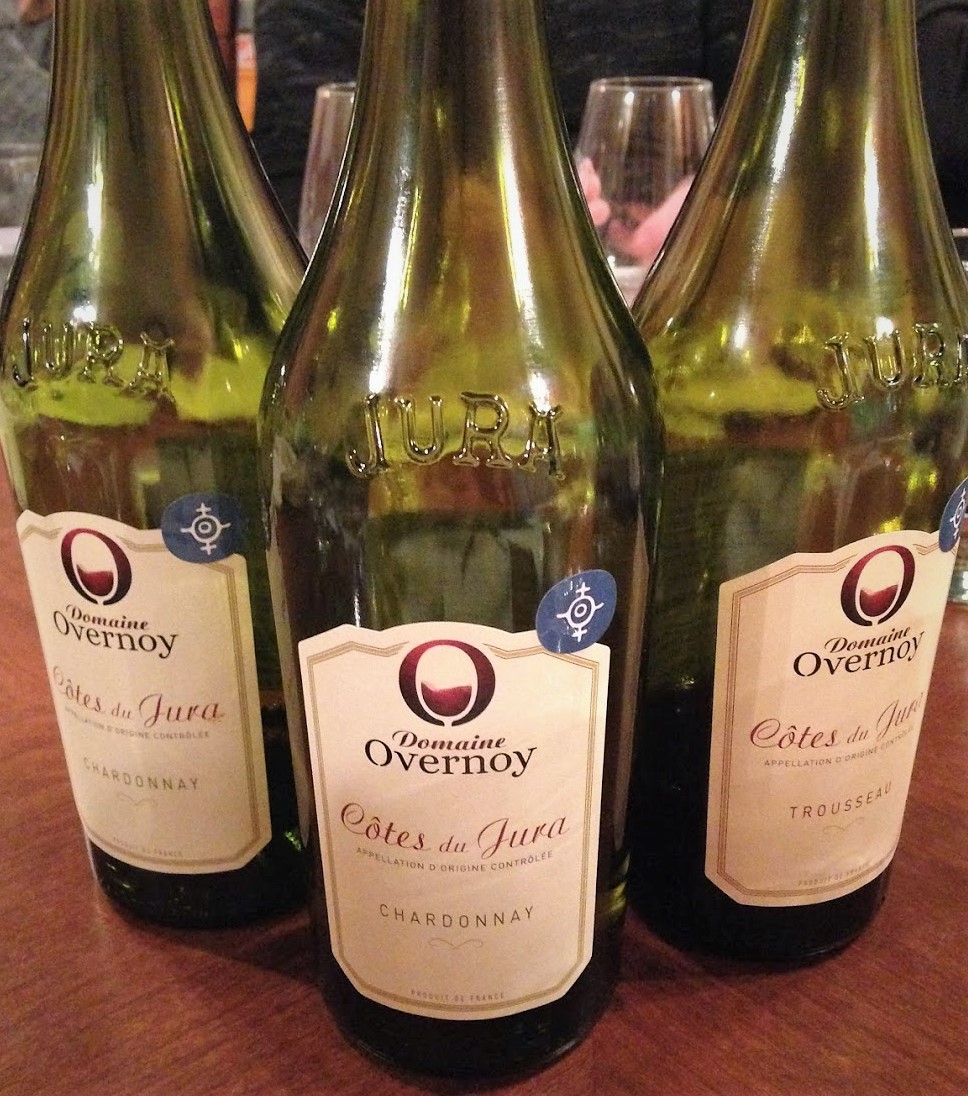
Côtes du Jura 2015, Chardonnay, Perce Neige, Domaine Overnoy ($32.75, private import, 6 bottles/case)
100% Chardonnay from vines in an historic parcel. May be fermented in tanks and may be prevented from undergoing malolactic fermentation. In any case, the winemaker’s aim is for a fresh wine to be drunk young and not necessarily with food. 13% ABV. Quebec agent: oenopole.
Engaging nose of yellow apple and straw with hints of pineapple and white flowers. Medium-bodied. Sweet-seeming on entry but actually quite dry. Ripe but hot heavy, in no small part due to the crisp acidity. The rich mid-palate is underlain with chalky minerals that last well into the long, drying finish. A clean, precise, refreshing wine with “lots of energy.” (Buy again? Yes.)
Côtes du Jura 2015, Chardonnay, Charmille, Domaine Overnoy ($37.25, private import, 6 bottles/case)
100% Chardonnay from the Charmille lieu-dit. Slow alcoholic fermentation (more than 10 months). Underwent malolactic fermentation. Matured in fifth- to sixth-fill fûts. 14.5% ABV. Quebec agent: oenopole.
More minerally, complex and serious than the Perce Neige, with notes of “curry,” “cumin seeds,” browning apple and crushed fresh herbs, especially chamomile. Rich and serious in the mouth (“like a Labet,” notes one taster). Clean and structured, fleet yet complex. There’s a load of minerals and great energy. Keeps its cool despite the alcohol. Savoury and dry, especially on the long finish. My favourite of the three. (Buy again? Def.)
Côtes du Jura 2015, Trousseau, Domaine Overnoy ($38.25, private import, 6 bottles/case)
100% Trousseau. Probably destemmed. Matured in neutral barrels. 13.5% ABV. Quebec agent: oenopole.
Red berries, boudoir, old wood, spice and eventually floral and earth notes. In the mouth, it’s “fruit-forward” and full of “ripe strawberry.” The acidity is pronounced but smooth. Round tannins and dark minerals stay in the background until the finish. While a bit atypical (richer, more fruit-driven and less structured than your average Trousseau, probably due to the vintage), it definitely works as a “vin plaisir.” Not sure it’s a long keeper, though. (Buy again? Yep.)
MWG November 10th tasting: flight 2 of 5
Peerless
Dolcetto d’Alba 2015, Cantina Bartolo Mascarello ($34.00, private import, 6 bottles/case)
100% Dolcetto from organically farmed vines. Fermented with indigenous yeasts in non-temperature-controlled concrete tanks with no pump-overs but with the skins and seeds kept submerged in the must. Matured one year in neutral, Slavonian oak botte. Lightly filtered before bottling. 14% ABV. The lovely label features a painting done by Bartolo when he was in his 70s. Quebec agent: oenopole.
Closed nose that, with coaxing, gives up mullbery, coffee, turned earth, “vanilla Coke,”Asian spice and “florals.” So dense, tannic, tight and primal in the mouth and yet so beautiful. The ripe fruit, which includes “black olive,” is carried on an underground river of acidity over a deep mineral substrate. The finish is endless. Balanced, profound, even mysterious, and full of potential: clearly a great wine. Give this monolith five years or longer to open up, then prepare to be wowed. (Buy again? Whenever the opportunity presents itself.)

Dolcetto d’Alba 2015, Giuseppe Rinaldi ($33.50, private import, 6 bottles/case)
100% Dolcetto from organically farmed vines. Fermented with indigenous yeasts in large wood vats. Matured in neutral Slavonian oak botte. 13.5% ABV. Quebec agent: oenopole.
Constantly evolving nose of, among other things, bitter cherry, sweet spice, leafmould, slate, incense and cascara. Medium- to full-bodied. Packed with fruit (mainly black cherry) and minerals. Structured by bright, smooth acidity and firm yet pliable tannins that another taster describes as “silty.” The long, silky finish is overtoned with earth and spice. A complete wine. Accessible, especially compared with the Mascarello, though capable of ageing a decade or even longer. (Buy again? Definitely.)
MWG October 26th tasting: flight 5 of 6
Step up, Riesling!
While the Melsheimer winery, which is located in the village of Reil, has been owned by the family of the same name for 200 years, their vineyards have been cultivated for far longer than that. Documentation for one goes back to the 12th century. The current wine-maker Thorsten Melsheimer began the switch to organic and biodynamic farming in 1995. The estate makes a broad range of Rieslings and little else. Annual production is around 60,000 bottles, about 40% of which is exported, with Denmark being a primary market.
Mosel 2015, Reiler Mullay-Hofberg, Kellerchen, Melsheimer ($48.25, private import, 6 bottles/case)
100% Riesling from biodynamically farmed vines averaging 30 years of age and rooted in the slate and quartz of the Mullay-Hofberg vineyard. Manually harvested. Macerated on the skins for 30 days. Fermented with indigenous yeasts. Matured one year in neutral 500-litre Slavonian oak barrels and one year in bottle. Unfiltered and unfined. 12.5% ABV. Quebec agent: Vadim Fonta.
Wafting nose of white flowers, yellow apple, quartz/chalk and background lemon/lime. Fine, clean and engaging in the mouth. The bright – not sharp – acidity gives the ripe fruit a sweet-and-sour quality. Dusty minerals add another layer of flavour and texture. Finishes long and dry. A lovely wine that was slightly overshadowed by its flightmate though that may no longer be the case in five years, when both wines should reach the plateau of maturity. (Buy again? Yes.)

Mosel 2015, Vade Retro, Melsheimer ($48.25, private import, 6 bottles/case)
The estate’s flagship wine. Its name derives from a medieval Catholic phrase used in exorcisms, Vade retro satana (“Step back, Satan”), perhaps a wry nod to the wine’s lack of fire and brimstone, er, added sulphur. 100% Riesling from biodynamically farmed vines in some of the Mosel’s steepest vineyards. Manually harvested. Spontaneously fermented on the skins in large oak barrels and no pumping. No filtering or added sulphur. 11% ABV. Quebec agent: Vadim Fonta.
Smoky, minerally, fruity nose with hints of nuts and lees. Rich yet fleet in the mouth. It’s dry (reportedly about 1 g/l of residual sugar) and full of minerals though it’s the fruit (mostly stone, some apple, a little citrus) that holds your attention. The acidity is pervasive but very well integrated. Layered, deep, long and pure. A baby but a beautiful one. Entirely consistent with a bottle – one of the stars in a stellar evening of wine and food – enjoyed a few weeks earlier at Candide. (Buy again? Yes.)
MWG October 13th tasting: flight 9 of 9
Istragram
Primorska 2013, Refošk, Rojac ($24.75, private import, 6 bottles/case)
Located on Slovenia‘s Istrian peninsula and just inland from the Adriatic coast, the Rojac estate has been making wine since the 17th century. The young Uroš Rojac took the reins in 2005, when his father unexpectedly passed away. 100% Refošk (aka Refosco d’Istria) from 13-year-old organically farmed vines rooted in sandy soil. Manually harvested. Fermented (with indigenous yeasts) and macerated in open vats for 10 to 15 days. Matured 18 months in oak and six months in stainless steel. Unfiltered and unfined. Vegan compatible. Around 20,000 bottles were produced. 13.5% ABV. Quebec agent: Vadim Fonta.

Fresh nose of blackberry, slate and distant spice. Medium-bodied. The very forward, juicy, sweet-tart red and black fruit is brightened by incandescent acidity, darkened by minerals. Pliable tannins add texture as much as structure. There’s not a lot of depth but good length. A few around the table were unenthusiastic but several of us found it had an earthy appeal. Would gladly make this straightforward and tasting wine a weeknight regular. (Buy again? Yes.)
MWG October 13th tasting: flight 8 of 9
Red devil
Vallée d’Aoste 2015, Enfer d’Arvier, Danilo Thomain ($37.75, private import, 6 bottles/case)
Located in a steep, south-facing ampitheatre in the Valle d’Aosta, the five-hectare Enfer d’Arvier subzone, which gained DOC status in 1971 but has since been incorporated into the valley-wide DOC, is named enfer (“hell” in French) due to the intensity of the light and summer heat and the aridity and hardness of the soil. The Thomain estate, which was founded in 1920 by Danilo’s grandfather, comprises one hectare and is the appellation’s only independent winemaker. Farming is not organic though use of chemicals is kept to a minimum. The wine-making is artisanal. Production averages around 5,000 bottles a year. This, the only wine made, is a blend of Petit Rouge (90%) with 10% Pinot Noir, Gamay and Gamaret from 35- to 40-year-old vines rooted in sandy glacial moraine. Manually harvested. Destemmed. Alcoholic fermentation with indigenous yeasts takes place in 1.5-ton fibreglass tanks and lasts around two weeks. The wine is then transferred to barrels for nine months for malolactic fermentation and maturation on the lees. Clarification is by settling; the wine is unfiltered and unfined. 13% ABV. Quebec agent: Vadim Fonta.

The first bottle seems lightly corked, which is confirmed when we open a backup. Appealing, earthy nose of sour cherry and choke cherry with hints of green and tarragon/licorice. In the mouth, it’s medium-bodied, dry and oh, so pure. The intense berry fruit tastes more wild than cultivated. Structure comes in the form of smooth but lively acidity, wiry tannins and a mineral underlay. The finish is long and a faint bitterness lingers. Tasty and very drinkable. Had this been available for purchase, we would have taken a case or two. (Buy again? Yes.)
MWG October 13th tasting: flight 7 of 9
L’Aietta trio
In 2001, Francesco Mulinari, then a 17-year-old high school student, decided to make wine from some abandoned Sangiovese vines growing on a 2.5-hectare plot of land that his parents had acquired as a picnicking spot and natural playground for their children. Located just outside the wall surrounding Montalcino, the spot, known as L’Aietta, had been the site of an army encampment during the 1555 siege of the city. When applying for a production permit, he – well, actually his mother, as he was underage – learned that the parcel lay within the Brunello di Montalcino appellation. His first vintage, the 2001 and officially a Brunello, consisted of 720 bottles.
In 2004, Mulinari replaced the old vines with bush vines, as the hard rock would have made installing posts difficult. The land is so steep – the tiny parcel is divided into 18 terraces – that all work is done by hand. In 2002, he acquired another hectare of Sangiovese vines in nearby Castelnuovo dell’Abate, eventually replacing them with bush vines too. He more recently took over a 2.5-hecatre plot in Monecucco, from whose grapes he makes a Chianti-style blend (Sangiovese, Canaiolo and Colorino) and a raisinated sweet white (Malvasia di Candia, Vermentino and Zibibbo). He works this last vineyard with a horse.
Farming is rigorously organic (certified in 2013); harvesting is manual; wine-making is non-interventionist. The winery, the smallest in Montalcino, has very little technology and only tanks and barrels. All farming and wine-making is done by Mulinari by himself. Current production is around 7,000 bottles a year.
Vino Spumante 2013, Brut, Metodo Classico, L’Aietta ($55.25, private import, 6 bottles/case)
100% Sangiovese Grosso from organically farmed vines averaging 15 years old and located in the Castelnuovo dell’Abate vineyard. The grapes are harvested based on their acidity, not their maturation, and before their colour is fully developed (green harvest fruit, in other words). Macerated and fermented (with indigenous yeasts) for 30 days in stainless steel tanks. The still wine is matured for one year in large Slavonian oak barrels. Secondary fermentation and one year’s maturation take place in the bottle. Unfiltered and unfined. 11.5% ABV. Around 700 bottles made. Quebec agent: Vadim Fonta.

Pale pink. Initially closed nose with notes of cheese, modelling clay, bread dough and eventually red berries. Light effervescence. Smooth despite the bright acidity. More savoury than fruity. The mineral underlay lasts well into the long, saline finish with its peekaboo berry notes. Elegant, tasty, unusual and rare, though is that enough to justify the champagne-rivaling price? (Buy again? If feeling flush.)
Rosso di Montalcino 2015, L’Aietta ($37.75, private import, 6 bottles/case)
100% Sangiovese Grosso from organically farmed vines averaging 15 years old and located in the Castelnuovo dell’Abate vineyard. The grapes are macerated and fermented (with indigenous yeasts) in stainless steel tanks for 30 days. Matured one year in large Slavonian oak barrels and one year in the bottle. Unfiltered and unfined. 2,600 bottles made. 14.5% ABV. Quebec agent: Vadim Fonta.
Classic nose of cherry, tobacco, herbs and graphite. Velvety smooth on the palate. The ripe fruit is illuminated by soft-glow acidity, shaded by minerals. Stealth tannins turn more assertive on the spicy finish. Will probably be even better in a year or two. Lovely though one of those wines that shows better at the dining table than at a tasting. (Buy again? Yes.)

Brunello di Montalcino 2012, L’Aietta ($71.25, private import, 6 bottles/case)
100% Sangiovese Grosso from organically farmed vines averaging 15 years old and located in the L’Aietta vineyard. The grapes are macerated and fermented (with indigenous yeasts) in stainless steel tanks for 21 days. Matured two years in large Slavonian oak barrels and one year in the bottle. Unfiltered and unfined. 2,200 bottles made. 14% ABV. Quebec agent: Vadim Fonta.
Complex, evolving nose of red and black berries, smoke, graphite, tobacco, leather, oak, spice and maybe mint. Fuller, rounder, deeper and longer than the Rosso. Satin-textured. The beautifully pure ripe fruit is structured by round, firm tannins and fluent acidity. Dark minerals, nose-echoing tertiary flavours and Asian spice overtones add complexity and interest. Very long. A noble wine that’s delicious now but still a youngster. Probably a stunner in five to 10 years. (Buy again? Yes.)
MWG October 13th tasting: flight 6 of 9
Orange anarchy
Based in Šentjur, in eastern Slovenia, about 20 km northwest of Zagreb, Aci Urbajs became interested in wine-making in 1969 when, as a boy, he worked in a vineyard his parents had acquired. In 1987, he received, as a present for graduating from university, a small vineyard on the Rifnik hill, where unearthed Roman artifacts pointed to a long wine-making tradition on the site. A disciple of organic farming from early on, he was soon attracted to biodynamics and joined the Slovenian Demeter association in 1999. In the cellar, his approach is resolutely minimalist: spontaneous fermentation, no racking, no filtering, no fining. Two lines of wines are made: one with a small amount of added sulphur (20 to 30 g/l vs. the allowed 250 g/l), the other a “natural” line with no added sulphur. Chardonnay, Kerner, Pinot Gris, Welschriesling, Blaufränkisch and Pinot Noir are grown. Production is tiny, only a few thousand bottles a year.
Posavje 2012, Organic Anarchy, Aci Urbajs ($59.25, private import, 6 bottles/case)
A blend of Chardonnay, Kerner and Laški Rizling (“Italian Riesling” aka Welschriesling) from vines planted in 1988 and rooted in marble-rich soil. Two weeks’ maceration on the skins. Fermented in open barrels using indigenous yeasts. Matured one year (in used barrels, I’d guess). Unfiltered and unfined. No added sulphur. Vegan-friendly. 12.5% ABV. Quebec agent: Vadim Fonta.
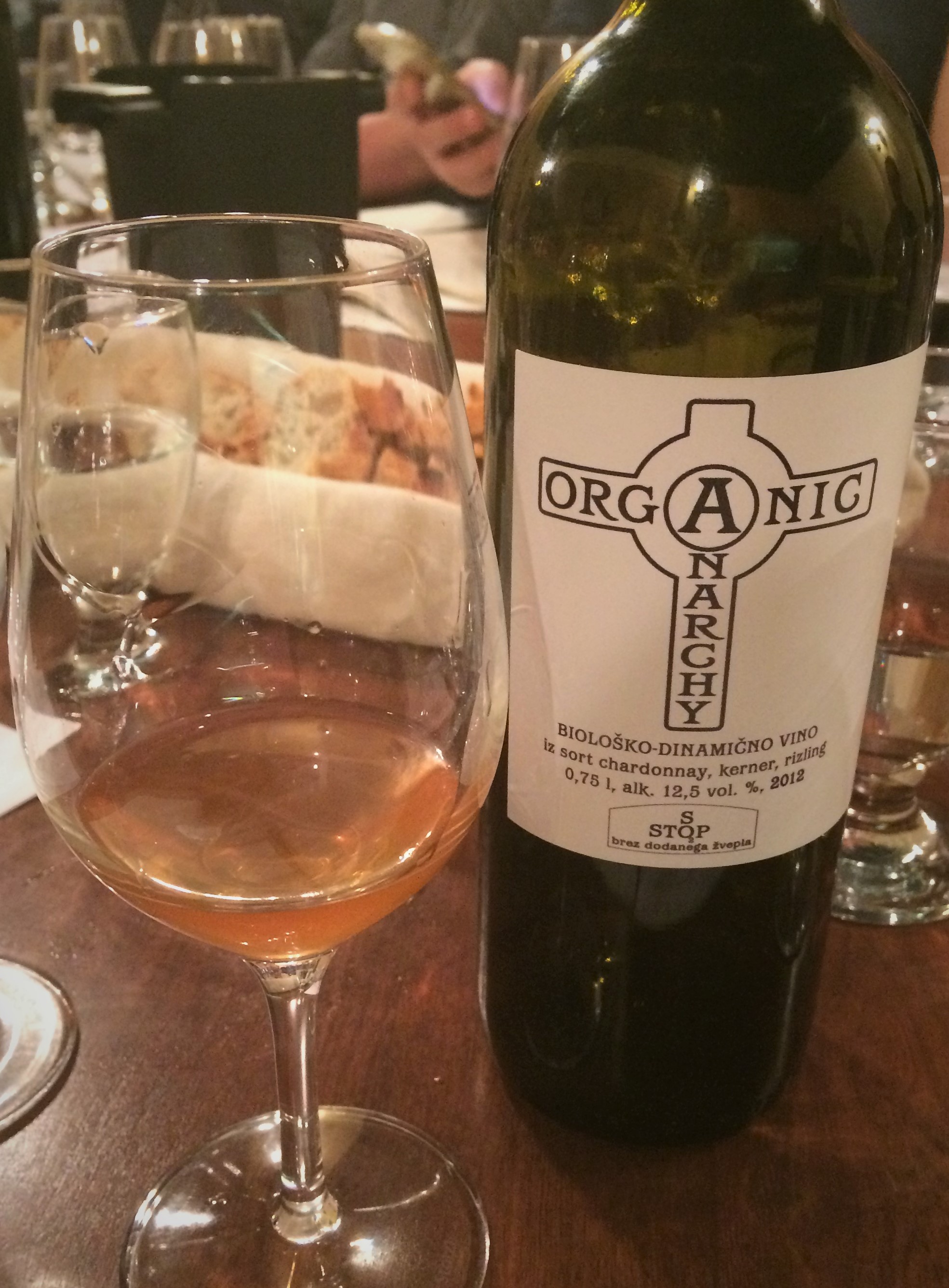
Hazy orange. Surprising, evolving nose: spicy, “kind of soapy,” “lit cigar,” dried orange peel and a hint of honey, among other things. Medium-bodied. Surprisingly fresh and vibrant for a five-year-old orange wine. The mineral-dusted fruit (stone fruit mainly) is almost sweet and yet so savoury. A hint of botrytis only increases the already complex set of flavours and aromas. Tingling acidity and a tannic rasp turn the silky texture a little raw-silky. The long finish is marked by pepper and nut notes. The way the wine developed in the glass suggests carafing an hour or two may be a good idea. Very impressive. I look forward to encounters with Urbajs’s other wines. (Buy again? The high price notwithstanding, yes, a bottle to savour at leisure.)
MWG October 13th tasting: flight 4 of 9
Orange crush
Located in Šempas in the western Vipava valley, about 20 kilometres east of Gorizia on the Italian border, the family-run Batič estate can trace its roots back to the late 16th century. It is known locally for its organically grown fruits and increasingly for its wines made from local and international varieties.
Primorska 2015, Zaria, Batič ($44.75, private import, 6 bottles/case)
A blend of Pinela (55%), Zelen (20%) Rebula (aka Ribolla Gialla, 5%), Vitovska (3%), Rumeni Mušat (aka Muscat Blanc à Petits Grains, 2%) and Chardonnay (1%) from biodynamically farmed vines planted in 1982 and rooted in marl soil of the Zaria vineyard. Manually harvested. Spontaneous co-fermentation on the skins in non-temperature-controlled open vats. Matured in Solvenian oak barrels. Unfiltered, unfined. No added sulphur. 13% ABV. Quebec agent: Vadim Fonta.

Hazy orange-bronze. A whiff of volatile acidity gives way to white spice, “cake,” yeast, minerals, peach and orange aromas. Lighter-bodied than expected (based on the appearance and nose) yet also very present. Complex and intensely flavoured with fruit, spice and minerals vying for attention. Light tannins and bright acidity give it some bite. The long, saline finish brings a hint of nuttiness and “lingering tortillas.” Characterful, engaging, satisfying, food-friendly and relatively affordable: what’s not to like? (Buy again? Yep.)
MWG October 13th tasting: flight 3 of 9
Collio rodeo
For its October agency tasting, the Mo’ Wine Group welcomed the personable Vadim Fonta, whose currently nameless wine agency – unofficially Agence sans nom – is usually referred to by his name. A couple of years ago, Vadim gave up a career in finance for one in wine, a field he felt far more passionate about. His primary focus is on a niche not particularly well represented in Quebec: organic, biodynamic and natural wines from Slovenia, the Balkans and eastern Europe as well as Italy, especially the northeast.
Once again the wines weren’t exactly in flights, though I’ve arranged them into such for reporting purposes.
Collio 2015, Bianco, Edi Keber ($40.50, private import, 6 bottles/case)
The estate, which has 10 hectares of vineyards, is located a short distance from the Slovenian border. The family has been making wines for more than three centuries though Keber’s first bottled vintage was 1957. This, the only wine it makes, is a blend of Friulano (aka Sauvignon Vert, usually around 70%), Malvasia and Ribolla Gialla from organically farmed vines averaging 40 years old and rooted in “ponka” – poor, stony, friable marl – soil. Manually harvested. Direct pressed (no skin contact). Fermentation in stainless steel tanks with selected, non-aromatic yeasts lasts three to four weeks. Matured one year in concrete tanks except for 20% of the Friulano, which spent six months in neutral tonneaux. Clarified by settling and fining with bentonite. Total production: 60,000 bottles. 13% ABV. Quebec agent: Vadim Fonta.
A bit reductive on opening, then dried lemon and limestone with some Sauvignon Blanc overtones. Rich and dense – not heavy – in the mouth. So clean and pure. Layers of yellow fruit (apple, peach), minerals, spice (anise), “almond blossom” and more make for an engagingly complex palate. Gleaming acidity keeps things fresh. The finish is long and bitter-edged, with herbal notes chiming in toward the end. (Buy again? Yes.)

Collio 2011, Bianco, La Castellada ($53.00, private import, 6 bottles/case)
Founded in the mid-1950s, the estate is located in Oslavia in the Gorizia hills close to the Slovenian border. A blend of Pinot Grigio (50%), Chardonnay and Malvasia from organically farmed vines averaging 35 years old rooted in ponka (see above). The Pinot Gris was direct pressed; the Chardonnay and Malvasia were macerated on the skins for four days. Spontaneous fermentation. Matured one year in stainless steel, one year in 200-litre Slavonian oak barrels, one year in neutral oak barrels and one year in the bottle. Unfiltered and unfined. 14% ABV. Quebec agent: Vadim Fonta.
Upfront minerals (including, per another taster, “plaster dust”) along with yellow tropical fruits and a shot of creamy vanilla. Richer and more honeyed than the Keber yet also “very savoury.” Great breadth, depth and length. The complex of fruit and minerals is sweetened by oak, lightly soured by acidity and complicated by a light but pervasive bitterness. Several tasters found this a little too rich and oaky, though nearly all conceded they might feel differently if it were served with a fancy seafood dish. (Buy again? A bottle for experimenting with food pairings.)
MWG October 13th tasting: flight 1 of 9
Native whites
Gaillac 2016, Les Pierres Blanches, Domaine De Brin ($24.85, 13314666)
A blend of Mauzac (60%) and Len de l’El (40%) from organically farmed vines rooted in stony calcareous-clay soil. Manually harvested. The grapes are direct-pressed and the must is chilled and clarified by settling. Vinification – including sponatneous alcoholic and complete malolactic fermentation – and maturation take place in neutral barrels and last nine to 12 months. Unfiltered and unfined. No added anything except possibly a tiny amount of sulphur at bottling. Reducing sugar: < 1.2 g/l. 12.5% ABV. Quebec agent: Ward & associés.
The first sniff brings a hint of reduction and volatile acidity followed by an odd mix of apple, flowers and sauerkraut. In the mouth, it’s clean, fresh and sleekly acidic, dry but full of applely fruit and quartzy minerals with a bitter undertow. Fair depth and good length. Not bad but not the revelation I was expecting. A taster who had enjoyed an earlier bottle didn’t peg our bottle, which was served double-blind, as the same wine. Nor did the wine match the description of the trustworthy SAQ advisor who recommended it. In other words, probably an off bottle. (Buy again? Yes, especially to give it another chance.)

Terre Siciliane 2016, Versante Nord, Uve Bianche, Eduardo Torres Acosta ($35.00, private import, 6 bottles/case)
Born in the Canary Islands, Acosta headed to southeast Sicily in 2012 to intern with Arianna Occhipinti. He later did a stint as a winemaker at Passopisciaro, eventually renting and farming a few parcels and making wine under his own name. His first commercial vintage was 2014. The grapes are grown in the Etna appellation but the wines are made at Occhipiniti’s facilities in Vittoria. That and the fact that at least some of the vineyards are higher than the allowed 800 metres of altitude are why the wines qualify only for the broad Terre Siciliane IGT designation and not the Etna DOC. This blend of Minella (60%) and other local varieties is made using grapes grown in six plots on the north face of Mount Etna. The organically farmed vines average 45 to 50 years old and are rooted in soils with a high volcanic ash content. The grapes are manually harvested, crushed and macerated on the skins for five days in concrete tanks with no temperature control. Fermented with indigenous yeasts. Matured eight months in neutral oak botti. The 2016 is the first vintage of the wine. Total production: 2,000 bottles. 12% ABV. Quebec agent: oenopole.
Complex nose, initially of “garlic sausage,” summer savoury and poblano chile, then more lemon and quartz. Dense and apricoty in the mouth, with citrusy acid and a mineral structure beyond the obvious current of salinity. The very long brings a lingering pithy bitterness. A multifaceted, engaging wine if not exactly a charmer. Probably better viewed as an accompaniment to dinner than an aperitif. Nearly the entire shipment was snatched up by Montréal Plaza restaurant, where it’s currently on the list for $76 and would make a smart match for many of their super-savoury dishes. (Buy again? Yes.)
MWG September 28th tasting: flight 2 of 7

 Brett happens