Posts Tagged ‘Red wine’
QPR CDR
 Côtes du Rhône Villages Signargues 2016, Domaine La Montagnette ($16.40, 11095949)
The grapes are grown by the estate’s owner but vinified, bottled and marketed by the small Vignerons d’Estézargues cooperative. This blend of Grenache (70%), Syrah (20%) and Carignan and Mourvèdre (together 10%) comes from vines grown in clay soil with the smooth stones typical of the former Rhône riverbed. Practices in the vineyard are semi-organic, with chemicals being used only as a last resort. The vines are gobelet-trained and the grapes are picked by hand, destemmed, lightly crushed, fermented at low temperatures and given a long (three to four weeks) maceration. After pressing, the wine is transferred to large barrels for maturation. No additives, including yeasts, except a small amount of sulphur at bottling. Unfiltered and unfined. Reducing sugar: 2.7 g/l. 14.5% ABV. Quebec agent: Rézin.
Delicious, Rhoney nose: red and black fruit (mainly berries), hints of black pepper, violet, spice, leather, leafmould and more. Medium-bodied. Heady but not hot, with a very fluid texture, ripe fruit and plenty of acidity. Light tannins provide an appealing rasp, dark minerals run throughout. A whiff of alcohol lifts the peppery finish while sandalwood and fruit cake linger. Other CDRs may have more depth but few offer this combination of savour, freshness, fleetness and price. A textbook, naturalistic CDR for $16.40, let alone the $14.65 it’s going for during the current promotion ($1 discount plus 750 Inspire points), this has QPR winner written all over it. (Buy again? For sure.)
Château Landra, take three
Ventoux 2016, Pur Jus Rouge, Château Landra ($25.86, private import, 12 bottles/case)
Syrah (60%) and Grenache (30%) and Cinsualt (10%) from 45-year-old vines rooted in gravelly alluvial deposits with lots of smooth pebbles and stones. Destemmed, crushed. Fermented (with indigenous yeasts) and matured in stainless steel. Unfined and probably unfiltered. No added sulphur. 14% ABV. Quebec agent: WINO.

Intriguing nose: cherry, black raspberry, “pink peppercorn,” “fresh-cut grass,” “asafoetida” (all per other tasters) and more. Medium-bodied, juicy and, alcohol notwithstanding, unhot. Packed with sweet fruit but far from a bomb. The extract and fine but present tannins give it a plush texture but the streaming acidity eliminates any possibility of heaviness. Long, clean, black pepper-dusted finish. A fresh, dry, savoury, uncomplicated red whose only drawback is that, at 14%, it’s dangerously drinkable. (Buy again? Sure.)
MWG July 13th tasting: flight 8 of 9
Cab Franc three ways
Though they don’t come from a wine-making family, brothers Fabien and Cyril Boisard founded Domaine du Mortier in 1996 when they both were in their teens. Their holdings comprise around 12 hectares of vineyards in Saint-Nicolas-de-Bourgueil and a recently acquired three hectares in Bourgueil. Farming is organic-leaning-biodynamic, harvesting is by hand and none of the wines is chaptalized.
Saint-Nicolas-de-Bourgueil 2015, Les Sables, Domaine du Mortier ($27.23, private import, 12 bottles/case)
100% Cabernet Franc from seven parcel of mostly young vines in sandy soil. Whole-bunch fermentation takes place in 70 hl concrete vats. Lees from earlier vintages are used to start the fermentation. Pump-overs with minimum oxygen uptake are performed for five or 10 minutes a day. Matured on the lees for about six months. Unfiltered and unfined. A tiny amount of sulphur (16 mg/l) is added at bottling. 12.27% ABV. Quebec agent: WINO.
Red and black berries, coffee, dried meat, slate, pepper, distant barnyard. Medium-bodied and so very drinkable. A mouthful of tart fruit, dark minerals, lively acidity, super-supple tannins. Dry and wonderfully pure. Nothing deep or complex (a function of soil and vine age), just good, clean fun. The easiest-drinking Cabernet Franc I’ve encountered in a coon’s age. (Buy again? Done!)

Saint-Nicolas-de-Bourgueil 2014, Dionysos, Domaine du Mortier ($32.89, private import, 6 bottles/case)
100% Cabernet Franc from 30-year-old vines rooted in gravel over tuffeau. Manually harvested. Gently destemmed, gently pressed and given around 25 days’ maceration on the skins. Barrel-fermented using indigenous yeasts. Matured eight months in old oak barrels. 13.35% ABV. Quebec agent: WINO.
Darker nose of red berries and slate with meat and vegetal notes. Full and round in the mouth, packed with remarkably juicy fruit. Firm tannins bestow a velour-like texture, bright acidity a bit of a bite. The bedrock minerality rumbles through the long, spicy finish. The winemakers feel this often needs a couple of years before it hits its stride and drinks well for six to eight years beyond that. (Buy again? Yes.)
Vin de France 2014, 180 jours, Domaine du Mortier ($63.79, private import, 6 bottles/case)
VdF because the brothers feel it wouldn’t be accepted by the AOC authorities and because it leaves them free to supplement Saint-Nicolas grapes with fruit from their holdings in Bourgueil. Cabernet Franc from 60- to 70-year-old vines in tuffeau. Whole-bunch fermented and macerated in old barrels for 180 days, with the barrel being tightly closed, not topped-up and turned once daily during fermentation; after 180 days, the barrel is taken apart so the wine and skins can be transferred to the press. After pressing, the wine is matured in new barrels for another 180 days. Unfiltered and unfined. No added sulphur. 13.5% ABV. Due to the small quantities made, the wine is normally sold only at the winery, a limit of 12 bottles per customer is imposed and, reportedly, none is exported. Bravo to Martin Landry for scoring a few cases for Quebec. Quebec agent: WINO
Much darker and denser than its flightmates. Complex, funky nose: old wood, dark fruit and minerals, “animale,” “green olives,” “the stuff you scoop out of a squash” and more. Rich and dark yet somehow fresh. So complex and layered, so plush and chewy. Superbly structured with velvety tannins, glowing acidity and mineral depth. Great length. Complete, elegant, accessible. A big wine but so not the overextracted monster I was fearing it would be. Just wow. (Buy again? Just yes.)
MWG July 13th tasting: flight 7 of 9
Gamay de soif
Touraine 2015, Gamay, Domaine Courtault Tardieux ($22.45, private import, 12 bottles/case)
After stints as a university student and briefly as a social worker, winemaker Simon Tardieux, who had spent time as a teenager working at the late, lamented Clos Roche Blanche, teamed up with Alain Courtault, a neighbour who had vines and was converting to organic agriculture. Located due east of the Thésée post office and less than a mile from the Cher river, the 15-hecatre estate specializes in vins de soif, thirst quenchers made from Cabernet Franc, Côt, Gamay, Pineau d’Aunis and Sauvignon Blanc. This 100% Gamay comes from organically farmed 50-year-old vines. Manually harvested. Whole-bunch maceration and fermentation took place in stainless steel tanks with indigenous yeasts. A small amount of sulphur dioxide was added at bottling. Bottled in March 2016. 12% ABV. Quebec agent: WINO.
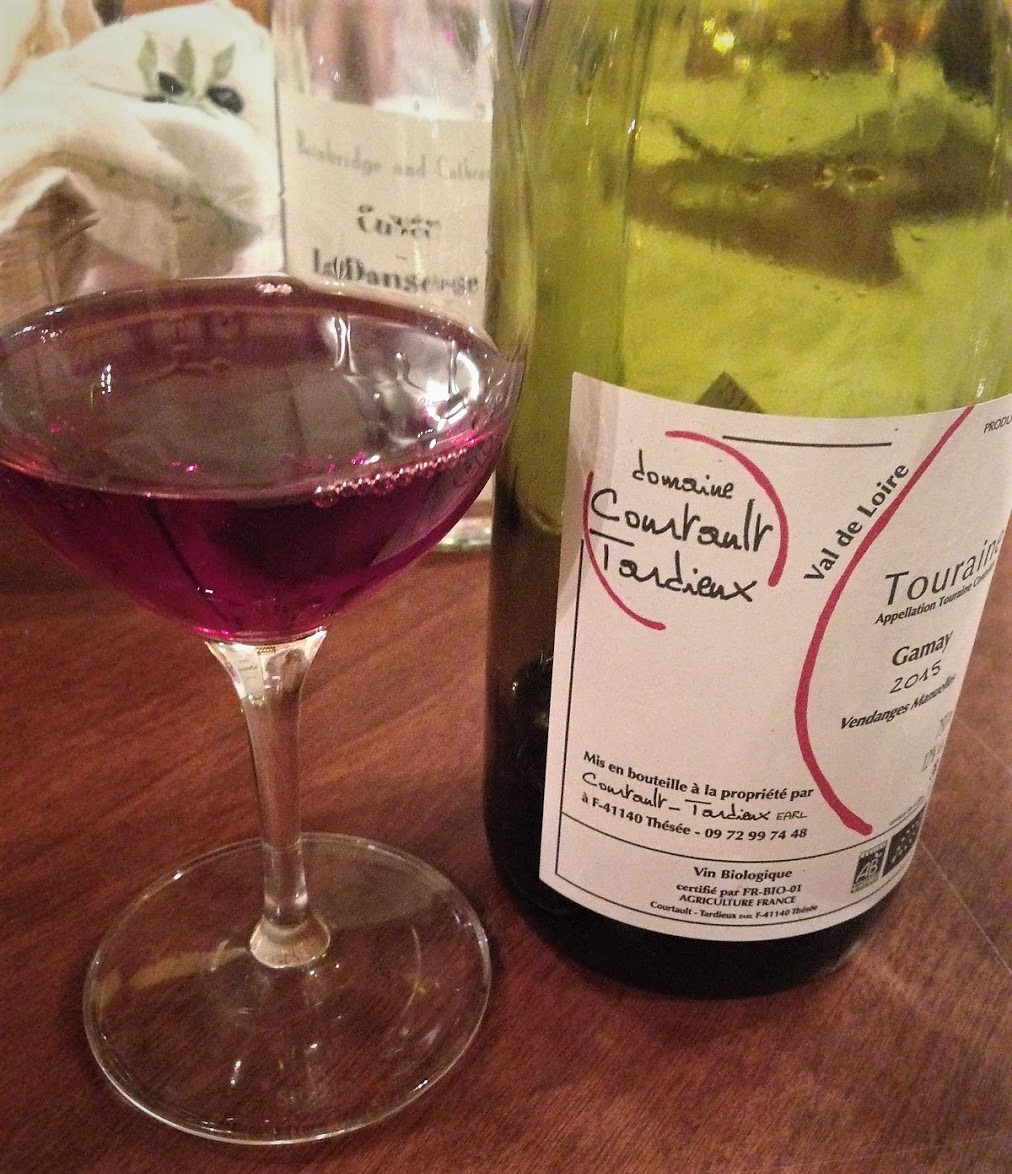
Light, winey, floral nose showing some sour berries and leaves and background funk. Light- to medium-bodied, gauzy tannined and acid bright. Not as plush-fruity as, say, a Morgon, but remarkably minerally and fluid, especially on the mid-palate. A faint lactic note on the finish prompts “cherry yogurt” from one of the assembled. Fresh, clean, tasty and so, so drinkable. Definitely a Gamay but definitely not a Beaujolais. (Buy again? Um, it’s irresistible.)
MWG July 13th tasting: flight 6 of 9
Neo Naoussa
 Naoussa 2014, Domaine Thymiopoulos ($23.85, 13288218)
A new cuvée that, in price and sophistication, sits between the Jeunes vignes and the Terre et Ciel (the Xinomavro Nature, available through the private import channel, stands apart in more ways than one). 100% Xinomavro from organically farmed, 30-year-old vines rooted in volcanic and limestone soil and located between 180 and 500 metres above sea level. Manually harvested. Fermented with indigenous yeasts. After alcoholic and malolatic fermentation, the wine was transferred into 500-litre oak barrels for 12 months’ maturation. Unfiltered. Reducing sugar: 2.4 g/l. 12.5% ABV. Quebec agent: oenopole.
Protean nose of, among other things, black cherry, wild strawberry, black olive, balsamic vinegar, old leather, earth and violet. Medium-bodied and, despite the fine, firm tannins, supple. Fruity but dry, with freshening acidity, flavours that echo the nose and a slatey underlay. Any oak is very sotto voce. The finish is savoury, while earth and sweet-spicy notes linger. Clean, pure and eminently drinkable. Food-friendly too. May be the most elegant Xinomavro I’ve tasted. Unsurprisingly, the limited quantities are disappearing fast. (Buy again? Of course.)
Mountain red
 Achaia 2010, Grand Cave, Domain Mega Spileo/Cavino ($28.85, 13110137)
The estate is named after a nearby monastery that once owned the vineyard. Most of the technical info comes from the back label and kudos to the winery for that. A 60-40 blend of Mavrodaphne and Mavro Kalavrytino (aka Black of Kalavryta) from vines rooted in sandy clay soil in a relatively cool-climate mountain vineyard between 780 and 880 metres above sea level and located near the village of Kalavryta. No chemical insecticides, herbicides or fertilizers are used. Manually harvested. Destemmed. Prefermentation maceration at low temperatures for 24-48 hours. Long and gentle alcoholic fermentation in small temperature-controlled tanks. Malolactic fermentation and maturation on the lees in new oak barrels (80% French, 20% American) for 16 months. Lightly filtered. Not cold stabilized. Bottle-aged 24 months before release. 6,500 bottles made. 13.5% ABV. Quebec agent: Divin Paradis.
Heady nose of plum, prune, leather, burned earth, sweet spice, coffee, hints of blood and chocolate. More medium- than full-bodied and very dry. The ripe but not jammy or forward fruit is complemented by a full set of tertiary flavours (old wood, leather, cigar box, dried herbs and earth) and a swirl of inky minerals, framed by smooth but animating acidity and soft tannins that show their mettle on the long, lightly astringent finish. Sandalwood, terracotta and dried cherry linger. Savoury, balanced and at peak. Fairly priced for a seven-year-old wine of this quality. Fairly cries out for grilled lamb. (Buy again? Yep.)
Alois and Eloi
The only connection between the wines in the last flight was that both were bigger reds that had caught my attention, the Trebulanum because it is made from a grape I’d never heard of, let alone tasted, the Trévallon because it was reportedly excellent and I’d been giving the wine a pass since an unhappy encounter with the 2007. The wines were double-carafed about four hours before we tasted them.
Terre del Volturno 2011, Trebulanum, Casavecchia, Alois ($44.00, 12628604)
Contrary to what SAQ.com claims, this is not made by the Piedmontese Azienda Agricola Casavecchia but by the Campanian estate Vini Alois, which is based in Pontelatone. 100% Cassavecchia from organically farmed wines averaging 20 to 25 years old and rooted in the mineral-rich volcanic soil of the 1.5 ha Cesone vineyard. Manually harvested. Alcoholic fermentation and maceration on the skins with regular pump-overs took place in stainless steel tanks and lasted 20 days. Transferred to large botti for 18 months, during which time it underwent complete malolactic fermentation. Racked into large botti for 12 months’ further maturation. Aged in bottles for six months. Reducing sugar: 1.8 g/l. 13% ABV. Quebec agent: Diamond Estates.
Wafting nose of ink, old leather, Chambord, “peat” and “smoke.” Dark and dense on the plate, rich in black raspberry fruit and slatey minerals. Tannins confer a velvet astringency, acidity a certain freshness. Finishes long. Spice and leather linger. Powerful, earthy and “too young” but not hot or harsh. Speaks of its place and, despite the modern wine-making, of an older time. (Buy again? Yes, and not just for curiosity’s sake.)

Alpilles 2013, Domaine de Trévallon ($85.25, 13269359)
Now in his mid-60s, Eloi Dürrbach began making wine in 1973, when he gave up architecture to manage a vacation property and a few vines his parents had bought. This, then, is his 40th vintage. A 50-50 blend of Cabernet Sauvignon and Syrah from organically farmed vines rooted in limestone and clay. The whole clusters were fermented with indigenous yeasts with regular punch-downs and pump-overs. Matured 24 months on the lees in foudres (95%) and barrels (5%). Fined with egg whites. Unfiltered. No added sulphur. 13% ABV. Quebec agent: LVAB.
An initially disconcerting nose of peas, “ketchup maison,” “beets” and beef bouillon gives way to plum, cassis, blackberry and garrigue. Rich and satiny in the mouth. The balance between the layered fruit, fleshy tannins and racy acidity is something to behold. Overtoned with black olive and leather, the minerally, bitter-edged finish seems to go on forever. Accessible yet capable of long ageing. One of the great wines of Provence. (Buy again? If I can scrape together the bucks…)
MWG June 22nd tasting: flight 7 of 7
Francs et graves
Côtes de Bordeaux Francs 2014, Emilien, Château le Puy ($28.15, 00709469)
A blend of Merlot, Cabernet Sauvignon and Carménère (typically 85%, 14% and 1% respectively) from biodynamically and organically farmed 50-year-old vines. The grapes are fully destemmed. Fermentation in open, temperature-controlled vats with indigenous yeasts and no chaptalization lasts two to four weeks. Matured 14 months in large foudres and 11 months in third- to fifth-fill oak casks. Bottled unfiltered with only a small dose of sulphur. Reducing sugar: 1.9 g/l. 12.5% ABV. A few 500 ml bottles of the 2012 can also be found ($20.75, 00896399). Quebec agent: A.O.C.
Intriguing nose that gets the aroma-namers going: plum, “edamame,” “nigella,” “pickled turnip juice.” Medium-bodied. The pure fruit and graphite underlay are nicely structured by fine, firm tannins and bright acidity. Finishes long and clean with faint notes of tobacco and spice. This perennial favourite is true to form in 2014: a savoury, refreshing, eminently drinkable wine that everybody always enjoys. The QPR is high on this one. (Buy again? Yep.)

Graves 2015, Clos 19 Bis/Vincent Quirac ($31.05, private import, 6 bottles/case)
Founded in the late 2000s, the tiny (1.5 hectare) estate makes a Sauternes and a red Graves. The latter is a blend of Merlot (around 50%), Cabernet Franc and Cabernet Sauvignon from organically farmed vines averaging 40 years old and rooted in gravelly soil over a clayey-calcareous base. Manually harvested. The varieties are vinified separately. The Merlot is cold-macerated before fermentation for a week, the Cabernets are directly fermented. Fermentation at low temperatures with indigenous yeasts, punch-downs and pour-overs (using buckets, not pumps) lasts 10 days. The wine is then left on it skins for another eight to 10 days. 12.5% ABV. Quebec agent: Vini-Vins.
Cherry, cassis, “cocoa powder and ashes” and a strong whiff of volatile acidity. Quite disjointed in the mouth, with a harsh verging on acrid note, a problem that airing and swirling didn’t resolve. Bears little resemblance to the fresh, clean, juicy-fruited, mineral-laden, roundly structured, medium-bodied wine enjoyed a few days earlier. Clearly defective and, as such, a disappointment. (Buy again? Based on the earlier bottle, yes.)
MWG June 22nd tasting: flight 6 of 7
Barrel-aged, new moon, off-track
Based in Mittelbergheim in the Bas-Rhin department, André Rohrer has run his eponymous eight-hectare estate since 1988, when he took the helm from his father. The estate, which has been in the family for eight generations, has holdings in three communes: Eichoffen, Mittelbergheim (including 18 ares in the Zotzenberg grand cru) and Barr. Though it abandoned herbicides in the 1960s and chemical insecticides in the 1980s, the estate has been certified organic only since 2001. In recent years, Rohrer has been exploring new wine-making paths, including a line of natural wines, one of which we tried. The estate doesn’t have a website and technical information is non-existent on the Web, though it’s probably safe to assume that the wines are fermented with indigenous yeasts and made with minimal intervention.
Alsace 2015, Pinot Noir, Élevé en Barrique, Domaine André Rohrer (ca. $23, importation valise)
100% Pinot Noir from organically farmed vines. Matured in oak barrels. 13.5% ABV.
Faintly candied nose of cherry-chocolate, red wine-poached pears and a little band-aid. Medium-bodied, dry and fruity, with streaming acidity and fine tannins mostly apparent on the longish, faintly astringent finish. The oak is less present on the palate than on the nose. “A bit rustic,” as one taster notes, not that there’s anything wrong with that. (Buy again? Sure, especially at the local price.)
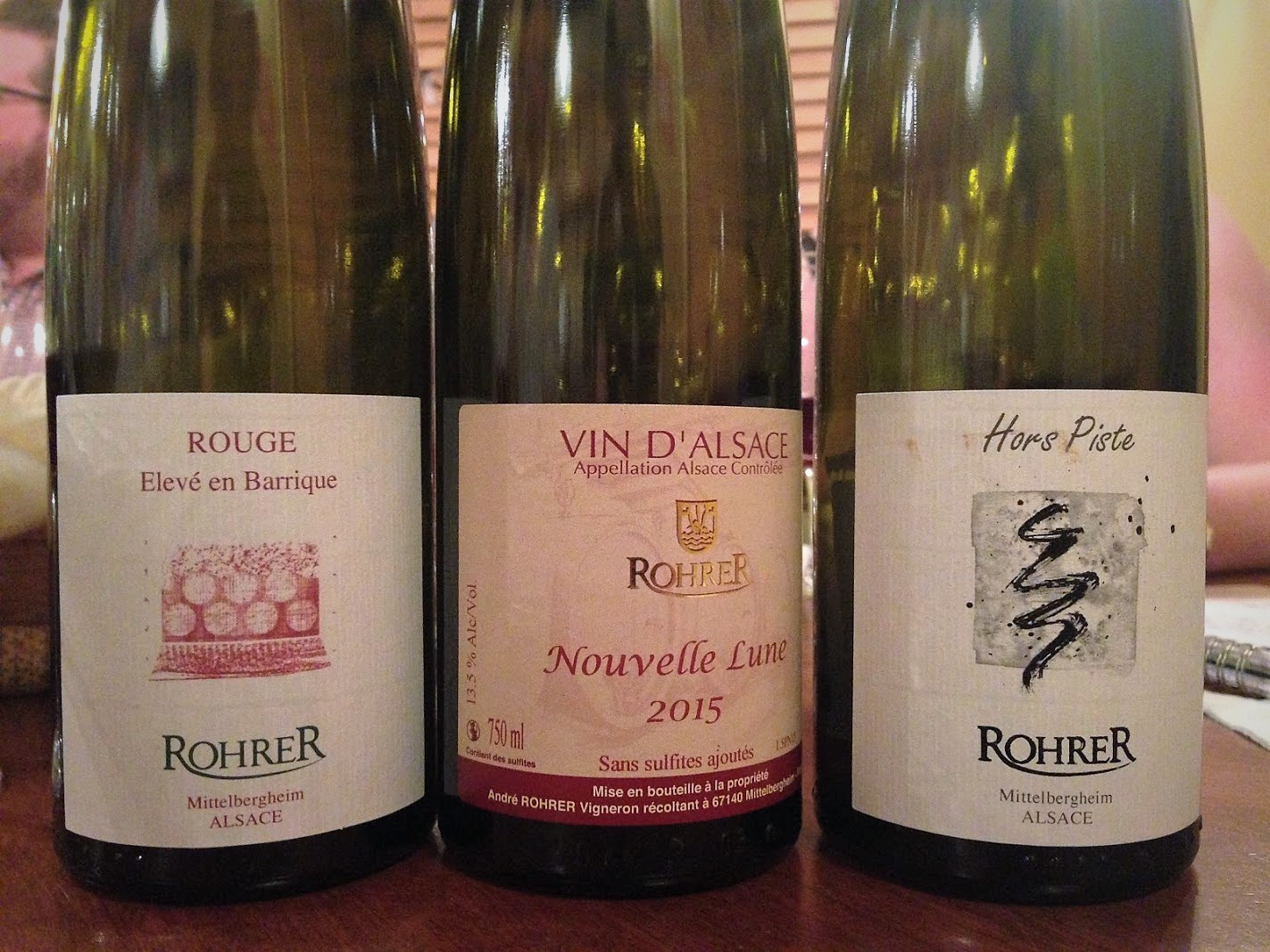
Alsace 2015, Pinot Noir, Nouvelle Lune, Domaine André Rohrer (ca. $26, importation valise)
100% Pinot Noir from organically farmed vines. Unfiltered and unfined. No added sulphur. 13.5% ABV.
Intriguing, involving nose of camphor, red berries and cherry taking on notes of game stew. Rich though medium-bodied, packed with ripe, almost juicy fruit. Velvety tannins and sleek acidity provide welcome structure. Nicely sustained finish. There was some discussion as to whether the bottle was a little corked; the consensus was no, it just needed time to sort itself out. (Buy again? Sure.)

Alsace 2015, Pinot Gris, Hors Piste, Domaine André Rohrer (ca. $25, importation valise)
100% Pinot Gris from organically farmed vines. Vinified like a red wine, with extended skin maceration. As Pinot Gris grape skins are dark pink in colour, so is the wine. Matured in neutral barrels. 14% ABV.
Intriguing nose of rose hip, peppermint, “nutmeg” and eventually honey. Lightweight yet possessed of a slightly unctuous texture. A tasty mouthful of spicy, strawberry-overtoned fruit, structured by lacy tannins, buoyed by acidity and underlain with minerals. The alcohol is well-nigh invisible. A savoury, refreshing, very drinkable wine quite unlike any other. (Buy again? Yes.)
MWG June 22nd tasting: flight 5 of 7
It’s a white! It’s a red! It’s Brutal!!!
Brutal!!! 2015, Partida Creus (ca. €10-15/$15-20 in Barcelona, importation valise)
Apparently, the wine is sin denominación, demoninationless. In any case, it’s a blend of several Catalan grape varieties (probably Vinyater, Subirat Parent, Xarel·lo, Cartoixa Vermell and Blanc de Sumoll) from biodynamically farmed vines planted in clayey-calareous soil. Manually harvested. The varieties are vinified separately and blended before bottling. Fermented with indigenous yeasts. Matured seven months in stainless steel tanks. Unfiltered, unfined. No added sulphur. 11% ABV.

Cloudy pink to the eye. Spicy/funky nose of dough, distant sweet berries, “pink peppercorns” and an evanescing whiff of volatile acidity that one taster describes as “latex gloves.” A bit spritzy in the mouth. Lightly fruity and quite dry but tangy like “kambucha” and “hibiscus.” The tannins are light while the acidity is electric. So refreshing and drinkable and such energy! Like nothing else I’ve tasted yet also like an instant old friend. Wow. (Buy again? By the case.)
On the Raw Wine website, Partida Creus describes themselves thus: “We are winegrowers and winemakers in the Massis de Bonastre terroir of Catalunya, working with our own production of grapes and with rescued ancient vineyards with interesting native variety of grape. All the vines are organic farming, our organic and natural wines express the terroir with its variety typicity. We try to put in the bottles our deep respect and love for wild and Mediterranean landscape, nothing else. A tribute to nature and biodiversity, our work is a way of life making wine. Certified organic by CCPAE Consell catalá de la Producció Agraria Ecologica.”
Partida Creus is represented in Quebec by Vinealis. A Brutal inquiry to the agency’s prime mover, André Papineau, elicited the following reply: “Oui je bosse avec Partida Creus depuis presque 4 ans maintenant. Quantités confidentielles au départ et de bons volumes maintenant. Par contre le Brutal a longtemps été seulement disponible pour le Bar Brutal; il est un peu cher, se vendrait @ ± 36 $ la bouteille le carton de 6, alors j’hésite un peu. Par contre j’aurai beaucoup de différents vins en août : VN blanco et tinto, BN blanco, TN Tinto, et les grandes cuvées de Vinyater, Cartoixa Vermell, Xarel-lo. Toutes les bulles sont réservées pour le groupe Joe Beef…” [Yes, I’ve been working with Partida Creus for nearly four years. Tiny quantities at the start and good volumes now. However, the Brutal!!! was available only at the Bar Brutal [in Barcelona] for the longest time. It’s kind of expensive, going for around $36 a bottle, case of six, so I’m hesitant. On the other hand, I’ll have a bunch of other Partida Creus wines in August: VN blanco and rojo, BN (white), TN (red) and the top wines, made from Vinyater, Cartoixa Vermell and Xarel-lo. All the sparklers are reserved for the Joe Beef group…”]
MWG June 22nd tasting: flight 4 of 7

 Brett happens