Posts Tagged ‘Sparklers’
L’Aietta trio
In 2001, Francesco Mulinari, then a 17-year-old high school student, decided to make wine from some abandoned Sangiovese vines growing on a 2.5-hectare plot of land that his parents had acquired as a picnicking spot and natural playground for their children. Located just outside the wall surrounding Montalcino, the spot, known as L’Aietta, had been the site of an army encampment during the 1555 siege of the city. When applying for a production permit, he – well, actually his mother, as he was underage – learned that the parcel lay within the Brunello di Montalcino appellation. His first vintage, the 2001 and officially a Brunello, consisted of 720 bottles.
In 2004, Mulinari replaced the old vines with bush vines, as the hard rock would have made installing posts difficult. The land is so steep – the tiny parcel is divided into 18 terraces – that all work is done by hand. In 2002, he acquired another hectare of Sangiovese vines in nearby Castelnuovo dell’Abate, eventually replacing them with bush vines too. He more recently took over a 2.5-hecatre plot in Monecucco, from whose grapes he makes a Chianti-style blend (Sangiovese, Canaiolo and Colorino) and a raisinated sweet white (Malvasia di Candia, Vermentino and Zibibbo). He works this last vineyard with a horse.
Farming is rigorously organic (certified in 2013); harvesting is manual; wine-making is non-interventionist. The winery, the smallest in Montalcino, has very little technology and only tanks and barrels. All farming and wine-making is done by Mulinari by himself. Current production is around 7,000 bottles a year.
Vino Spumante 2013, Brut, Metodo Classico, L’Aietta ($55.25, private import, 6 bottles/case)
100% Sangiovese Grosso from organically farmed vines averaging 15 years old and located in the Castelnuovo dell’Abate vineyard. The grapes are harvested based on their acidity, not their maturation, and before their colour is fully developed (green harvest fruit, in other words). Macerated and fermented (with indigenous yeasts) for 30 days in stainless steel tanks. The still wine is matured for one year in large Slavonian oak barrels. Secondary fermentation and one year’s maturation take place in the bottle. Unfiltered and unfined. 11.5% ABV. Around 700 bottles made. Quebec agent: Vadim Fonta.

Pale pink. Initially closed nose with notes of cheese, modelling clay, bread dough and eventually red berries. Light effervescence. Smooth despite the bright acidity. More savoury than fruity. The mineral underlay lasts well into the long, saline finish with its peekaboo berry notes. Elegant, tasty, unusual and rare, though is that enough to justify the champagne-rivaling price? (Buy again? If feeling flush.)
Rosso di Montalcino 2015, L’Aietta ($37.75, private import, 6 bottles/case)
100% Sangiovese Grosso from organically farmed vines averaging 15 years old and located in the Castelnuovo dell’Abate vineyard. The grapes are macerated and fermented (with indigenous yeasts) in stainless steel tanks for 30 days. Matured one year in large Slavonian oak barrels and one year in the bottle. Unfiltered and unfined. 2,600 bottles made. 14.5% ABV. Quebec agent: Vadim Fonta.
Classic nose of cherry, tobacco, herbs and graphite. Velvety smooth on the palate. The ripe fruit is illuminated by soft-glow acidity, shaded by minerals. Stealth tannins turn more assertive on the spicy finish. Will probably be even better in a year or two. Lovely though one of those wines that shows better at the dining table than at a tasting. (Buy again? Yes.)

Brunello di Montalcino 2012, L’Aietta ($71.25, private import, 6 bottles/case)
100% Sangiovese Grosso from organically farmed vines averaging 15 years old and located in the L’Aietta vineyard. The grapes are macerated and fermented (with indigenous yeasts) in stainless steel tanks for 21 days. Matured two years in large Slavonian oak barrels and one year in the bottle. Unfiltered and unfined. 2,200 bottles made. 14% ABV. Quebec agent: Vadim Fonta.
Complex, evolving nose of red and black berries, smoke, graphite, tobacco, leather, oak, spice and maybe mint. Fuller, rounder, deeper and longer than the Rosso. Satin-textured. The beautifully pure ripe fruit is structured by round, firm tannins and fluent acidity. Dark minerals, nose-echoing tertiary flavours and Asian spice overtones add complexity and interest. Very long. A noble wine that’s delicious now but still a youngster. Probably a stunner in five to 10 years. (Buy again? Yes.)
MWG October 13th tasting: flight 6 of 9
Bulles de Germain
Saumur, Brut, Bulles de Roche, Thierry Germain/Michel Chevré ($33.25, 13059706)
Best known for his Domaine des Roches Neuves bottlings, Thierry Germain also produces wines with his long-time associate and vineyard manager Michel Chevré, who has acquired his own vineyards. The wines are made in the Roches Neuves cellars. This traditional method sparkler is a blend of Chenin Blanc (90%), Cabernet Franc (5%) and Chardonnay (5%) from 60-year-old biodynamically farmed vines rooted in limestone and clay. The still wine is fermented with indigenous yeasts and then matured three months in 228-litre used oak barrels. The bottled wine spends nine months on lattes prior to disgorgement. No dosage. 12.5% ABV. Quebec agent: Balthazard.

Pale gold with tiny bubbles and quickly disappearing foam. Expressive nose of quartz, candied apple, raisin brioche and honey. Medium-bodied, intense and very dry, with a fine, caressing, evanescing effervescence. Shot through with minerals (“lots of salinity”) and vibrant acidity, the ripe fruit (apple and pear mainly) lasts well into the long, bitterish finish. Intense. Some tasters detected a vague “stemmy” or “something vegetal” note but, if there was one, it was very low key. There’s been considerable variation in the four bottles of this I’ve tasted, some coming across as mineral-driven, others as more about the fruit. In all iterations, however, it’s been a wine with real presence and a lot of class. (Buy again? Yep.)
MWG September 28th tasting: flight 1 of 7
Champagne naturally
Champagne, Fidèle, Vouette et Sorbée ($87.47, private import, 6 bottles/case)
This is nearly all 2014 except for a dollop (about 5%) of reserve wine from a solera-type system started in 2001. A blanc de noirs: 100% Pinot Noir from 30-year-old biodynamically farmed vines from several parcels but all rooted in Kimmeridgian marl. The manually harvested grapes are gently pressed. The free-run juice is transferred to 400-litre oak casks for fermentation (with indigenous yeasts) and maturation. Undergoes malolactic fermentation. Indigenous yeasts are used for primary and secondary fermentation. Matured 10 months in used Meursault barrels. The bottled wine is aged on its lees on lattes and riddled on racks for around 15 months. No dosage. Sulphur dioxide is added to the incoming grapes but not at bottling. 12% ABV. Quebec agent: Rézin.
A white wine but with a rosé cast. Intriguing nose of distant strawberry, fired minerals and “garlic brioche.” Fine, non-aggressive bubbles, pure fruit, silky acidity and an unmissable mineral depth. Long flavourful finish with lingering rhubarb crème brûlée. Absolutely not an aperitif wine, rather one to open ahead of time, maybe even carafe, and drink with food. (Buy again? Yes.)

Champagne, Extra Brut, Blanc d’Argile, Vouette et Sorbée ($114.58, private import, 3 bottles/case)
A blanc de blancs: 100% Chardonnay from biodyanmically farmed vines planted in 2000 in a single plot. The vines – massale cuttings from Jacques Sélosse and Vincent Dauvissat – were planted “wild” (directly in the unprepared clay and Kimmeridgian limestone soil). Manually harvested. Fermented and sparkled with indigenous yeasts. The still wine is matured 18 months on the lees in oak casks. Undosed. 12% ABV. Quebec agent: Rézin.
Dried apple, yeast, icing sugar and a faint, nougaty oxidative note. Fine, caressing bubbles. Smooth, caressing acidity. Browning apple upfront, apple Danish and salty seashells on finish. Still a baby. Clean, tonic and bracing, this cuvée lives up to its reputation of being a Chablis with bubbles. As a group, champagne is arguably the most overpriced wine in the world; that said, this delivers exceptional if relative QPR. (Buy again? Yes.)
The first time I tasted them, Vouette et Sorbée’s champagnes did not impress. Subsequent encounters, which have mostly involved bottles laid down a few years, have been much more positive and I now rank the house among my favourite producers.
MWG August 11th tasting: flight 9 of 9
Cidereal
Located in Franklin, Quebec, and founded in 2010, Entre Pierre et Terre is run by the husband and wife team of Loïc Chanut and Michelle Boyer. An oenologist by training, Chanut began working at La Face cachée de la pomme and for a while was a partner in Domaine des Salamandres. Production is limited to a range of still and sparkling apple and pear ciders, still fruit wine and apple-based vermouth. Cortland, Golden Russet and Macintosh are the estate’s backbone apple varieties though trials are being conducted with others, including some old northern French varieties. All the sparklers are made using the traditional method.
Poiré mousseux, Entre Pierre et Terre ($19.95, 12120579)
A pear cider made from mid-season fruit. The juice takes several weeks to ferment. Matured and sparkled in the bottle for a minimum of nine months. Sulphur use is limited to a small shot at disgorging. Reducing sugar: 27 g/l. 7% ABV. Quebec agent: Rézin.
Applesauce, pear compote and hay stubble. Fine effervescence. The flavour is clearly though not intensely pear, with a bit of white pepper adding intrigue. Clean and verging on off-dry but drying on the finish. While it’s a tad sweeter than I remember earlier bottles being, it’s still a pleasant sipper. (Buy again? Sure.)
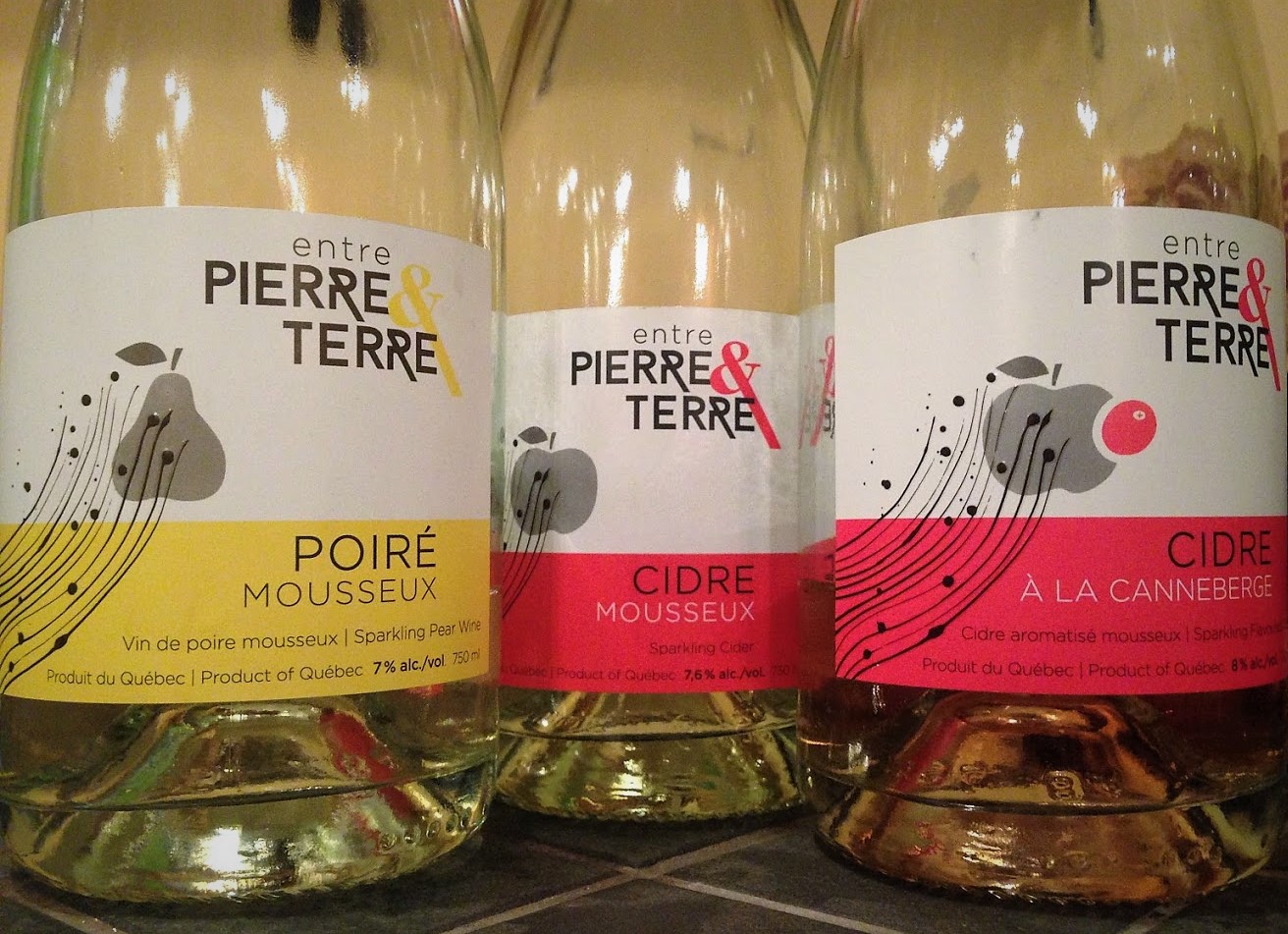
Cidre mousseux, Entre Pierre et Terre ($18.90, 11957043)
The apples for this cider are harvested over two months, then pressed together. The juice is concentrated by exposure to the cold of winter. Primary and secondary fermentation (the latter in bottles on lattes) last a minimum of 10 months. Reducing sugar: 18 g/l. 7.6% ABV. Quebec agent: Rézin.
A nose more subtle than the poiré’s: green pear and apple. Dryish and elegant in the mouth, the effervescence understated. A mineral streak joins the savoury fruit joined while smooth acidity keeps things lively. Clean finishes. (Buy again? Sure.)
Cidre à la canneberge, Entre Pierre et Terre ($16.25, 12030291)
Cranberries are macerated in the cider before bottling. The bottles spend at least nine months on lattes before disgorging. 8% ABV. Quebec agent: Rézin.
Fresh and baked apple, wild red berries and a hint of cheese. Clean and not especially fruity. Dry with bright, even trenchant acidity. A faint saline undertow lasts well into the long finish. Somewhat to my surprise, the most complex and nuanced of the trio. Would make an excellent Thanksgiving aperitif and could probably continue right on through the meal. (Buy again? Yes.)
MWG July 27th tasting: flight 1 of 7
Winey dancer
Vin de France 2015, La Danseuse, Bainbridge and Cathcart ($32.34, private import, 6 bottles/case)
British expat Tony Bainbridge and his American wife Julie worked in wine and ESL in Burgundy before moving to the Loire, where Tony initially held a job at Domaine Mosse. In 2007, with the help of Ali and Rob Cathcart, the couple acquired 4.2 hectares of vineyards in Faye d’Anjou and Chavagnes les Eaux. Total production is around 6,500 bottles. This rosé sparkler is 100% Grolleau from organically farmed grapes. The grapes are manually harvested, given a short maceration on the skins and fermented with indigenous yeasts. Fermentation continues in the bottles, which are riddled and eventually disgorged. Unfiltered, unfined and, like all the estate’s wines, bottled in a clear champagne bottle and closed with a crown cap. The name (“the dancer”) refers to the barrel of wine that, back in the day, a vigneron would set aside for his mistress. 11.5% ABV. Quebec agent: WINO.
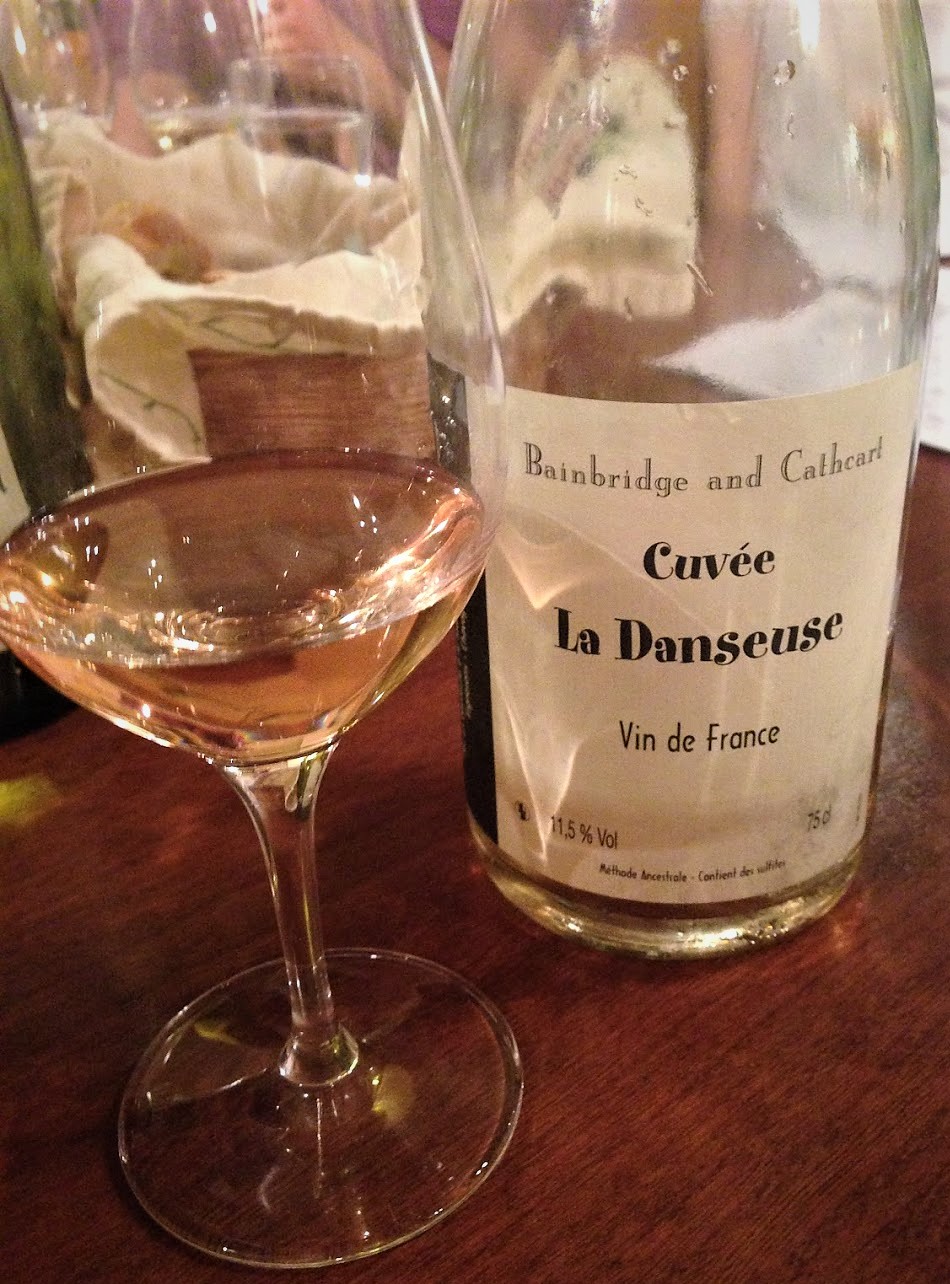
Delightful nose of strawberry pastry, “rugelach” (per another taster), a touch of arugula and yeast. Clean and dryish in the mouth, with bright-verging-on-tart acidity cutting any residual sugar. Tiny prickly bubbles add texture and lift. The load of minerals makes the wine taste more white than red, despite the beguiling strawberry overtones. Some caramel cream creeps in on the finish. Fresh, lip-smacking and super-drinkable. (Buy again? Yep.)
MWG July 13th tasting: flight 4 of 9
Hit and miss
Crémant du Jura, Rosé, Domaine Désiré Petit ($24.00, 12399717)
100% Pinot Noir from vines averaging 20 years old and rooted in calcareous topsoil over red marl. Sparkled using the traditional method. Reducing sugar: 12 g/l. 11.5% ABV. Quebec agent: Tannins.
Engaging nose dominated by cherry and almond. Softly effervescent. Dry. Fruity attack, savoury mid-palate. Lots of minerals. Crisp acidity adds cut and freshness. Spice and “pink grapefruit pith” mark the fair finish. Parabolic in that it got better as it breathed but then became a little one-note as it warmed. That said, this would make a fine starter at a backyard barbecue and you could keep going with it if you had some salmon on the grill. (Buy again? Sure.)

Crémant du Jura, Rosé, Domaine André et Mireille Tissot ($30.75, 13236670)
Pinot Noir (50%), Poulsard (25%) and Trousseau (25%) from biodynamically farmed vines around a quarter of a century old and rooted in clay and limestone. Half the grapes were direct pressed, the other half pressed after a short maceration. Fermented and matured in stainless steel tanks. Once malolactic fermentation was completed, the wine was bottled and sparkled using the traditional method. 12.5% ABV. Quebec agent: LVAB.
Yeasty/briochey nose of red berries, yellow plum and, a bit disconcertingly, “ketchup maison.” Very dry on the palate (I suspect this may be a zero dosage sparkler). Fine effervescence with bubbles one taster describes as “crunchy.” Minerals galore, peekaboo strawberry and soft but sufficient acidity. Sadly, all that takes a backseat to an overwhelming bitterness. Improved slightly with time in the glass, though never enough to win over a single taster. Tissot is one of our favourite Jura producers and this was the first Tissot rosé any of us had tasted, so the letdown was huge. Didn’t smell or taste like an off bottle. Just off the boat so maybe suffering from travel shock? (Buy again? Only to give it a second chance.)
MWG May 18th tasting: flight 1 of 6
Red bubble
Vin de France 2015, La Bulle Rouge, Les Capriades ($35.25, private import, 12 bottles/case)
Based in the Loire Valley’s Touraine region, Les Capriades founder and co-owner, Pascal Potaire, is considered the king of pet nats (short for pétillants naturels, natural sparkling wines produced using the ancestral method). This red example is a blend of juice from three varieties of organically farmed red-fleshed Gamay – Gamay de Bouze, Gamay de Chaudenay and Gamay Fréaux – explaining the cuvée’s former name, BCF. 11% ABV and I’m guessing somewhere around 10 g/l of residual sugar. Quebec agent: Glou.

Medium red with scarlet glints and fast-disappearing shocking pink foam. The nose is a swirl of raspberry vinegar, burnt hair, burnt sugar, lipstick, chocolate, pink blossoms and spice. A sip reveals a soft-sparkled wine that’s fresh, fruity and definitely not dry. Sleek acidity, a mineral underlay and a lingering bitterness counteract the sweetness to some degree. “Raspberry freezee” concludes one taster. A tad richer than but otherwise not dissimilar to a Bugey-Cerdon, which can be had for about $12 less. (Buy again? Maybe.)
MWG April 21st tasting: flight 3 of 6
Off and on
Crémant d’Alsace 2013, Bernhard & Reibel ($25.75, 13133224)
Not listed on the producer’s website, this appears to be a Quebec-only bottling. A blend of organically farmed Chardonnay and Pinot Noir (50-50 per the SAQ, 80-20 per the agency whose technical info for the wine is identical to the producer’s info for the non-vintage crémant with a different label). Manually harvested. Slow pneumatic pressing. The must is fermented with indigenous yeasts. Sparkled using the traditional method. Matured at least one year in the bottle on lattes. Lightly filtered. Reducing sugar: 6.9 g/l. 12% ABV. Quebec agent: Boires.
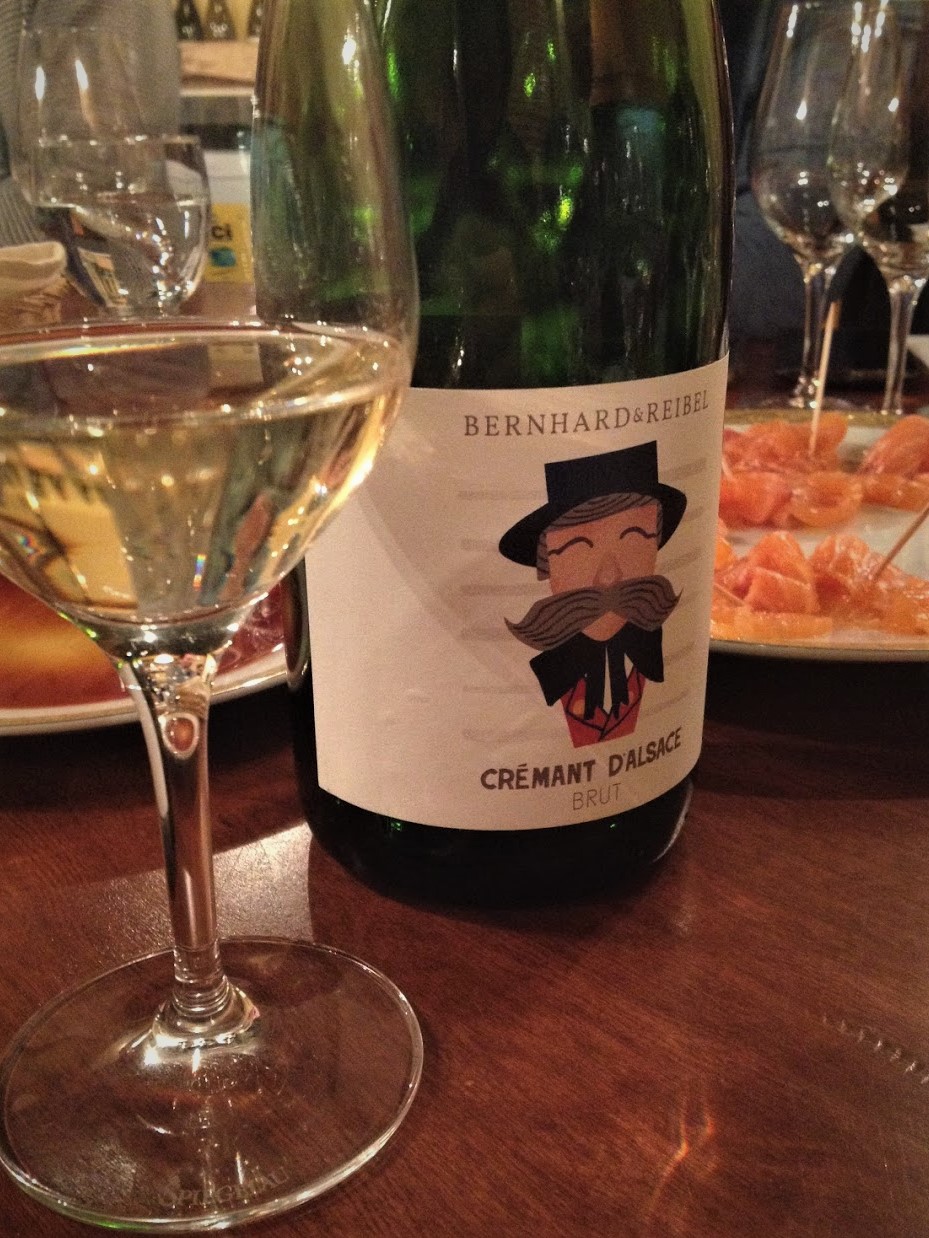
First bottle: Pale gold with fine bubbles. The nose is described variously as “more apple than pear,” “caramel apple,” apple seeds, “sweat or maybe volatile acidity,” chalk, “rancio” and “wet laundry.” In the mouth, the wine is fruity and dry, with good acidity and a fine effervescence. Yet there’s a fuzziness about it, a touch of oxidation and a lingering impression of something a little off. No one is enamoured and one or two perceptive tasters suggest our bottle is defective. Plates of Scottish-Asian gravlax having been set out (thanks, Mike!), we decide to open the backup.
Second bottle: Less gold in colour, the bubbles equally fine. The nose is fresher and fruitier, full of apple, citrus and mineral aromas and a whiff of brioche. On the palate, it’s crisper, cleaner, brighter, more textured and even drier. The racy acidity and mineral substrate last well into the creamy finish. We have a winner. (Buy again? Sure.)
MWG April 6th tasting: flight 1 of 7
WINO tasting (3/6)
Located in the commune of Montaigu in the southern Jura, the estate now known as Domaine Pignier was created by monks in the 13th century and acquired by the Pignier family in 1794. It was certified biodyanmic in the early 2000s. The focus is on the vineyards, with a minimalist approach in the cellar (no added anything except occasionally minute amounts of sulphur).
Crémant du Jura, Rosé, Domaine Pignier ($36.46, private import, 6 bottles/case)
100% Pinot Noir from biodynamically framed vines. Manually harvested. Briefly macerated and fermented using a pied de cuve starter. The base wine is matured six months in oak barrels, then sparkled using the traditional method, with no dosage. No added sulphur. The bottles are aged on lattes for 12 months. 12.5% ABV. Quebec agent: WINO.
Deep salmon pink with pink foam and fine bubbles. Intriguing nose: strawberry cheese danish, “cheese rind,” prosciutto, “baker’s yeast” and more. Dry and buoyant on the palate. Though there’s a soft-glowing core of red berries, the fruit is ethereal, haunting more than inhabiting a matix of minerals that prompted descriptors like “saline” and “seaweed.” Long savoury finish. Lovely. (Buy again? Yes.)


Côtes du Jura 2014, Trousseau, Les Gauthières, Domaine Pignier ($57.33, private import, 6 bottles/case)
100% Trousseau from biodynamically farmed, massal propagated vines. Yields are kept very low (25 hl/ha). The manually harvested grapes are destemmed, macerated and fermented using a pied de cuve starter and manual punch-downs and pump-overs during an entire lunar cycle. Matured 12 months in oak barrels of various sizes. Unfiltered. Bottled by gravity and with no added sulphur on a fruit day (per the lunar calendar). 11.5% ABV. Quebec agent: WINO.
Morello cherry, hard red candy, dried leaves, limestone, eventually tomato and “umami.” More like cranberry in the mouth with charcoal overtones. Medium-bodied and satin-textured. Chewing brings out the fruit and reveals dimension and complexity. The fine tannins add a mild astringency to the long, vapourous finish with its faint almond note and Szechuan pepper-like numbingness. Accessible but young and best cellared for five or 10 years. Way pricey but one of the most beautiful Trousseaus I’ve tasted. (Buy again? Yes.)
MWG March 23rd tasting: flight 3 of 6
WINO tasting (1/6)
The Mo’ Wine Group’s latest agency tasting was led by the affable Martin Landry from WINO. Around three years old, the agency specializes in wines that are, at a minimum, organic or biodyamic and often “natural.” You’ll find them on the lists at many of the city’s hipper restaurants and wine bars, including Diplomat, Pullman, Rouge Gorge and Moleskine (to name a few recent sightings).
We got things rolling with a classy sparkler from Limoux.
Blanquette de Limoux 2015, Monsieur S./Étienne Fort ($25.33, private import, 12 bottles/case)
Fort is a barely 30-something vigneron who works the family’s two hectares of vines at the Château Saint Salvadou in Bourliège in the Aude department. In 2011, he decided to stop selling his fruit to the local co-op and to start making his own wines. The grapes for this 100% Mauzac come from organically and biodynamically farmed, 30-year-old vines rooted in deep clayey limestone. Manually harvested. Made without additives of any kind. Fermented in stainless steel. Sparkled using the traditional method. Matured 12 months on the lees. Undosed, unfined, unfiltered. Spent 12 months in the bottle on lattes. 12% ABV. Quebec agent: WINO.
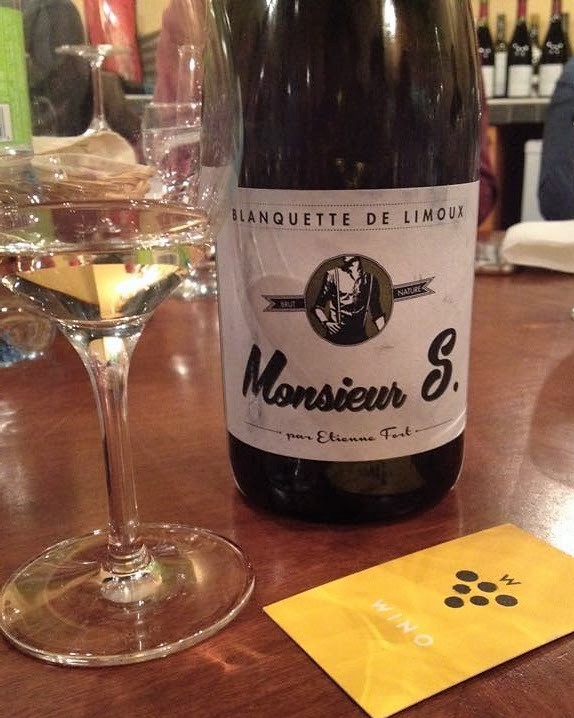
Yeasty, leesy nose with quartz and lemon notes. Tiny, tingling verging on prickly bubbles. Bone dry, crisp and clean. Trenchant and minerally upfront with lemon and gooseberry emerging on the mid-palate. A pithy thread runs throughout. The long, savoury, fairly complex finish has a touch of salinity. This bracing and refreshing sparkler would make a fine aperitif or, as Martin suggested, a dashing companion to oysters on the half shell. (Buy again? Yes.)
MWG March 23rd tasting: flight 1 of 6

 Brett happens