Posts Tagged ‘Under 13 percent’
Loosen up
Mosel 2015, Riesling, Dr. L, Loosen Bros. ($16.45, 1068525)
The estate’s entry-level Riesling is a négociant wine made from grapes grown to spec and bought under long-term contracts. Vinified in stainless steel tanks. Fermentation is stopped by chilling before all the sugar has been converted to alcohol. Screwcapped. Reducing sugar: 45 g/l. 8.5% ABV. Quebec agent: Select Vins.
Textbook nose: lime, white grapefruit, green apple, quartz and slate. A first sip reveals a spritzy tingle. Electric acidity shreds the sugar: while this is technically off-dry, it comes across as tartish, reinforcing the impression that the fruit is citrus, though peach is there too if you look for it. Chalkly, quartzy veins thread their way throughout, which is not to say there’s the kind of mineral (or any other) depth found in the estate’s single-vineyard bottlings. The puckery finish doesn’t last long, giving you the perfect excuse to take another sip. So pound-backable and – at 8.5% – you don’t pay a price for doing so. Lemon-limeade for adults. Should be on the wine list of every southeast Asian restaurant in the city and yet, amazingly, it almost never is. (Buy again? Yes, yes, yes.)
Morgon, Morgon, not Morgon
Morgon 2014, Côte de Py, Jean Foillard ($41.09, private import, 12 b/c)
100% Gamay from organically farmed vines between ten and 90 years old and grown in manganese-rich schist and granite. Manually harvested. Whole-cluster fermentation lasts three to four weeks. Matured six to nine moths in used oak barrels. No additives of any kind during the wine-making. Unfiltered and unfined. A minimal amount of sulphur dioxide may be added at bottling. 12.5% ABV. Quebec agent: Rézin.
Aromatic, very Gamay nose: slate, “dried leaves” (per another taster), floral notes and a whiff of earthy funkiness along with the expected red berries. Medium-bodied and satin-textured. A touch of sweet red chile savouries the lush fruit. The frame of light tannins, the illuminating acidity and a vein of dark minerals run from start through the nicely sustained finish. Accessible if somewhat monolithic at this stage, it showed best at the end of the tasting, four hours after it was opened and double-decanted. A couple of years or more in the cellar will do a world of good. (Buy again? Done!)
Morgon 2014, Cuvée Corcelette, Jean Foillard ($38.75, 12201643)
100% Gamay from organically farmed vines averaging 80 years old and grown in sandstone soil. Manually harvested. Whole-cluster fermentation lasts three to four weeks. Matured six to nine moths in used oak barrels and a single 30-hl foudre. No additives of any kind during the wine-making. Unfiltered and unfined. A minimal amount of sulphur dioxide may be added at bottling. Reducing sugar: less than 1.2 g/l. Quebec agent: Rézin.
Nose of red berries, faint spice, horse/leather: similar to the Côte de Py though a shade less complex, outgoing and airy. So fresh, pure, savoury and delicious. Ripe fruit, good structure and length, with the minerals most prominent on the finish. Perhaps a little less dense, more rustic and more open than its sibling though also sure to benefit from being left unopened for a year or three. Is there a better Beaujolais at the SAQ? (Buy again? Yes.)
After we’d finished with the Foillards, one of tasters generously offered to open a new arrival he had purchased on his way to the tasting room. I wondered whether its coming after two top Morgons might show it to disadvantage but I needn’t have worried.
Vin de France 2015, Le P’tit Poquelin, Maison B. Perraud ($22.70, 12517998)
100% Gamay from biodynamically farmed 40-year-old vines. Manually harvested. The whole clusters undergo carbonic maceration for 12 days. No additives, including sulphur. Unfiltered and unfined. Reducing sugar: 1.3 g/l. 13% ABV. Quebec agent: Raisonnance.
Appealing nose: floral, slate, berries, sap. A bit of spritz on the palate (carafe the wine for hour an hour if that sort of thing bothers you). On the lighter side of medium-bodied. The sweet fruit has a sour edge and is lightly structured by fine, supple tannins and glowing acidity. Sappy, lip-smacking finish. An easy-drinker with real presence. What it lacks in dimensionality and class compared with the Foillards, it makes up for in immediate appeal. The most successful of the three vintages of this wine that I’ve tasted. (Buy again? Yes.)
MWG October 27, 2016, tasting: flight 5 of 7
Vini per salumi
Grignolino d’Asti 2014, Grignè, Montalbera ($19.35, 13014372)
100% Grignolino from five- to 25-year-old vines. Manually harvested. Fermented in stainless steel tanks for 15 days, with the seeds removed after four to six days. Undergoes malolactic fermentation. Racked into stainless steel tanks for four months’ maturation. Lightly filtered. Reducing sugar: 7.0 g/l. 12.5% ABV. Quebec agent: Valmonti.
Cedar, “old lady’s rose perfume” (in the words of another taster), tea leaves, sour cherry. Becomes perfumier as it breathes and eventually takes on a honey note. Light- to medium-bodied. The bright acidity and higher-than-usual residual sugar confer a sweet-and-sour edge, “like rose kombucha.” Tannins are slim and only a little raspy. Dark minerals and a sappy green streak tether the floral component. A faint bitterness lingers through the finish. Quite different (more Ruchè- or Larcrima di Morro-like) from other Grignolinos I’ve tried – this one, for example. (Buy again? Probably not, though I’ll gladly check out the 2015 if it’s drier.)
Dogliani 2014, San Luigi, Chionetti ($21.80, 12466001)
See here for background on the producer. 100% Dolcetto from vines averaging around 25 years old and grown in the San Luigi vineyard. Manually harvested. The soft-pressed grapes were macerated and fermented in temperature-controlled (max 29–30°C) tanks with indigenous yeasts and daily pump-overs for seven days. The wine was racked into new tanks for malolactic fermentation and 11 months’ maturation. Saw only stainless steel until bottling. Cold stabilized but unfiltered. Reducing sugar: 1.9 g/l. 13.5% ABV. Quebec agent: oenopole.
Mulberry, morello cherry, animale and sandalwood. A silky middleweight. Fruity but dry and nicely tart. Slightly rustic tannins give it a light, pervasive astringency, the rumbling of minerals a modicum of depth. Finishes faster than I’d like though a bitter almond note lingers. Pure, tasty and easy to down. (Buy again? Yep.)
MWG October 27, 2016, tasting: flight 4 of 7
On Borde
After studying oenology and working at estates in various regions of France, Julien Mareschal founded Domaine de la Borde in Pupillin in the Jura in 2003. The estate currently has 5 ha of vines, 3.5 ha of which are white grape varieties. The vines – the typical mix of Chardonnay, Savagnin, Poulsard, Pinot Noir and Trouseau – average around 30 years of age. Though synthetic chemicals and herbicides have been avoided from the start, the estate officially switched to organic farming only in 2012, when it also began following certain biodynamic procedures.
Arbois Pupillin 2014, Terre du Lilas, Domaine de la Borde ($40.25, 12886494)
100% Chardonnay from a steeply sloped (20°), southwest-facing vineyard of argillo-calcareous topsoil over deep grey marl. Altitude: 450 m. Manually harvested. Eighty percent destemmed. The pressed juice is chilled to 6 to 8°C, then clarified by settling for 12 to 24 hours. Fermented with indigenous yeasts in 500-litre neutral oak barrels. Undergoes malolactic fermentation. Matured on the lees for 20 months. Reducing sugar: 2.4 g/l. 12.5% ABV. Quebec agent: Rézin.
Intriguing nose of toffee, shrimp shells and apricot yogurt. Medium-bodied, hazy and round, with no sharp edges. Apple, lemon, oatmeal and mineral flavours intertwine. Acidity buoys. Finishes long and on a dried seaweed note. Approachable and likeable. (Buy again? Yes.)
Arbois Pupillin 2014, Naturé, Foudre à Canon, Domaine de la Borde ($40.25, 12886566)
100% Naturé (aka Savagnin from a very steeply sloped (30°) vineyard of grey and blue marl covered by paper shale. Altitude: 400 m. Manually harvested. Eighty percent destemmed. The pressed juice is chilled to 6 to 8°C, then clarified by settling for 12 to 24 hours. Fermented with indigenous yeasts in 600- and 1,200-litre foudres. Undergoes malolactic fermentation. Matured on the lees for 20 months. Reducing sugar: <1.2 g/l. 12.5% ABV. Quebec agent: Rézin.
Initial surprising aromas (smoke, “sour cabbage,” “paprika”) segue into less unexpected limestone, pear and dried lemon zest as the wine breathes. Bracing and a little austere on the palate. White and citrus fruit and a mother lode of minerals are thrown into relief by streaming acidity and a striking absence of sugar. White spice and brine haunt the long finish. The purity and delineation are breathtaking. Even better three or four hours after opening. (Buy again? Done!)
Arbois Pupillin 2014, Côte de Caillot, Domaine de la Borde ($40.25, 12886427)
100% Chardonnay from a very steeply sloped (30°), south-facing vineyard of pebbly argillo-calcareous topsoil over limestone. Altitude: 550 m. Manually harvested. Eighty percent destemmed. The pressed juice is chilled to 6 to 8°C, then clarified by settling for 12 to 24 hours. Fermented with indigenous yeasts in second- to fifth-fill 500-litre oak barrels. Undergoes malolactic fermentation. Matured on the lees for 20 months. Reducing sugar: 1.3 g/l. 13% ABV. Quebec agent: Rézin.
Complex nose of “butter,” “smoke,” tropical fruit, sweat, “hay” and a hint of honey. Richer and a bit sweeter seeming than the Lilas. Except for the addition of yellow apple, the flavours echo the nose. Soft-glow acidity provides enough freshness, the aforementioned flavours and a chalky/flinty substrate produce a layered effect. Long, honey-cream finish. (Buy again? Sure though not in preference to the Terre du Lilas.)
A flight that generated a lot of discussion. Most around the table were seduced by the Chardonnays, found the Naturé too austere. When cleaning up after everyone had left, I discovered tail ends of the bottles in the fridge and revisited them. The Chards were still beguiling but seemed a little soft and shapeless and dominated by caramel/toffee/honey. The Naturé, on the other hand, was singing, glorying in its vibrancy, intensity and awesome minerality. I bought a bottle the next day.
MWG October 27, 2016, tasting: flight 3 of 7
Start off?
Montlouis sur Loire, Brut Nature, François Chidaine ($29.35, 11537049)
100% Chenin Blanc from biodynamically farmed vines between 20 and 50 years old. Manually harvested in several passes. The grapes are pneumatically pressed. Alcoholic fermentation with indigenous yeasts takes place in 600-litre demi-muids and can last up to six months. Malolactic fermentation is usually avoided. Sparkled using the traditional method. Undosed. The bottles spend 12 months on lattes. Reducing sugar: 8.2 g/l. 12% ABV. Quebec agent: Le Maître de Chai.
The cork emerges easily and without the expected pop. No foam and only a little fizz are to be seen in the glasses. The nose is complex with notes of sweat, wax, distant fields, citrus and oxidized pear. A sip shows the wine to be barely effervescent and what bubbles there are tiny and tickling. The low level of fizz combines with the extract, smooth acidity and touch of residual sugar to convey an impression of roundness. Quince and pear flavours tinged by browning dominate the palate, while the mineral substrate and a hint of white spice come to the fore on the long finish. Probably a defective bottle but still engaging and delicious. (Buy again? Yes, to see if ours was off or to re-experience it if it wasn’t.)
MWG October 27, 2016, tasting: flight 1 of 7
Greek winery tour: Papagiannakos (Attica)
[Hover over pics to display captions and credits; click to embiggen.]

Located a 20-minute drive southeast of Athens International Airport, the Papagiannakos Winery sits on the northwestern edge of Porto Rafti in Markopoulo. Shoebox-shaped with a sloping roof and prominent girders that, in profile, look like a giant Π (pi, the first letter of the family name), the current structure was built in the mid-2000s. It is, in a word, gorgeous: clean and modern in design, integrated into the surroundings, eco-friendly and featuring extensive use of local materials, in particular stones. The equipment is state of the art, the compact barrel cellar houses Allier and Nevers oak casks. A glass wall under a large overhang faces south providing ample daylight while, on the north side, a row of clerestory windows runs above the tall stone wall ensuring good airflow and an escape route for warm air. At the far (west) end of the building are found, on the lower level, a large tasting room and, on the upper level, a beautiful, high-ceilinged event space with a sweeping view over the valley to the ridge separating the region from Athens, with the airport’s control tower just visible over the intervening hills. Carefully chosen artwork adorns the walls. In short, it’s a feel good place.
The Papagiannakos family has been growing grapes and making wine in Markopoulo since 1919. In the 1960s, the second generation upgraded the winery and improved the quality of its output. The current, third-generation owner-winemaker, Vassilis, took over in 1992, and almost immediately began the process of bringing the winery into the 21st century.
 It may be a conceit but I’ve often found winemakers to resemble the wines they make. In any case, it’s true for Vassilis: classy yet down-to-earth, generous yet reserved, rooted in the past yet forward-looking, attached to a place yet also aware of the world. Speaking about his wines, he rightly said “they don’t shout,” but he could equally have been talking about himself (or his winery’s handsome labels, for that matter).
Papagiannakos has several vineyards, some around the winery and others – including ones under contract – scattered throughout the environs. Though the soil varies from parcel to parcel, it is generally rocky and infertile over a limestone base. The area receives no rain to speak of from May or June through October, so the vines are grown in low bushes; rot isn’t a problem here, in contrast to, say, the Peleponnese, where grape vines are usually trained on wires. The dry, breezy conditions also mean there is no need for insecticides or fungicides. On the other hand, irrigation (drip to conserve water) is a necessity, especially for young vines.
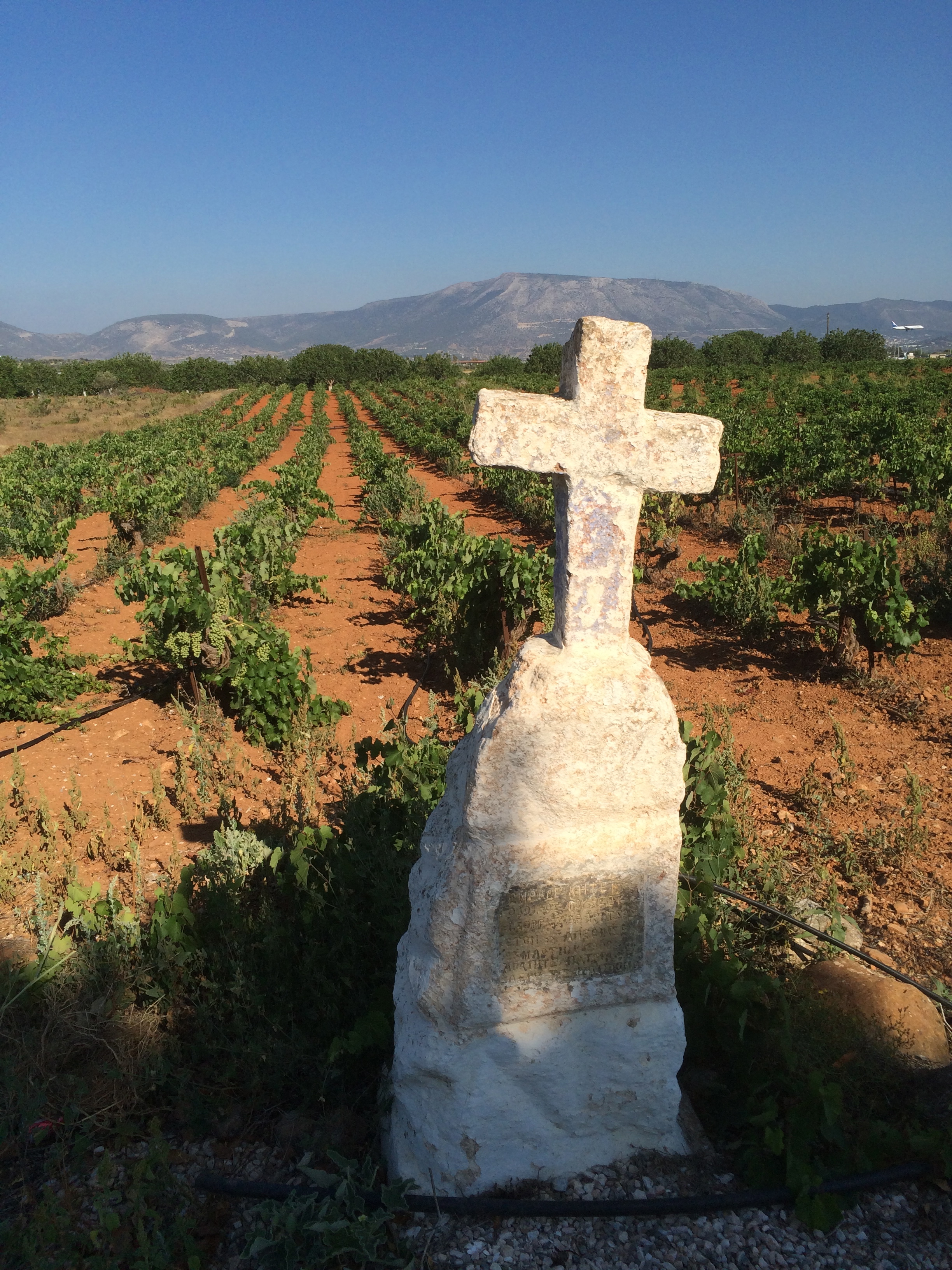 The winery has specialized in Savatiano since its founding. Actually, it was the only grape variety grown at the estate until Vassilis took the helm. He soon began playing with the newly resuscitated Malagousia variety and then red grapes. He also has several experimental plots, one of them Greco di Tufo, the first real vintage of which will be the 2016. “Italian grapes,” I exclaimed, unable to hide the surprise in my voice. With a shrug of the shoulders and a wry smile came the reply: “Well, as the name implies, it’s probably Greek.”
After a tour of the building, we gathered in the event room for a technical tasting with Vassilis and members of his family, including his children, affable, knowledgeable and articulate young adults who will eventually take the reins from their father. You’ll find my tasting notes after the jump.
For details about where we stayed, where and what we ate and what we saw, including some of Papagiannakos’s vineyards, see the Day One report on carswelliana.
INTRODUCTION
♦ PAPAGIANNAKOS (ATTICA)
TSELEPOS (ARCADIA)
MERCOURI (ELIS)
TETRAMYTHOS (ACHAEA)
THYMIOPOULOS (MACEDONIA)
ARGYROS (SANTORINI)
Red redemption
Prince Edward County 2010, Pinot Noir, Diana Block, Grange of Prince Edward ($35.00 at the winery)
100% Pinot Noir, the best lots from the Diana Block vineyard (the other lots go into the Estate and Select bottlings). The vines were planted in 2001 and 2002. Manually harvested and sorted. Alcoholic fermentation lasted 28 days. Matured 30 months in neutral French oak barrels. 13% ABV.
Showed some reductive funk at first, eliciting descriptors like “cherry-eucalyptus cough drops,” “putrescables after a couple of days” and “butterscotch” but soon comeing around. In the mouth, it’s medium-bodied and charming from the get-go. The cherry fruit is silky, the acidity bright, the tannins just firm enough. Minerals provide some depth. The barrels may be neutral but the oak seems a little laid-on, though not to the point of interfering with enjoyment. Could be longer. (Buy again? Maybe.)
Canada 2014, Pinot Noir, The Old Third ($43.00 at the winery)
100% Pinot Noir from the estate’s organically farmed Closson Road vineyard in Prince Edward County. The vines were planted in the mid-2000s. Fermented in stainless steel tanks with indigenous yeasts, then racked into French oak barrels, a fraction of which were new, where it matured for about one year. Bottled unfiltered, unfined and minimally sulphured. 12.5% ABV.
Engaging nose of red berries, spice and clay. Unmistakably Pinot from the first sip but with a striking umami side. The fruit is ripe and rich, tethered by tartness, supported by lithe tannins, shot through with wood and limestone. The long finish brings a red peppery note one taster characterized as “paprika.” Simultaneously earthy and elegant, like a good Burgundy. Hasn’t quite coalesced though the in-glass evolution indicates it will. (Buy again? Yes.)
Prince Edward County 2014, Pinot Noir, County, Unfiltered, Norman Hardie ($45.00 at the winery)
100% Pinot Noir. Given a six- to eight-day cold soak, then fermented seven days with indigenous yeasts and no more than two punch-downs a day. Macerated another week, more or less, with daily turning of the cap. Basket-pressed and transferred to French oak barrels for 10 months’ maturation. Bottled unfined and unfiltered, with a tiny shot of sulphur. 10.9% (!) ABV.
Red berries (strawberry above all), spice, cola, mowed field, hints of tar and cedar – classic, wot? Fresh sweet fruit, glowing acidity, soft tannins, some mineral earthiness, a subtle infusion of oak and the body of a welterweight about sum it up. The most obviously Pinot Noir of the quartet. Lovely if a bit facile, at least at this stage, and the price does give one pause. (Buy again? Maybe.)
Prince Edward County 2014, Pinot Noir, Quatres Anges, Lighthall ($35.00 at the winery)
100% Pinot Noir from estate vineyards. Fermented in temperature-controlled concrete tanks and some French oak barrels. Matured on the lees in French oak barrels. And that is all the winery thinks you need to know… 12.5% ABV.
“Wet dog” and sap aromas give way to cherry with hints of smoke and spice. A delight in the mouth: medium-bodied and silky, fresh-fruited and brightly acidic with fine, structuring tannins and a surprising complexity involving discreet layers of minerals and oak and a faint green streak, more herbal than vegetal and most noticeable on the long, clean finish. Integrated, harmonious and ready to go. For drinking here and now, the winner of the quartet. (Buy again? Def.)
None of the wines was carafed beforehand and all showed better after 40 minutes in the glass. As usual, the tasting was double-blind to everyone except me and the “importer” (blind to us). Those in the dark quickly pegged the wines as Pinot Noir but were perplexed as to their origin, finally settling on “some fictional region between Loire and Jura and like, Jamaica.” Oddly, while there was some initial speculation about Oregon, no one suggested Prince Edward County and most were dumbfounded when the bottles were unveiled. All in all, a well-received flight and coming as quite the relief three weeks after the PEC Cab Franc and Zweigelt debacle.
MWG September 8, 2016, tasting: flight 5 of 6
Two Channing Daughters
North Fork of Long Island 2014, Rosso Fresco, Channing Daughters (US$20.00 at the winery)
Always a blend, though the grapes and percentages change from vintage to vintage. The 2014 is 39% Merlot, 21% Dornfelder, 16% Syrah 3% Lagrein, 3% Teroldego and 1% Blaufränkisch. The grapes are hand-picked, destemmed and crushed by foot. Fermented with indigenous yeasts and regular punch-downs. Matured eight months is old oak barrels. Filtered but not fined.
Red berries, graphite and a hint of barnyard. Medium-bodied. Structured more by bright acidity than the supple tannins, the juicy fruit slow fades to old wood and minerals. Overtones of sweet spice and “salted plum” linger into the finish, which seems anchored by a not unpleasant bitterness. Simple but not facile, and really quite drinkable. (Buy again? Yes, especially at the US$14 it goes for in some New York City wine shops.)
The Hamptons 2013, Blaufränkisch, Sylvanus Vineyard, Channing Daughters (US$26.00 at the winery)
A 75-25 blend of Blaufränkisch and Dornfelder from vines planted in 1999. The grapes are picked by hand, destemmed and crushed by foot. Fermented with regular punch-downs. Matured 12 months in old hogsheads, puncheons and barriques made from French and Slovenian oak. Gravity-bottled without fining or filtration. 12% ABV.
“Smells like a permanent” says one taster. “Aubergine” and “rotting leaves” add others. I also get blackberry tea, sawed wood, graphite and eventually spice. In the mouth, it’s richer, rounder and more dimensional than the Rosso Fresco. Bone dry, with sleek acidity and medium if chewy tannins. The fruit has noticeable dark cherry and mineral components, especially iron, like you sometimes get in red meat. A radicchio-like bitter streak appears on the finish. Savoury, even earthy and a bit unsmiling, this would probably be better with food. At C$33.75, the QPR seems a little off compared with its Austrian counterparts. (Buy again? Another bottle to try at the dining table.)
MWG September 8, 2016, tasting: flight 3 of 6
Majorly Muscadet
Muscadet Sèvre et Maine 2012, Clisson, Famille Lieubeau ($24.95, 12923021)
100% Melon de Bourgogne from organically farmed vines averaging 30 years old and rooted in granite soil in various parcels in the Clisson commune. Manually harvested. Whole-cluster pressed. Fermentation with indigenous yeasts took place in temperature-controlled (20°C) tanks and lasted three weeks. Matured 24 months in tanks on its lees. Reducing sugar: 1.3 g/l. 12% ABV. Quebec agent: Société Clément.
“Shrimp shells” (per another taster), lemon, apple, limestone and, eventually, peat and “celery salt” notes. Rich and round, dry and tart, subdued but revealing layers of flavour. The pure fruit is dusted with minerals while the credible finish has a saline edge and a faint hint of honey or caramel. Very likeable. (Buy again? Yes.)
Muscadet Côtes de Grand Lieu 2014, Clos de la Butte, Domaine de l’Aujardière/Éric Chevalier ($19.05, 12886831)
100% Melon de Bourgogne from 50-year-old vines planted in serpentinite, eclogite and quartz in the La Butte lieu-dit. The grapes are pneumatically pressed and the must transffered into glass-lined tanks. Fermented with indigenous yeasts. Matured eight to 10 months on the lees with regular stirring. Unracked and unfiltered. Reducing sugar: 1.3 g/l. 11.5% ABV. Quebec agent: oenopole.
Similar nose to the Clisson’s but deeper, the shells more oyster-like and showing a distinct white pepper note. Even smoother and rounder on the palate though equally layered and minerally. Crisp acidity keeps things fresh and lively. Hints of butter and caramel colour the long finish. The most middle-of-the-road of the trio, not that there’s anything wrong with that. Great QPR. (Buy again? Yes.)
Muscadet Sèvre et Maine 2014, Le Breil, Complémen’Terre ($30.25, private import, 12 bottles/case, NLA)
Founded in 2013 in Le Pallet, the winery is owned and operated by Marion Pescheux and Manuel Landron, son of legendary Muscadet producer Jo Landron. The couple works according to the lunar calendar. 100% Melon de Bourgogne from organically farmed vines rooted in orthogneiss and quartz. Manually harvested. After pressing, the juice is clarified by settling and fermented with indigenous yeasts. Matured on the fine lines for eight months. Nothing added except, when deemed necessary, a shot of sulphur (35 mg/l maximum). 12% ABV. Quebec agent: oenopole.
Lemon and minerals with hints of butter and eventually pale berries. In the mouth, it’s less rich and more rainwatery than its flightmates. On an equal footing with fired minerals, the subdued fruit is buoyed by soft acidity.. A thread of bitterness spools into the saline finish. Long and elegant if a bit inscrutable. Would love to revisit in a couple of years. (Buy again? If feeling flush, yes.)
MWG September 8, 2016, tasting: flight 2 of 6
World class
Golden Russet Cider 2014, Cuvée Yquelon, The Old Third ($21.00 at the winery)
Made from Golden Russet apples from an orchard near the winery. The fruit is hand picked and sorted. This being a traditional method sparkler, the second fermentation takes place in the bottle. Manually riddled and disgorged. Closed with a cork. 9.5% ABV.
Yeasty nose with some lime and chalk though, surprisingly, only a hint of apple. The effervescence is subdued to the eye, soft and fine in the mouth. Dry and winey, with wafting flavours of underripe pear and “guava” (quoting another taster), ground ginger notes, bright but smooth acidity and a faint tannic bitterness on the sustained finish. Tasting double-blind, several at the table thought this was a wine, not a cider, and it’s easy to see why. (Buy again? Definitely.)
MWG September 8, 2016, tasting: flight 1 of 6

 Brett happens