Posts Tagged ‘Under 13 percent’
Orange anarchy
Based in Šentjur, in eastern Slovenia, about 20 km northwest of Zagreb, Aci Urbajs became interested in wine-making in 1969 when, as a boy, he worked in a vineyard his parents had acquired. In 1987, he received, as a present for graduating from university, a small vineyard on the Rifnik hill, where unearthed Roman artifacts pointed to a long wine-making tradition on the site. A disciple of organic farming from early on, he was soon attracted to biodynamics and joined the Slovenian Demeter association in 1999. In the cellar, his approach is resolutely minimalist: spontaneous fermentation, no racking, no filtering, no fining. Two lines of wines are made: one with a small amount of added sulphur (20 to 30 g/l vs. the allowed 250 g/l), the other a “natural” line with no added sulphur. Chardonnay, Kerner, Pinot Gris, Welschriesling, Blaufränkisch and Pinot Noir are grown. Production is tiny, only a few thousand bottles a year.
Posavje 2012, Organic Anarchy, Aci Urbajs ($59.25, private import, 6 bottles/case)
A blend of Chardonnay, Kerner and Laški Rizling (“Italian Riesling” aka Welschriesling) from vines planted in 1988 and rooted in marble-rich soil. Two weeks’ maceration on the skins. Fermented in open barrels using indigenous yeasts. Matured one year (in used barrels, I’d guess). Unfiltered and unfined. No added sulphur. Vegan-friendly. 12.5% ABV. Quebec agent: Vadim Fonta.
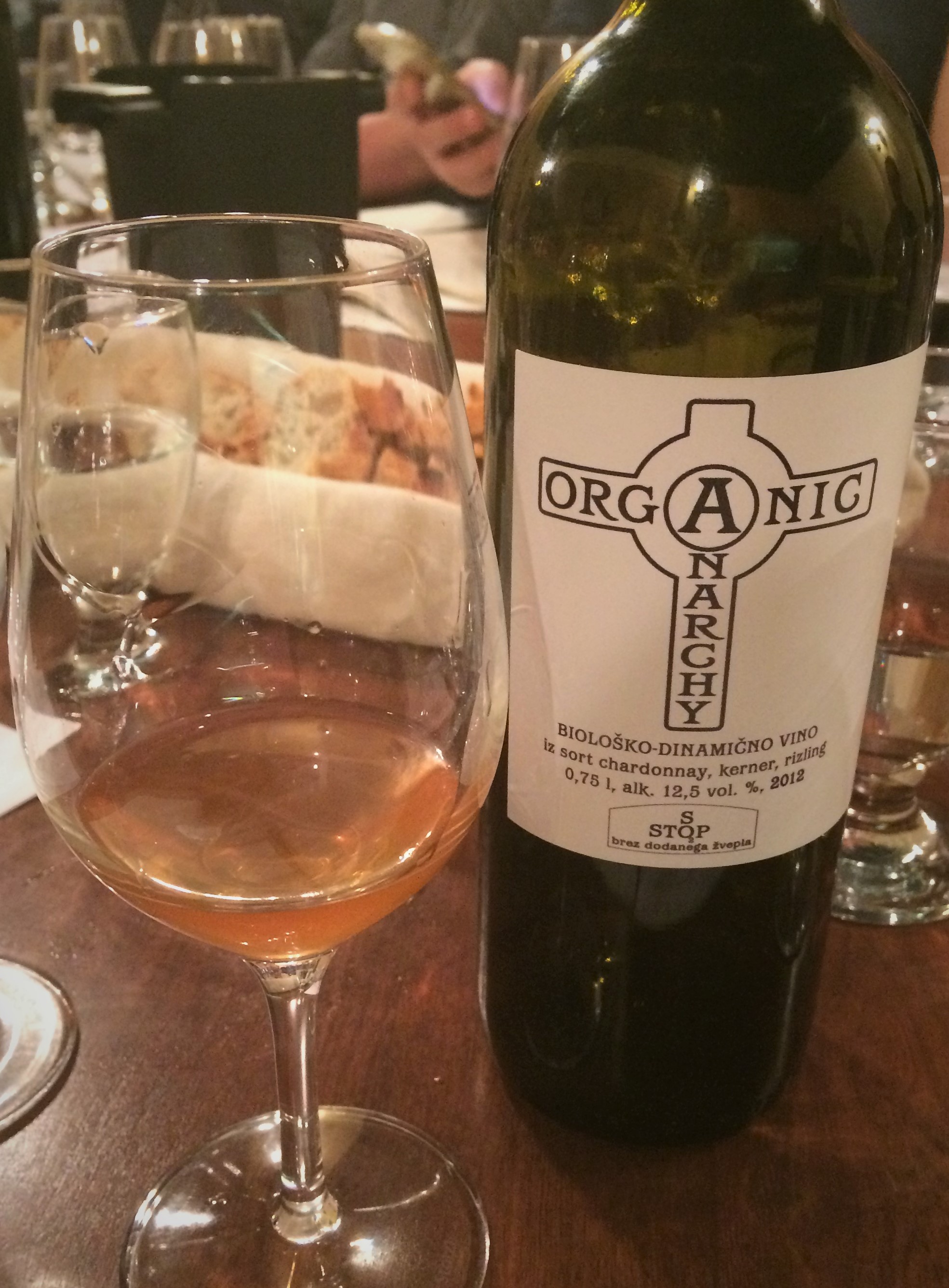
Hazy orange. Surprising, evolving nose: spicy, “kind of soapy,” “lit cigar,” dried orange peel and a hint of honey, among other things. Medium-bodied. Surprisingly fresh and vibrant for a five-year-old orange wine. The mineral-dusted fruit (stone fruit mainly) is almost sweet and yet so savoury. A hint of botrytis only increases the already complex set of flavours and aromas. Tingling acidity and a tannic rasp turn the silky texture a little raw-silky. The long finish is marked by pepper and nut notes. The way the wine developed in the glass suggests carafing an hour or two may be a good idea. Very impressive. I look forward to encounters with Urbajs’s other wines. (Buy again? The high price notwithstanding, yes, a bottle to savour at leisure.)
MWG October 13th tasting: flight 4 of 9
Tripel header
New Lang Syne 2017, Extra Strong Beer, Beau’s (MSRP: $16.00)
A limited-release Belgian-style Tripel, number 59 in the brewery’s Wild Oats series. Ingredients: local spring water, organic barley malts (Pilsner, acidulated, carafoam), organic cane sugar, organic hops (Strisselspalt, perle, magnum), yeast. A portion was brewed during the summer and aged in Pinot Gris barrels for four months. In the fall, the aged ale was blended with freshly brewed batches. Initial fermentation was with Belgian strong ale yeast; champagne yeast was added on bottling to create natural carbonation. 9% ABV. IBUs: 33. Original gravity: 19° P. Final gravity: 3.4° P.
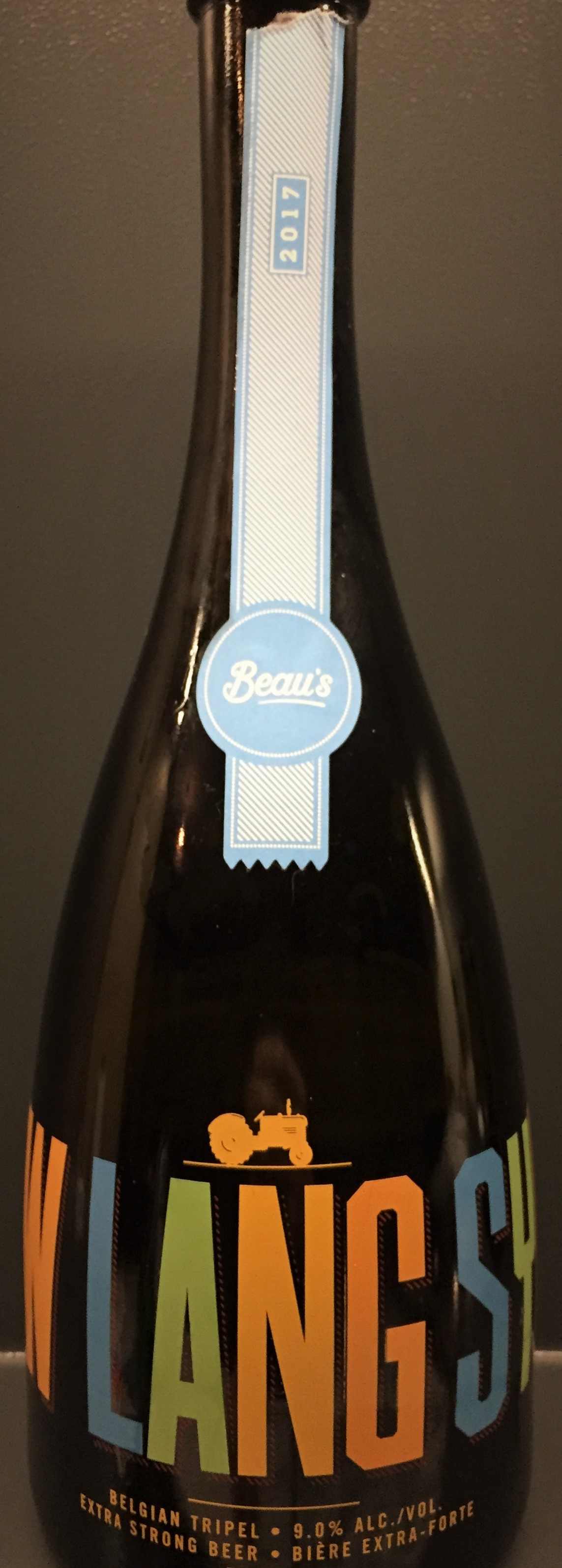 Impressive packaging: a sleek, heavy bottle with bold, multi-coloured lettering, a long neck runner that bears the vintage, a champagne cork and cage and a tag listing, among other things, the batch and bottle number and the bottling date. My sample – no. 3395 from batch no. 6479 – was bottled on August 28, 2017. I tasted the beer with two friends, one of whom is a serious amateur brewer and has done a tour of Belgian breweries for a national magazine.
Hazy amber-bronze in the glass, with ample, long-lasting, rocky white foam (“can’t believe the head,” notes the brewer).
Appealing, complex nose: spicy and malty with notes of apple, butterscotch, “coriander seed” and wheat berries. “You get the esters but they’re spicy, not banana,” though a touch of dried banana does eventually appear.
The first sip prompts an “Oh, that’s nice” and indeed it is. So smooth and creamy (“the texture may be the most remarkable thing about it”) yet also deeply hoppy. There’s great complexity of flavour, an almost fruity (“pineapple juice”) maltiness and an undercurrent of sourish acidity. The hops kick in on mid-palate and make their presence felt, even to the point where one of the other tasters says the “bitterness masks so much.” A woody “barrel character” – a faint smoky overtone – appears on appears on the transition to the finish but there’s no clear line between where the bitterness stops and the tannins start. Finishes long with “prickly bitters, especially on the aftertaste.”
The bottom line: a fine, imposing, gastronomic ale that, while enjoyable now (provided you’re not allergic to hops), will surely benefit from spending a few months to a couple of years in a cool, dark place. (Buy again? “Yes.” “A bottle or two to cellar.” For sure.)
What would you serve with it? Cheese. “Fried chicken and cornbread.” I also like the brewery’s suggestion of blackened salmon. Oddly enough, a piece of dark chocolate studded with toffee malt followed by a swig of the ale didn’t clash and completely tamed the hoppiness, so maybe Beau’s suggested pairing of pineapple upside-down cake isn’t as off the mark as it seems.
Released on November 9, 2017. A number of stores in Montreal and Quebec stock Beau’s products (see map) and some are reportedly carrying the New Lang Syne.
Disclaimer: The brewery provided this sample for review purposes with the understanding that I would be free to critique it however I saw fit.
Update (2017-11-27): After some searching and reaching out to Beau’s, I finally found bottles at Le Marché des Saveurs du Québec (Jean Talon Market) and at Dépanneur Peluso Beaubien (though oddly not at the original Rachel Street Peluso), where it goes for a heafty $19.99 a bottle.
Ontario’s red grape?
Niagara Peninsula 2015, Cabernet Franc, Sans Soufre, Norman Hardie ($35.00 at the winery)
100% Cabernet Franc from organically farmed vines. Manually harvested. Fully destemmed. Fermented with indigenous yeasts in one-ton fermenters. Pressed in a basket press. Matured 10 months in 225-litre French oak barrels. Unfiltered and unfined. No added sulphur. 12.5% ABV.
Entertaining nose: a mix of dark fruit (cherry, blackberry) and umami (meat, mushroom) that prompts peanut gallery descriptors like “floral,” “spices,”“earthy,” “kelp” and “creosote.” Medium-bodied and fluid. Seems sweet on entry but turns appetizingly dry. Full of crunchy ripe fruit framed by soft tannins and enlivened by a stream of acidity. The complex of flavours includes minerals and herbal notes but absolutely no greenness. Finishes long and clean. So fresh, so drinkable. Enjoyable now and over the next two or three years if not longer. (Buy again? Yes.)

Canada 2015, Cabernet Franc, The Old Third ($55.00 at the winery, around $34 on preorder)
100% Cabernet Franc from the estate’s organically farmed Closson Road terrace vineyard in Prince Edward County. Fermented in stainless steel tanks with indigenous yeasts, then racked into French oak barrels, where it matured for about a year and a half. Unfiltered, unfined and minimally sulphured. Bottled in July 2017. 12.5% ABV.
Raspberry and black currants along with “black tea,” “pencil shavings,” “nut cake” and “prune.” Richer, rounder and denser than its flightmate, velour to Hardie’s satin. The ripe fruit is structured by smooth tannins and smooth acidity. Balanced, layered, long and full of potential: a complete wine. If there’s an issue now, it’s that the wine is a bit monolithic and the oak a little too obvious – nothing four or five years in the cellar won’t take care of. Late spring frost made 2015 a difficult vintage for many Prince Edward County producers though not for The Old Third and that’s totally apparent here. (Buy again? Yes, especially at the preorder price.)
World-class wines like these make a convincing argument that Cabernet Franc is Ontario’s red grape.
MWG September 28th tasting: flight 6 of 7
Vibrant, tasty, companionable
Adelaide Hills 2016, Skin n’ Bones Pinot Noir, BK Wines ($38.00, importation valise)
100% Pinot Noir from organically farmed vines grown in the cool-climate Lenswood subregion of the Adelaide Hills of South Australia. Manually harvested. After sorting, 70% of the clusters were left whole and 30% destemmed. All the fruit was then placed in French oak barrels (10% new, 90% neutral), leaving a generous amount of head space to be filled by the carbon dioxide gas resulting from fermentation. The barrels were sealed and the wine was allowed to spontaneously ferment and macerate for 100 days, after which the barrels were broken apart and the wine pressed. Bottled unfiltered and unfined. 12.8% ABV. Represented in western Canada by Calgary-based Crush Imports.
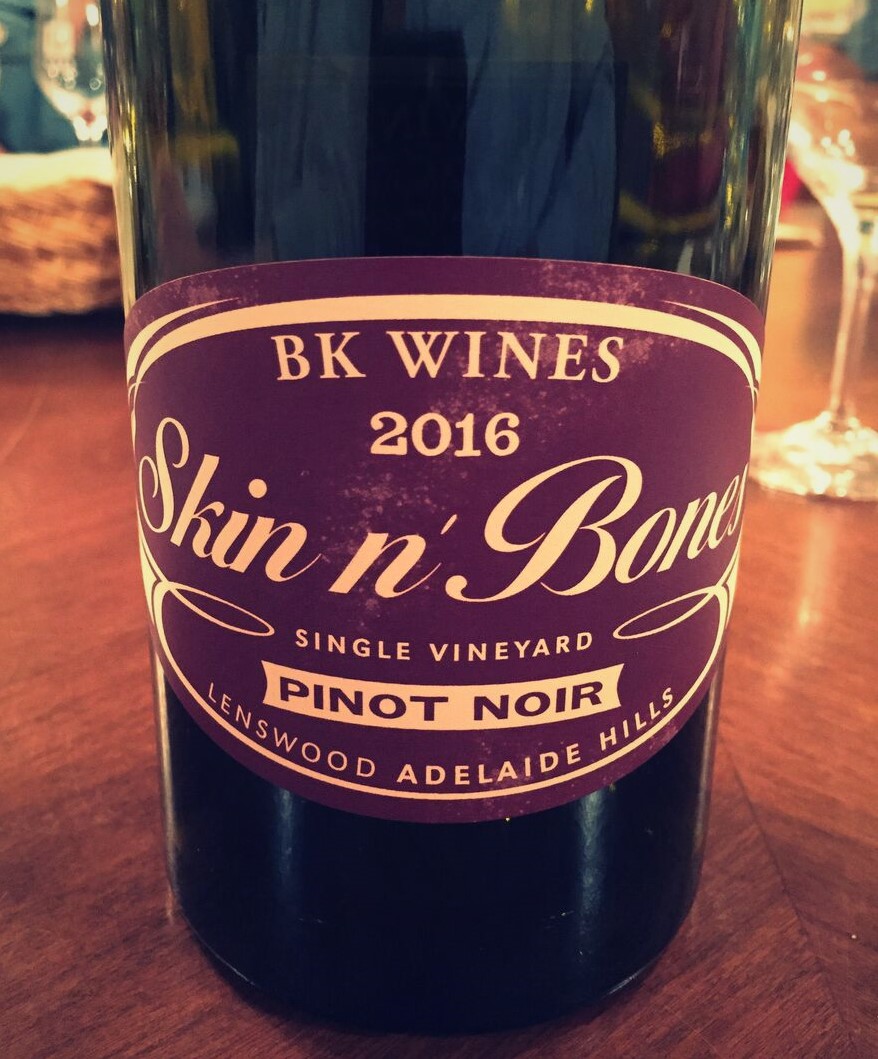
Fragrant, engaging nose: raspberry and cherry along with sandalwood, cedar, “tomato sauce” and graphite. Light- to medium-bodied. Juicy but not a bomb. Actually, there’s lots of detail, great precision and real energy. The sweet silky fruit is framed by fresh acidity and light though very present tannins. Chewing reveals unsuspected depth and structure. The spice-overtoned finish is clean and well sustained. A vibrant, tasty, companionable Pinot Noir that, while accessible now, has the potential to develop over the next few years. (Buy again? Yep.)
Based on this and the same estate’s Savagnin, some enterprising agency needs to be bringing these wines into Quebec.
MWG September 28th tasting: flight 5 of 7
Antipodal Savagnins
Côtes du Jura 2015, Savagnin, Les Sarres, Domaine Rijckaert ($29.95, 12951356)
The estate avoids herbicides and insecticides and limits its use of synthetic chemicals to treatments against mildew and odium. All the estate’s wines are made in barrels. 100% Savagnin from the Les Sarres vineyard located in Buvilly. Fermented with indigenous yeasts. Underwent full malolactic fermentation. Matured two years on the lees in neutral French oak barrels with no stirring. Kept topped up, so not oxidized. Reducing sugar: 1.9 g/l. 13% ABV. Quebec agent: La QV.
Slightly hazy pale electrum to the eye. Minerally nose of lemon and grapefruit with hints of potpourri and almond. In the mouth, it’s clean and tonic. The fruit (lemon, yellow plum) is sweet-seeming on the attack, though the wine is actually very dry. There’s a real mineral depth, including a shot of salinity. The bright acidity combines with a faint bitterness on the long finish to provide a bit of grip. Less electric than some Savagnins but still a fine example of what the grape can do. (Buy again? Sure.)

Adelaide Hills 2016, Skin n’ Bones White, BK Wines ($35.00, importation valise)
The South Australian estate was founded in 2007 by Brendon and Kristy Keys. This monovarietal is made using Savagnin from organically farmed 10-year-old vines rooted in limestone and sandstone over deep clay in Lobethal in the cool-climate Lenswood subregion. The grapes were manually harvested and fully destemmed but not crushed. Spent one month on the skins with twice-daily pump-overs, then was pressed and racked into neutral French oak barrels with regular stirring for nine months. Alcoholic and full malolactic fermentation were spontaneous. Total production: 200 cases. 11.8% ABV. Represented in western Canada by Calgary-based Crush Imports.
One-of-a-kind nose of “smoked fish,” “sushi” and “barbecued corn” (quoting other tasters) as well as dried apricot and, with time, green fruit (kiwi, melon) and herbal notes. Dry, fluid and layered. Nicely structured with pervasive but smooth acidity, a current of white minerals and ghostly tannins that last well into the long finish. Grape skins and apricot pit linger. As unusual and engaging as it is savoury and delicious. (Buy again? Gladly.)
MWG September 28th tasting: flight 3 of 7
Native whites
Gaillac 2016, Les Pierres Blanches, Domaine De Brin ($24.85, 13314666)
A blend of Mauzac (60%) and Len de l’El (40%) from organically farmed vines rooted in stony calcareous-clay soil. Manually harvested. The grapes are direct-pressed and the must is chilled and clarified by settling. Vinification – including sponatneous alcoholic and complete malolactic fermentation – and maturation take place in neutral barrels and last nine to 12 months. Unfiltered and unfined. No added anything except possibly a tiny amount of sulphur at bottling. Reducing sugar: < 1.2 g/l. 12.5% ABV. Quebec agent: Ward & associés.
The first sniff brings a hint of reduction and volatile acidity followed by an odd mix of apple, flowers and sauerkraut. In the mouth, it’s clean, fresh and sleekly acidic, dry but full of applely fruit and quartzy minerals with a bitter undertow. Fair depth and good length. Not bad but not the revelation I was expecting. A taster who had enjoyed an earlier bottle didn’t peg our bottle, which was served double-blind, as the same wine. Nor did the wine match the description of the trustworthy SAQ advisor who recommended it. In other words, probably an off bottle. (Buy again? Yes, especially to give it another chance.)

Terre Siciliane 2016, Versante Nord, Uve Bianche, Eduardo Torres Acosta ($35.00, private import, 6 bottles/case)
Born in the Canary Islands, Acosta headed to southeast Sicily in 2012 to intern with Arianna Occhipinti. He later did a stint as a winemaker at Passopisciaro, eventually renting and farming a few parcels and making wine under his own name. His first commercial vintage was 2014. The grapes are grown in the Etna appellation but the wines are made at Occhipiniti’s facilities in Vittoria. That and the fact that at least some of the vineyards are higher than the allowed 800 metres of altitude are why the wines qualify only for the broad Terre Siciliane IGT designation and not the Etna DOC. This blend of Minella (60%) and other local varieties is made using grapes grown in six plots on the north face of Mount Etna. The organically farmed vines average 45 to 50 years old and are rooted in soils with a high volcanic ash content. The grapes are manually harvested, crushed and macerated on the skins for five days in concrete tanks with no temperature control. Fermented with indigenous yeasts. Matured eight months in neutral oak botti. The 2016 is the first vintage of the wine. Total production: 2,000 bottles. 12% ABV. Quebec agent: oenopole.
Complex nose, initially of “garlic sausage,” summer savoury and poblano chile, then more lemon and quartz. Dense and apricoty in the mouth, with citrusy acid and a mineral structure beyond the obvious current of salinity. The very long brings a lingering pithy bitterness. A multifaceted, engaging wine if not exactly a charmer. Probably better viewed as an accompaniment to dinner than an aperitif. Nearly the entire shipment was snatched up by Montréal Plaza restaurant, where it’s currently on the list for $76 and would make a smart match for many of their super-savoury dishes. (Buy again? Yes.)
MWG September 28th tasting: flight 2 of 7
Bulles de Germain
Saumur, Brut, Bulles de Roche, Thierry Germain/Michel Chevré ($33.25, 13059706)
Best known for his Domaine des Roches Neuves bottlings, Thierry Germain also produces wines with his long-time associate and vineyard manager Michel Chevré, who has acquired his own vineyards. The wines are made in the Roches Neuves cellars. This traditional method sparkler is a blend of Chenin Blanc (90%), Cabernet Franc (5%) and Chardonnay (5%) from 60-year-old biodynamically farmed vines rooted in limestone and clay. The still wine is fermented with indigenous yeasts and then matured three months in 228-litre used oak barrels. The bottled wine spends nine months on lattes prior to disgorgement. No dosage. 12.5% ABV. Quebec agent: Balthazard.

Pale gold with tiny bubbles and quickly disappearing foam. Expressive nose of quartz, candied apple, raisin brioche and honey. Medium-bodied, intense and very dry, with a fine, caressing, evanescing effervescence. Shot through with minerals (“lots of salinity”) and vibrant acidity, the ripe fruit (apple and pear mainly) lasts well into the long, bitterish finish. Intense. Some tasters detected a vague “stemmy” or “something vegetal” note but, if there was one, it was very low key. There’s been considerable variation in the four bottles of this I’ve tasted, some coming across as mineral-driven, others as more about the fruit. In all iterations, however, it’s been a wine with real presence and a lot of class. (Buy again? Yep.)
MWG September 28th tasting: flight 1 of 7
Natural Catalans
BN 2015, Blanco Natural, Partida Creus ($27.45, private import, 6 bottles/case)
A skin-contact white made from biodynamically farmed Macabeo (90%) and Cartoixa Vermell (10%). Fermented with indigenous yeasts. Unfiltered and unfined. No added sulphur. 10.5% ABV. Quebec agent: Vinealis.
Bronze to the eye. Engaging nose of hayloft, dried white fruit, sawed wood, apricot skin and lees. Smooth and buoyant on the attack. Layers of flavour, only one or two of which are fruit. Broad and long though not remarkably deep. A light tannic astringency adds some structure to the finish. So savoury. A very good orange wine at a very good price. (Buy again? Yes.)


Côtes Catalanes 2015, L’Année blanc, Les Clos Perdus ($26.85, private import, 12 bottles/case)
Macabeu (aka Macabeo, 65%), Grenache Gris (30%) and Muscat (5%) from biodynamically farmed grapes. Manually harvested. Fermented with indigenous yeasts. Matured in stainless steel and barrels. Undergoes malolactic fermentation. Sulphur use is minimal. 13.5% ABV. Quebec agent: Vinealis.
Delicious nose. Blast of minerals, especially granite (“presque pétrole” notes André), along with orchard fruit (yellow apple in particular), a hint of funk and eventually “honey” and white meat notes. The ripe fruit and dense, almost oily texture come with compensating acidity. Finishes long and strong with a mix of spice and minerals. A serious, savoury wine that delivers considerable bang for the buck. (Buy again? Yes.)
Wein wine
Vinealis was the featured agency at the Mo’ Wine Group’s early September tasting, which was led by the agency’s founder and head honcho, André Papineau. Despite the fact that I’ve known André for longer than about anyone else in the Quebec wine importing business (we first met when he was a sommelier at Montreal’s Laloux restaurant), this was his first visit to the group. I suspect it won’t be his last. We began with a wine from the outskirts of Vienna.
Wein 2016, Riesling, Wieninger ($28.15, private import, 6 bottles/case)
100% Riesling from biodynamically farmed vines rooted in loess and limestone. The grapes are manually harvested and macerated on the skins for five hours. Fermented with indigenous yeasts. Matured on the fine lees. Residual sugar 1.2 g/l. 12.5% ABV. Quebec agent: Vinealis.

Beautiful nose: apple, peach, chalky minerals, white flowers, crushed leaves and, per another taster, “passion fruit.” Pure, dry and grippy (due not to tannins, of course, but rather to the bracing acidity and high mineral content), filled with ripe yet austere fruit. Impressive dimensionality for a wine at this price point, including a long, stony finish. (Buy again? Done!)
WMG September 14th tasting: flight 1 of 9
Champagne naturally
Champagne, Fidèle, Vouette et Sorbée ($87.47, private import, 6 bottles/case)
This is nearly all 2014 except for a dollop (about 5%) of reserve wine from a solera-type system started in 2001. A blanc de noirs: 100% Pinot Noir from 30-year-old biodynamically farmed vines from several parcels but all rooted in Kimmeridgian marl. The manually harvested grapes are gently pressed. The free-run juice is transferred to 400-litre oak casks for fermentation (with indigenous yeasts) and maturation. Undergoes malolactic fermentation. Indigenous yeasts are used for primary and secondary fermentation. Matured 10 months in used Meursault barrels. The bottled wine is aged on its lees on lattes and riddled on racks for around 15 months. No dosage. Sulphur dioxide is added to the incoming grapes but not at bottling. 12% ABV. Quebec agent: Rézin.
A white wine but with a rosé cast. Intriguing nose of distant strawberry, fired minerals and “garlic brioche.” Fine, non-aggressive bubbles, pure fruit, silky acidity and an unmissable mineral depth. Long flavourful finish with lingering rhubarb crème brûlée. Absolutely not an aperitif wine, rather one to open ahead of time, maybe even carafe, and drink with food. (Buy again? Yes.)

Champagne, Extra Brut, Blanc d’Argile, Vouette et Sorbée ($114.58, private import, 3 bottles/case)
A blanc de blancs: 100% Chardonnay from biodyanmically farmed vines planted in 2000 in a single plot. The vines – massale cuttings from Jacques Sélosse and Vincent Dauvissat – were planted “wild” (directly in the unprepared clay and Kimmeridgian limestone soil). Manually harvested. Fermented and sparkled with indigenous yeasts. The still wine is matured 18 months on the lees in oak casks. Undosed. 12% ABV. Quebec agent: Rézin.
Dried apple, yeast, icing sugar and a faint, nougaty oxidative note. Fine, caressing bubbles. Smooth, caressing acidity. Browning apple upfront, apple Danish and salty seashells on finish. Still a baby. Clean, tonic and bracing, this cuvée lives up to its reputation of being a Chablis with bubbles. As a group, champagne is arguably the most overpriced wine in the world; that said, this delivers exceptional if relative QPR. (Buy again? Yes.)
The first time I tasted them, Vouette et Sorbée’s champagnes did not impress. Subsequent encounters, which have mostly involved bottles laid down a few years, have been much more positive and I now rank the house among my favourite producers.
MWG August 11th tasting: flight 9 of 9

 Brett happens