Posts Tagged ‘Upper mid’
Northern exposure
Terre Siciliane 2015, Versante Nord, Eduardo Torres Acosta ($35.00, 13387380)
Nerello Mascalese with 20% other varieties, including Nerello Capuccio and possibly Alicante Bouschet and Grenache from vines in two co-planted parcels (Pietramarina and Crasa, totalling 1.5 ha) at 550 to 750 metres in elevation on the north-facing side of Mount Etna, hence the bottling’s name. The vines average 45 to 50 years old, with the oldest being about 80. The manually harvested grapes were transported to Arianna Occhipinti’s winery in Vittoria. Some clusters were destemmed, others left whole. Fermented with indigenous yeasts and macerated on the skins for 15 days in a cement tank with no temperature control. Matured 16 months in 750-litre Slavonian oak botti. Minimally sulphured. The 2015 is the second vintage of the wine. Total production: 6,000 bottles. 13.5% ABV per the label, 12% ABV per the SAQ. Quebec agent: oenopole.
The expected cherry and plum plus cedar, blood and stone. No more than medium-bodied. Structured by silky acidity and gossamer tannins, the fruit seems shot through with minerals. The sustained finish brings a light astringency and a dusty aftertaste. So pure and savoury, so effortlessly complex. A pleasure to drink. (Buy again? Yes.)

Terre Siciliane 2015, Pirrera, Eduardo Torres Acosta ($59.00, 13387371)
The blend is similar to the Versante Nord but with 90% Nerello Mascalese. All grapes come from the high-altitude (850 metres) Pirrera vineyard on the north slope of Mount Etna, which had been abandoned until Acosta began rehabilitating it. The vines average 50 years old and the soil is sandy with volcanic ash and stones. The wine-making was identical to that for the Versante Nord. The 2015 is the second vintage of the wine. Total production: 1,100 bottles. 13.5% ABV per the label, 12% ABV per the SAQ. Quebec agent: oenopole.
Inexhaustible nose of spice, cedar, old wood, forest floor, background dried cherry, floral and balsamic notes and more. Richer than the Versante but still medium-bodied and silky. There’s a pure core of fruit, racy but integrated acidity, an airframe tannic structure, minerals galore, a feathery astringency and a very long, subtly inflected cherry marzipan finish. More serious than its flightmate yet still so fresh. A flawless, complex, engaging, delicious wine. (Buy again? Yes.)
Soon after the wines’ release, a MWG member who was wondering which if any to buy asked a well-regarded SAQ wine advisor for input. The advisor said he was enamoured with the Versante Nord but felt the Pirrera wasn’t worth the extra outlay. The member bought some of the Versante and gave the Pirrera a pass. At the tasting a few days later, our experience was more the opposite: both wines were delightful but the Pirrera was the standout. The member made a beeline to the SAQ and scored a couple of bottles.
MWG September 28th tasting: flight 7 of 7
Ontario’s red grape?
Niagara Peninsula 2015, Cabernet Franc, Sans Soufre, Norman Hardie ($35.00 at the winery)
100% Cabernet Franc from organically farmed vines. Manually harvested. Fully destemmed. Fermented with indigenous yeasts in one-ton fermenters. Pressed in a basket press. Matured 10 months in 225-litre French oak barrels. Unfiltered and unfined. No added sulphur. 12.5% ABV.
Entertaining nose: a mix of dark fruit (cherry, blackberry) and umami (meat, mushroom) that prompts peanut gallery descriptors like “floral,” “spices,”“earthy,” “kelp” and “creosote.” Medium-bodied and fluid. Seems sweet on entry but turns appetizingly dry. Full of crunchy ripe fruit framed by soft tannins and enlivened by a stream of acidity. The complex of flavours includes minerals and herbal notes but absolutely no greenness. Finishes long and clean. So fresh, so drinkable. Enjoyable now and over the next two or three years if not longer. (Buy again? Yes.)

Canada 2015, Cabernet Franc, The Old Third ($55.00 at the winery, around $34 on preorder)
100% Cabernet Franc from the estate’s organically farmed Closson Road terrace vineyard in Prince Edward County. Fermented in stainless steel tanks with indigenous yeasts, then racked into French oak barrels, where it matured for about a year and a half. Unfiltered, unfined and minimally sulphured. Bottled in July 2017. 12.5% ABV.
Raspberry and black currants along with “black tea,” “pencil shavings,” “nut cake” and “prune.” Richer, rounder and denser than its flightmate, velour to Hardie’s satin. The ripe fruit is structured by smooth tannins and smooth acidity. Balanced, layered, long and full of potential: a complete wine. If there’s an issue now, it’s that the wine is a bit monolithic and the oak a little too obvious – nothing four or five years in the cellar won’t take care of. Late spring frost made 2015 a difficult vintage for many Prince Edward County producers though not for The Old Third and that’s totally apparent here. (Buy again? Yes, especially at the preorder price.)
World-class wines like these make a convincing argument that Cabernet Franc is Ontario’s red grape.
MWG September 28th tasting: flight 6 of 7
Character analysis
Vin de France 2015, Kharaktêr, Domaine Le Briseau ($42.25, private import, 6 bottles/case)
After abandoning an estate in Vouvray, the late Christian Chaussard met and married Natalie Gaubicher and, with her, set up shop in the Jasnières/Coteaux-du-Loir region, first by founding a small négociant firm (Nana Vins et Cie) and then by acquiring vineyards of their own. The farming is biodynamic and the wine-making tends natural. 100% Chenin Blanc from organically and biodynamically farmed 50-year-old vines in the Jasnières AOC. Manually harvested. The grapes are gently pressed. The juice is clarified by settling and racking. Vinified with indigenous yeasts and bacteria. Malolactic fermentation is allowed. Matured nine months in stainless steel tanks. Lightly filtered. No added anything except a tiny shot of sulphur dioxide at bottling. 13.5% ABV. Quebec agent: WINO.

Draws-you-in nose of maple réduit*, corn silk, poached quince, “grapefruit,” chalk, linden flowers, a touch of honey and, eventually, “pancake batter.” Very dry. The mouth-filling flavours echo the nose. There’s a certain weightiness to the wine yet it’s fleet on its feet due to the faint spritz, sleek but sustained acidity and flood of minerals. Lovely bitter notes join the fruit on the long, saline finish. Improves with time in the glass so carafing is probably in order. (Buy again? Yes, though not without wishing it were $7-10 cheaper.)
*réduit is maple sap that has been reduced in an evaporator but is only about halfway to maple syrup. It can, among other things, be added to drinks and used as a cooking medium (e.g. Martin Picard’s exquisite lobster poached in réduit). For more information, consult your local sugar shack operator or the Au Pied de Cochon Sugar Shack Cookbook.
MWG July 13th tasting: flight 3 of 9
Gauzy Ozzie
Blewitt Springs 2016, Chenin Pet nat, Jauma ($43.25, private import, 6 bottles/case)
Founded and run by former sommelier James Erskine and based in the Basket Range section of the Adelaide Hills in South Australia, Jauma is one of the leaders of Australia’s natural wine movement. An ancestral method sparkler. 100% Chenin Blanc from 60-year-old vines organically farmed by Fiona Wood. Manually harvested. Fermented in stainless steel with indigenous yeasts. Matured in French oak barrels. Unfiltered and unfined. No added anything, including sulphur. Crown cap. Residual sugar: ca. 10 g/l. 10.5% ABV. Also available in 12-bottle cases at the LCBO ($53.10, 361641). Quebec agent: WINO.

Hazy, pale yellow-beige. Super natural nose of lemon pith and apple, lees, “jasmine” (per another taster) or maybe honeysuckle and “a little hairspray.” Very dry in the mouth, with tiny, tickly bubbles. The zingy acidity and lemony flavours bring lemonade and maybe wheat beer to mind. The complex of minerals includes a saline streak. The long, savoury finish brings a chamomile or “chrysanthemum tea” note. Light, tart, refreshing and so much fun to drink. The Quebec – let alone Ontario – price does give one pause but this is an ideal summer sipper. (Buy again? A splurge bottle, yes.)
MWG July 13th tasting: flight 2 of 9
A toast to Haridimos Hatzidakis
Originally from Crete, Haridimos Hatzidakis founded his eponymous estate in Pyrgos, on Santorini, in 1996, replanting a vineyard that had been abandoned 40 years earlier after the devastating 1956 earthquake. Today the estate comprises 10 hectares of owned and leased vineyards. Assyrtiko, Aidani and Mavrotragano are grown and the farming is organic, still something of a rarity on the island.
Hatzidakis’s wines, which the Mo’ Wine Group began discovering when some of the 2008s became available through the private import channel, quickly convinced me that Santorini was one of the world’s great wine appellations and that Hatzidakis was one of the world’s great winemakers. My first encounter with the Mylos, again the 2008, had me declaring it to be one of the world’s great whites, a claim subsequent encounters and vintages have not called into question.
I met Hatzidakis only once, at last year’s Salon des vins d’importation privée. He seemed a humble, somewhat shy, soft-spoken man who needed only a little prompting to reveal his passion for wine-making, organic farming and Santorini. He spoke with pride about his new winery and encouraged me to visit if I made it back to the island. It is something I ardently hope to do but, alas, it won’t be in his company: Haridimos Hatzidakis died suddenly last Friday.
On Saturday, friends and I opened a bottle of the recently arrived 2016 Mylos, arguably the estate’s flagship wine, and raised a glass in honour of Haridimos’s life and accomplishments and in the hope that his legacy lives on.
Santorini 2016, Assyrtiko de Mylos, Vieilles Vignes, Hatzidakis ($51.75, 12338834)
100% Assyrtiko from dry-farmed old vines – ungrafted like all Santorini vines – that average 150 to 300 years old. The certified organic, late-harvested grapes were picked by hand, destemmed, cooled, crushed and macerated on their skins for 12 hours. Fermentation (at 18°C with indigenous yeasts) and maturation (on the lees) took place in stainless steel tanks and lasted 10 months. Bottled unfiltered, unfined and with minimal sulphur dioxide. About 3,000 bottles made. 13.5% ABV. Quebec agent: oenopole.
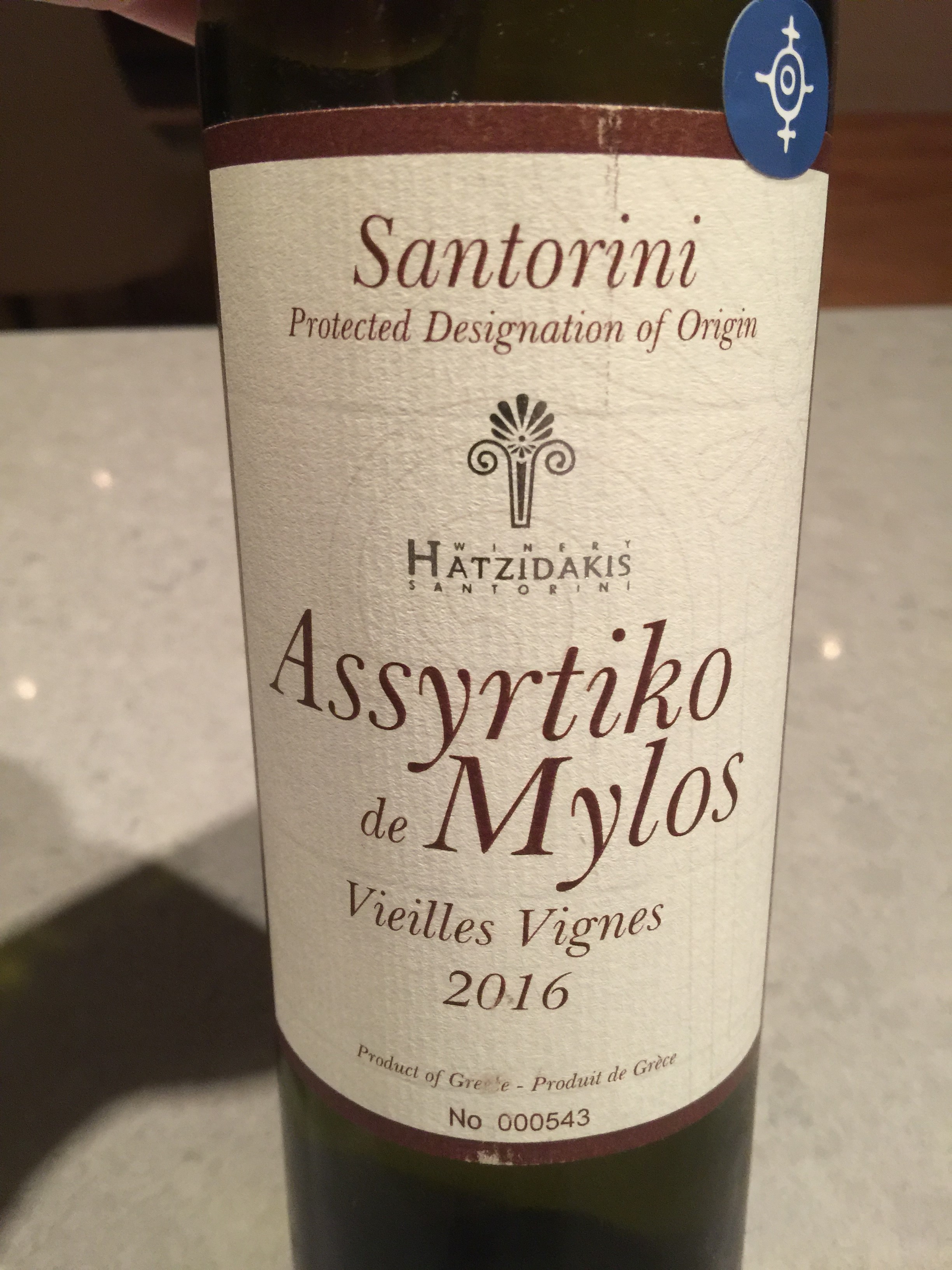
Already pale gold in colour. Tightly furled nose that blossoms as the wine breathes: preserved lemon, minerals, hints of petrol and fish oil and eventually Mediterranean herbs. Weighty in the mouth, with an oily texture, Meyer lemon flavours, a mineral structure and an astounding salinity. Assyrtiko’s trademark acidity is here turned stealthy by the dense extract. Dominated by citrus-pith and sharp-edged minerals and developing honeyed overtones, the intense finish lasts for minutes. Made a credible pairing for grilled octopus dressed with wine vinegar, olive oil, red onion and capers and a superb match for bucantini with olive oil, lemon, leek and bottarga, which brought out the wine’s fruit (“though it’s fruity in the sense that olives are fruity,” another imbiber noted). (Buy again? Oh, yes.)
Earlier vintages of this wine have “aged” quickly, turning a rich gold-bronze, gaining pronounced oxidative and honeyed notes, the acidity smoothing out, the minerality receding slightly. However disconcerting this can be at first, you are soon won over by the wine’s richness, authority and infinitely layered complexity. At that stage, it is excellent with grilled lamb chops (recipe after the jump) and sublime with beef tartare.
Update (September 9, 2017): On the oenopole website, Theo Diamantis has posted a moving tribute to Haridimos.
Alois and Eloi
The only connection between the wines in the last flight was that both were bigger reds that had caught my attention, the Trebulanum because it is made from a grape I’d never heard of, let alone tasted, the Trévallon because it was reportedly excellent and I’d been giving the wine a pass since an unhappy encounter with the 2007. The wines were double-carafed about four hours before we tasted them.
Terre del Volturno 2011, Trebulanum, Casavecchia, Alois ($44.00, 12628604)
Contrary to what SAQ.com claims, this is not made by the Piedmontese Azienda Agricola Casavecchia but by the Campanian estate Vini Alois, which is based in Pontelatone. 100% Cassavecchia from organically farmed wines averaging 20 to 25 years old and rooted in the mineral-rich volcanic soil of the 1.5 ha Cesone vineyard. Manually harvested. Alcoholic fermentation and maceration on the skins with regular pump-overs took place in stainless steel tanks and lasted 20 days. Transferred to large botti for 18 months, during which time it underwent complete malolactic fermentation. Racked into large botti for 12 months’ further maturation. Aged in bottles for six months. Reducing sugar: 1.8 g/l. 13% ABV. Quebec agent: Diamond Estates.
Wafting nose of ink, old leather, Chambord, “peat” and “smoke.” Dark and dense on the plate, rich in black raspberry fruit and slatey minerals. Tannins confer a velvet astringency, acidity a certain freshness. Finishes long. Spice and leather linger. Powerful, earthy and “too young” but not hot or harsh. Speaks of its place and, despite the modern wine-making, of an older time. (Buy again? Yes, and not just for curiosity’s sake.)

Alpilles 2013, Domaine de Trévallon ($85.25, 13269359)
Now in his mid-60s, Eloi Dürrbach began making wine in 1973, when he gave up architecture to manage a vacation property and a few vines his parents had bought. This, then, is his 40th vintage. A 50-50 blend of Cabernet Sauvignon and Syrah from organically farmed vines rooted in limestone and clay. The whole clusters were fermented with indigenous yeasts with regular punch-downs and pump-overs. Matured 24 months on the lees in foudres (95%) and barrels (5%). Fined with egg whites. Unfiltered. No added sulphur. 13% ABV. Quebec agent: LVAB.
An initially disconcerting nose of peas, “ketchup maison,” “beets” and beef bouillon gives way to plum, cassis, blackberry and garrigue. Rich and satiny in the mouth. The balance between the layered fruit, fleshy tannins and racy acidity is something to behold. Overtoned with black olive and leather, the minerally, bitter-edged finish seems to go on forever. Accessible yet capable of long ageing. One of the great wines of Provence. (Buy again? If I can scrape together the bucks…)
MWG June 22nd tasting: flight 7 of 7
Meridional v. septentrional
IGP des Bouches-du-Rhône 2015, Gueule de Loup, Château de Roquefort ($25.35, private import, 6 bottles/case)
A blend of organically farmed Grenache (normally around 80%), Cabernet Sauvignon and Merlot (some websites, though not the estate’s, claim Cinsault is part of the mix) from organically farmed, 20- to 55-year-old vines rooted in clayey-calcareous soil. Manually harvested. Ninety percent of the grapes are partially destemmed and crushed. Alcoholic fermentation, with indigenous yeasts in temperature-controlled tanks, lasts two to four weeks. Maturation is in cement tanks (80%) and foudres (20%). Unfiltered and unfined. 13.5% ABV. Quebec agent: La QV.
Attractive nose of plum, raspberry, spice, earth, cookie dough and a hint of barnyard. Rich but fresh, the freshness a function of the juicy acidity and clean fruit that’s framed by fine-edged tannins. Against a faintly lactic backdrop, cherry, pepper and slate fade into a long, heady finish. Enjoyable but less distinctive than the estate’s stellar Petit Salé and Corail. (Buy again? Sure.)

Crozes-Hermitage 2015, Et la bannière…, Matthieu Barret SARL ($42.00, private import, 6 bottles/case)
Matthieu Barret is the owner-winemaker at Domaine du Coulet. The eponymous SARL is his crittertastic négociant label. This is 100% biodynamically and organically farmed Syrah, the only red grape variety allowed in the appellation. The grapes are destemmed and fermented in concrete vats with indigenous yeasts and pump-overs. The resulting wine is racked, matured for 12 months, then bottled unfiltered and unfined with a tiny amount of pre-bottling sulphur being the only additive used in making the wine. 13% ABV. Quebec agent: La QV.
Nose initially marked by volatile acidity. Alongside it are dark berries, some of them candied, and olive tapenade with hints of game, bacon and sawdust. In the mouth, there a tension of sorts between the juicy sweet fruit and sour/bitter edge. The picture is completed by balancing acidity, dark minerality, fine tannins and nicely sustained finish. Accessible now though capable of ageing another five to 10 years. Some found this a little overwrought and rustic (“more like a Cornas than a Crozes,” huffed one skeptic) but I liked its complex mix of juiciness and savour. (Buy again? Yes.)
MWG June 8th tasting: flight 6 of 6
Cabgamay Franc
Santa Ynez Valley 2015, Cabernet Franc, Coquelicot Vineyard, Lo-Fi Wines ($44.95, private import, 6 bottles/case)
100% Cabernet Franc from organically farmed vines in the Coquelicot vineyard (fluvial sandy loam and gravel) near Solvang. Manually harvested. The whole clusters – neither destemmed nor crushed – were placed in a vat, which was filled with carbon dioxide gas and covered. Once a day for 14 days, the free-run juice was pumped over, then the vat was covered and gassed again. When alcoholic fermentation (with indigenous yeasts) was complete, the wine was pressed into tanks, settled and racked into neutral barrels (85% in 228-litre French oak barriques, 15% in a 600-litre demi-muid) for eight months’ maturation. Underwent full malolactic fermentation. Racked twice prior to bottling. Unfiltered and unfined. A small shot of sulphur dioxide was added at bottling. 12.2% ABV. Quebec agent: La QV.
Earthy, slightly jammy red fruit with hints of sandalwood and black olive. Dark-fruity and Asian-spicy in the piehole, the brighter colours darkened by an earthy substratum. Structured – if that’s the word for such a fuzzy wine – by smooth acidity and stealth tannins that make their presence felt only on the long, leathery/earthy finish. However original and interesting an interpretation of Cabernet Franc this may be, the QPR – as with so many California wines in Quebec – is seriously out of whack. (Buy again? Irrespective of price, sure.)

Saint-Nicolas de Bourgueil 2015, Hurluberlu, Sébastien David ($27.30, private import, 12 bottles/case)
100% organically and biodynamically farmed Cabernet Franc. Manually harvested, fermented with indigenous yeasts. Vinified Beaujolais style – using carbonic maceration – and given a very short maturation in tanks, with bottling occurring early in the new year following harvest. Unfiltered. No added sulphur. 12% ABV. Quebec agent: La QV.
Red fruity, cedary and a little poopy. From a hot vintage so richer, rounder, more extracted and conventional, less “like health juice” than some earlier versions. Still refreshing due to its bright acidity, supple tannins and pure fruit. Good, ultradrinkable juice, just a little less special than before. The shapely clear glass bottle is a beaut, especially in magnums. (Buy again? Sure.)
Coteaux Bourguignons 2015, Gamay, Domaine Bouillot Salomon ($29.95, private import, 12 bottles/case)
100% Gamay from biodynamically farmed vines rooted in clayey-calcareous soil. Manually harvested. Non-interventionist wine-making with no added anything, including sulphur. Matured in stainless steel and cement tanks. 12% ABV. Quebec agent: La QV.
Attractive nose of slightly candied red berries, spice, cola and background barnyard. A bit spritzy (carafing would have eliminated the gas). Fleet, fresh, fruity and dry with bright verging on tart acidity and a rumbling mineral bass line. The longish finish brings an appetizing bitter note. Would be interesting to taste this alongside some cru Beaujolais; I suspect the difference in terroirs would be noticeable. (Buy again? Yes.)
MWG June 8th tasting: flight 5 of 6
Meinklangers
The Mo’ Wine Group’s latest agency tasting was led by La QV’s head honcho Cyril Kérébel. The wine-up featured a particularly high proportion of whites, all with great minerality and a saline edge, as well as a wowser rosé and a handful of super-drinkable reds. We began with a trio of new-to-most whites from one of our favourite producers.
Burgenland 2015, Burgenlandwhite, Meinklang ($23.00, private import, 12 bottles/case)
A blend of Grüner Veltliner (50%), Welschriesling (40%) and Muscat Ottonel (10%) from biodynamically farmed vines. Manually harvested. Fermented (with indigenous yeasts) and matured in stainless steel tanks. Screwcapped. Residual sugar: 4.9 g/l. 12% ABV. Quebec agent: La QV.
Hay, straw, white flowers, chalk, distant “chives” and dried orange peel. Round in the mouth, the acidity smooth, the texture verging on waxy. The upfront fruit and underlying minerals give ways to a long savoury, saline finish with a lingering white pepper note. “Building spiciness underneath rosewater,” proclaims one taster. A perfect summer white is the general consensus. (Buy again? Yep.)

Somló 2015, H15, Meinklang ($37.65, private import, 6 bottles/case)
100% Hárslevelü from biodynamically farmed vines grown at the base of the extinct Somló (pronounced shom-low) volcano in southwest Hungary, not far from the Austrian border. The must is passed through a coarse filter before fermentation. The wine-making – which takes place at the estate’s Burgenland winery – is non-interventionist, with no additions except, possibly, a tiny squirt of sulphur at bottling. Matured in stainless steel tanks and old oak barrels for 12 months. Residual sugar: 4.2 g/l. 12% ABV. Quebec agent: La QV.
Complex, aromatic nose dominated by honey, spice and yellow fruit. Dense and weighty (not heavy) on the palate, the fruit wrapped around a softly glowing core of acidity. The complex of flavours turns impressively savoury/salty/sweaty on the mid-palate. Very long. Less tense and minerally, more stone-fruity and unctuous than some earlier vintages but no less engaging. (Buy again? Yep.)
Burgenland 2014, Konkret Weiss, Meinklang ($65.75, private import, 6 bottles/case)
A field blend of three Gewürztraminers, specifically Red Traminer, Yellow Traminer and plain old Gewürztraminer. Macerated on the skins for 21 days. Vinified in egg-shaped concrete tanks. No added anything, including sulphur. Residual sugar: 1.6 g/l. 12% ABV. Quebec agent: La QV.
For once, an orange wine that actually has an orange cast. One taster describes the complex nose of gardenia, cedar, spice and a funky whiff as “like the old lady in front of me on the bus, eating a grapefruit.” Dazzlingly complex and layered on the palate. Rich yet fluid. Dry but not austerely so. Structured by bright acidity and light tannins. The endless finish is awash in umami. (Buy again? Yep, wincing only slightly at the price.)
And Cyril shared some good Meinklang news with us: the SAQ will be including their impressive “Graupert” Pinot Gris in its Opération vins oranges release this fall and will also be carrying their fine ancient grains beer.
MWG June 8th tasting: flight 1 of 6
Brand new and old
The April 21st tasting featured wines represented in Quebec by Glou and was led by the agency’s prime mover, Jack Jacob. We started with a flight of four fine Alsatians.
Created in 1950 and based in Ergersheim, Domaine Brand sits in the middle of La Couronne d’or, a swath of vineyards stretching from Strasbourg to Marienheim. The estate’s 10 hectares of vineyards are in the communes of Ergersheim, Osthoffen and Wolxheim. Farming has been organic since 2001 and certified biodynamic (Demeter) since 2015.
Current winemaker Philippe Brand took the helm in 2008, following stints at Domaine de Montchovet in Burgundy and wineries in the Peloponnese (Greece) and Barossa Valley (Australia). He soon imposed a regime of non-interventionist wine-making where the only additive, if any, is small amounts of sulphur dioxide. The estate makes a separate line of unsulphured natural wines under the Apollinaire moniker whose labels feature calligrams by the eponymous artist.

Alsace 2013, Riesling, Kefferberg, Brand & Fils ($33.06, private import, 6 bottles/case)
100% Riesling from the Kefferberg vineyard. Manually harvested. The whole clusters are gently pressed. Fermented (with indigenous yeasts) and matured in large barrels. 12.5% ABV. Quebec agent: Glou.
Gold bronze to the eye. Complex nose of apple, pear and chalk with hints of petrol and “Meyer lemon” (quoting another taster). Rich but not heavy in the mouth, the fruit tending toward baked apple. Dry and very minerally. The combination of acidity and minerals lends an almost “tannic bite” to the long finish. (Buy again? Sure.)
Alsace 2015, La Chimère, Charles et Philippe Brand ($34.76, private import, 6 bottles/case)
One of the estate’s Apollinarie wines. 100% Riesling from the Osthoffen vineyard. Manually harvested. The whole clusters are gently pressed. Fermentation with indigenous yeasts and 12 months’ maturation take place in third- and fourth-fill barrels. Unfiltered and unfined. No added sulphur. 13% ABV. Quebec agent: Glou.
Paler. Faintly funky nose of white flowers, lemon peel, flint, barley sugar and a pungent note some described as bubble gum and others as camphor. A bit spritzy on the palate. Less rich and extracted, more crystalline than the Kefferberg. Bone dry (0.5 g/l residual sugar). Lingering green mango. I like. (Buy again? Yes.)
Alsace 2015, Fleurs, Charles et Philippe Brand ($37.64, private import, 6 bottles/case)
One of the estate’s Apollinaire wines. 80% Pinot Gris, 20% Riesling. Manually harvested. The whole clusters are gently pressed. Fermentation with indigenous yeasts and 12 months’ maturation take place in third- and fourth-fill barrels. Unfiltered and unfined. No added sulphur. Residual sugar: 1.0 g/l. 13.5% ABV. Quebec agent: Glou.
Engaging nose of white peach, white spice and slate with honey and lactic notes. Very dry yet with an “implied sweetness.” Buoyant acidity. Faint spritz. Pearish with bergamot overtones. Mineral-rich. Long bitter-edged finish. Complex. Impressive. (Buy again? Gladly. And I’m really looking forward to trying the orange version.)
Alsace 1999, Riesling, Kefferberg, Brand & Fils ($56.34, private import, 6 bottles/case)
100% Riesling from the Kefferberg. Manually harvested. The whole clusters are gently pressed. Fermented (with indigenous yeasts) and matured in large barrels. 12% ABV. Quebec agent: Glou.
A deep bronze colour approaching that of iced tea. Complex, unfathomable nose: dried apple, brown sugar, smoke, hints of petrol and “spicy green” or “dried mint” and more. Equally complex in the mouth, the flavours echoing the nose and resonating on their own. Super dry. Smooth acidity. Considerable depth. Endless finish with, once again, a hint of something camphor-like. The price is more than reasonable for a wine of this age and quality. (Buy again? Oh, yes.)
MWG April 21st tasting: flight 1 of 6

 Brett happens