Posts Tagged ‘White wine’
It’s a white! It’s a red! It’s Brutal!!!
Brutal!!! 2015, Partida Creus (ca. €10-15/$15-20 in Barcelona, importation valise)
Apparently, the wine is sin denominación, demoninationless. In any case, it’s a blend of several Catalan grape varieties (probably Vinyater, Subirat Parent, Xarel·lo, Cartoixa Vermell and Blanc de Sumoll) from biodynamically farmed vines planted in clayey-calareous soil. Manually harvested. The varieties are vinified separately and blended before bottling. Fermented with indigenous yeasts. Matured seven months in stainless steel tanks. Unfiltered, unfined. No added sulphur. 11% ABV.

Cloudy pink to the eye. Spicy/funky nose of dough, distant sweet berries, “pink peppercorns” and an evanescing whiff of volatile acidity that one taster describes as “latex gloves.” A bit spritzy in the mouth. Lightly fruity and quite dry but tangy like “kambucha” and “hibiscus.” The tannins are light while the acidity is electric. So refreshing and drinkable and such energy! Like nothing else I’ve tasted yet also like an instant old friend. Wow. (Buy again? By the case.)
On the Raw Wine website, Partida Creus describes themselves thus: “We are winegrowers and winemakers in the Massis de Bonastre terroir of Catalunya, working with our own production of grapes and with rescued ancient vineyards with interesting native variety of grape. All the vines are organic farming, our organic and natural wines express the terroir with its variety typicity. We try to put in the bottles our deep respect and love for wild and Mediterranean landscape, nothing else. A tribute to nature and biodiversity, our work is a way of life making wine. Certified organic by CCPAE Consell catalá de la Producció Agraria Ecologica.”
Partida Creus is represented in Quebec by Vinealis. A Brutal inquiry to the agency’s prime mover, André Papineau, elicited the following reply: “Oui je bosse avec Partida Creus depuis presque 4 ans maintenant. Quantités confidentielles au départ et de bons volumes maintenant. Par contre le Brutal a longtemps été seulement disponible pour le Bar Brutal; il est un peu cher, se vendrait @ ± 36 $ la bouteille le carton de 6, alors j’hésite un peu. Par contre j’aurai beaucoup de différents vins en août : VN blanco et tinto, BN blanco, TN Tinto, et les grandes cuvées de Vinyater, Cartoixa Vermell, Xarel-lo. Toutes les bulles sont réservées pour le groupe Joe Beef…” [Yes, I’ve been working with Partida Creus for nearly four years. Tiny quantities at the start and good volumes now. However, the Brutal!!! was available only at the Bar Brutal [in Barcelona] for the longest time. It’s kind of expensive, going for around $36 a bottle, case of six, so I’m hesitant. On the other hand, I’ll have a bunch of other Partida Creus wines in August: VN blanco and rojo, BN (white), TN (red) and the top wines, made from Vinyater, Cartoixa Vermell and Xarel-lo. All the sparklers are reserved for the Joe Beef group…”]
MWG June 22nd tasting: flight 4 of 7
Two misses and a hit
Bandol 2016, Blanc, Domaine de l’Olivette ($26.05, 10884559)
Clairette (80%), Rolle (aka Vermentino, 10%) and Ugni Blanc (aka Trebbiano, 10%). Manually harvested. After destemming, the grapes are cold-macerated on their skins, then pressed. Fermentation in oak vats is at low temperatures for about two weeks. The resulting wine is chilled and allowed to clarify by settling. Reducing sugar: 2.2 g/l. 13% ABV. Quebec agent: Vins de Châteaux.
Complex nose: “sweaty” (per another taster) with notes of fired minerals, dried flowers (linden), almond pastry cream, “straw fruit,” “celery salt” and more. Rich and round in the mouth and “a bit reductive.” The combination of highish extract and lowish acidity means the wine comes across as lethargic, a little flabby, “kind of flat” and “gassy.” The appealing nose and minerality aside, not a strong showing. A disappointment then, especially as I and others in the group have enjoyed earlier vintages. (Buy again? Meh.)

Bandol 2015, Blanc, Domaine la Suffrene ($26.45, 11903491)
A 50–50 blend of Clairette and Ugni Blanc from vines averaging 35 to 40 years old. Manually harvested. To increase flavour extraction, the crushed grapes are kept on their skins for 12 hours at 8°C before pressing. After clarification by settling, the juice is fermented in stainless steel tanks for around 15 days at around 19°C, then racked into other tanks for fining and maturation. Filtered before bottling. Reducing sugar: 1.8 g/l. 13.5% ABV. Quebec agent: Les Sélections Vin-Coeur.
Lemon and peach blossom, apple and honey. Rich on the palate but more fluid than the Olivette. Quite dry and minerally though turning fruitier on the long finish. Soft-glow acidity and a lingering bitterness complete the picture which, unfortunately, became less interesting as the wine breathed and warmed. Again, a wine that doesn’t seem equal to earlier vintages. (Buy again? Maybe.)
Bandol 2016, Blanc, Domaine du Gros’Noré ($34.00, 12206989)
A 70-30 blend of Ugni Blanc and Clairette from organically (uncertified) farmed vines averaging 30 years old. The must is macerated on the skins for 24 hours, then fermented at low temperatures with indigenous yeasts. Sees only stainless steel until bottling. Unfiltered and unfined. 13.5% ABV. Quebec agent: oenopole.
Lovely, wafting nose of white grapefruit, fired quartz, lemon flower and a “kaffir-like herbaceous note.” Clean and fluid with smooth acidity. Very minerally, especially on the finish. Dry, layered, long and savoury. “Apple seed bitterness” linger. Became better as it warmed and breathed. We have a winner. Try this with the winemaker’s recommended pairing: grilled mussels with rosemary (Buy again? Yep.)
MWG June 22nd tasting: flight 2 of 7
Chenintastic
The first in a series of notes from a recent mostly new arrivals tasting that featured several impressive wines purchased abroad and shared by travelling Mo’ Wine Group members.
Saumur 2010, Entre Deux Voyes, Le P’tit Domaine (ca. $30, importation valise)
Based in Varrains and Ecoert certified in 2012, the tiny estate (around two hectares of vines) is owned and operated by Richard Desouche, the manager at Château de Chaintres. It makes three wines: two reds and a white. This 100% Chenin Blanc, the fifth vintage of the wine, comes from organically farmed old vines rooted in clayey-calcareous soil. Fermented with indigenous yeasts in stainless steel tanks. Matured in old barrels. 12% ABV.
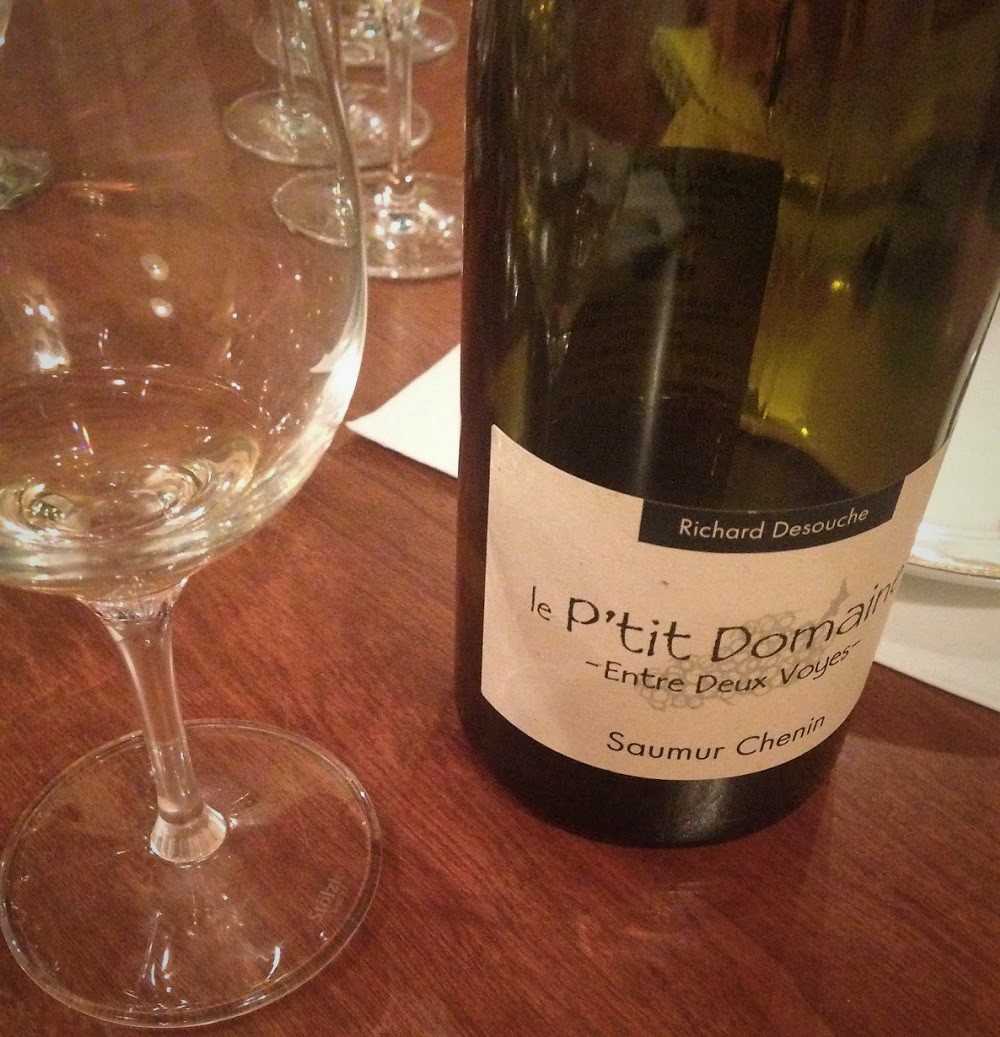
Intriguingly evolved nose of quartz dust, ham fat, lemon and hazelnut. Medium-bodied and ever so faintly spritzy. Ripe, almost sweet-seeming, but actually dry and very saline. The level of extract gives the wine a certain density and a bordering-on-waxy texture, a prefect foil for the trenchant acidity and super minerality. “Like a green apple with salt,” notes one taster. The depth and breath are sustained through the very long, bitter-, lemon- and almond-noted finish. A treat. (Buy again? If only…)
MWG June 22nd tasting: flight 1 of 7
Notes from the edges
Vin de Sologne 2014, Quartz, Domaine Étienne Courtois ($39.25, private import, 6 bottles/case)
Located in the Sologne, Étienne and his father Claude make wines exclusively using ancestral methods and sometimes run afoul of authorities. Farming is strictly organic and biodynamic. This 100% Sauvignon Blanc comes from 15-year-old vines. Manually harvested, destemmed and gently pressed. Fermented (with indigenous yeasts) and matured in oak barrels for 12 to 24 months. 11.7% ABV. Quebec agent: La QV.
Striking, complex nose of turpentine, “eucalyptus,” “wild ginger,” California bay leaf, dried lemon, quartz crystals and parafin. A core of fruit (“candied lemon”) and more (“braised fennel”) wrapped in salt, energized by bright acidity. Good balance and length and real mineral depth. “The best Sauvignon Blanc I’ve ever had,” declares one taster. That said, I don’t imagine most people tasting it double-blind would guess it’s a Sauvignon Blanc. Whatever. It’s spellbinding. (Buy again? Oh, yes.)

Bourgogne Aligoté 2015, Troma-Onirique, François Écot ($38.15, private import, 12 bottles/case)
Based in Mailly-le-Château in the Yonne department of northeastern Burgundy, François Écot not only runs, with his American wife, a natural wine agency in New York City, he makes wines using grapes from an abandoned one-hectare vineyard that he resurrected. This 100% Aligoté, however, comes from purchased biodynamically and organically farmed (though not certified) grapes. Manually harvested. Vinified and matured eight months in foudres, fûts and amphorae. No added anything, including sulphur. Unfiltered and unfined. 12.5% ABV. Quebec agent: La QV.
The nose prompts comments along the lines of chalk quarry, “match stick,” “waxy” and lemon juice. A sip reveals a rich and minerally wine with a mouthfeel as much like a Chardonnay’s as an Aligoté’s. There’s some surprisingly juicy fruit, bright but smooth acidity, impressive purity and depth and a long, minerally finish. It’s still a surprise to see a $40 price tag on an Aligoté, but that’s what the top wines go for these days. And this is definitely a top wine. (Buy again? Yes.)
Coteaux Bourguignons 2015, Pinot Beurot, Domaine Bouillot Salomon ($32.20, private import, 12 bottles/case)
This admirable northern Rhône estate recently acquired 2.7 hectares of vineyards west of Dijon. 100% Pinot Beurot (aka Pinot Gris) from biodynamically farmed vines rooted in clayey-calcareous soil. Manually harvested. Non-interventionist wine-making with no added anything, including sulphur. Matured in stainless steel and cement tanks. 13.5% ABV. Quebec agent: La QV.
Pear, minerals and more than a hint of reduction, which other tasters describe as “durian” and “cow piss and camomile.” Smooth, round and dry in the mouth. Soft acidity enlivens the verging-on-unctuous texture and brings welcome freshness. There’s a certain minerality and some white spice and butter on the long finish. Not a wine that will have Alsace quaking in its boots but more than just a curiosity. Carafe it at least a couple of hours before serving if drinking now or hide it in the cellar for a two or three years. (Buy again? Sure.)
MWG June 8th tasting: flight 4 of 6
Rocca fortis
Located in Roquefort-la-Bédoule, about 15 km east-southeast of Marseille and at the northwestern edge of the Bandol appellation, Château de Roquefort today comprises 24 hectares of vines located on a northwest-facing mountain slope at about 375 m. The soil is mainly flinty clay-limestone. The vineyard’s orientation and altitude are said to give its wines a rare balance, which is attributed to the grapes’ slow development. The estate has been owned by the De Villeneuve family since the early 1800s and is farmed organically. Most of the wines are blends and in all the blends the grapes are cofermented. Cellar work is gravity fed whenever possible.
In this instance, Roquefort has nothing to do with the celebrated blue cheese from Aveyron and envrions in the French southwest. The Provençal roquefort is derived from the Latin rocca fortis (rocky outcrop), one of which dominates the estate’s vineyards.
IGP des Bouches-du-Rhône 2016, Petit Salé, Château de Roquefort ($25.90, private import, 12 bottles/case)
Mostly Clairette with lesser amounts of Ugni Blanc (aka Trebbiano) and Vermentino; the Clairette, locally called petit salé, comes from vines planted in the 1950s. The hand-picked grapes were destemmed, crushed and cold-macerated on the skins before being pneumatically pressed. Fermentation with indigenous yeasts took place in temperature-controlled (18-23°C) tanks. Malolactic fermentation was blocked. Matured in concrete tanks and bottled in February and March of 2017. 11% ABV. Quebec agent: La QV.
Lemon, white flowers, mineral dust, faint peach. Light yet intense and very fresh. Bone dry but not austere. A vein of salinity runs throughout. Long, clean finish. Much more akin to a Cassis than a Rhône white, this has seafood – including the raw variety – written all over it. (Buy again? Def.)

Côtes de Provence 2016, Corail, Château de Roquefort ($25.60, private import, 12 bottles/case)
This rosé is always made from Grenache, Syrah, Cinsault, Carignan, Vermentino and Clairette, though the proportions vary from vintage to vintage; in 2016 they were 30%, 25%, 20%, 10%, 10% and 5% respectively. The manually harvested grapes were partially destemmed. Some of the varieties were cold-macerated from eight to 24 hours. All the grapes were direct pressed, with the juice being combined and fermented in temperature-controlled (18-23°C) tanks with indigenous yeasts. 12.5% ABV. Quebec agent: La QV.
Subtle nose of peach, lime, sun-baked rocks and garrigue. Clean and fresh in the mouth. There’s a core of sweet fruit (though the wine is very dry), a bit of an acid bite and, again, a current of salinity. Finishes long and savoury. Even rosé skeptics liked this. (Buy again? Def.)
MWG June 8th tasting: flight 3 of 6
White orange
Vipavska Dolina 2015, Bela, Burja ($37.60, private import, 6 bottles/case)
A blend of Istrian Malvasia (30%), Welschriesling (30%), Ribola Gialla (30%) and unspecified other varieties from biodynamically farmed vines grown in the Vipava Valley and ranging from 25 to 75 years in age. Macerated on the skins for eight days before pressing. Fermented with indigenous yeasts in stainless steel tanks. Matured in 25 to 50 hl Slavonian oak barrels. 13.5% ABV. Quebec agent: La QV.
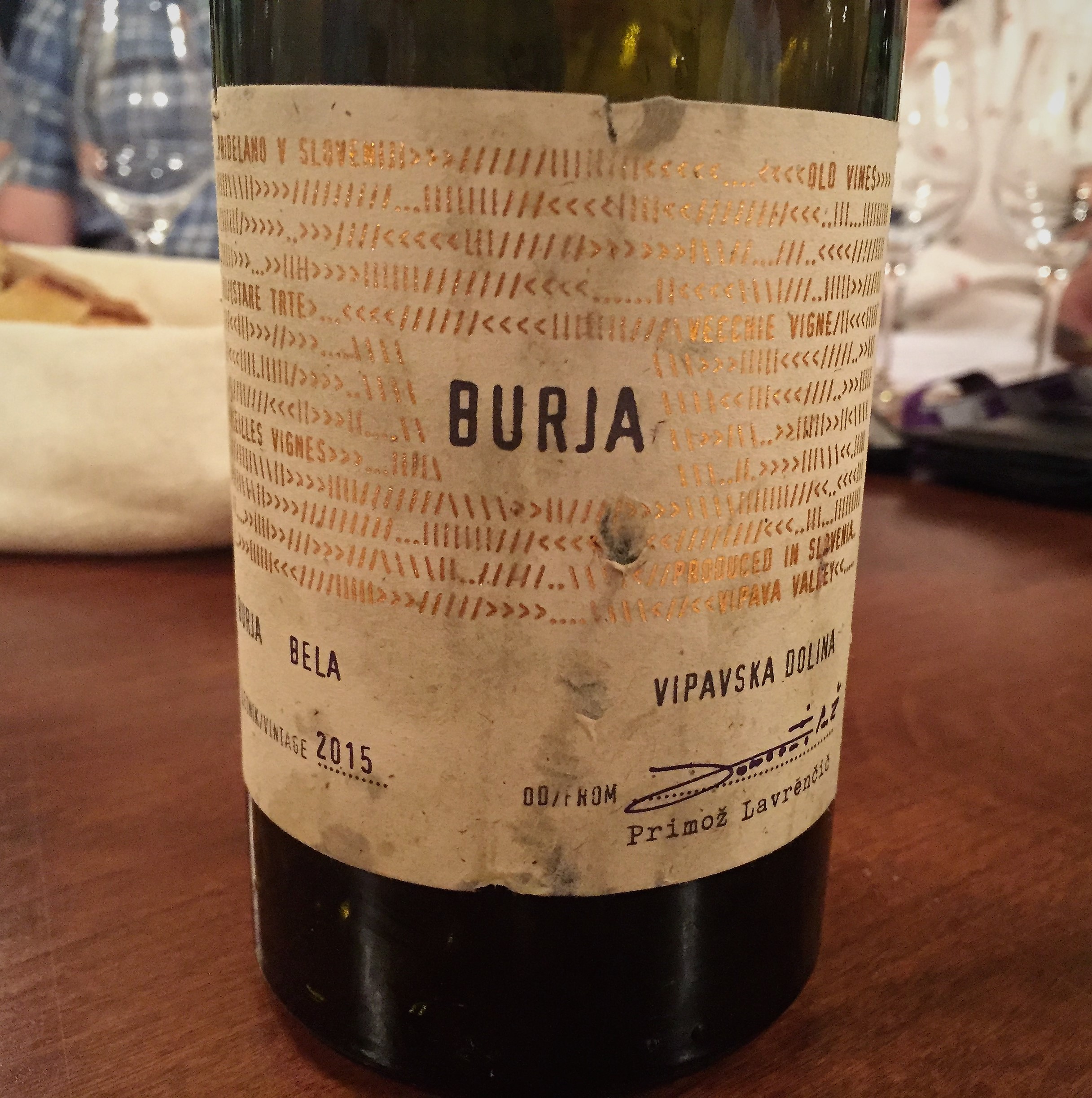
To all appearances, not an orange wine; the skin contact may add complexity and depth but the colour is lighter and more golden than, say, the Konkret Weiss, the nose is aromatic without being particularly estery/phenolic and if tannins are to be found, they escaped my notice. So, what are the aromatics? Preserved lemon, white pepper, quartz, maybe a floral note. In the mouth, the wine is very dry and savoury. The fruit takes a back seat to the minerals and a surprisingly intense salinity while sleek if sustained acidity counters the oily texture. The finish is long and vapourous. A food wine if ever there were one and probably a bottle that won’t suffer from a few years in the cellar. (Buy again? Yes.)
MWG June 8th tasting: flight 2 of 6
Meinklangers
The Mo’ Wine Group’s latest agency tasting was led by La QV’s head honcho Cyril Kérébel. The wine-up featured a particularly high proportion of whites, all with great minerality and a saline edge, as well as a wowser rosé and a handful of super-drinkable reds. We began with a trio of new-to-most whites from one of our favourite producers.
Burgenland 2015, Burgenlandwhite, Meinklang ($23.00, private import, 12 bottles/case)
A blend of Grüner Veltliner (50%), Welschriesling (40%) and Muscat Ottonel (10%) from biodynamically farmed vines. Manually harvested. Fermented (with indigenous yeasts) and matured in stainless steel tanks. Screwcapped. Residual sugar: 4.9 g/l. 12% ABV. Quebec agent: La QV.
Hay, straw, white flowers, chalk, distant “chives” and dried orange peel. Round in the mouth, the acidity smooth, the texture verging on waxy. The upfront fruit and underlying minerals give ways to a long savoury, saline finish with a lingering white pepper note. “Building spiciness underneath rosewater,” proclaims one taster. A perfect summer white is the general consensus. (Buy again? Yep.)

Somló 2015, H15, Meinklang ($37.65, private import, 6 bottles/case)
100% Hárslevelü from biodynamically farmed vines grown at the base of the extinct Somló (pronounced shom-low) volcano in southwest Hungary, not far from the Austrian border. The must is passed through a coarse filter before fermentation. The wine-making – which takes place at the estate’s Burgenland winery – is non-interventionist, with no additions except, possibly, a tiny squirt of sulphur at bottling. Matured in stainless steel tanks and old oak barrels for 12 months. Residual sugar: 4.2 g/l. 12% ABV. Quebec agent: La QV.
Complex, aromatic nose dominated by honey, spice and yellow fruit. Dense and weighty (not heavy) on the palate, the fruit wrapped around a softly glowing core of acidity. The complex of flavours turns impressively savoury/salty/sweaty on the mid-palate. Very long. Less tense and minerally, more stone-fruity and unctuous than some earlier vintages but no less engaging. (Buy again? Yep.)
Burgenland 2014, Konkret Weiss, Meinklang ($65.75, private import, 6 bottles/case)
A field blend of three Gewürztraminers, specifically Red Traminer, Yellow Traminer and plain old Gewürztraminer. Macerated on the skins for 21 days. Vinified in egg-shaped concrete tanks. No added anything, including sulphur. Residual sugar: 1.6 g/l. 12% ABV. Quebec agent: La QV.
For once, an orange wine that actually has an orange cast. One taster describes the complex nose of gardenia, cedar, spice and a funky whiff as “like the old lady in front of me on the bus, eating a grapefruit.” Dazzlingly complex and layered on the palate. Rich yet fluid. Dry but not austerely so. Structured by bright acidity and light tannins. The endless finish is awash in umami. (Buy again? Yep, wincing only slightly at the price.)
And Cyril shared some good Meinklang news with us: the SAQ will be including their impressive “Graupert” Pinot Gris in its Opération vins oranges release this fall and will also be carrying their fine ancient grains beer.
MWG June 8th tasting: flight 1 of 6
Doubleheader
Côtes du Jura 2014, Naturé, Domaine de l’Aigle à Deux Têtes ($29.00, 13200183)
 Located in Vincelles in the southern Jura, Henri Le Roy’s micro estate has been making wines since 2005. 100% Naturé (aka Savignan) from organically farmed vines. Fermentation (with indigenous yeasts) and maturation (on the fine lees) took place in old barrels. As Le Roy is not a fan of oxidized wines, the barrels were kept topped up. No added anything, including sugar, except for a tiny squirt of sulphur dioxide. Wax capsule. Reducing sugar: <1.2 g/l. 12.5% ABV. Quebec agent: Ward & associés.
The fragrant nose draws you in: browning yellow apple, drying hay, limestone, hints of wax, honey, butter and marzipan. A sip reveals a complex, exquisitely balanced wine. While Savagnin’s pronounced acidity structures, it here is softened by the richness of the fruit, so ripe it almost convinces you the wine isn’t bone dry, when in fact it is. And yet this isn’t a fruit-forward wine. The minerality is of a kind normally associated with Chablis or Santorini. The very long, pear-scented finish brings what the French call des beaux amères, a subtle complex of bitter notes, in this case including citrus pith. Unullaged Savagnin is often – and deliciously – done in a bold and bracing style; this adopts another approach, less primary colours, more pastels. A gorgeous wine and a certifiable bargain. (Buy again? Imperatively.)
Greek winery tour: Mercouri (Elis)
[Hover over pics to display captions and credits; click to embiggen.]
 In so many ways – historically, climatically, viticulturally, architecturally, culturally, even scenically – the Mercouri Estate stands apart from the other wineries we visited and quite possibly from all wineries in Greece.
Created in 1864 by merchant Theodoros Mercouri, the estate is one of the oldest in the country. Wine-growing began in 1870, when Refosco vines imported from northeast Italy, where Mercouri had trade ties, were planted. The resulting wine soon gained a reputation and was not only consumed locally but also exported on ships that docked at the estate. Such was its renown that the Refosco grape came to be called Mercoureiko in Elis (aka Ilia). New wine-making facilities were built in 1930. Production more or less ceased between World War II and 1985, when Vasilis and Christos Kanellakopoulos, the fourth generation of the family, began revitalizing the estate and its wines. These days, Vasilis’s two sons are taking the helm, Dimitris as the oenologist and Labis looking after the business and marketing side of things. To all appearances, the estate’s future is in good hands.
 Set like an emerald on a small bay to the west of Korakochori, the estate enjoys a unique micro-climate. The Ionian Sea has a tempering effect and, as rain clouds in Greece tend to travel from west to east, the average annual precipitation and relative humidity are higher than in the rest of the Peloponnese, though paradoxically the summer and fall are drier than areas further east, a boon for grape health and harvest. The danger of frost is very low.
The mix of grape varieties grown in the 40 hectares of vineyards is as unparalleled as it is cosmopolitan, and includes the Greek Agiorgitiko, Assyrtiko, Avgoustiatis, Korinthiaki, Malvasia, Mavrodaphne, Rhoditis and Robola as well as the extra-Hellenic Mourvèdre, Negroamaro, Ribolla Gialla, Syrah and Viognier. The winery also reportedly has or has had experimental plots of Albariño, Cabernet Franc, Cabernet Sauvignon, Grenache, Merlot, Sangiovese and Sauvignon Blanc.
Several of the buildings, including ones still in use, are little changed from when they were constructed in the late 19th and early 20th centuries. Many are built from local stone. Several have steeply pitched tiled roofs. Parts of the winery have been preserved as if in amber, with the original furnishings, paintings and equipment intact.  Walking through the front door is like stepping back in time, a feeling only increased by a visit to the estate’s small museum with its collection of old presses, tools and photographs, among other things.
While Greece is rightly seen as a meeting place between the western and eastern Mediterranean cultures, the estate feels closer to the west than the east, seems to have one foot in Greece and the other foot in Italy. Take the grape varieties, for example. Take the now abandoned owner’s mansion, which is depicted on the label of the estate’s flagship reds and wouldn’t be out of place in Brindisi or Bari. The Italian feel even extends to the park-like grounds. With its lush foliage, huge trees, expanses of lawn, gentle inclines and pristine shore, the landscape is uniquely pastoral and bucolic.
However present the past may be at Mercouri, the wine-making is resolutely modern, which is not surprising for an estate that has been crafting wines from local and foreign varieties for close to a century and a half. Even the wine labels seem to express this embrace of new and old; the flagship dry whites, Lampadias rosé and Antares red feature reproductions of colourful stylized or abstract paintings; the flagship reds’ labels are far more traditional; the newer reds’ labels live in both eras, with modern typography and an old photograph of young members of the family. The kicker is that all the bottlings, whether old or new and especially the reds, are among the most elegant Greek wines I’ve tasted.
You’ll find my notes on all the Mercouri wines after the jump. For details about where we stayed and ate and what we ate and saw, see the Day Three report on carswelliana.
INTRODUCTION
PAPAGIANNAKOS (ATTICA)
TSELEPOS (ARCADIA)
♦ MERCOURI (ELIS)
TETRAMYTHOS (ACHAEA)
THYMIOPOULOS (MACEDONIA)
ARGYROS (SANTORINI)
So similar, so different
Stellenbosch 2014, Chenin Blanc, Organic, Reyneke ($26.60, 13123608)
100% Chenin Blanc from biodyanmically farmed vines around 45 years old and rooted in granitic loam over clay. Manually harvested. Whole-cluster pressed. The must was allowed to settle then fermented with indigenous yeasts in 300-litre second-fill French oak barrels and a 2,500-litre foudre. Matured on its lees for 10 months then racked into a stainless steel tank for another month. Reducing sugar: 1.9 g/l. 13% ABV. Quebec agent: Univins.
Intriguing, even mysterious nose of white spice, chalk, lemon, roasted white meat and “garum.” In the mouth, it’s round from start to finish, honeyed yet dry, packed with ripe fruit and minerals. A stream of acidity adds backbone and life. Faint bitter saline notes mark the nicely sustained finish. One of those wines that seems as Old World as New, this had several fans around the table. While I found it a little two-dimensional, especially in comparison to its flightmate, I’ll readily admit those dimensions are lovely. (Buy again? Sure.)

Jasnières 2015, Sec, Domaine de la Roche Bleue ($27.90, 12856228)
100% Chenin Blanc from organically farmed 10- to 25-year-old vines planted in clayey, flinty topsoil over a limestone base. Manually harvested. Whole-cluster pressed. The must was allowed to settle, then fermented (slowly due to the cool cellar temperatures) with indigenous yeasts, 60% in fourth- to sixth-fill barrels (wine from older vines) and 40% in stainless steel tanks (wine from younger vines). Matured four months in sixth-fill barrels. Reducing sugar: 3.0 g/l. 13% ABV. Quebec agent: Boires.
Complex, winey nose of linden flowers, “sake,” quince, lime and, eventually honey. Sleek and spicy on the palate, alive with acidity. The tart fruit (citrus and stone mainly) is dusted with chalk and gunflint. Sugar levels notwithstanding, this seems significantly drier – not to mention leaner, more crystalline and better delineated – than the Reyneke. Pure, long and delicious. (Buy again? Yes.)
MWG May 18th tasting: flight 3 of 6

 Brett happens