Posts Tagged ‘White wine’
Pairing Melon with Burgs
Vin de France 2015, Melon, Domaine de la Cadette ($28.80, private import, 12 bottles/case)
100% Melon de Bourgogne (aka Muscadet) from organically farmed 25- to 30-year-old vines in the Bourgogne-Vézeley appellation (despite its name, the grape isn’t one of Burgundy’s permitted varieties, which explains the VDF designation). Manually harvested. Whole-cluster pressed. Fermented with indigenous yeasts, matured six months in stainless steel tanks and bottled unfined with only a tiny shot of sulphur dioxide. 12% ABV. Quebec agent: oenopole.
Lemon, chalk and the faintest hint of grass. Wonderfully clean, round and fresh. Fruitier than your average Muscadet. Less crystalline too, though with the grape’s trademark mineral substrate. Soft acidity gives it a glow. Straightforward, long and pure. “I like the lingering sourness,” notes one taster. Me too. (Buy again? Oh, yes.)

Bourgogne-Vézelay 2015, La Châtelaine, Domaine de la Cadette ($29.35, 11094621)
100% Chardonnay from organically farmed 25-year-old vines rooted in clay and limestone. Manually harvested. Gently pressed. Fermented with indigenous yeasts and matured 14 months on the fine lees. Lightly filtered. Sees only stainless steel until bottlng. Reducing sugar: 2.7 g/l. 12.5% ABV. Quebec agent: oenopole.
Lemon, oats, quartz, white flowers – typical, wot? Clean and fresh but less overtly fruity than the Melon. More minerally though. The stuffing and bright acidity are well balanced, the finish long and clean. Even at this early point, one of the best vintages of this wine I’ve tasted, with the potential to improve over the short and medium term. (Buy again? Yes.)
Bourgogne-Vézelay 2015, La Piècette, Domaine de la Cadette ($31.25, 11589691)
100% Chardonnay from organically farmed 20- to 30-year-old vines in several parcels. The hand-picked whole clusters are gently pressed. The must is transferred to 228-litre barrels (called pièces) for six months’ alcoholic and malolactic fermentation (no added yeasts or bacteria). Matured 11 months on the lees. Lightly filtered. Reducing sugar: 2.3 g/l. 12.5% ABV. Quebec agent: oenopole.
Initially reticent nose of butter and faint vanilla, opening to lemon and quartzy chalk. Rich but not happy. There’s bright acidity, entwined minerals and oak, a certain depth and, disconcertingly, a “weird sweetish taste” that lasts through the long finish and makes the wine taste not so much off as unsettled. A taster notes that a recently opened six-year-old bottle was “amazing,” supporting the impression that the 2015 is a wine that will benefit enormously from a few years in the cellar. (Buy again? A bottle or two to lay down.)
MWG May 18th tasting: flight 2 of 6
The farthest thing from an aperitif wine
Languedoc 2013, Roucaillat, Domaine des Hautes Terres de Comberousse ($29.55, private import, 12 bottles/case)
The 14-hectare estate is located about 15 kilometres north of Sète. Its first vines were planted in 1981, The current company, a father and son operation, was founded in 2001. Farming has been organic since the start and the mostly calcareous vineyards are neither tilled nor weeded. This, the estate’s flagship white, is a blend of Roussanne (50%), Rolle (aka Vermentino, 30%) and Grenache Blanc (20%). The grapes are manually harvested and given extended maceration before being gently pressed. The must is chilled, clarified though settling and fermented in temperature-controlled (19-20°C) tanks. Malolactic fermentation and several months’ maturation follow. 13.5% ABV. Quebec agent: Glou.

Striking, savoury nose of “spruce bark,” yellow beet, “cooked Swiss chard,” bacon fat and “pumpkin seed.” In the piehole, it’s rich and heady, extracted but not particularly fruity: beeswax overtoned with orange, bacon and dried herbs. The acidity is of the soft-glow variety while the long finish fades into a lingering bitterness. Unrefreshing on its own (the farthest thing from an aperitif wine), this absolutely requires food. Unique, surprising and, maybe, a year or two before its prime. (Buy again? A bottle or two to relive the experience and play with food pairings.)
MWG April 21st tasting: flight 2 of 6
Brand new and old
The April 21st tasting featured wines represented in Quebec by Glou and was led by the agency’s prime mover, Jack Jacob. We started with a flight of four fine Alsatians.
Created in 1950 and based in Ergersheim, Domaine Brand sits in the middle of La Couronne d’or, a swath of vineyards stretching from Strasbourg to Marienheim. The estate’s 10 hectares of vineyards are in the communes of Ergersheim, Osthoffen and Wolxheim. Farming has been organic since 2001 and certified biodynamic (Demeter) since 2015.
Current winemaker Philippe Brand took the helm in 2008, following stints at Domaine de Montchovet in Burgundy and wineries in the Peloponnese (Greece) and Barossa Valley (Australia). He soon imposed a regime of non-interventionist wine-making where the only additive, if any, is small amounts of sulphur dioxide. The estate makes a separate line of unsulphured natural wines under the Apollinaire moniker whose labels feature calligrams by the eponymous artist.

Alsace 2013, Riesling, Kefferberg, Brand & Fils ($33.06, private import, 6 bottles/case)
100% Riesling from the Kefferberg vineyard. Manually harvested. The whole clusters are gently pressed. Fermented (with indigenous yeasts) and matured in large barrels. 12.5% ABV. Quebec agent: Glou.
Gold bronze to the eye. Complex nose of apple, pear and chalk with hints of petrol and “Meyer lemon” (quoting another taster). Rich but not heavy in the mouth, the fruit tending toward baked apple. Dry and very minerally. The combination of acidity and minerals lends an almost “tannic bite” to the long finish. (Buy again? Sure.)
Alsace 2015, La Chimère, Charles et Philippe Brand ($34.76, private import, 6 bottles/case)
One of the estate’s Apollinarie wines. 100% Riesling from the Osthoffen vineyard. Manually harvested. The whole clusters are gently pressed. Fermentation with indigenous yeasts and 12 months’ maturation take place in third- and fourth-fill barrels. Unfiltered and unfined. No added sulphur. 13% ABV. Quebec agent: Glou.
Paler. Faintly funky nose of white flowers, lemon peel, flint, barley sugar and a pungent note some described as bubble gum and others as camphor. A bit spritzy on the palate. Less rich and extracted, more crystalline than the Kefferberg. Bone dry (0.5 g/l residual sugar). Lingering green mango. I like. (Buy again? Yes.)
Alsace 2015, Fleurs, Charles et Philippe Brand ($37.64, private import, 6 bottles/case)
One of the estate’s Apollinaire wines. 80% Pinot Gris, 20% Riesling. Manually harvested. The whole clusters are gently pressed. Fermentation with indigenous yeasts and 12 months’ maturation take place in third- and fourth-fill barrels. Unfiltered and unfined. No added sulphur. Residual sugar: 1.0 g/l. 13.5% ABV. Quebec agent: Glou.
Engaging nose of white peach, white spice and slate with honey and lactic notes. Very dry yet with an “implied sweetness.” Buoyant acidity. Faint spritz. Pearish with bergamot overtones. Mineral-rich. Long bitter-edged finish. Complex. Impressive. (Buy again? Gladly. And I’m really looking forward to trying the orange version.)
Alsace 1999, Riesling, Kefferberg, Brand & Fils ($56.34, private import, 6 bottles/case)
100% Riesling from the Kefferberg. Manually harvested. The whole clusters are gently pressed. Fermented (with indigenous yeasts) and matured in large barrels. 12% ABV. Quebec agent: Glou.
A deep bronze colour approaching that of iced tea. Complex, unfathomable nose: dried apple, brown sugar, smoke, hints of petrol and “spicy green” or “dried mint” and more. Equally complex in the mouth, the flavours echoing the nose and resonating on their own. Super dry. Smooth acidity. Considerable depth. Endless finish with, once again, a hint of something camphor-like. The price is more than reasonable for a wine of this age and quality. (Buy again? Oh, yes.)
MWG April 21st tasting: flight 1 of 6
Sea wine
Santorini 2016, Thalassitis, Gaia Wines ($29.55, 11966695)
The cuvée’s name refers to the ancient practice of mixing wine with sea water (thalassa meaning sea in ancient Greek) to produce a health-promoting beverage called thalassitis oenos or sea-originated wine. 100% Assyrtiko from ungrafted vines about to enter their ninth decade, trained into nests and rooted in the arid, soil (mostly pumice devoid of organic matter) of Episkopi, Akrotiri and Pyrgos. Vinified in stainless steel. Fermented with selected yeasts. Did not undergo malolactic fermentation as the winery claims it contains no malic acid to be converted into lactic acid. Spent five to six months on the lees. Sealed with a synthetic cork that looks a little like the black sand and rocks found on the island. Reducing sugar: 1.6 g/l. 13% ABV. Quebec agent: Le Marchand de Vin.
Fresh and preserved lemon, tidal pool, pumice, faint honey. Buttery texture. Fruity attack for an Assyrtiko. Still, the fruit soon gives way to the expected minerality. Acidity is, of course, very present, especially from the mid-palate on, but seems a tad smoother and less trenchant than is sometimes the case in Santorini Assyrtikos. Very dry, especially on the long, extremely saline finish. Probably my favourite of Gaia’s three Santorini bottlings. While not as deep, powerful or crystalline as some of its (often more expensive) peers, it would still make a good introduction to the grape and terroir. The winery suggests ageing it two to three years; given Assyrtiko’s propensity to oxidize and syncorks’ propensity to allow oxidation, I wouldn’t chance keeping it much longer than that. A near-perfect pairing for oysters on the half shell, grilled sea bass or porgy drizzled with olive oil and lemon juice and just about any octopus dish; with some oxidation, a killer match for beef or venison tartare. (Buy again? Yes.)
Stone wine
Robola de Céphalonie 2015, Vino di Sasso, Domaine Sclavos ($26.95, 12485877)
100% Robola from organically and biodynamically farmed, ungrafted old vines on the Ionian island of Cephalonia. Vino di sasso means “wine of stone,” a reference to the island’s rocky cliffs and outcrops and the vineyard, composed mainly of calcerous pebbles at an elevation ranging up to 850 metres. The manually harvested grapes are directly pressed. The must is fermented at low temperatures with indigenous yeasts and matured eight months on the lees. Sees only stainless steel until bottling. Bottled unfiltered, unfined and with only a tiny squirt of sulphur dioxide. Reducing sugar: 1.4 g/l. 12.5% ABV. Quebec agent: oenopole.

Limestone dust, dried hay, yellow apple, faint peach, dried herbs, almonds and smoke. A striking combination of minerality and richness. Bone dry. Seems built around an acid-mineral core. A saline current runs under the ethereal orchard fruit and tangs the long, fruity, almondy, smoky finish. A unique, fascinating wine, more enigmatic and involving than the 2014. The price of admission is more than fair. (Buy again? Yes, including a couple of bottles to cellar for a year or two.)
Just in time for asparagus season
Wachau 2014, Grüner Veltliner, Terrassen, Nikolaihof ($21.65, 13166181)
Austria’s oldest estate and one of its most storied. This is the first Nikolaihof wine to be sold at the SAQ. 100% Grüner Veltliner from organically and biodynamically farmed estate vines between 10 and 45 years old planted in the Wachau on the south shore of the Danube. Fermented with indigenous yeasts. Alcoholic fermentation and three months’ maturation on the lees took place in very large barrels. Malolactic fermentation was avoided. The wine was later matured in tanks before being lightly filtered (but not fined) and bottled. The only addition was a squirt of sulphur dioxide at bottling. Screwcapped. Reducing sugar: 3.3 g/l. 12.5% ABV. Quebec agent: Ward & associés.

Textbook nose: white pepper, stone, lime (fruit and pith), herb salad, turned earth, sea brine and the faintest hint of honey. Texture somewhere between waxy and buttery. Savoury and quite dry. The fruit and greens are swirled with an intense minerality (quartz, saline). The pervasive acidity is softened by the not inconsiderable extract. The long finish brings a white pepper note and a Szechuan pepper numbingness. Not as crystalline, layered, dimensional or commanding as a top GV but punching well above its weight. A natural with river fish and white meats accompanied by cabbage and, like many GVs, unfazed by asparagus. (Buy again? Yes, though unfortunately there’s not much left in the system.)
Busch babies
Based in Pünderich on the banks of the Mosel River, Clemens Busch took over his family winery in 1984. Starting with the original two hectares, he has expanded the estate’s holdings to 25 hectares, mostly in the 1980s by buying vertiginously steep, hard-to-work vineyards from neighbours who abandoned them to plant faddish Pinot Noir on the much flatter plains above the slopes. Sixteen of the hectares are in the Pünderich Marienburg vineyard, south-facing and considered one of the top Mosel sites. Though a 1971 law consolidated all the hillside’s parcels under the Marienburg name, Busch vinifies them on a parcel by parcel basis and bottles his top cuvées under the original names.
The farming is organic (since 1986) and biodynamic (since 2004). The wine-making is non-interventionist, with no fining and nothing added except a small squirt of sulphur dioxide at bottling for most cuvées. Most of the wines are dry, though small quantities of sweet and botrytized wines are also made.
The estate’s website features some impressive, full-screen photographs of the vineyards and winery.
Mosel 2015, Riesling, (alter)native, Clemens Busch ($32.00, private import, 12 bottles/case)
This is an unfiltered, low-sulphur bottling. Nearly the entire production goes to Quebec, though a little also makes its way to New York and Japan. 100% organically and biodynamically farmed Riesling from the Marienburg vineyard. Manually harvested. Macerated 12 to 24 hours on the skins. Spontaneous fermentation lasted until the end of December. Matured 15 months on the lees with no stirring in large (1,000-litre), old (50 years) wooden barrels. Unfiltered and unfined. A tiny amount of sulphur was added at bottling. Residual sugar: under 4 g/l. 11.5% ABV. Quebec agent: Ward & associés.
Hazy to the eye. The nose elicits descriptors like “pear cider,” “blanche-ish,” bread dough and lemon apples. Mouth-filling, bone dry and clean, with a slightly chewy texture and acidity that’s more puckery than crisp. Apple and mineral flavours last through the long finish. Fuzzier than – not as precise or delineated as – its flightmate and not a traditional Mosel Riesling by any means, but on its own terms it absolutely works. (Buy again? Yes.)
Ordered at Marconi a couple of nights after the tasting, a glass of the Mosel 2015, Riesling Trocken, LS, Clemens Busch (ca. $32.00, private import, 6 bottles/case) – the LS (or <s on at least some labels) stands for “low sulphur” and the wine contains only about a third of the already low amount of sulphur dioxide used in the regular bottlings – was in many ways similar to the (alter)native but clearer and a little more focused if also slightly more conventional. It elicited an “Oh, wow” from my Riesling-loving dining companions, whose first Busch wine it was.


Mosel 2015, Riesling, Marienburg GG, Clemens Busch ($61.34, private import, 3 bottles/case)
100% organically and biodynamically farmed Riesling from 25- to 60-year-old vines rooted in the grey slate section of the original Marienburg vineyard. Manually harvested in late October and early November. Macerated 12 to 24 hours on the skins. Spontaneous fermentation. Matured 12 months on the lees with no stirring in large (1,000-litre), old (50 years) wooden barrels. The barrels are not topped-up for the first month to encourage a little oxidative complexity. Unfiltered and unfined. A tiny amount of sulphur was added on bottling. Residual sugar: under 6 g/l. 12.5% ABV. Quebec agent: Ward & associés.
Classic Mosel nose of green apple, lime, slate and a touch of petrol. In the mouth, it’s astoundingly pure, focused, complex and balanced. Bone dry but with compensating fruit and layered minerals that, in combination with the lithe acidity, give the wine a strong though not rigid backbone. Very long. Doesn’t stop evolving in the glass, pointing to a long ageing potential (five to 20 years per Ward’s Alex Boily). A complete and beautiful wine. (Buy again? Oh, yes.)
The GG stands for Großes Gewächs (“great growth”), an unofficial designation for top-level dry wines from selected sites that is increasingly used in the Mosel by the members of the Bernkasteler Ring and elsewhere (except the Rheingau) by the members of the VDP growers’ association. Busch makes four GG cuvées: the Marienburg, Marienburg Rothenpfad, Marienburg Fahrlay and Marienburg Falkenlay.
MWG April 6th tasting: flight 3 of 7
Archetypical and atypical
Sancerre 2015, Domaine Vacheron ($36.25, 10523892)
100% Sauvignon Blanc from organically farmed massal selection vines. The grapes are manually harvested and gently pressed. The must is chilled and clarified by settling. Low-temperature (<20°C) fermentation and maturation on the lees take place in stainless steel tanks. Filtered before bottling. Reducing sugar: 3.0 g/l. 12.5% ABV. Quebec agent: Le Maître de Chai.
Textbook Loire Sauvignon Blanc nose: gooseberry, citrus, grass, chalk and flint. Rich bordering on lush, sleek and impressively pure. Fruity upfront with a mineral substrate emerging as the wine moves through the mouth. The considerable extract rounds the bright acidity. Long, lively, saline finish. Initially engaging, the wine’s youthful exuberance comes across as a little caricatural and fatiguing by the end of the glass, a bit like a bouncy puppy or some New Zealand Sauvignon Blancs for that matter. Will be interesting to see what transpires in two or three years. (Buy again? Maybe.)


Sancerre 2013, Constellation du Scorpion, Vincent Gaudry ($41.25, private import, 6 bottles/case)
This is a new name for a bottling formerly called L’Esprit de Rudolph in honour of the founder of biodynamism, Rudolph Steiner. Gaudry is reportedly secretive about his methods and not much technical information about this wine is to be found. 100% Sauvignon Blanc from biodynamically farmed vines rooted in flinty soil. Partially matured in oak barrels. Unfiltered. 13% ABV. Quebec agent: Ward & associés.
Wafting nose of grapefruit, chalk and quartz dust, “pink flowers” and “thyme.” Rainwatery yet also very present. The rich texture is lightened by “lime acidity,” deepened by a chalky underlay. A hint of caramel appears on the long finish. “A Sancerre that wants to be a Chardonnay,” concludes one taster. Subtle and subdued yet complex and delicious says me. (Buy again? Yes.)
MWG April 6th tasting: flight 2 of 7
Off and on
Crémant d’Alsace 2013, Bernhard & Reibel ($25.75, 13133224)
Not listed on the producer’s website, this appears to be a Quebec-only bottling. A blend of organically farmed Chardonnay and Pinot Noir (50-50 per the SAQ, 80-20 per the agency whose technical info for the wine is identical to the producer’s info for the non-vintage crémant with a different label). Manually harvested. Slow pneumatic pressing. The must is fermented with indigenous yeasts. Sparkled using the traditional method. Matured at least one year in the bottle on lattes. Lightly filtered. Reducing sugar: 6.9 g/l. 12% ABV. Quebec agent: Boires.
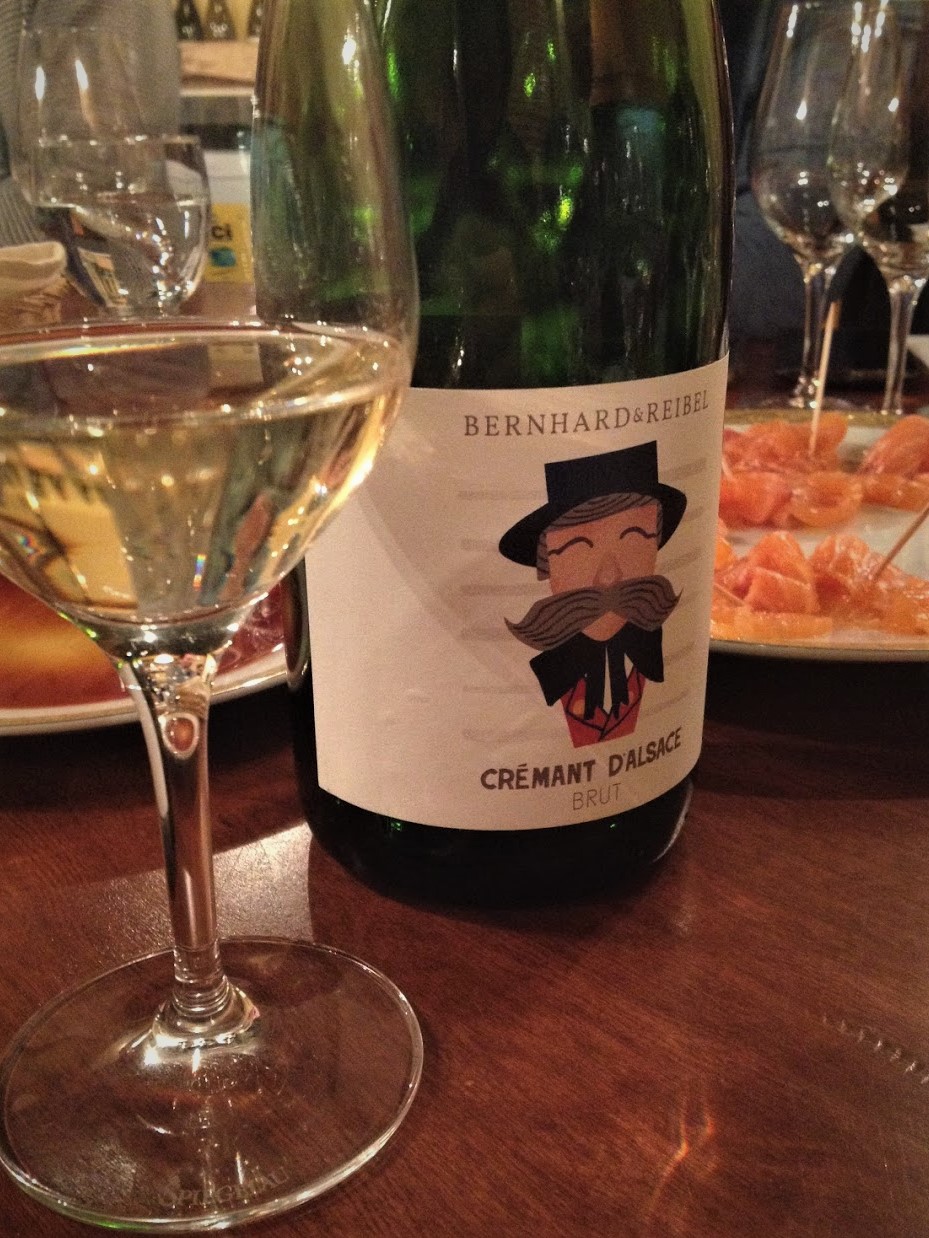
First bottle: Pale gold with fine bubbles. The nose is described variously as “more apple than pear,” “caramel apple,” apple seeds, “sweat or maybe volatile acidity,” chalk, “rancio” and “wet laundry.” In the mouth, the wine is fruity and dry, with good acidity and a fine effervescence. Yet there’s a fuzziness about it, a touch of oxidation and a lingering impression of something a little off. No one is enamoured and one or two perceptive tasters suggest our bottle is defective. Plates of Scottish-Asian gravlax having been set out (thanks, Mike!), we decide to open the backup.
Second bottle: Less gold in colour, the bubbles equally fine. The nose is fresher and fruitier, full of apple, citrus and mineral aromas and a whiff of brioche. On the palate, it’s crisper, cleaner, brighter, more textured and even drier. The racy acidity and mineral substrate last well into the creamy finish. We have a winner. (Buy again? Sure.)
MWG April 6th tasting: flight 1 of 7
WINO tasting (2/6)
Muscadet-Côtes de Grandlieu 2013, Les Hautes Noëlles, Domaine Les Hautes Noëlles ($36.46, private import, 6 bottles/case)
Founded in 1930, the estate, which has some 25 hectares of vines, is located in St-Léger-les-Vignes. 100% Melon de Bourgogne from organically farmed vines more than 80 years old and rooted in sand and clay on mica schist. Production is limited to 2,000 bottles a year. The grapes are picked by hand and macerated briefly before pneumatic pressing. The must is clarified by settling. Fermentation (with indigenous yeasts at c. 18°C) and maturation (c. 12 months on the lees with regular stirring) take place in oak barrels, a quarter of which are new. Sulphur use is kept to a minimum. 12% ABV. Quebec agent: WINO.
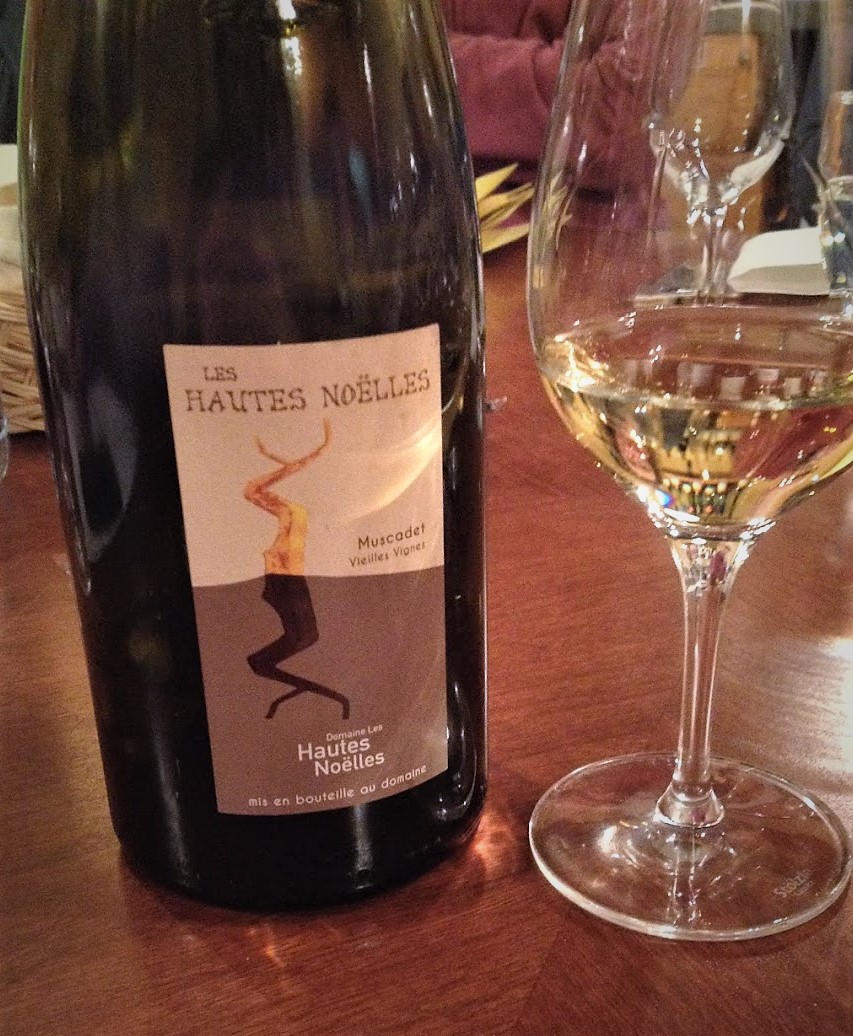
Multi-faceted nose with scents of apple, “strudel dough” (per another taster), faint marzipan, quartz, dried banana, lemon and more. Rich, fluid, complex, layered and dry. The initial fruit makes room for minerals (“chalk grotto” my note arcanely reads), while sleek acidity lends a soft glow. Honey, “ginger” and faint bitter notes colour the impressively sustained finish. A delicious, absorbing wine quite unlike any other Muscadet I’ve tasted. Would make an interesting ringer in a flight of Chenins or Chardonnays with some age on them. (Buy again? Yes.)
Tasted at Moleskine the following evening, the estate’s 2014 “Les Parcelles” bottling ($20.50, WINO, 12 bottles/case) was crisp, clean and appetizing though far more conventional.
MWG March 23rd tasting: flight 2 of 6

 Brett happens