Posts Tagged ‘biodynamic’
AOC shunners
Vin de table 2014, Zacmau, Causse Marines ($35.62, private import, 6 bottles/case)
100% Mauzac from organically and biodynamically farmed 90-year-old vines in Gaillac. Fermented with indigenous yeasts in temperature-controlled tanks. Maturated in stainless steel tanks and, on the lees with regular stirring, in barrels (30-50%). Fined and filtered only on an as-needed basis. Sulphur use is kept to a minimum. 13% ABV. Quebec agent: Rézin.
Striking nose of apple, sushi, “pumpkin,” and flat champagne. Smooth and rich in the mouth, with lowish acidity. The “loose attack” gives way to a savoury-overtoned, limestoney mid-palate. Not a lot of depth but a certain opulence and a great complexity of flavours, with tasters noting “apple compote,” “dried white flowers” and “propolis” among other things. Long finish. Fascinating. (Buy again? Sure.)


Vin de France 2015, Le Pont Bourceau, Les Roches Sèches ($31.38, private import, 6 bottles/case)
Technically an Anjou blanc. 100% Chenin Blanc from organically farmed vines planted in 1973. Manually harvested. Direct pressed. Vinified and matured in tanks for around 12 months. Filtered. 12% ABV. Quebec agent: Rézin.
Attractive nose of pear, quince and quartzy limestone. Rich, fruity and dry in the mouth. The smooth surface is unperturbed by the pervasive acidity. Great minerality. Honey overtones. Fundamentally savoury. Very long. Intense yet civilized. Delicious. (Buy again? Yes.)
MWG August 11th tasting: flight 4 of 9
Irrepressible
Moonlighting from his daytime gig at Rézin, the irrepressible Steve Beauséjour returned to the Mo’ Wine Group in August to lead another of his sui generis wine and food tastings. It goes without saying that the assembled masses enjoyed themselves. Our tastings start at 7 p.m. and normally end between 9:30 and 10; this one finished after midnight.
While the wines weren’t really served in flights, I’ve organized them that way for reporting purposes.
Québec 2016, Seyval-Chardo, Nature SSA, Les Pervenches (ca. $19)
A private bottling of the estate’s regular Seyval-Chardonnay blend. The wine went directly from the barrel into the bottle, with no filtering, fining or added sulphur. While I don’t have the exact proportions of the grape varieties, they’re normally 80% Seyval Blanc and 20% Chardonnay from biodynamically farmed vines. Manually harvested. Fermented with indigenous yeasts. Undergoes malolactic fermentation. Matured in neutral French oak barrels. 11.7% ABV. While this bottling was never retailed, the estate’s other wines are (though they usually sell out a few weeks after their release) at the winery, at a few area food stores specializing in local products (e.g. Dans la côte, Fromagerie Hamel) and through the Quebec agent, La QV.

Clean nose of lemon, chalk and mowed fields. Fresh and pristine in the mouth. Medium-bodied. The pure fruit lends some sweetness that’s immediately checked by the incisive – not harsh – acidity and dancing minerality. Gains breadth and depth as it breathes. Finishes clean, fresh and long. A bracing, super-drinkable and, yes, irrepressible wine with “lots of energy” (quoting another taster). I’d buy a case if I could. (Buy again? Please!)
MWG August 11th tasting: flight 1 of 9
Blank slate
Burgenland 2014, Weisser Schiefer, Winebau Uwe Schiefer ($24.35, 13349543)
A former sommelier turned winemaker, Uwe Schiefer, whose last name means slate in German, has earned the reputation of a bad boy of Austrian wine. Located in southern Burgenland, his eponymous estate focuses on Austrian varieties, in particular Blaufränkisch. As of a few years ago, it was said to be organic converting to biodynamic though I’ve not found any recent information about that. The grapes for this “white slate” blend of Welschriesling (90%), Grüner Veltliner (5%) and Pinot Blanc (5%) came from vineyards in the Eisenberg, Hannersdorf and Kohfidisch DACs. Fermented with indigenous yeasts in large wood vats. Malolactic fermentation and maturation on the lees in neutral barrels lasted 11 months. Unfiltered. 12% ABV. Quebec agent: Tocade.
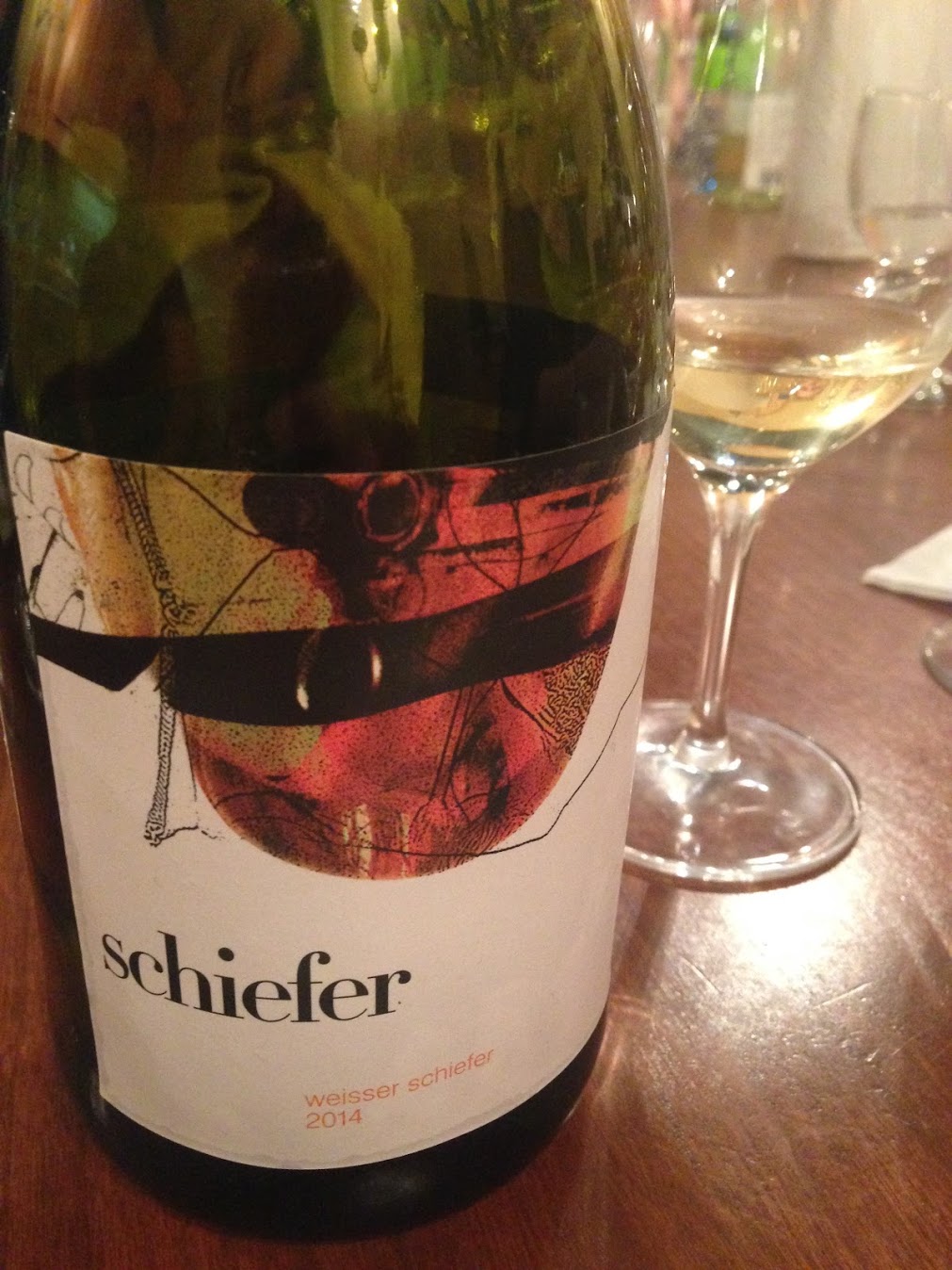
A faint reductive note blows off, leaving a distant, elusive nose that has the assembled tasters grasping for descriptors: “yogurty stuff,” “wet fur,” “sour grape,” “quince.” Shows a similar lack of presence in the mouth, the texture watery (“lacks glycerol” notes one taster), the acidity incognito and the flavours bland, a final hint of marzipan being the only exception. Chewing reveals minerals, pith, stone fruit and a little more dimensionality. Tasted the next day, the tail end had lost whatever mojo it once had. Something of a wallflower, then. Passing through a phase? Proof that, on its own, Welschriesling is, as some claim, best suited for sweet, botrytized wines? In any case, only two of us were intrigued enough to say we’d buy another bottle. In the past, the group has been impressed by Schiefer’s reds (April 2016, February 2012) but this didn’t generate anywhere near the same excitement. (Buy again? Maybe. Or maybe wait for the next vintage.)
Soave sia il Veneto…
 Veneto 2015, Masieri, Bianco, La Biancara ($22.20, 12846741)
Founded in 1999, Angeiolino Maule’s nine-hectare estate is located in Gambellara in the foothills of the Soave region. The estate-grown Garganega and Trebbiano grapes in this 80-20 blend come from biodynamically farmed vines rooted in volcanic soil. Manually harvested. Direct pressed. Vinified in stainless steel in small batches. Fermented with indigenous yeasts. No additives except a tiny amount of sulphur at bottling. Unfiltered and unfined. Reducing sugar: <1.2 g/l. 11% ABV. Quebec agent: Labelle Bouteille.
Hazy straw yellow to the eye. Discreet, fresh nose: quartz, sand, distant white fruit and the faintest hint of asafoetida. Leaner than your typical Soave: less pear, more lemon along with some green apple and a touch of lees. Smooth, transparently integrated acidity. Lots of chalky minerals and a faint almond overtone from the mid-palate on, joined by hints of watermelon fruit, rind and seeds on the bitter-tinged finish. A subtle, nuanced wine – a pleasure to spend time with – and a QPR winner. This bottle was singing from the get-go but others have needed several minutes of breathing to find their voice, so carafing is advisable. (Buy again? Definitely.)
(Musical accompaniment and origin of the title’s pun: Così fan tutte: “Soave sia il vento” – Mozart.)
Jaune and jauneish
Vin de France 2011, 3.11, Bertin-Delatte ($38.25, private import, 6 bottles/case)
Founded in 2008, the three-hectare estate is based in Rablay-sur-Layon. This 100% Chenin Blanc is from organically farmed young vines. The grapes, which normally would have been used for the flagship L’Échalier bottling, are harvested by hand and gently pressed. Barrel-fermented and -matured. The barrels were not topped up and a veil of yeast formed on the surface, much like on a vin jaune. This one-off experiment spent five years in the barrel. Unfiltered and unfined. Sulphur is minimal. Three barrels (800 bottles) were made; that and the last two digits of the vintage explain the name. 13.5% ABV. Quebec agent: WINO.
Typically oxidized nose of nutty yellow fruit but maybe not as complex or opulent as a good vin jaune’s. Lovely on the palate: sleek textured, lightly oxidized, clean fruited and minerally with great acidity, freshness and length. “Très chenin” and “great Chenin character” note other tasters. More than just a curiosity. (Buy again? Yes.)

Côtes du Jura 2009, Vin Jaune, Domaine Pignier ($102.10/620 ml, private import, 6 bottles/case)
Founded in the 13th century and in the hands of the Pignier family since 1794, the estate is located in the commune of Montaigu in the southern Jura. 100% Savagnin from biodynamically farmed vines rooted in clayey calcareous marl with Lias slate. Manually harvested. Fermented and matured in untopped-up oak barrels under a yeast veil for seven years. No added yeast. No chaptalization or racking. Bottled according to the lunar calendar. 13.5% ABV. Quebec agent: WINO.
On the nose, it’s a beautiful, subtle mix of nuts, yellow fruit, straw and white minerals. In the mouth, it’s a perfect balance between the pure fruit, fine acidity and imposing minerality. Not as oxidized as some but elegant, “accessible” and “super fresh.” (Buy again? If feeling flush, yes.)
MWG July 13th tasting: flight 9 of 9
Cab Franc three ways
Though they don’t come from a wine-making family, brothers Fabien and Cyril Boisard founded Domaine du Mortier in 1996 when they both were in their teens. Their holdings comprise around 12 hectares of vineyards in Saint-Nicolas-de-Bourgueil and a recently acquired three hectares in Bourgueil. Farming is organic-leaning-biodynamic, harvesting is by hand and none of the wines is chaptalized.
Saint-Nicolas-de-Bourgueil 2015, Les Sables, Domaine du Mortier ($27.23, private import, 12 bottles/case)
100% Cabernet Franc from seven parcel of mostly young vines in sandy soil. Whole-bunch fermentation takes place in 70 hl concrete vats. Lees from earlier vintages are used to start the fermentation. Pump-overs with minimum oxygen uptake are performed for five or 10 minutes a day. Matured on the lees for about six months. Unfiltered and unfined. A tiny amount of sulphur (16 mg/l) is added at bottling. 12.27% ABV. Quebec agent: WINO.
Red and black berries, coffee, dried meat, slate, pepper, distant barnyard. Medium-bodied and so very drinkable. A mouthful of tart fruit, dark minerals, lively acidity, super-supple tannins. Dry and wonderfully pure. Nothing deep or complex (a function of soil and vine age), just good, clean fun. The easiest-drinking Cabernet Franc I’ve encountered in a coon’s age. (Buy again? Done!)

Saint-Nicolas-de-Bourgueil 2014, Dionysos, Domaine du Mortier ($32.89, private import, 6 bottles/case)
100% Cabernet Franc from 30-year-old vines rooted in gravel over tuffeau. Manually harvested. Gently destemmed, gently pressed and given around 25 days’ maceration on the skins. Barrel-fermented using indigenous yeasts. Matured eight months in old oak barrels. 13.35% ABV. Quebec agent: WINO.
Darker nose of red berries and slate with meat and vegetal notes. Full and round in the mouth, packed with remarkably juicy fruit. Firm tannins bestow a velour-like texture, bright acidity a bit of a bite. The bedrock minerality rumbles through the long, spicy finish. The winemakers feel this often needs a couple of years before it hits its stride and drinks well for six to eight years beyond that. (Buy again? Yes.)
Vin de France 2014, 180 jours, Domaine du Mortier ($63.79, private import, 6 bottles/case)
VdF because the brothers feel it wouldn’t be accepted by the AOC authorities and because it leaves them free to supplement Saint-Nicolas grapes with fruit from their holdings in Bourgueil. Cabernet Franc from 60- to 70-year-old vines in tuffeau. Whole-bunch fermented and macerated in old barrels for 180 days, with the barrel being tightly closed, not topped-up and turned once daily during fermentation; after 180 days, the barrel is taken apart so the wine and skins can be transferred to the press. After pressing, the wine is matured in new barrels for another 180 days. Unfiltered and unfined. No added sulphur. 13.5% ABV. Due to the small quantities made, the wine is normally sold only at the winery, a limit of 12 bottles per customer is imposed and, reportedly, none is exported. Bravo to Martin Landry for scoring a few cases for Quebec. Quebec agent: WINO
Much darker and denser than its flightmates. Complex, funky nose: old wood, dark fruit and minerals, “animale,” “green olives,” “the stuff you scoop out of a squash” and more. Rich and dark yet somehow fresh. So complex and layered, so plush and chewy. Superbly structured with velvety tannins, glowing acidity and mineral depth. Great length. Complete, elegant, accessible. A big wine but so not the overextracted monster I was fearing it would be. Just wow. (Buy again? Just yes.)
MWG July 13th tasting: flight 7 of 9
Character analysis
Vin de France 2015, Kharaktêr, Domaine Le Briseau ($42.25, private import, 6 bottles/case)
After abandoning an estate in Vouvray, the late Christian Chaussard met and married Natalie Gaubicher and, with her, set up shop in the Jasnières/Coteaux-du-Loir region, first by founding a small négociant firm (Nana Vins et Cie) and then by acquiring vineyards of their own. The farming is biodynamic and the wine-making tends natural. 100% Chenin Blanc from organically and biodynamically farmed 50-year-old vines in the Jasnières AOC. Manually harvested. The grapes are gently pressed. The juice is clarified by settling and racking. Vinified with indigenous yeasts and bacteria. Malolactic fermentation is allowed. Matured nine months in stainless steel tanks. Lightly filtered. No added anything except a tiny shot of sulphur dioxide at bottling. 13.5% ABV. Quebec agent: WINO.

Draws-you-in nose of maple réduit*, corn silk, poached quince, “grapefruit,” chalk, linden flowers, a touch of honey and, eventually, “pancake batter.” Very dry. The mouth-filling flavours echo the nose. There’s a certain weightiness to the wine yet it’s fleet on its feet due to the faint spritz, sleek but sustained acidity and flood of minerals. Lovely bitter notes join the fruit on the long, saline finish. Improves with time in the glass so carafing is probably in order. (Buy again? Yes, though not without wishing it were $7-10 cheaper.)
*réduit is maple sap that has been reduced in an evaporator but is only about halfway to maple syrup. It can, among other things, be added to drinks and used as a cooking medium (e.g. Martin Picard’s exquisite lobster poached in réduit). For more information, consult your local sugar shack operator or the Au Pied de Cochon Sugar Shack Cookbook.
MWG July 13th tasting: flight 3 of 9
Francs et graves
Côtes de Bordeaux Francs 2014, Emilien, Château le Puy ($28.15, 00709469)
A blend of Merlot, Cabernet Sauvignon and Carménère (typically 85%, 14% and 1% respectively) from biodynamically and organically farmed 50-year-old vines. The grapes are fully destemmed. Fermentation in open, temperature-controlled vats with indigenous yeasts and no chaptalization lasts two to four weeks. Matured 14 months in large foudres and 11 months in third- to fifth-fill oak casks. Bottled unfiltered with only a small dose of sulphur. Reducing sugar: 1.9 g/l. 12.5% ABV. A few 500 ml bottles of the 2012 can also be found ($20.75, 00896399). Quebec agent: A.O.C.
Intriguing nose that gets the aroma-namers going: plum, “edamame,” “nigella,” “pickled turnip juice.” Medium-bodied. The pure fruit and graphite underlay are nicely structured by fine, firm tannins and bright acidity. Finishes long and clean with faint notes of tobacco and spice. This perennial favourite is true to form in 2014: a savoury, refreshing, eminently drinkable wine that everybody always enjoys. The QPR is high on this one. (Buy again? Yep.)

Graves 2015, Clos 19 Bis/Vincent Quirac ($31.05, private import, 6 bottles/case)
Founded in the late 2000s, the tiny (1.5 hectare) estate makes a Sauternes and a red Graves. The latter is a blend of Merlot (around 50%), Cabernet Franc and Cabernet Sauvignon from organically farmed vines averaging 40 years old and rooted in gravelly soil over a clayey-calcareous base. Manually harvested. The varieties are vinified separately. The Merlot is cold-macerated before fermentation for a week, the Cabernets are directly fermented. Fermentation at low temperatures with indigenous yeasts, punch-downs and pour-overs (using buckets, not pumps) lasts 10 days. The wine is then left on it skins for another eight to 10 days. 12.5% ABV. Quebec agent: Vini-Vins.
Cherry, cassis, “cocoa powder and ashes” and a strong whiff of volatile acidity. Quite disjointed in the mouth, with a harsh verging on acrid note, a problem that airing and swirling didn’t resolve. Bears little resemblance to the fresh, clean, juicy-fruited, mineral-laden, roundly structured, medium-bodied wine enjoyed a few days earlier. Clearly defective and, as such, a disappointment. (Buy again? Based on the earlier bottle, yes.)
MWG June 22nd tasting: flight 6 of 7
It’s a white! It’s a red! It’s Brutal!!!
Brutal!!! 2015, Partida Creus (ca. €10-15/$15-20 in Barcelona, importation valise)
Apparently, the wine is sin denominación, demoninationless. In any case, it’s a blend of several Catalan grape varieties (probably Vinyater, Subirat Parent, Xarel·lo, Cartoixa Vermell and Blanc de Sumoll) from biodynamically farmed vines planted in clayey-calareous soil. Manually harvested. The varieties are vinified separately and blended before bottling. Fermented with indigenous yeasts. Matured seven months in stainless steel tanks. Unfiltered, unfined. No added sulphur. 11% ABV.

Cloudy pink to the eye. Spicy/funky nose of dough, distant sweet berries, “pink peppercorns” and an evanescing whiff of volatile acidity that one taster describes as “latex gloves.” A bit spritzy in the mouth. Lightly fruity and quite dry but tangy like “kambucha” and “hibiscus.” The tannins are light while the acidity is electric. So refreshing and drinkable and such energy! Like nothing else I’ve tasted yet also like an instant old friend. Wow. (Buy again? By the case.)
On the Raw Wine website, Partida Creus describes themselves thus: “We are winegrowers and winemakers in the Massis de Bonastre terroir of Catalunya, working with our own production of grapes and with rescued ancient vineyards with interesting native variety of grape. All the vines are organic farming, our organic and natural wines express the terroir with its variety typicity. We try to put in the bottles our deep respect and love for wild and Mediterranean landscape, nothing else. A tribute to nature and biodiversity, our work is a way of life making wine. Certified organic by CCPAE Consell catalá de la Producció Agraria Ecologica.”
Partida Creus is represented in Quebec by Vinealis. A Brutal inquiry to the agency’s prime mover, André Papineau, elicited the following reply: “Oui je bosse avec Partida Creus depuis presque 4 ans maintenant. Quantités confidentielles au départ et de bons volumes maintenant. Par contre le Brutal a longtemps été seulement disponible pour le Bar Brutal; il est un peu cher, se vendrait @ ± 36 $ la bouteille le carton de 6, alors j’hésite un peu. Par contre j’aurai beaucoup de différents vins en août : VN blanco et tinto, BN blanco, TN Tinto, et les grandes cuvées de Vinyater, Cartoixa Vermell, Xarel-lo. Toutes les bulles sont réservées pour le groupe Joe Beef…” [Yes, I’ve been working with Partida Creus for nearly four years. Tiny quantities at the start and good volumes now. However, the Brutal!!! was available only at the Bar Brutal [in Barcelona] for the longest time. It’s kind of expensive, going for around $36 a bottle, case of six, so I’m hesitant. On the other hand, I’ll have a bunch of other Partida Creus wines in August: VN blanco and rojo, BN (white), TN (red) and the top wines, made from Vinyater, Cartoixa Vermell and Xarel-lo. All the sparklers are reserved for the Joe Beef group…”]
MWG June 22nd tasting: flight 4 of 7
Meridional v. septentrional
IGP des Bouches-du-Rhône 2015, Gueule de Loup, Château de Roquefort ($25.35, private import, 6 bottles/case)
A blend of organically farmed Grenache (normally around 80%), Cabernet Sauvignon and Merlot (some websites, though not the estate’s, claim Cinsault is part of the mix) from organically farmed, 20- to 55-year-old vines rooted in clayey-calcareous soil. Manually harvested. Ninety percent of the grapes are partially destemmed and crushed. Alcoholic fermentation, with indigenous yeasts in temperature-controlled tanks, lasts two to four weeks. Maturation is in cement tanks (80%) and foudres (20%). Unfiltered and unfined. 13.5% ABV. Quebec agent: La QV.
Attractive nose of plum, raspberry, spice, earth, cookie dough and a hint of barnyard. Rich but fresh, the freshness a function of the juicy acidity and clean fruit that’s framed by fine-edged tannins. Against a faintly lactic backdrop, cherry, pepper and slate fade into a long, heady finish. Enjoyable but less distinctive than the estate’s stellar Petit Salé and Corail. (Buy again? Sure.)

Crozes-Hermitage 2015, Et la bannière…, Matthieu Barret SARL ($42.00, private import, 6 bottles/case)
Matthieu Barret is the owner-winemaker at Domaine du Coulet. The eponymous SARL is his crittertastic négociant label. This is 100% biodynamically and organically farmed Syrah, the only red grape variety allowed in the appellation. The grapes are destemmed and fermented in concrete vats with indigenous yeasts and pump-overs. The resulting wine is racked, matured for 12 months, then bottled unfiltered and unfined with a tiny amount of pre-bottling sulphur being the only additive used in making the wine. 13% ABV. Quebec agent: La QV.
Nose initially marked by volatile acidity. Alongside it are dark berries, some of them candied, and olive tapenade with hints of game, bacon and sawdust. In the mouth, there a tension of sorts between the juicy sweet fruit and sour/bitter edge. The picture is completed by balancing acidity, dark minerality, fine tannins and nicely sustained finish. Accessible now though capable of ageing another five to 10 years. Some found this a little overwrought and rustic (“more like a Cornas than a Crozes,” huffed one skeptic) but I liked its complex mix of juiciness and savour. (Buy again? Yes.)
MWG June 8th tasting: flight 6 of 6

 Brett happens