Posts Tagged ‘Red wine’
New-wave Rioja?
Rioja 2015, Tempranillo, Bodegas Moraza ($18.35, 12473825)
100% Tempranillo from organically farmed vines in three parcels with chalky-claey soil around the village of San Vicente de la Sonsierra, Rioja Alta. In a quest for freshness and lower-than-usual alcohol levels, the grapes are picked (by hand) earlier than at most other estates in the region. Undergoes partial carbonic maceration. Fermented in concrete tanks. Reducing sugar: 1.3 g/l. 13% ABV. Quebec agent: Boires.
Spiced plum and black raspberry, turned earth, old wood, some leather in the background. On the fuller side of medium-bodied. The spicy ripe fruit seems sweet on entry, an impression that quickly fades, leaving a bone-dry mid-palate. Prominent mineral and faint lactic notes add interest, sleek acidity keeps things fresh. The tannins are stealthy, most apparent on the long finish, which is marked by a light but pervasive astringency, a note pitched between dried tree leaves and dried herbs and a lingering black pepper bite. While there’s not a lot of depth (maybe it’s a young-vine cuvée?), this is a high-quality, complex and savoury sub-$20 wine, albeit one that virtually demands food. Smooths and coheres after an hour’s breathing, so carafing isn’t a bad idea. (Buy again? Yes.)
I’d seen this recent arrival on the monopoly’s shelves but my interest wasn’t really piqued until I read Karyne Duplessis Piché’s profile of the estate in Friday’s La Presse and the companion piece about the attempts of a handful of iconoclast producers to open the Rioja appellation to a more terroir-driven approach.
Gamay/Poulsard, Gewürz, Gamay
Cerdon, Méthode Ancestrale, Demi-sec, Gérald Dubreuil ($30.00, private import, 6 bottles/case)
An ancestral method sparkler made from Gamay and Poulsard. The estate uses no pesticides, favours green cover over herbicides and turns to fungicides only on an as-needed basis. Immediately after harvest, the grapes are pressed and the must is fermented in tanks with indigenous yeasts. When the alcohol level reaches about 6%, the wine is chilled to near freezing, then filtered and bottled. Fermentation resumes as the wine warms, with the by-product carbon dioxide creating the sparkle. Residual sugar: 55 g/l. 8% ABV. Quebec agent: Mon Caviste.
Exuberantly fruity nose of “strawberry and strawberry greens” with a bit of black pepper. In the mouth, it’s smooth and softly effervescent, full of tart fruit, dusty minerals and bright acidity but no tannins to speak of. Not exactly dry but far from sweet. Long. A fun summer sipper that can also work as an aperitif, accompany lightly sweetened fruit-based desserts and pair beautifully with mild- to medium-hot Punjabi dishes. Would love to try the “sec,” which has 20% less residual sugar. (Buy again? Irrespective of price, yes, though maybe not when I can get single bottles of the excellent Renardat-Fâche for $6 less.)
Alsace 2012, Gewürztraminer, Tradition, Domaine Pfister ($39.00, private import, 6 bottles/case)
100% Gewürztraminer from two parcels in the Silberberg lieu-dit. 12.5% ABV. Quebec agent: Mon Caviste.
Classic nose and palate, marked by rose, litchi, candied orange peel and white spice. Technically a demi-sec but quite light on its feet and not too sweet. Stone fruit and minerals add complexity to the palate, with soft-glow acidity deftly balancing the residual sugar. The clean, faintly honeyed finish has Gewürztraminer’s telltale bitter edge. Impressive for its purity, balance and pleasurability though the price of admission seems a tad high. (Buy again? Sure.)
Coteaux Bourguignons 2014, Philippe Gavignet ($31.00, private import, 6 bottles/case)
The Coteaux Bourguignons AOC replaced the Bourgogne Grand Ordinaire AOC in 2011. The estate is based in Côtes-de-Nuits. 100% Gamay from 40-year-old vines; farming is close to organic. The juice is macerated on the skins for four or five days. Fermentation in tanks is followed by 12 months’ maturation. 12% ABV. Quebec agent: Mon Caviste.
Served last in the tasting after all the champagnes and a semi-sweet Gewürztraminer, which didn’t make sense until we took a sip and found it woke up the palate like a slap to the face. Red and black berries, minerals and a whiff of sap. Medium-bodied yet fleshy/chewy. Clean and bright fruit with darker mineral shadings. Lively acidity, light but firm tannins (had I not been told otherwise, I would have guessed there was some Pinot Noir in the blend). So focused and energetic. One of the most vibrant Gamays I’ve tasted in ages. (Buy again? Absolutely.)
MWG November 10, 2016, tasting: flight 9 of 9
Very Volpaia
Chianti Classico 2013, Volpaia ($26.65, 10858262)
Sangiovese (90%) and Merlot (10%) from organically farmed vines. Manually harvested. Destemmed and lightly crushed. Alcoholic fermentation with indigenous yeasts and twice-daily punch-downs in temperature controlled (80-86F) tanks lasted 14 days. The wine was then left to macerate on the skins for seven more days. After malolactic fermentation, the wine was transferred to Slavonian oak botti for 14 months’ maturation. Lightly filtered. Reducing sugar: 1.6 g/l. 13% ABV. Quebec agent: Rézin.
Textbook Chianti nose of cherry, dried leaves, tobacco and terracotta. Medium-bodied and silky textured. Lean fruit, bright acidity, Burgundian tannins, a mineral substrate and a drying, bitter-edged finish give it an appealing austerity. Balanced and approachable. (Buy again? Sure.)
Chianti Classico 2013, Riserva, Castello di Volpaia ($36.75, 00730416)
100% Sangiovese from organically farmed vines grown in five vineyards. The grapes from each parcel are vinified separately and the best barrels are blended to make this bottling. Manually harvested. Destemmed and lightly crushed. Alcoholic fermentation with indigenous yeasts and twice-daily punch-downs in temperature controlled (80-86F) tanks lasted 14 days. The wine was then left to macerate on the skins for seven more days. After malolactic fermentation, the wine was matured for two years, 80% in used Slavonian oak botti and French oak casks and 20% in new French oak cask, then blended and lightly filtered. Reducing sugar: 2.0 g/l. 13.5% ABV. Quebec agent: Rézin.
Closed at first but eventually gorgeous: cherry, leather, sandalwood, “terracotta tiles” (per another taster). Lusher than the Volpaia though still medium-bodied. Ripe but not heavy fruit, animating acidity, wonderful minerals and real depth. Quite tannic yet balanced. The oak is discreet (more so than in some earlier vintages, if memory serves), not that I’m complaining. Very long mineral-, leather- and tobacco-scented finish. Pure and structured, rich yet austere in that way that few non-Chianti reds can be. Even better in five to 10 years. (Buy again? Oh, yes.)
MWG October 27, 2016, tasting: flight 6 of 7
Morgon, Morgon, not Morgon
Morgon 2014, Côte de Py, Jean Foillard ($41.09, private import, 12 b/c)
100% Gamay from organically farmed vines between ten and 90 years old and grown in manganese-rich schist and granite. Manually harvested. Whole-cluster fermentation lasts three to four weeks. Matured six to nine moths in used oak barrels. No additives of any kind during the wine-making. Unfiltered and unfined. A minimal amount of sulphur dioxide may be added at bottling. 12.5% ABV. Quebec agent: Rézin.
Aromatic, very Gamay nose: slate, “dried leaves” (per another taster), floral notes and a whiff of earthy funkiness along with the expected red berries. Medium-bodied and satin-textured. A touch of sweet red chile savouries the lush fruit. The frame of light tannins, the illuminating acidity and a vein of dark minerals run from start through the nicely sustained finish. Accessible if somewhat monolithic at this stage, it showed best at the end of the tasting, four hours after it was opened and double-decanted. A couple of years or more in the cellar will do a world of good. (Buy again? Done!)
Morgon 2014, Cuvée Corcelette, Jean Foillard ($38.75, 12201643)
100% Gamay from organically farmed vines averaging 80 years old and grown in sandstone soil. Manually harvested. Whole-cluster fermentation lasts three to four weeks. Matured six to nine moths in used oak barrels and a single 30-hl foudre. No additives of any kind during the wine-making. Unfiltered and unfined. A minimal amount of sulphur dioxide may be added at bottling. Reducing sugar: less than 1.2 g/l. Quebec agent: Rézin.
Nose of red berries, faint spice, horse/leather: similar to the Côte de Py though a shade less complex, outgoing and airy. So fresh, pure, savoury and delicious. Ripe fruit, good structure and length, with the minerals most prominent on the finish. Perhaps a little less dense, more rustic and more open than its sibling though also sure to benefit from being left unopened for a year or three. Is there a better Beaujolais at the SAQ? (Buy again? Yes.)
After we’d finished with the Foillards, one of tasters generously offered to open a new arrival he had purchased on his way to the tasting room. I wondered whether its coming after two top Morgons might show it to disadvantage but I needn’t have worried.
Vin de France 2015, Le P’tit Poquelin, Maison B. Perraud ($22.70, 12517998)
100% Gamay from biodynamically farmed 40-year-old vines. Manually harvested. The whole clusters undergo carbonic maceration for 12 days. No additives, including sulphur. Unfiltered and unfined. Reducing sugar: 1.3 g/l. 13% ABV. Quebec agent: Raisonnance.
Appealing nose: floral, slate, berries, sap. A bit of spritz on the palate (carafe the wine for hour an hour if that sort of thing bothers you). On the lighter side of medium-bodied. The sweet fruit has a sour edge and is lightly structured by fine, supple tannins and glowing acidity. Sappy, lip-smacking finish. An easy-drinker with real presence. What it lacks in dimensionality and class compared with the Foillards, it makes up for in immediate appeal. The most successful of the three vintages of this wine that I’ve tasted. (Buy again? Yes.)
MWG October 27, 2016, tasting: flight 5 of 7
Vini per salumi
Grignolino d’Asti 2014, Grignè, Montalbera ($19.35, 13014372)
100% Grignolino from five- to 25-year-old vines. Manually harvested. Fermented in stainless steel tanks for 15 days, with the seeds removed after four to six days. Undergoes malolactic fermentation. Racked into stainless steel tanks for four months’ maturation. Lightly filtered. Reducing sugar: 7.0 g/l. 12.5% ABV. Quebec agent: Valmonti.
Cedar, “old lady’s rose perfume” (in the words of another taster), tea leaves, sour cherry. Becomes perfumier as it breathes and eventually takes on a honey note. Light- to medium-bodied. The bright acidity and higher-than-usual residual sugar confer a sweet-and-sour edge, “like rose kombucha.” Tannins are slim and only a little raspy. Dark minerals and a sappy green streak tether the floral component. A faint bitterness lingers through the finish. Quite different (more Ruchè- or Larcrima di Morro-like) from other Grignolinos I’ve tried – this one, for example. (Buy again? Probably not, though I’ll gladly check out the 2015 if it’s drier.)
Dogliani 2014, San Luigi, Chionetti ($21.80, 12466001)
See here for background on the producer. 100% Dolcetto from vines averaging around 25 years old and grown in the San Luigi vineyard. Manually harvested. The soft-pressed grapes were macerated and fermented in temperature-controlled (max 29–30°C) tanks with indigenous yeasts and daily pump-overs for seven days. The wine was racked into new tanks for malolactic fermentation and 11 months’ maturation. Saw only stainless steel until bottling. Cold stabilized but unfiltered. Reducing sugar: 1.9 g/l. 13.5% ABV. Quebec agent: oenopole.
Mulberry, morello cherry, animale and sandalwood. A silky middleweight. Fruity but dry and nicely tart. Slightly rustic tannins give it a light, pervasive astringency, the rumbling of minerals a modicum of depth. Finishes faster than I’d like though a bitter almond note lingers. Pure, tasty and easy to down. (Buy again? Yep.)
MWG October 27, 2016, tasting: flight 4 of 7
Daube duty II
Coteaux d’Aix-en-Provence 2014, Les Béatines, Domaine des Béates ($20.20, 13027886)
Per the winemaker, Syrah (50%), Grenache Noir (30%) and Carignan (20%) from organically farmed vines (SAQ.com’s percentages are different and probably wrong). The manually harvested grapes are destemmed and given a brief (15-day) maceration on the skins and in stainless steel tanks with regular pump-overs and push-downs. After fermentation with indigenous yeasts, the free-run and press wines are matured separately in stainless steel tanks with regular racking. Reducing sugar: 1.7 g/l. 13.5% ABV. Quebec agent: La QV (new and improved website!).
Somewhat introverted nose. Coaxing reveals leathery raspberry, sawdust, faint spice, dark minerals. On the palate, it’s medium-bodied and suppler than the Revelette. The ripe fruit is an equal partner with mineral and old wood flavours while gleaming acidity and fine, taut tannins provide an air-frame structure. Turns lightly astringent on the medium finish. A nicely balanced, fruity but dry wine. Dandy with leftover daube but light enough to pair with tuna and other meaty fish if served slightly chilled. The quaffability quotient and QPR are high on this one. (Buy again? Yep.)
Daube duty I
Coteaux d’Aix-en-Provence 2014, Château Revelette ($23.30, 10259737)
Syrah (55%), Cabernet Sauvignon (34%) and Grenache (11%) from quarter century-old organically farmed vines. The varieties are vinified separately. Fermented (with indigenous yeasts) in temperature-controlled (25-27°C) concrete tanks. Matured in concrete tanks except for 15% of the Grenache and Cab, which are matured in neutral casks. A tiny amount of sulphur is added at bottling. Reducing sugar: 1.4 g/l. 13% ABV. Quebec agent: Rézin.
Fresh nose. Starts out Cabernet-ish (cassis, graphite) but gains blackberry, plum, game, spice, earth and turned leaves. Full bodied, rich textured and quite structured, with sustained acidity, medium but bitey tannins and some mineral depth. Very dry, the ripe-sweet fruit notwithstanding, especially on the long finish, where the tannins’ astringency comes through along with tea, tobacco and nougat notes. Straightforward and enjoyable. Doesn’t have the dimensionality of its bigger brother but, then again, it’s about half the price. Made a fine match for a Provençal beef and mushroom stew scented with orange. (Buy again? Yes.)
Greek winery tour: Papagiannakos (Attica)
[Hover over pics to display captions and credits; click to embiggen.]

Located a 20-minute drive southeast of Athens International Airport, the Papagiannakos Winery sits on the northwestern edge of Porto Rafti in Markopoulo. Shoebox-shaped with a sloping roof and prominent girders that, in profile, look like a giant Π (pi, the first letter of the family name), the current structure was built in the mid-2000s. It is, in a word, gorgeous: clean and modern in design, integrated into the surroundings, eco-friendly and featuring extensive use of local materials, in particular stones. The equipment is state of the art, the compact barrel cellar houses Allier and Nevers oak casks. A glass wall under a large overhang faces south providing ample daylight while, on the north side, a row of clerestory windows runs above the tall stone wall ensuring good airflow and an escape route for warm air. At the far (west) end of the building are found, on the lower level, a large tasting room and, on the upper level, a beautiful, high-ceilinged event space with a sweeping view over the valley to the ridge separating the region from Athens, with the airport’s control tower just visible over the intervening hills. Carefully chosen artwork adorns the walls. In short, it’s a feel good place.
The Papagiannakos family has been growing grapes and making wine in Markopoulo since 1919. In the 1960s, the second generation upgraded the winery and improved the quality of its output. The current, third-generation owner-winemaker, Vassilis, took over in 1992, and almost immediately began the process of bringing the winery into the 21st century.
 It may be a conceit but I’ve often found winemakers to resemble the wines they make. In any case, it’s true for Vassilis: classy yet down-to-earth, generous yet reserved, rooted in the past yet forward-looking, attached to a place yet also aware of the world. Speaking about his wines, he rightly said “they don’t shout,” but he could equally have been talking about himself (or his winery’s handsome labels, for that matter).
Papagiannakos has several vineyards, some around the winery and others – including ones under contract – scattered throughout the environs. Though the soil varies from parcel to parcel, it is generally rocky and infertile over a limestone base. The area receives no rain to speak of from May or June through October, so the vines are grown in low bushes; rot isn’t a problem here, in contrast to, say, the Peleponnese, where grape vines are usually trained on wires. The dry, breezy conditions also mean there is no need for insecticides or fungicides. On the other hand, irrigation (drip to conserve water) is a necessity, especially for young vines.
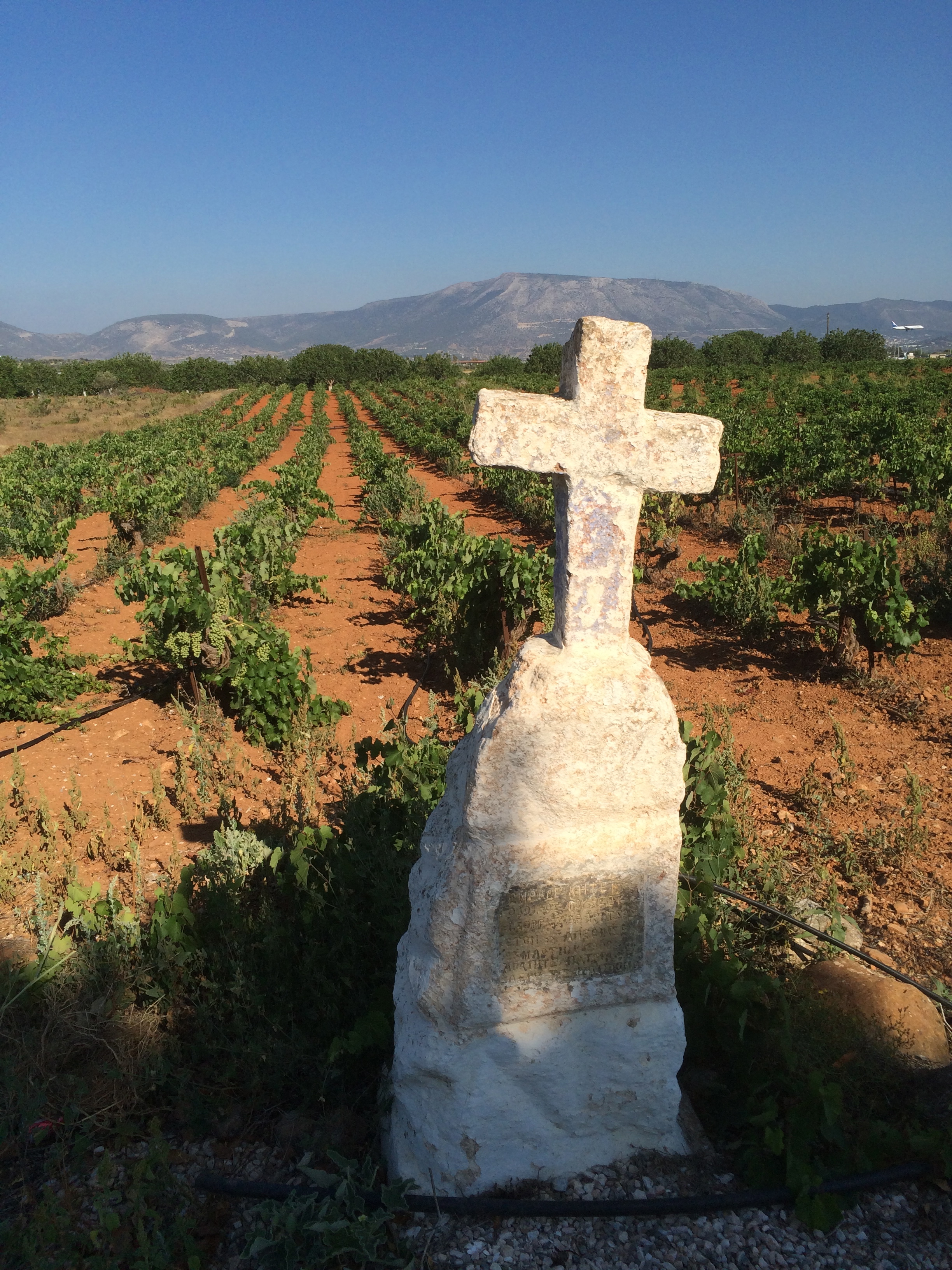 The winery has specialized in Savatiano since its founding. Actually, it was the only grape variety grown at the estate until Vassilis took the helm. He soon began playing with the newly resuscitated Malagousia variety and then red grapes. He also has several experimental plots, one of them Greco di Tufo, the first real vintage of which will be the 2016. “Italian grapes,” I exclaimed, unable to hide the surprise in my voice. With a shrug of the shoulders and a wry smile came the reply: “Well, as the name implies, it’s probably Greek.”
After a tour of the building, we gathered in the event room for a technical tasting with Vassilis and members of his family, including his children, affable, knowledgeable and articulate young adults who will eventually take the reins from their father. You’ll find my tasting notes after the jump.
For details about where we stayed, where and what we ate and what we saw, including some of Papagiannakos’s vineyards, see the Day One report on carswelliana.
INTRODUCTION
♦ PAPAGIANNAKOS (ATTICA)
TSELEPOS (ARCADIA)
MERCOURI (ELIS)
TETRAMYTHOS (ACHAEA)
THYMIOPOULOS (MACEDONIA)
ARGYROS (SANTORINI)
Tre vermut eccezionali
It has been great to see artisanal vermouths becoming available in Quebec in recent years, first through the private import channel and now, with the arrival of this Piedmontese paragon (among others), at the SAQ.
The mash-up known as vermouth (vermut in the Turin dialect) has been a thing since at least the 18th century. Originally considered medicinal, the concoction quickly became popular as a digestion-promoting aperitif. During the reign (1831 to 1849) of Carlo Alberto, King of Sardinia and Duke of Savoy, the royal chef developed a vermouth specially for the famously dyspeptic ruler. After the latter’s demise, the recipe made its way into the hands of a Turin shopkeeper, Tumalin Baracco Bartolomé de Baracho, who named the product after the deceased monarch. Production has continued to this day.
The company explains the production process as follows:
Starting from the base wine, which must be an excellent one. As per the 1837 recipe, we use the DOGC Asti Muscat and the DOGC Caluso Erbaluce, the latter produced in a very limited quantity, almost impossible to find. To this superb base, we add 43 botanical elements: herbs, berries, spices, flowers and fruits selected and infused in 45° alcohol for 40 days. Afterward, we lightly filter the steeping and decant it in Piedmont barrels for approximately 3 to 6 months, regularly testing for the perfect ripening of the matrix before bottling. This Vermut can be tasted similarly to Carlo Alberto’s way who sipped it straight as an aperitif, 10 minutes before meals. Otherwise, it expresses its best characters in cocktails.
At the tasting, the wines were first sampled on their own. Then ice cubes, club soda, tonic water and sliced lemon, lime and orange were set out so the tasters could experiment with various combinations.
Vermut di Torino, Extra-dry, Riserva Carlo Alberto ($32.00, private import, 6 bottles/case)
Flavoured with 21 herbs and spices, including yarrow, ginger, tarragon, coriander seed, gentian and nutmeg. Filtered only once. Plastic stopper cap. Reducing sugar: 60 g/l. 18% ABV. Quebec agent: oenopole.
Disconcertingly ashy/smoky along with fresh birch leaf and clove aromas. A couple of days later, the ash was fainter and earthier, leaving more room for a complex bouquet with nuances of green herbs (think tarragon) and bergamot. Unctuous and, residual sugar notwithstanding, coming across as dry. Ash dominates the palate though not to the point of obliterating other flavours. In fact, this seems the deepest of the trio. Lemon pith joins the herb-spice complex on the long, bitter-edged finish. Less appealing on its own than its siblings though lovely in a Cirka gin martini. The Quebec agent says this is normally devoid of ashy aromas and flavours, so ours may have been a slightly off bottle. Still, as one of tasters later wrote “the extra-dry was intriguing to say the least and I was bouncing between ‘wow that’s great’ and ‘wow, that really tastes like ashtray.'” (Buy again? Yes, for investigative purposes and martini-making, if nothing else.)
Vermut di Torino, Bianco, Riserva Carlo Alberto ($32.00, 12928594)
Erbaluce (90%) and Moscato (10%) flavoured with 25 herbs and spices, including wild rose, mandarin, bitter orange, clove, cherry, absinthe and coriander seed. Plastic stopper cap. Reducing sugar: 140 g/l. 18% ABV. Reducing sugar: 140 g/l. Quebec agent: oenopole.
Effusive nose dominated by scents of fennel seed, sap, sweet white spice and honey. Intensely flavoured but delicious and not at all saccharine. Stealth acidity enlivens without disturbing the smooth surface, letting you focus on the kaleidoscopic flavours. A bitter current runs throughout and comes to the fore on the long, spice-laden finish. A little overpowering straight up but a knockout with lemon and tonic. (Buy again? Done!)
Vermut di Torino, Rosso, Riserva Carlo Alberto ($32.00, 12928720)
Erbaluce (90%) and Moscato (10%) flavoured with 27 herbs and spices, including marjoram, saffron, dandelion, rhubarb, nutmeg, vanilla, star anise, tonka bean and carnation. Plastic stopper cap. 18% ABV. Reducing sugar: 60 g/l. Quebec agent: oenopole.
The colour is more brown than red. Impossibly complex nose: gingerbread and molasses, canned mincemeat, cherry, chocolate, a whiff of fennel and more. Soft and semi-sweet in the mouth, the flavours echoing the nose with some old wood in the background. Vivid acidity and a faint tannic bite add interest while a hint of black pepper and that telltale bitterness appear on the long, long finish. In contrast to something like Cinzano, a bit too intense to sip on its own. Better with a splash of club soda (or more than a splash of ginger beer) and a slice of orange. Also makes a killer negroni if used in smaller amounts than most recipes call for. (Buy again? Done!)
MWG September 8, 2016, tasting: flight 6 of 6
Red redemption
Prince Edward County 2010, Pinot Noir, Diana Block, Grange of Prince Edward ($35.00 at the winery)
100% Pinot Noir, the best lots from the Diana Block vineyard (the other lots go into the Estate and Select bottlings). The vines were planted in 2001 and 2002. Manually harvested and sorted. Alcoholic fermentation lasted 28 days. Matured 30 months in neutral French oak barrels. 13% ABV.
Showed some reductive funk at first, eliciting descriptors like “cherry-eucalyptus cough drops,” “putrescables after a couple of days” and “butterscotch” but soon comeing around. In the mouth, it’s medium-bodied and charming from the get-go. The cherry fruit is silky, the acidity bright, the tannins just firm enough. Minerals provide some depth. The barrels may be neutral but the oak seems a little laid-on, though not to the point of interfering with enjoyment. Could be longer. (Buy again? Maybe.)
Canada 2014, Pinot Noir, The Old Third ($43.00 at the winery)
100% Pinot Noir from the estate’s organically farmed Closson Road vineyard in Prince Edward County. The vines were planted in the mid-2000s. Fermented in stainless steel tanks with indigenous yeasts, then racked into French oak barrels, a fraction of which were new, where it matured for about one year. Bottled unfiltered, unfined and minimally sulphured. 12.5% ABV.
Engaging nose of red berries, spice and clay. Unmistakably Pinot from the first sip but with a striking umami side. The fruit is ripe and rich, tethered by tartness, supported by lithe tannins, shot through with wood and limestone. The long finish brings a red peppery note one taster characterized as “paprika.” Simultaneously earthy and elegant, like a good Burgundy. Hasn’t quite coalesced though the in-glass evolution indicates it will. (Buy again? Yes.)
Prince Edward County 2014, Pinot Noir, County, Unfiltered, Norman Hardie ($45.00 at the winery)
100% Pinot Noir. Given a six- to eight-day cold soak, then fermented seven days with indigenous yeasts and no more than two punch-downs a day. Macerated another week, more or less, with daily turning of the cap. Basket-pressed and transferred to French oak barrels for 10 months’ maturation. Bottled unfined and unfiltered, with a tiny shot of sulphur. 10.9% (!) ABV.
Red berries (strawberry above all), spice, cola, mowed field, hints of tar and cedar – classic, wot? Fresh sweet fruit, glowing acidity, soft tannins, some mineral earthiness, a subtle infusion of oak and the body of a welterweight about sum it up. The most obviously Pinot Noir of the quartet. Lovely if a bit facile, at least at this stage, and the price does give one pause. (Buy again? Maybe.)
Prince Edward County 2014, Pinot Noir, Quatres Anges, Lighthall ($35.00 at the winery)
100% Pinot Noir from estate vineyards. Fermented in temperature-controlled concrete tanks and some French oak barrels. Matured on the lees in French oak barrels. And that is all the winery thinks you need to know… 12.5% ABV.
“Wet dog” and sap aromas give way to cherry with hints of smoke and spice. A delight in the mouth: medium-bodied and silky, fresh-fruited and brightly acidic with fine, structuring tannins and a surprising complexity involving discreet layers of minerals and oak and a faint green streak, more herbal than vegetal and most noticeable on the long, clean finish. Integrated, harmonious and ready to go. For drinking here and now, the winner of the quartet. (Buy again? Def.)
None of the wines was carafed beforehand and all showed better after 40 minutes in the glass. As usual, the tasting was double-blind to everyone except me and the “importer” (blind to us). Those in the dark quickly pegged the wines as Pinot Noir but were perplexed as to their origin, finally settling on “some fictional region between Loire and Jura and like, Jamaica.” Oddly, while there was some initial speculation about Oregon, no one suggested Prince Edward County and most were dumbfounded when the bottles were unveiled. All in all, a well-received flight and coming as quite the relief three weeks after the PEC Cab Franc and Zweigelt debacle.
MWG September 8, 2016, tasting: flight 5 of 6

 Brett happens