Posts Tagged ‘Upper mid’
Archetypical and atypical
Sancerre 2015, Domaine Vacheron ($36.25, 10523892)
100% Sauvignon Blanc from organically farmed massal selection vines. The grapes are manually harvested and gently pressed. The must is chilled and clarified by settling. Low-temperature (<20°C) fermentation and maturation on the lees take place in stainless steel tanks. Filtered before bottling. Reducing sugar: 3.0 g/l. 12.5% ABV. Quebec agent: Le Maître de Chai.
Textbook Loire Sauvignon Blanc nose: gooseberry, citrus, grass, chalk and flint. Rich bordering on lush, sleek and impressively pure. Fruity upfront with a mineral substrate emerging as the wine moves through the mouth. The considerable extract rounds the bright acidity. Long, lively, saline finish. Initially engaging, the wine’s youthful exuberance comes across as a little caricatural and fatiguing by the end of the glass, a bit like a bouncy puppy or some New Zealand Sauvignon Blancs for that matter. Will be interesting to see what transpires in two or three years. (Buy again? Maybe.)


Sancerre 2013, Constellation du Scorpion, Vincent Gaudry ($41.25, private import, 6 bottles/case)
This is a new name for a bottling formerly called L’Esprit de Rudolph in honour of the founder of biodynamism, Rudolph Steiner. Gaudry is reportedly secretive about his methods and not much technical information about this wine is to be found. 100% Sauvignon Blanc from biodynamically farmed vines rooted in flinty soil. Partially matured in oak barrels. Unfiltered. 13% ABV. Quebec agent: Ward & associés.
Wafting nose of grapefruit, chalk and quartz dust, “pink flowers” and “thyme.” Rainwatery yet also very present. The rich texture is lightened by “lime acidity,” deepened by a chalky underlay. A hint of caramel appears on the long finish. “A Sancerre that wants to be a Chardonnay,” concludes one taster. Subtle and subdued yet complex and delicious says me. (Buy again? Yes.)
MWG April 6th tasting: flight 2 of 7
WINO tasting (5/6)
Vin de France 2015, Le Vin de Blaise ($49.67, private import, 6 bottles/case)
Run by Paris-based Stéphanie Rougnon and located in Sainte-Cécile-les-Vignes in the Rhône valley, the three-hectare family estate is in the second year of conversion to organic farming. (Blaise Granier, Nathalie’s great-great-grandfather, first planted vines there.) This, the inaugural vintage of its first wine, is mostly Cinsault with a little Grenache and Carignan from vines more than half a century old. In 2015, a total of 1,167 bottles were produced; in 2016, production rose to 1,800 bottles plus 100 bottles of rosé. The grapes are not coplanted but are cofermented after being hand-picked and crushed. The free run juice is transferred to a stainless steel tank and the grapes are pressed. The resulting must is added to the free run juice and fermented with indigenous yeasts. Unfiltered and unfined. No added anything except maybe a tiny shot of sulphur dioxide at bottling. 13.5% ABV. Quebec agent: WINO.

Solar red and black fruit and minerals (“like the Siccagno” notes one taster), sukiyaki, spice, lemon zest and background leather. Medium-bodied and fruit-forward, and such pure fruit it is. Coursing acidity delivers freshness in spades and imbues the fruit with a lip-smacking tartness. Layered minerals add depth while supple, raspy tannins give grain to the silky texture. Finishes long and clean. So bright and alive, so up my alley. Just about everyone around the table loved this wine and also felt the QPR was wacky. The price of admission to a limited edition? A natural wine that demands a credit line? (Buy again? A case… if it were 30 bucks a bottle.)
MWG March 23rd tasting: flight 5 of 6
WINO tasting (4/6)
Based in Curtil-Vergy, between Nuits-Saint-Georges and Vosne-Romanée, Bertrand Machard de Gramont founded his eponymous estate in 1983. In 2004, he was joined by his daughter Axelle, who has since taken the reins and converted the estate to organic farming. A replanting of the long-abandoned Vallerots terraces in 2001 raised the total surface area to six hectares. Besides the five wines we tasted, the estate makes an Aligoté, a Vosne-Romanée and occasional other bottlings.
The wine-making is the same for all the red cuvées. The manually harvested grapes are destemmed and crushed. Two weeks’ fermentation with indigenous yeasts is followed by 18 to 20 months’ maturation in 228-litre used oak barrels. The wines are bottled unfiltered and unfined. Sulphur use is kept to a minimum.
Bourgogne 2014, Les Grands Chaillots, Bertrand Machard de Gramont (c. $40.00, private import, 6 bottles/case, NLA)
100% Pinot Noir from 27-year-old vines. 12.5% ABV. Quebec agent: WINO.
Attractive nose of crushed red berries, earth, slate and gentian. Light- to medium-bodied and silky textured. Ça pinote, though with a lactic edge. The tannins are lacy and the acidity comes with a bit of a bite. The long drying finish shows some spice. Pure and elegant if less dimensional than its flightmates. (Buy again? Sure.)
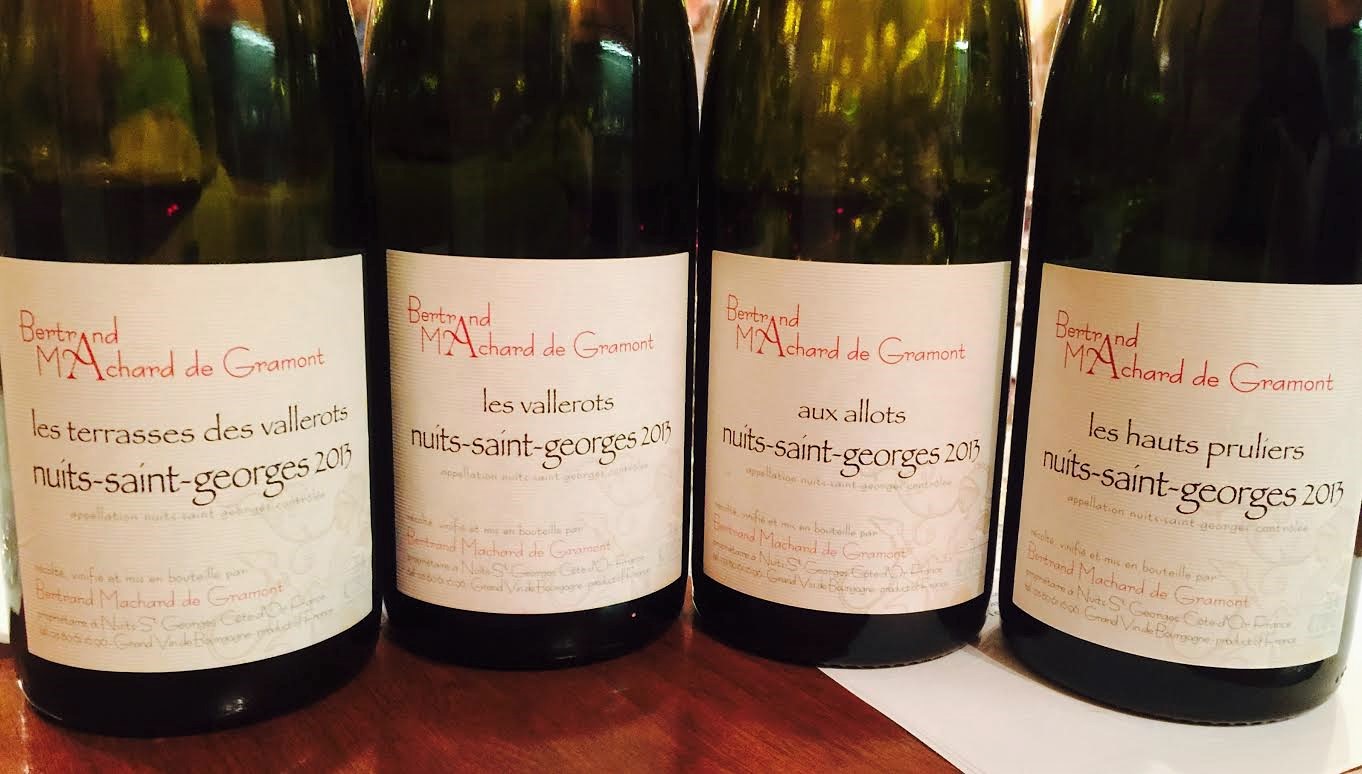
Nuits-Saint-Georges 2013, Les Terrasses des Vallerots, Bertrand Machard de Gramont 2013 ($70.58, private import, 6 bottles/case)
100% Pinot Noir from a two-hectare parcel of 12-year-old vines rooted in clay and limestone. 13% ABV. Quebec agent: WINO.
Complex, savoury nose of spice, candied berries, sweat, “orange papaya,” drying leaves and more. Pure and delicate, beautifully balanced between ripe fruit, sourish acidity and supple tannins. Finishes long and clean. Not remarkably deep but the clarity is impressive. Very approachable. (Buy again? Sure.)
Nuits-Saint-Georges 2013, Les Vallerots, Bertrand Machard de Gramont ($81.74, private import, 6 bottles/case)
100% Pinot Noir from 39-year-old vines in a half-hectare parcel located above the terrasses. 13% ABV. Quebec agent: WINO.
As above though somewhat closed and showing hints of dried mint and “orange oil.” Richer and deeper than the Terrasses. Given a tart edge by sleek acidity, the gorgeous fruit glows against a mineral/earth backdrop. Pliant tannins provide just enough structure. A spice note chimes on the persistent finish. Lovely. (Buy again? Yes.)
Nuits-Saint-Georges 2013, Aux Allots, Bertrand Machard de Gramont ($85.57, private import, 6 bottles/case)
100% Pinot Noir from 80-year-old vines rooted in deep clay and limestone at the bottom of the slope near Vosne-Romanée. 13% ABV. Quebec agent: WINO.
Slightly candied red berries, spice, slate, oak smoke and a floral note make for a classic Burgundian nose. In the piehole it’s verging on voluptuous: a medium-bodied, fluid mouthful of spicy fruit, airframe tannins and silky acidity. Darker and deeper currents lurk below the sleek surface. An elegant wine whose energy and presence last through the long, clean finish. Of the five BMdG wines, this was the favourite of nearly everyone around the table, including Martin. (Buy again? Would love to.)
Nuits-Saint-Georges 2013, Les Hauts Prûliers, Bertrand Machard de Gramont ($89.14, private import, 6 bottles/case)
100% Pinot Noir from 48-year-old vines planted in thin soil in a 1.5-hecatre plot on a steep slope above the Prûliers premier cru. 13% ABV. Quebec agent: WINO.
Complex, savoury, earthy nose dominated by leafmould, cherry, spice and a “peat thing, like Scotch peat.” Medium-bodied and fluid. Cherry, slate and old wood – the dominant flavours – are carried on a stream of acidity while firm tannins provide texture as well as a structural framework. Finishes as impressively as it starts. A beautifully structured wine of great precision and depth and the one most in line with a conventional NSG (or, as Martin put it, a wine with “une austerité que je retrouve chez Gouges.”). Though far from rebarbative at this stage, it will benefit from five to 10 years in the cellar. (Buy again? If I had the bucks and patience, yes.)
MWG March 23rd tasting: flight 4 of 6
WINO tasting (3/6)
Located in the commune of Montaigu in the southern Jura, the estate now known as Domaine Pignier was created by monks in the 13th century and acquired by the Pignier family in 1794. It was certified biodyanmic in the early 2000s. The focus is on the vineyards, with a minimalist approach in the cellar (no added anything except occasionally minute amounts of sulphur).
Crémant du Jura, Rosé, Domaine Pignier ($36.46, private import, 6 bottles/case)
100% Pinot Noir from biodynamically framed vines. Manually harvested. Briefly macerated and fermented using a pied de cuve starter. The base wine is matured six months in oak barrels, then sparkled using the traditional method, with no dosage. No added sulphur. The bottles are aged on lattes for 12 months. 12.5% ABV. Quebec agent: WINO.
Deep salmon pink with pink foam and fine bubbles. Intriguing nose: strawberry cheese danish, “cheese rind,” prosciutto, “baker’s yeast” and more. Dry and buoyant on the palate. Though there’s a soft-glowing core of red berries, the fruit is ethereal, haunting more than inhabiting a matix of minerals that prompted descriptors like “saline” and “seaweed.” Long savoury finish. Lovely. (Buy again? Yes.)


Côtes du Jura 2014, Trousseau, Les Gauthières, Domaine Pignier ($57.33, private import, 6 bottles/case)
100% Trousseau from biodynamically farmed, massal propagated vines. Yields are kept very low (25 hl/ha). The manually harvested grapes are destemmed, macerated and fermented using a pied de cuve starter and manual punch-downs and pump-overs during an entire lunar cycle. Matured 12 months in oak barrels of various sizes. Unfiltered. Bottled by gravity and with no added sulphur on a fruit day (per the lunar calendar). 11.5% ABV. Quebec agent: WINO.
Morello cherry, hard red candy, dried leaves, limestone, eventually tomato and “umami.” More like cranberry in the mouth with charcoal overtones. Medium-bodied and satin-textured. Chewing brings out the fruit and reveals dimension and complexity. The fine tannins add a mild astringency to the long, vapourous finish with its faint almond note and Szechuan pepper-like numbingness. Accessible but young and best cellared for five or 10 years. Way pricey but one of the most beautiful Trousseaus I’ve tasted. (Buy again? Yes.)
MWG March 23rd tasting: flight 3 of 6
Bargain Barolo
Barolo 2012, Riva del Bric, Paolo Conterno ($41.50, 10860223)
100% Nebbiolo from youngish vines (around 20 years old). Manually harvested. On arrival at the winery, the grapes are crushed, destemmed and transferred to tanks for two to three weeks’ maceration and fermentation. Matured 30 to 36 months in 35-hectolitre French oak barrels and six to 12 months in the bottle. Reducing sugar: 1.6 g/l. 14.5% ABV. Quebec agent: Sélections Fréchette.

Cherry, sawdust, kirsch, rose water and eventually hints of leafmould, candied violets and truffle. On the fuller side of medium-bodied. Very dry. The sweet fruit cloaks the fine but firm tannins though it can’t hide the astringent undertow. Bright acidity adds sheen to the velours-like texture while spice and floral notes overtone the long finish. A step up from most Langhe offerings, this is like mainlining Nebbiolo. Impressive QPR. Accessible for a five-year-old Barolo but still primary and best cellared for a couple of years or carafed for an hour or two. (Buy again? Sure.)
My bottle was a generous gift from a Mo’ Wine Group member. Merci Julien !
Three Bierzos from Raúl Pérez
Bierzo 2013, Ultreia St-Jacques, Raúl Pérez ($25.95, 12331835)
A Mencia-dominated blend with Bastardo (aka Trousseau) and Garnacha Tintorera (aka Alicante Bouschet) from organically farmed vines in a five-hectare, clay-soiled vineyard planted in 1900 to 1940 in Valtuille de Abajo. Manually harvested. Fermented (80% whole clusters) in large oak vats. Maceration lasts between two and five months. Matured in 225- and 500-litre barrels, foudres and cement tanks. Unfiltered and unfined. Reducing sugar: 2.1 g/l. 13.5% ABV. Quebec agent: Vintrinsec.
Umami-ish nose of slatey plum, blackberry, spice, “bay leaf,” “sumac,” “blond tobacco,” India ink. Medium-bodied and supple-surfaced with clean fruit, fine tannins, streaming acidity and an underlay of minerals and old oak. The persistent finish is complexed by a light astringency and bitterness, while leaf mould lingers. A little too dark and weighty to be a vin plaisir but sharing that genre’s qualities of being straightforward, accessible and delicious. (Buy again? Yes.)


Bierzo 2014, Vico, Raúl Pérez ($40.25, 12335035)
Also available as part of a recent Cellier operation for 25 cents less ($40.00, 13193761). 100% Mencia from dry- and organically farmed 80-year-old vines in Valtuille de Abajo. Soil is sandy with small river stones. Manually harvested. Fermented (30% whole clusters) and macerated for 60 days. Matured 11 months in third-fill, 300-litre French oak barrels. 13.5% ABV. Quebec agent: Vintrinsec.
Complex nose of gingerbread, black pepper, “grape cola,” “Brio Chinato,” slate and balsam fir. Denser and more structured than the Ultreia but even more Burgundian in texture. The remarkably pure fruit is deepened by minerals, structured by fluent acidity and firm but round tannins. The finish is long and savoury. Young and a little monolithic though accessible with a few hours’ carafing. Would be interested in seeing how this tastes in ten or 15 years. A second bottle – opened (by mistake) and immediately recorked 26 hours beforehand – paired deliciously with braised lamb. (Buy again? Yes.)
Bierzo 2013, La Poulosa, La Vizcaina, Raúl Pérez ($54.25, 12332264)
Mencia (90%) and Garnacha Tintorera (aka Alicante Bouschet, 10%) from dry- and organically farmed vines planted in 1940 and rooted in the clay and river stone soil of the two-hectare La Poulosa vineyard in Valtuille de Abajo. Fermented (80% whole clusters) in large oak vats. Total maceration time: 60 days. Matured 12 months in 225-litre used French oak barrels. Unfiltered and unfined. 14.5% ABV. Quebec agent: Vintrinsec.
Wood and leather then smoke, spice and plum then blackberry cordial. Medium- to full-bodied and beautifully structured. A wine with every dimension, including unplumbable depth. The alcohol is well integrated; indeed, the wine is quite fresh, with that balsam note appearing once again. Dark minerals last well into the long finish. Needs five or 10 years but has the potential and balance to convince you it will only improve with age. (Buy again? Yes.)
A flight that made less of an impact than I expected it would. I suspect that’s partly because the wines were young and partly because of what I call the Chianti effect: that, like many Chiantis, these are wines that show better in the dining room than in a tasting room. Before the tasting, the winemaker’s cult status had me worrying that the wines – especially the Poulosa and the second flight’s La del Vivo – would be Parkerized overachievers but they were anything but. They may be a little pricey but their quality is undeniable. Pérez is obviously someone to keep an eye on.
MWG February 17, 2017, tasting: flight 6 of 6
Revelatory
MWG member Nick spent the holidays down under. While he didn’t make it to Clare Valley as originally planned, he did bring back a fascinating trio of new vintage, dry Clare Valley Rieslings, which he kindly shared with the group.
Clare Valley 2016, Riesling, Watervale, Gully View Vineyard, Koerner ($27.00, importation valise)
100% Riesling from 17-year-old vines rooted in the red clay and limestone soil of the Gullyview vineyard. Manually harvested in two passes a week apart. The first pass grapes were pressed immediately; the second pass grapes were given 24 hours of skin contact before pressing. In both cases, a small amount of sulphur was added to the press tray. The juice was cold-settled for about a week. Fermentation with indigenous yeasts in ceramic eggs and stainless steel tanks lasted about three weeks. Matured five months on the fine lees. Bottled unfiltered and unfined but with a small squirt of sulphur dioxide. Vegan compatible. Screwcapped. 12% ABV.
Classic, open nose of white flowers, apple, lime, quartz, flint. A sleek textured mouthful of grapefruit and “apricot” that seems almost sweet upfront but proves quite dry. Chewing brings out the crisp acidity and plenty of minerals. Lime, green apple and spice notes and a lingering bitterness mark the finish. A delicious gush on opening, this had lost some of its oomph by the time we got around to it a hour or so later. (Buy again? At least another bottle for research purposes.)
Clare Valley 2016, Riesling, Watervale, Gullyview Vineyard, Adelina ($23.00, importation valise)
No, it’s not a typo; Koerner and Adelina do indeed spell the vineyard name differently. 100% Riesling from vines planted in 1977 and 2001 in red loamy clay over limestone. The grapes were manually harvested and whole cluster-pressed. The juice was cold-settled then fermented in stainless steel tanks with selected yeasts. Fermentation was halted with around 5 g/l of sugar remaining. The wine was then clarified and bottled. Screwcapped. 11.5% ABV. Only about 2,400 bottles made.
Hazy and one of the least coloured wines I’ve seen. Complex nose of white gas, lemon-lime zest, “white lily,” minerals, rainwater and “ground cherry.” Light and fresh in the mouth, fruity yet dry, ethereal yet dimensional. Flavours tend to citrus, green apple and a chalky tutti-fruitiness one taster likens to “love hearts.” Turns savoury on the long, minerally finish. Full of energy and lots of fun. Excellent QPR. (Buy again? Yes.)
Clare Valley 2016, Riesling, Polish Hill, Grosset ($55.00, importaton valise)
The 36th vintage of this wine. 100% Riesling from organically farmed vines in the 8 ha Polish Hill vineyard. The soil is shallow shale and a thin crust of clay marl over slate. Yields are extremely low, giving the equivalent of two bottles per vine. The grapes were hand-picked. A small portion of whole clusters were set aside; the rest of the grapes were crushed and destemmed. The fruit was gently pressed and the free-run juice was chilled to near freezing and allowed to settle and clarify in a tank for five days. Low-temperature fermentation and maturation took place in stainless steel tanks. Blended just before bottling in July 2016. Vegan compatible. Screwcapped. 12.7% ABV. A few bottles of the excellent and more approachable 2012 ($50.00, 10956022) remain at the SAQ. Quebec agent (per the Grosset website): Elixirs.
Closed yet profound nose: lime, chalky quartz, eventually linden flower. Rich, racy, structured, deep and long. The fruit, minerals and acidity are in perfect taut balance. A bone-dry Riesling with every positive quality, including heft and presence. Needs time. Deserves a place alongside such giants as Ostertag’s Muenchberg and Nikolaihof’s Steiner Hund. (Buy again? Yes.)
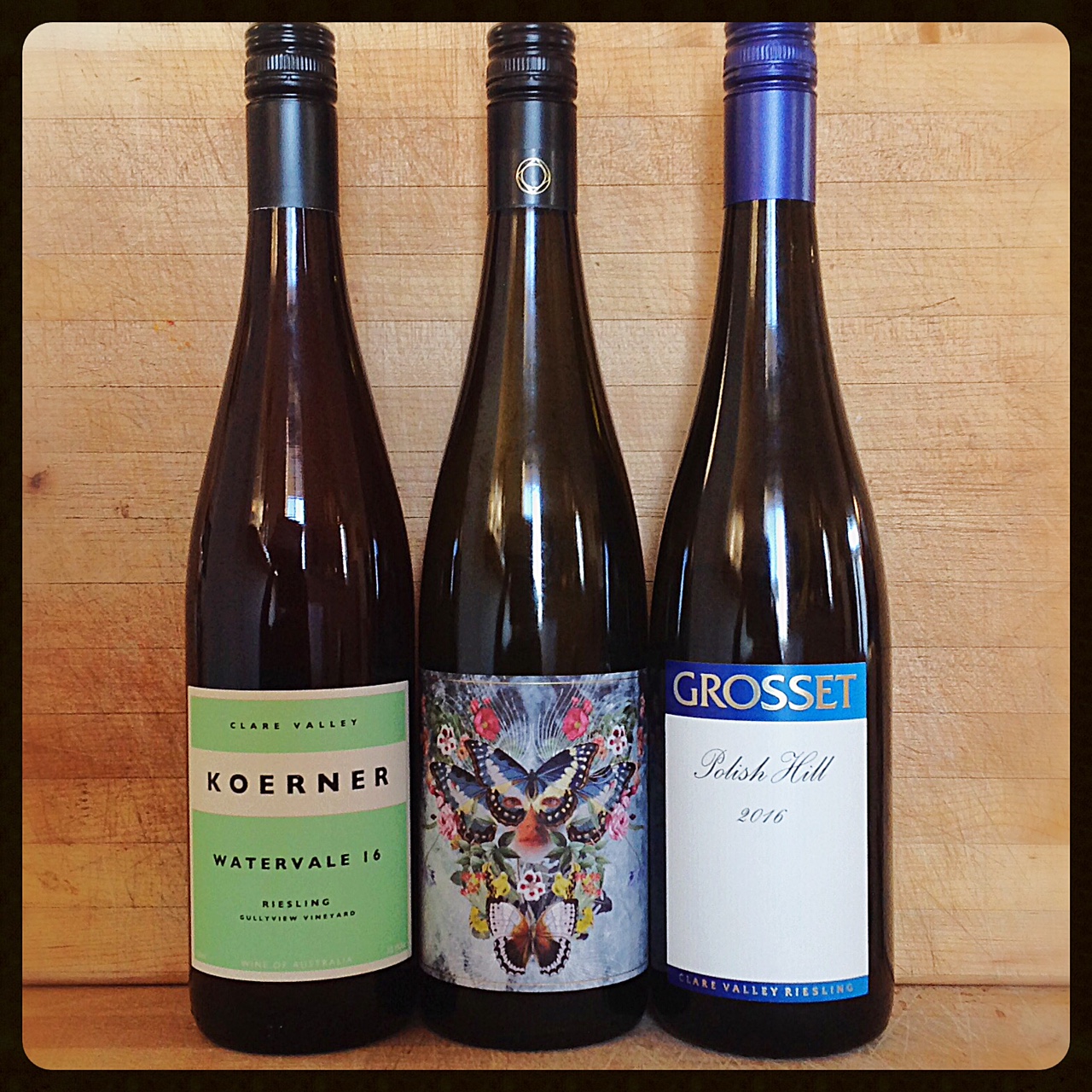
As usual, the wines were served double-blind. While the grape variety was soon deduced, no one guessed the provenance and several tasters were astounded to learn that Australia is producing such engaging, fleet and minerally whites. In short, to quote one taster, “a revelatory flight.”
MWG February 17, 2017, tasting: flight 3 of 6
Two Galicians and an ugly duckling
Ribeiro 2014, Coto de Gomariz ($26.95, 13075554)
A blend of Treixadura (70%), Albariño (10%), Godello (10%) and Loureiro (10%) from biodyanmically and organically (non-certified) farmed vines grown in granite, schist and clay on slopes and terraces near the village of Gomariz. The grapes are hand-picked, destemmed, crushed and lightly pressed. The juice is cold-settled and fermented in stainless steel tanks at low temperatures. Bottled from the tank on demand and always on a flower day. Vegan-compatible. Reducing sugar: 2.2 g/l. 13.5% ABV. Quebec agent: Vintrinsec.
Promising nose dominated by white grapefruit along with apple, pear, pineapple and background herbs and stone. Smooth and suave in the mouth. Quite dry. Brisk acidity lightens the somewhat viscous texture. Marked by sweet fruit upfront but minerals and dried fruit on the long finish. A sensation – faintly biting, like pepper can be (though the flavour isn’t at play) – that I suspect results from a combination of acid, mineral bitterness and maybe stealth tannins lingers after the fruit has disappeared, adding intrigue. (Buy again? Sure.)


Rias Baixas 2015, Lagar de Cervera ($27.40, 13159272)
100% Albariño from estate vineyards in O Rosla and Cambados. The manually harvested grapes were destemmed and macerated on the skins for 10 hours, followed by gentle pressing at 10C in an inert-gas atmosphere to prevent oxidation. After settling and racking, the must was fermented at 15C. One quarter of the wine underwent malolactic fermentation. Matured on its fine lees with occasional stirring. Saw only stainless steel until bottling. Reducing sugar: 2.8 g/l. 12.5% ABV. Quebec agent: Vinicolor.
Straightforward nose of grapefruit and quartz with faint white flower notes. In the mouth, the wine is middle-weighty, clean and as minerally as fruity. The smooth acidity barely ramps up the tension. A touch of bitterness on the fairly long finish adds welcome intrigue. Tasted twice – first at the store, then at the tasting – with consistent impressions, this well-made but somewhat listless wine was a disappointment, especially in view of the estate’s reputation and the glowing reviews the wine received in the media. Would likely show better alongside grilled fish. (Buy again? Meh.)
Bierzo 2013, La del Vivo, La Vizcaína, Raúl Pérez ($57.00, 12332045)
A relatively new project, La Vizcaína (“the Biscayan”) produces five wines – four reds and this white – using fruit from vineyards around cult winemaker Raúl Pérez’s hometown of Valtuille de Abajo. This is a blend of Doña Blanca (80%), Godello (10%) and Palomino (10%) from organically farmed vines, some planted as long ago as 1916. The manually harvested grapes are handled in two ways. Around 80% are pressed and racked into 500- and 700-litre French barrels for fermentation and maturation; they are left untouched for one year. The remainder are fermented on the skins in clay amphorae for one year, again untouched. The two parts are blended and the wine is bottled unfiltered and unfined. 13% ABV. Quebec agent: Vintrinsec.
The wine in our bottle was double-carafed about an hour before we tasted it. Gold bronze in the glass. Complex nose of straw, chalk, honey and a faintly acrid note that several tasters found off-putting, at least initially. Improved with time, developing scents of white spice, “sage,” “late corn field,” “yellow flowers” and “faint nuts.” A sip shows it to be rich, extracted, broad, just acidic enough, dry and not particularly fruity, and what fruit there is is candied. Wax, bitter, mineral and oxidative threads intertwine, most apparently on the long finish. Still, some tasters wanted nothing to do with it and “interesting” was about the best any of us could say. However, those of us who kept our glasses until the end of the tasting – four or five hours after the double-carafing – were amply rewarded, as the acridity had vanished and the wine had deepened, sweetened and become beautifully layered and coherent. Memorable. (Buy again? Yes.)
MWG February 17, 2017, tasting: flight 2 of 6
Ward & associés tasting (3/9)
Steirerland Landwein, “Trauben, Liebe und Zeit”, Weiss No. 7, Strohmeier ($50.73, private import, 6 bottles/case)
Trauben, Liebe und Zeit means “grapes, love and time” and is the name given to the estate’s line of natural wines. Mainly Pinot Blanc with some Chardonnay from the 2014 and 2015 vintages. The grapes are estate-grown, organically farmed and manually harvested. Fermented with indigenous yeasts. Matured 11 months in neutral 500-litre barrels. No added anything, including sulphur. Unfiltered and unfined. 11.5% ABV. Quebec agent: Ward & associés.
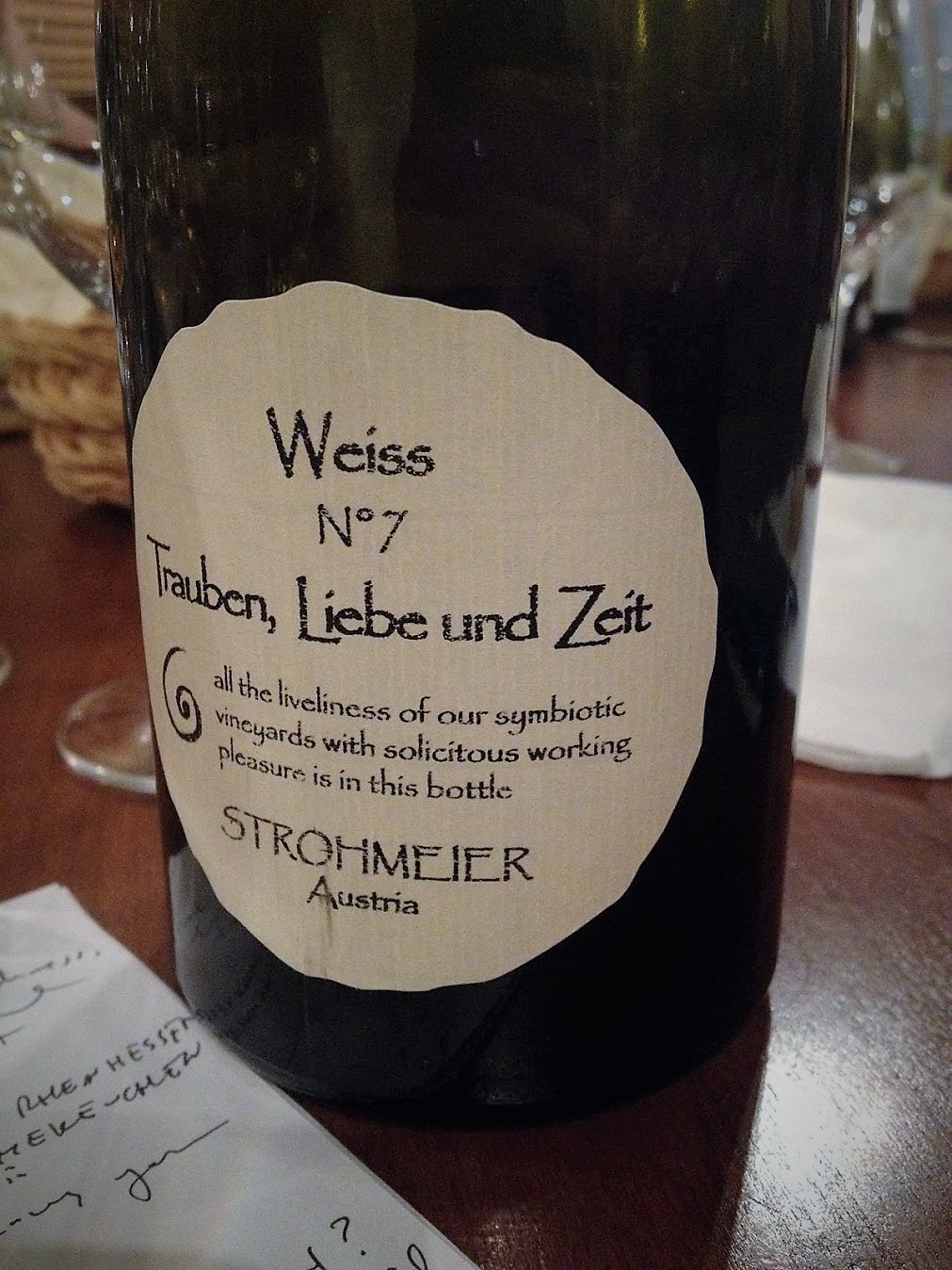
Cloudy light green-gold in the glass. Nose of white pepper, lemon, “sour orange,” lees and more besides. In the mouth, it’s soft textured and a bit spritzy. A wallflower at first though chewing reveals all kinds of complexity – including pear, herbs and chalk – and some depth. Comments from the peanut gallery: “like a gueuze,” “tastes like scrapes” (which, as I learned, are light metal shavings), “stealth acidity.” The long finish is faintly bitter and sour. Unique, fascinating and delicious. I was ready to lay down my money until I saw the price… (Buy again? Only if feeling flush, alas.)
MWG February 2, 2017, tasting: flight 3 of 9
Odd flightfellows
Colline Lucchesi 2013, Palistorti, Tenuta di Valgiano ($29.80, 12767840)
Sangiovese (70%), Merlot (15%) and Syrah (15%) from organically and biodynamically farmed vines around 20 years old. Manually harvested. The sorted grapes are gravity-fed into open wooden vats and crushed by hand or foot. Fermented (with indigenous yeasts, one supposes) and macerated for around two weeks with occasional punch-downs and pump-overs. Racked, settled and gravity-fed into lightly toasted French oak barrels (5% new) for malolactic fermentation and 12 months’ maturation. Blended and transferred into concrete vats for six months’ additional maturation. Unfiltered and unfined. 13% ABV. Quebec agent: Balthazard.
Appealing nose of cherry, tar, turned earth, Asian spices and a fresh, almost ferny note. A medium- to full-bodied mouthful of ripe fruit, bright acidity and firm but not rigid tannins. Despite the superficial sleekness, broad, deep and long. Beautifully balanced and complete, modern yet also terroirtorial. I’m usually unenthusiastic about blends of Sangiovese with international varieties but this is exceptional. It was also the only wine in the tasting that absolutely everyone around the table liked. The price seems more than fair. (Buy again? Yes.)
Swartland 2014, Family Red Blend, A.A. Badenhorst ($40.00, 12275298)
An unorthodox blend – around two-thirds Syrah with Tinta Barroca, Cinsault and Grenache – from estate-grown and purchased grapes. Farming practices are organic or nearly so. Manually harvested. The whole clusters, including stems, are crushed by foot and fermented with indigenous yeasts in concrete and wood tanks with twice-daily punch-downs. Given extended maceration (up to six months) before pressing. Transferred to 4,000-litre barrels for 16 months’ maturation. Blended just before bottling. Sulphur (pre- and post-fermentation) is the only addition. Reducing sugar: 1.4 g/l. 13.5% ABV. Quebec agent: Symbiose.
Complex, warm-climate nose of prune, plum, eucalyptus, black olive, dark minerals and eventually dried herbs. Full-bodied, rich and dense, balanced and savoury. Round tannins and smooth acidity provide sufficient structure. The flavours linger long and tend to the darker side of the spectrum: black fruit, slatey minerals, smoke, leather, compost, animale and a volatile note that puts me in mind of charred eucalyptus but that one taster describes as “electrical tape.” Not quite my style but definitely drinkable and as Old Worldish as New. (Buy again? Would gladly drink if offered but doubt I’d buy a bottle.)
MWG January 12, 2017, tasting: flight 7 of 7

 Brett happens