Posts Tagged ‘Inexpensive’
Greek trio
Crete 2015, Vilana, Lyrarakis ($14.05, 11607553)
100% Vilana from vineyards in Alagni, central Crete, south-southeast of Heraklion. Manually harvested. Half the grapes were whole-cluster pressed; the other half were destemmed and cold-macerated on the skins for several hours. Fermentation took place in temperature-controlled (17-19°C) stainless steel tanks. Screwcapped. Reducing sugar: 1.9 g/l. 12.5% ABV. Quebec agent: Focus Cellars.
Chalk, quartz, matches and a hint of dried herbs. Clean, light and smooth in the mouth, with citrusy, Sauvignon Blanc-like fruit, good acidity and a decently long, clean, minerally finish. Certainly drinkable but also somewhat simple and a bit anonymous. Would like to taste the more upscale bottling. (Buy again? Maybe.)
Patras 2015, Roditis, Tetramythos Winery ($15.80, 12484575)
100% Roditis from organically farmed vines in limestone-soil vineyards located about 10 km south and 800 metres above the Gulf of Corinth. The manually harvested grapes are destemmed and pneumatically pressed. The must is gravity-fed into small, temperature-controlled stainless steel tanks for fermentation (with indigenous yeasts) and maturation. Reducing sugar: 1.9 g/l. 12% ABV. Quebec agent: oenopole.
Expressive nose of candied white berries, quartz dust and a hint of jalapeño. The fruity extract and lemon overtones notwithstanding, minerally – even rainwatery – on the palate, an impression only heightened by the brisk acidity. Ripe-sweet upfront, dry on the long, saline finish. Direct and to the point. Experience shows this really comes into its own with a selection of meze or a grilled porgy. (Buy again? Yes.)
Markopoulo 2015, Savatiano, Vieilles Vignes, Domaine Papagiannakos ($16.55, 11097451)
100% Savatiano from unirrigated 50-year-old vines in rocky, limestone soil a few kilometres east of Athens airport. Manually harvested. Fermented with selected yeasts in temperature-controlled (16-18°C) stainless steel tanks. Matured on the lees for three months. Reducing sugar: 2.0 g/l. 12.5% ABV. Quebec agent: oenopole.
The nose’s combination of floral notes, sandy beach, lemon curd and white peach is unique. Lemon with hints of tropical fruit, a mineral substrate and bright but unaggressive acidity mark the palate. A bitter thread weaves through the long finish. Probably the most versatile of the trio. As the 2008 Estate bottling tasted last summer showed, Savatiano is capable of improving with age. (Buy again? Yes, including a couple of bottles to cellar for five or six years.)
MWG January 12, 2017, tasting: flight 2 of 7
Top sub-$15 red at the SAQ?
Dâo 2014, Duque de Viseu, Quinta dos Carvalhais/Sogrape ($14.05, 00546309)
Touriga Nacional (55%), Tinta Roriz (aka Tempranillo, 32%), Alfrocheiro (7%) and Jaen (aka Mencia, 6%). The grapes were destemmed, gently crushed and gravity-fed into temperature-controlled stainless steel vats. Alcoholic fermentation, with regular pump-overs, lasted about six days. After pressing, the wine was transferred to stainless steel vats for malolactic fermentation. Half the finished wine was matured in used French oak barrels, the other half in stainless steel tanks, both for 12 months. Micro-oxygenation is practised. Reducing sugar: 1.7 g/l. 13% ABV. Quebec agent: Charton Hobbs.
Intriguing nose: plum, dark berries, fallen leaves, a kischy high note, a hint of rubber and a faint vegetal streak, all of which are echoed on the palate. In the piehole, it’s medium-bodied, full of ripe but not heavy fruit with a slatey substrate, lively acidity and smooth tannins that show some astringent mettle on a credibly long, spice-scented finish. Very drinkable and food friendly (even with white meats, even with non-Portuguese fare), neither industrial nor soulless. This fluent wine is certainly one of the top sub-$15 reds at the SAQ. (Buy again? Sure.)
New-wave Rioja?
Rioja 2015, Tempranillo, Bodegas Moraza ($18.35, 12473825)
100% Tempranillo from organically farmed vines in three parcels with chalky-claey soil around the village of San Vicente de la Sonsierra, Rioja Alta. In a quest for freshness and lower-than-usual alcohol levels, the grapes are picked (by hand) earlier than at most other estates in the region. Undergoes partial carbonic maceration. Fermented in concrete tanks. Reducing sugar: 1.3 g/l. 13% ABV. Quebec agent: Boires.
Spiced plum and black raspberry, turned earth, old wood, some leather in the background. On the fuller side of medium-bodied. The spicy ripe fruit seems sweet on entry, an impression that quickly fades, leaving a bone-dry mid-palate. Prominent mineral and faint lactic notes add interest, sleek acidity keeps things fresh. The tannins are stealthy, most apparent on the long finish, which is marked by a light but pervasive astringency, a note pitched between dried tree leaves and dried herbs and a lingering black pepper bite. While there’s not a lot of depth (maybe it’s a young-vine cuvée?), this is a high-quality, complex and savoury sub-$20 wine, albeit one that virtually demands food. Smooths and coheres after an hour’s breathing, so carafing isn’t a bad idea. (Buy again? Yes.)
I’d seen this recent arrival on the monopoly’s shelves but my interest wasn’t really piqued until I read Karyne Duplessis Piché’s profile of the estate in Friday’s La Presse and the companion piece about the attempts of a handful of iconoclast producers to open the Rioja appellation to a more terroir-driven approach.
Loosen up
Mosel 2015, Riesling, Dr. L, Loosen Bros. ($16.45, 1068525)
The estate’s entry-level Riesling is a négociant wine made from grapes grown to spec and bought under long-term contracts. Vinified in stainless steel tanks. Fermentation is stopped by chilling before all the sugar has been converted to alcohol. Screwcapped. Reducing sugar: 45 g/l. 8.5% ABV. Quebec agent: Select Vins.
Textbook nose: lime, white grapefruit, green apple, quartz and slate. A first sip reveals a spritzy tingle. Electric acidity shreds the sugar: while this is technically off-dry, it comes across as tartish, reinforcing the impression that the fruit is citrus, though peach is there too if you look for it. Chalkly, quartzy veins thread their way throughout, which is not to say there’s the kind of mineral (or any other) depth found in the estate’s single-vineyard bottlings. The puckery finish doesn’t last long, giving you the perfect excuse to take another sip. So pound-backable and – at 8.5% – you don’t pay a price for doing so. Lemon-limeade for adults. Should be on the wine list of every southeast Asian restaurant in the city and yet, amazingly, it almost never is. (Buy again? Yes, yes, yes.)
Vini per salumi
Grignolino d’Asti 2014, Grignè, Montalbera ($19.35, 13014372)
100% Grignolino from five- to 25-year-old vines. Manually harvested. Fermented in stainless steel tanks for 15 days, with the seeds removed after four to six days. Undergoes malolactic fermentation. Racked into stainless steel tanks for four months’ maturation. Lightly filtered. Reducing sugar: 7.0 g/l. 12.5% ABV. Quebec agent: Valmonti.
Cedar, “old lady’s rose perfume” (in the words of another taster), tea leaves, sour cherry. Becomes perfumier as it breathes and eventually takes on a honey note. Light- to medium-bodied. The bright acidity and higher-than-usual residual sugar confer a sweet-and-sour edge, “like rose kombucha.” Tannins are slim and only a little raspy. Dark minerals and a sappy green streak tether the floral component. A faint bitterness lingers through the finish. Quite different (more Ruchè- or Larcrima di Morro-like) from other Grignolinos I’ve tried – this one, for example. (Buy again? Probably not, though I’ll gladly check out the 2015 if it’s drier.)
Dogliani 2014, San Luigi, Chionetti ($21.80, 12466001)
See here for background on the producer. 100% Dolcetto from vines averaging around 25 years old and grown in the San Luigi vineyard. Manually harvested. The soft-pressed grapes were macerated and fermented in temperature-controlled (max 29–30°C) tanks with indigenous yeasts and daily pump-overs for seven days. The wine was racked into new tanks for malolactic fermentation and 11 months’ maturation. Saw only stainless steel until bottling. Cold stabilized but unfiltered. Reducing sugar: 1.9 g/l. 13.5% ABV. Quebec agent: oenopole.
Mulberry, morello cherry, animale and sandalwood. A silky middleweight. Fruity but dry and nicely tart. Slightly rustic tannins give it a light, pervasive astringency, the rumbling of minerals a modicum of depth. Finishes faster than I’d like though a bitter almond note lingers. Pure, tasty and easy to down. (Buy again? Yep.)
MWG October 27, 2016, tasting: flight 4 of 7
Greek winery tour: Papagiannakos (Attica)
[Hover over pics to display captions and credits; click to embiggen.]

Located a 20-minute drive southeast of Athens International Airport, the Papagiannakos Winery sits on the northwestern edge of Porto Rafti in Markopoulo. Shoebox-shaped with a sloping roof and prominent girders that, in profile, look like a giant Π (pi, the first letter of the family name), the current structure was built in the mid-2000s. It is, in a word, gorgeous: clean and modern in design, integrated into the surroundings, eco-friendly and featuring extensive use of local materials, in particular stones. The equipment is state of the art, the compact barrel cellar houses Allier and Nevers oak casks. A glass wall under a large overhang faces south providing ample daylight while, on the north side, a row of clerestory windows runs above the tall stone wall ensuring good airflow and an escape route for warm air. At the far (west) end of the building are found, on the lower level, a large tasting room and, on the upper level, a beautiful, high-ceilinged event space with a sweeping view over the valley to the ridge separating the region from Athens, with the airport’s control tower just visible over the intervening hills. Carefully chosen artwork adorns the walls. In short, it’s a feel good place.
The Papagiannakos family has been growing grapes and making wine in Markopoulo since 1919. In the 1960s, the second generation upgraded the winery and improved the quality of its output. The current, third-generation owner-winemaker, Vassilis, took over in 1992, and almost immediately began the process of bringing the winery into the 21st century.
 It may be a conceit but I’ve often found winemakers to resemble the wines they make. In any case, it’s true for Vassilis: classy yet down-to-earth, generous yet reserved, rooted in the past yet forward-looking, attached to a place yet also aware of the world. Speaking about his wines, he rightly said “they don’t shout,” but he could equally have been talking about himself (or his winery’s handsome labels, for that matter).
Papagiannakos has several vineyards, some around the winery and others – including ones under contract – scattered throughout the environs. Though the soil varies from parcel to parcel, it is generally rocky and infertile over a limestone base. The area receives no rain to speak of from May or June through October, so the vines are grown in low bushes; rot isn’t a problem here, in contrast to, say, the Peleponnese, where grape vines are usually trained on wires. The dry, breezy conditions also mean there is no need for insecticides or fungicides. On the other hand, irrigation (drip to conserve water) is a necessity, especially for young vines.
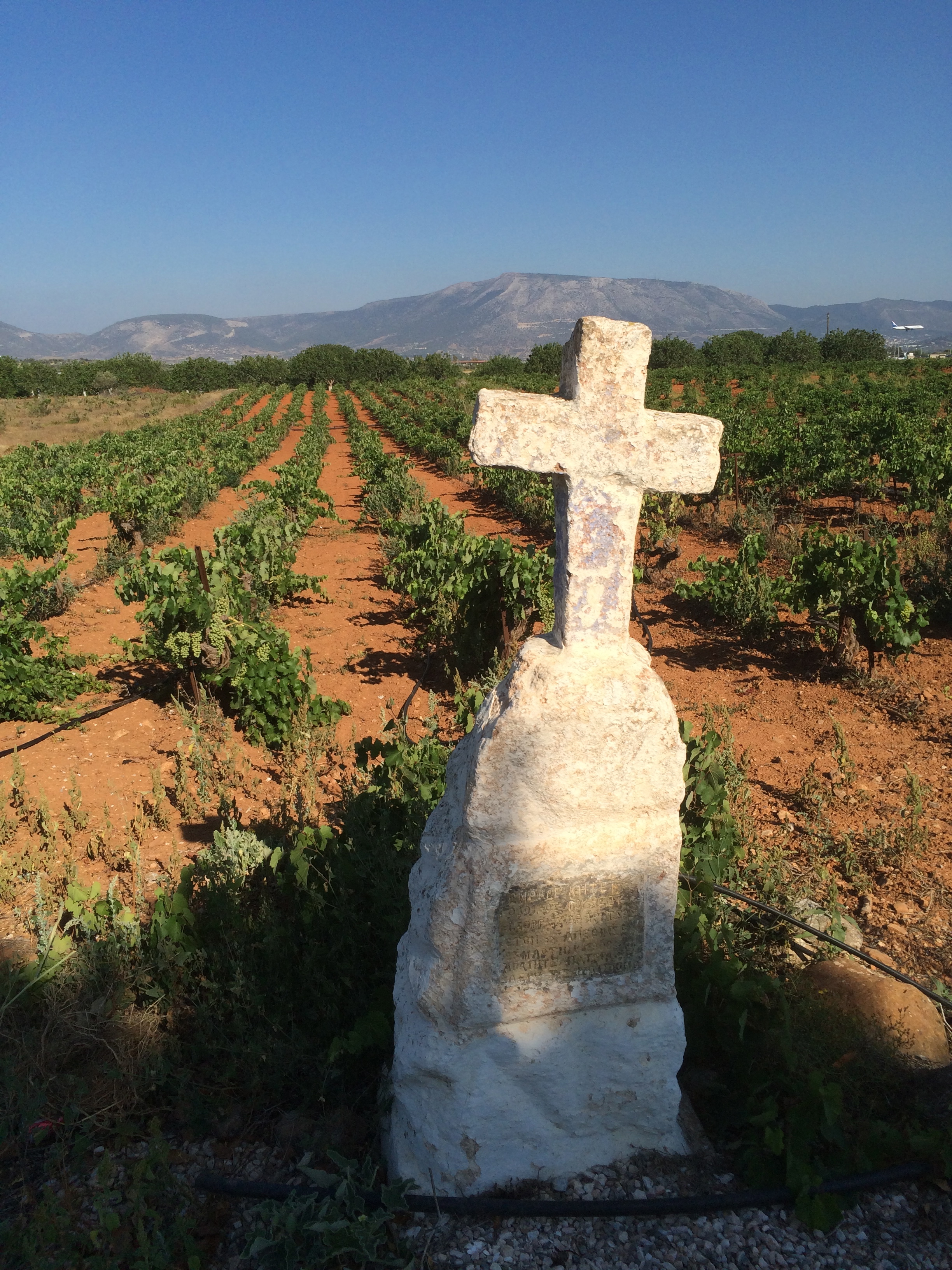 The winery has specialized in Savatiano since its founding. Actually, it was the only grape variety grown at the estate until Vassilis took the helm. He soon began playing with the newly resuscitated Malagousia variety and then red grapes. He also has several experimental plots, one of them Greco di Tufo, the first real vintage of which will be the 2016. “Italian grapes,” I exclaimed, unable to hide the surprise in my voice. With a shrug of the shoulders and a wry smile came the reply: “Well, as the name implies, it’s probably Greek.”
After a tour of the building, we gathered in the event room for a technical tasting with Vassilis and members of his family, including his children, affable, knowledgeable and articulate young adults who will eventually take the reins from their father. You’ll find my tasting notes after the jump.
For details about where we stayed, where and what we ate and what we saw, including some of Papagiannakos’s vineyards, see the Day One report on carswelliana.
INTRODUCTION
♦ PAPAGIANNAKOS (ATTICA)
TSELEPOS (ARCADIA)
MERCOURI (ELIS)
TETRAMYTHOS (ACHAEA)
THYMIOPOULOS (MACEDONIA)
ARGYROS (SANTORINI)
Majorly Muscadet
Muscadet Sèvre et Maine 2012, Clisson, Famille Lieubeau ($24.95, 12923021)
100% Melon de Bourgogne from organically farmed vines averaging 30 years old and rooted in granite soil in various parcels in the Clisson commune. Manually harvested. Whole-cluster pressed. Fermentation with indigenous yeasts took place in temperature-controlled (20°C) tanks and lasted three weeks. Matured 24 months in tanks on its lees. Reducing sugar: 1.3 g/l. 12% ABV. Quebec agent: Société Clément.
“Shrimp shells” (per another taster), lemon, apple, limestone and, eventually, peat and “celery salt” notes. Rich and round, dry and tart, subdued but revealing layers of flavour. The pure fruit is dusted with minerals while the credible finish has a saline edge and a faint hint of honey or caramel. Very likeable. (Buy again? Yes.)
Muscadet Côtes de Grand Lieu 2014, Clos de la Butte, Domaine de l’Aujardière/Éric Chevalier ($19.05, 12886831)
100% Melon de Bourgogne from 50-year-old vines planted in serpentinite, eclogite and quartz in the La Butte lieu-dit. The grapes are pneumatically pressed and the must transffered into glass-lined tanks. Fermented with indigenous yeasts. Matured eight to 10 months on the lees with regular stirring. Unracked and unfiltered. Reducing sugar: 1.3 g/l. 11.5% ABV. Quebec agent: oenopole.
Similar nose to the Clisson’s but deeper, the shells more oyster-like and showing a distinct white pepper note. Even smoother and rounder on the palate though equally layered and minerally. Crisp acidity keeps things fresh and lively. Hints of butter and caramel colour the long finish. The most middle-of-the-road of the trio, not that there’s anything wrong with that. Great QPR. (Buy again? Yes.)
Muscadet Sèvre et Maine 2014, Le Breil, Complémen’Terre ($30.25, private import, 12 bottles/case, NLA)
Founded in 2013 in Le Pallet, the winery is owned and operated by Marion Pescheux and Manuel Landron, son of legendary Muscadet producer Jo Landron. The couple works according to the lunar calendar. 100% Melon de Bourgogne from organically farmed vines rooted in orthogneiss and quartz. Manually harvested. After pressing, the juice is clarified by settling and fermented with indigenous yeasts. Matured on the fine lines for eight months. Nothing added except, when deemed necessary, a shot of sulphur (35 mg/l maximum). 12% ABV. Quebec agent: oenopole.
Lemon and minerals with hints of butter and eventually pale berries. In the mouth, it’s less rich and more rainwatery than its flightmates. On an equal footing with fired minerals, the subdued fruit is buoyed by soft acidity.. A thread of bitterness spools into the saline finish. Long and elegant if a bit inscrutable. Would love to revisit in a couple of years. (Buy again? If feeling flush, yes.)
MWG September 8, 2016, tasting: flight 2 of 6
Bargain Jurançon
Jurançon Sec 2014, Domaine Laguilhon ($16.95, 13028651)
The estate is reportedly owned by viticulturalist Henri Estreboou Suberbie but, though the wine isn’t listed on its website, the producer is the Cave de Gan, a cooperative which M. Estreboou Suberie appears to chair. In any case, this is a 50-50 blend of Gros Manseng and Petit Manseng from sustainably farmed vines in Monein. Manually harvested. Fermented in temperature-controlled stainless steel tanks. Matured on its lees for six months. Stoppered with a cork (not syncork as SAQ.com has it). Reducing sugar: 3.2 g/l. 12.5% ABV. Quebec agent: Les vins Dupré.
Subtle nose of yellow apple and pear, frangipane, faint chalk and honey. Medium-bodied and round, with a satiny verging on waxy texture. Well chilled, grapefruit seems the dominant fruit; warmer, pear with almond overtones comes to the fore. Dry, especially on the finish, though there’s also a thread of sweetness that’s countered by the streaming acidity, crystalline minerals and lingering touch of pith-like bitterness. Fairly long. Not exactly deep but surprisingly nuanced, complex and pure for a $17 wine. Excellent as an aperitif. Not bad with roasted cod loin under a fines herbes, lemon zest and panko crust. I can also see it working with pan-seared scallops in a delicate sauce. (Buy again? Yes.)
Maverick Malagousia
Achaia 2014, Malagousia, Domaine Tetramythos ($18.50, 12910335)
100% organically farmed Malagousia from vines grown at just under 1,000 m. Manually harvested. Destemmed. Macerated on the skins for 30 hours. Only the free-run juice is used. Fermented in temperature-controlled (18°C) stainless steel tanks with indigenous yeasts for 100 days. Undergoes full malolactic fermentation. Reducing sugar: 1.8 g/l. 12.5% ABV. Quebec agent: oenopole.
Aromatic but not exaggeratedly so: floral (jasmine, lily), fruity (pineapple, peach, lemon), minerals (chalk, quartz) and a hint of green herbs. Fresh and lively in the mouth. Very dry. Most present on the attack, the fruit quickly gives way to crystalline minerals. The long citric finish has a lingering bitterness and touch of heat that I don’t recall from a bottle tasted at the winery six weeks earlier. A bit more rustic than I remember, too, not that there’s anything wrong with that. Well chilled, an aperitif wine par excellence; slightly warmer, a fine accompaniment to grilled prawns with a herby pineapple salsa. (Buy again? Done!)
More subdued, acidic and minerally than is usual for this grape, a fact the winemaker attributes above all to the vineyard’s altitude.
MWG August 12th tasting: flight 1 of 8
Blaufränkisch times two and a half…
…or maybe times two and three-quarters, since Zweigelt is a cross of Blaufränkisch and St. Laurent.
Burgenland 2013, Pitti, Weingut Pittnauer ($18.55, 12411000)
A 50-50 blend of Blaufränkisch and Zweigelt from biodynamically farmed vines. Manually harvested. Destemmed. Macerated on the skins for two to three weeks. Pressed pneumatically. Fermented (with indigenous yeasts) and matured (for about six months) in temperature-controlled stainless steel. Lightly filtered before bottling. Screwcap. Reducing sugar: 6.4 g/l. 13.5% ABV. Quebec agent: Rézin.
Appealing nose of red and black berries and turned earth. In the piehole, it’s juicy, brightly acidic and, due to that, fundamentally dry. Floral aromatics and crunchy minerals colour the mid-palate while light raspy tannins mark the finish. A bit rustic and all the better for it. Totally poundbackable and a delight with grilled sausages, all for well under $20 – what’s not to like? (Buy again? Yep.)
Burgenland 2013, Blaufränkisch, Weinbau Uwe Schiefer ($24.75, 12806571)
100% Blaufränkisch. Schiefer, whose last name fortuitously means schist in German, is a former sommelier who decided to get his hands dirty. Located in southern Burgenland, his estate is organic but converting to biodynamism. The winemaking is minimalist: “All the wines ferment spontaneously and mature in differently sized casks on the yeast. No modern technology, no barrique.” Reducing sugar: 1.8 g/l. 12.5% ABV. Quebec agent: Tocade.
Spice, leafmould and slate, gaining red meat and menthol notes. Medium-bodied and silky textured. Blackberry juicey – both very fruity and very dry, with streaming acidity, sleek tannins and a dark mineral underlay. Good length. Less complex and deep than Schiefer’s high-end cuvées (which cost twice as much) but still lovely. (Buy again? Yes.)
Burgenland 2012, Blaufränkisch, Reserve, Weingut Moric ($51.00, 12282527)
100% Blaufränkisch from century-old vines in the Neckenmarkt and Lutzmannsburg vineyards. Owner Roland Velich farms without herbicides, pesticides, fungicides or chemical fertilizers but doesn’t claim the organic label. Fermented with indigenous yeasts. Matured in old barrels. Sulphur use is kept to a minimum. Unfined, like all Moric wines. 13.5% ABV. Quebec agent: Rézin.
Evolving nose: rose, spice, slate and, eventually, leather and faint juniper berries. Beautiful if young, an extracted yet balanced mix of ripe fruit and slate, cranberry-like tartness and finely detailed tannins. “Bitterness adds the balancing touch” (quoting another taster) to the long, long finish. Great clarity and precision. Multidimensional but still a little monolithic (give it a few more years in the cellar or a few hours in a carafe), pricey but not overpriced. Having been burned so many times, I now buy backup bottles for tastings and return the backup if the first bottle isn’t defective. I’d planned to do that with this but couldn’t bring myself to part with the second bottle. (Buy again? Done!)
MWG April 14th tasting: flight 5 of 6

 Brett happens