Posts Tagged ‘Red wine’
Piedmontissimo
Located in Monforte d’Alba, the approximately seven-hectare Cascina Disa estate has been in the Sandri family since 1965, the year of current owner/winemaker Elio Sandri’s birth. Elio has been in charge since 2000 and his is the only name now shown on the wines’ front labels. Only six wines – all red and resolutely traditional in style – are made: Dolcetto d’Alba, Barbera d’Alba, Langhe Nebbiolo, Marapika (a Langhe blend of the three varieties), Barolo and Barolo Riserva. The farming is organic but uncertified. Pruning is about the only intervention in the vineyard. The wine-making is similarly non-interventionist: spontaneous fermentation, minimal manipulation, extended maturation in neutral botti and no filtering or fining. The only addition is tiny amounts of sulphur dioxide at bottling. Sandri is sometimes ranked alongside Bartolo Mascarello and Rinaldi; to go by our tasting, it’s easy to see why.

Langhe Rosso 2013, Marapika, Elio Sandri ($25.95, private import, 12 bottles/case)
A blend of Barbera and Dolcetto, in equal proportion, with a small dollop of Nebbiolo from younger vines planted on north- and east-facing slopes. 12.5% ABV. Quebec agent: Labelle Bouteille/oenopole.
Bitter cherry, including the pits, along with minerals and a bit of spice. A medium-bodied mouthful of ripe-sweet fruit, silky smooth acidity and fine tannins that become more assertive with chewing. Dark minerals provide some depth. Finishes longish, clean and bitter-tinged. Definitely gluggable. (Buy again? Yes.)
Dolcetto d’Alba 2015, Elio Sandri ($25.95, private import, 12 bottles/case)
100% Dolcetto from vines planted in 1977. Vinified in cement tanks. 13% ABV. Quebec agent: Labelle Bouteille/oenopole.
Textbook nose of mulberry, bitter cherry and leafmould. Quite elegant in the mouth with its core of vibrant fruit, lively acidity, fine bitey tannins and long minerally finish. A touch of astringency lingers. Gorgeous. (Buy again? Def.)
Barbera d’Alba Superiore 2015, Elio Sandri ($38.00, private import, 6 bottles/case)
100% Barbera from vines rooted in ferrous sandstone and planted in 1945 and 1976. Manually harvested. Partially destemmed. Matured eight months in very old Slovenian oak botti, six months in the bottle. 14.5% ABV. Quebec agent: Labelle Bouteille/oenopole.
Deep nose of ripe blackberry, slate and graphite with clove overtones. Medium-bodied and supremely fluent. Very dry though ripe-sweet on the attack. Built around an intense core of dark fruit wrapped in wiry tannins, aglow with fine acidity and shot through with minerals. Long, complete and elegant. Accessible now but ageable, too. Pricey Barberas from other producers are often New Worldishly fruit- and oak-driven. This takes another, more authentic and much more enjoyable path. (Buy again? Oh, yes.)
Barolo 2010, Perno, Elio Sandri ($71.50, private import, 6 bottles/case)
100% Nebbiolo from vines planted in 1937. Macerated, with a submerged cap, for 28 days. Matured six years in neutral Slavonian oak botti. Total production: 3,500 bottles. 14% ABV. Quebec agent: Labelle Bouteille/oenopole.
Subtle, perhaps somewhat closed nose of red and black fruit and turned earth with telltale hints of tar and violet. Medium- to full-bodied. The fruit is remarkably pure, the structure what you’d expect from a traditionally styled Barolo: robust attack, sleek acidity, firm yet pliable tannins, a deep mineral foundation and an impressively sustained, somewhat astringent finish. A flawless wine with great energy, focus and balance, every dimension and soul. Young and promising but also surprisingly accessible. (Buy again? Yes.)
MWG November 10th tasting: flight 5 of 5
Could-be Chiantis
The daughter of an oenologist, Giovanna Morganti studied oenology and then began working for San Felice, where she focused on preserving some 300 old Tuscan grape varieties. When her father gave her the three-hectare Podere le Boncie, an olive-growing estate in Castelnuovo Berardenga, Giovanna created a vineyard, populating it with Sangiovese and her favourite old varieties – Ciligiolo, Foglia Tonda, Mammolo and Prugnolo – planted very densely (7,000 vines per hectare). She has since acquired another 1.3 hectares nearby. The farming is mostly biodynamic. Fermentation, with indigenous yeasts, takes place in traditional open-topped wood tanks. Two wines are produced: the flagship Le Trame and a “second” wine, Il Cinque, a young-vines cuvée that was originally sold only at the winery.
Located in Carmignano, Italy’s smallest wine appellation and one of its oldest (granted special protections as far back as 1716), Fattoria di Baccherto has been in the hands of the Tesi family since 1920. Currently run by Rossela Bencini Tesi, the estate is centred around a former Medici hunting lodge. In 2001, unhappy with the quality of her wines and the condition of her soil, Rossela switched to natural wine-making: organic and eventually biodynamic farming, no additions in the cellar other than a tiny shot of sulphur dioxide at bottling, spontaneous fermentations, no temperature control, no filtering and no fining. Sangiovese, Cabernet Sauvignon (long present in the appellation and possibly introduced in the 16th century by Catherine de’ Medici), Canaiolo, Trebbiano Toscano and Malvasia del Chinati are the main grape varieties. Annual production is around 10,000 bottles of red wine, 2,000 bottles of white wine and 1,000 bottles of vin santo as well as olive oil, honey and figs.

IGT Toscana 2015, Cinque, Podere le Boncie ($33.50, private import, 12 bottles/case)
Sangiovese (70%) with Mammolo, Colorino, Foglia Tonda and Ciliegolo making up the balance. Manually harvested. Destemmed. Fermented with indigenous yeasts in stainless steel tanks. Matured 12 months in barrels and six months in the bottle. Unfiltered and unfined. 14% ABV. Quebec agent: oenopole.
Wafting nose of ripe plum, sawed wood, spice, moldering leaves, ink and tobacco. Medium-bodied, silky textured and oh, so flavourful. The ripe, almost juicy fruit is grounded in a earthy mineral substrate. Bright acidity and wiry tannins provide a light but tensile structure. Finishes long and clean. Accessible now and best drunk over the next two or three years, methinks. (Buy again? Done!)
Carmignano 2014, Terre a Mano, Fattoria di Bacchereto ($50.75, private import, 6 bottles/case)
75% Sangiovese, 10% Canaiolo Nero, 15% Cabernet Sauvignon from vines planted in 1979, 1994 and 2004. Manually harvested. Destemmed. Alcoholic fermentation takes place in glass-lined concrete tanks and lasts 15 days. The wine is then transferred to used 350-litre Allier oak barrels for malolactic fermentation and maturation, typically lasting 18 to 24 months. Unfiltered and unfined. 13.5% ABV. Quebec agent: oenopole.
Pure cherry faceted with plum, dried herbs, sun-baked earth and a hint of leather. Medium- to full-bodied. Ideal balance between ripe, savoury, satiny fruit and a lovely airframe structure comprising robust tannins, bright acidity and real mineral depth. A floral note creeps in on the long finish. The touch of rusticity in no way detracts from the wine’s overall elegance. (Buy again? Yes.)
IGT Toscana 2014, Le Trame, Podere le Boncie ($54.50, private import, 6 bottles/case)
Sangiovese (90%), Foglia Tonda, Colorino and Mammolo (10% combined) from vines averaging 20 years old. Manually harvested. Destemmed. Fermented 20 days in small wood vats with indigenous yeasts and twice-daily punch-downs. Matured 26 months in large barrels and six months in the bottle. Annual production: around 6,000 bottles. 13.5% ABV. Quebec agent: oenopole.
Echt-Sangiovese nose of cherry, sawdust, terracotta and sandalwood with earthy overtones of mushroom and humus. Rich, the fleshiest of the three but in no way heavy. Glowing acidity enlightens the sweet-ripe, somewhat dusky fruity. Round tannins add a light, drying rasp. Dark minerals abound, including a ferrous rumble that lasts well into the long finish. Red fruit, terracotta, spice and a hint of mint linger. Already showing considerable complexity, not to mention superb depth and balance, this will age beautifully for another five or 10 years. (Buy again? Done!)
MWG November 10th tasting: flight 4 of 5
Dufaitre trio
Based in Saint-Étienne-des-Oullières, Laurence and Rémi Dufaitre began working their first hectare of vines in 2001, initially selling the fruit to the local co-op. They started making wine and bottling it under their own label in 2010. Today their holdings, which include the former Domaine de Botheland, total around 12 hectares, one of which is planted to Chardonnay. Inspired by Jules Chauvet and his disciples, especially Jean Foillard, the Dufaitres use organically farmed grapes that undergo carbonic maceration and are given long, naturally low-temperature fermentations with indigenous yeasts. Chaptalization, filtering and fining are strictly avoided. When used, sulphur dioxide is kept to a minimum.

Beaujolais Villages 2016, Prémices, Laurence et Rémi Dufaitre ($28.40, private import, 12 bottles/case)
100% Gamay from 35-year-old vines grown in the granite, sand and gravel soil of a plot named Prémices. Carbonic maceration lasted 16 days. Fermented and matured in concrete tanks. No added sulphur. Bottled in February 2017. 13% ABV. Quebec agent: oenopole.
Cherry, red berries and vine sap with background slate and ink. Fresh and light on the palate, with lovely ripe fruit, bright acidity and light, caressing tannins. Ripe-sweet upfront, drying on the long, savoury, spicy finish with its lingering hint of stem. Straightforward but far from simple, a wine of great purity and finesse. A second encounter, a bottle drunk on its own at dinner, impressed me even more; tasting double-blind and fooled by its raspberry-leaning fruit and peppery spice, I guessed it was carbonic-macerated Grenache. (Buy again? Definitely.)
Brouilly 2016, Laurence et Rémi Dufaitre ($34.75, private import, 12 bottles/case)
100% Gamay from 60- to 65-year-old vines rooted in granite and volcanic soil. Carbonic maceration lasted 18 days. Fermented in concrete tanks. Matured in old 200-litre oak barrels. Bottled in March 2017. 12.5% ABV. Quebec agent: oenopole.
Earthy nose, the fruit overtoned with old wood, spice and a hint of barnyard. In the mouth, the wine is a bit more intense – a bit less vin plaisir – than the Prémices though still on the lighter side of medium-bodied. Veils of fruit, great minerality, buoyant acidity and light tannins hold the attention. As Theo notes, there’s a lovely “clarity [that] comes in the middle of the mouth.” The longest of the three. (Buy again? Yes, though not necessarily in preference to the Côte de Brouilly.)
Côte de Brouilly 2016, Laurence et Rémi Dufaitre ($36.50, private import, 12 bottles/case)
100% Gamay from 50- to 70-year-old vines rooted in granite and volcanic soil. Carbonic maceration lasted 18 days. Fermented in concrete tanks. Matured in used Burgundy barrels. Bottled in March 2017, a month earlier than usual. 12.5% ABV. Quebec agent: oenopole.
A nose similar to the Brouilly’s but deeper, more complex and savoury, with mushroom creeping in and the spice taking on Asian overtones. A medium-bodied mouthful of rich yet crunchy fruit and slate. Finely structured by sleek acidity and supple yet resilient tannins. So pure and elegant, this complete and balanced wine is delicious now but has the wherewithal to age for several years. (Buy again? Yes.)
MWG November 10th tasting: flight 3 of 5
Southern Overnoys
A surprising number of Jura winemakers share family names. The list includes the Benoits (Denis and Paul et fils), the Boilleys (Joël and Luc), the Bulabois (Claude, Georges, Philippe and Régis), the Clavelins (Charles and Hubert et fils), the Puffeneys (Frédéric and Jacques), the Rolets (the eponymous estate and Gérard) and the Tissots (Jean-Louis, Jacques and André et Mireille).
The Overnoys also belong on this list. The wines made by Pupilin-based Pierre Overnoy (and now his former assistant, Emmanuel Houillon) have long been favourites bordering of fetish objects of natural wine geeks. Also based in Pupillin, Domaine Overnoy-Crinquand has a somewhat lower profile but is something of a rising star. Until this fall, however, I didn’t know there was a third Overnoy estate: Domaine Overnoy, which is located further south, in the commune of Orbagna, and is currently run by 20-something Guillaume Overnoy, Pierre’s great nephew.
Actually, Domaine Overnoy is a neighbour of Domaine Labet (both estates are in the Sud-Revermont region) and Julien Labet has been active in introducing the estate to agents he deals with, including oenopole, which is how the wines have made their way to Quebec.
Guillaume took over the 5.5-hectare family estate from his father, Jean-Louis, in 2013. The following year, he began converting it to organic farming, obtaining certification in 2016. While Trousseau is the flagship, wines are made from all five official Jura varieties (the estate has 3 ha of Chardonnay, 1 ha of Savagnin and around 1 ha of red varieties, of which Trousseau comprises 55 ares, the rest being Poulsard and Pinot Noir). The soil tends to grey marl. Harvesting is manual. Wine-making is non-interventionist. Alcoholic and malolactic fermentations are spontaneous. In the cellar, sulphur use is minimal.
All three wines we tasted were from the 2015 vintage. The last few vintages have been difficult in the Jura and 2015 was no exception, the main problems being excessive heat and drought.
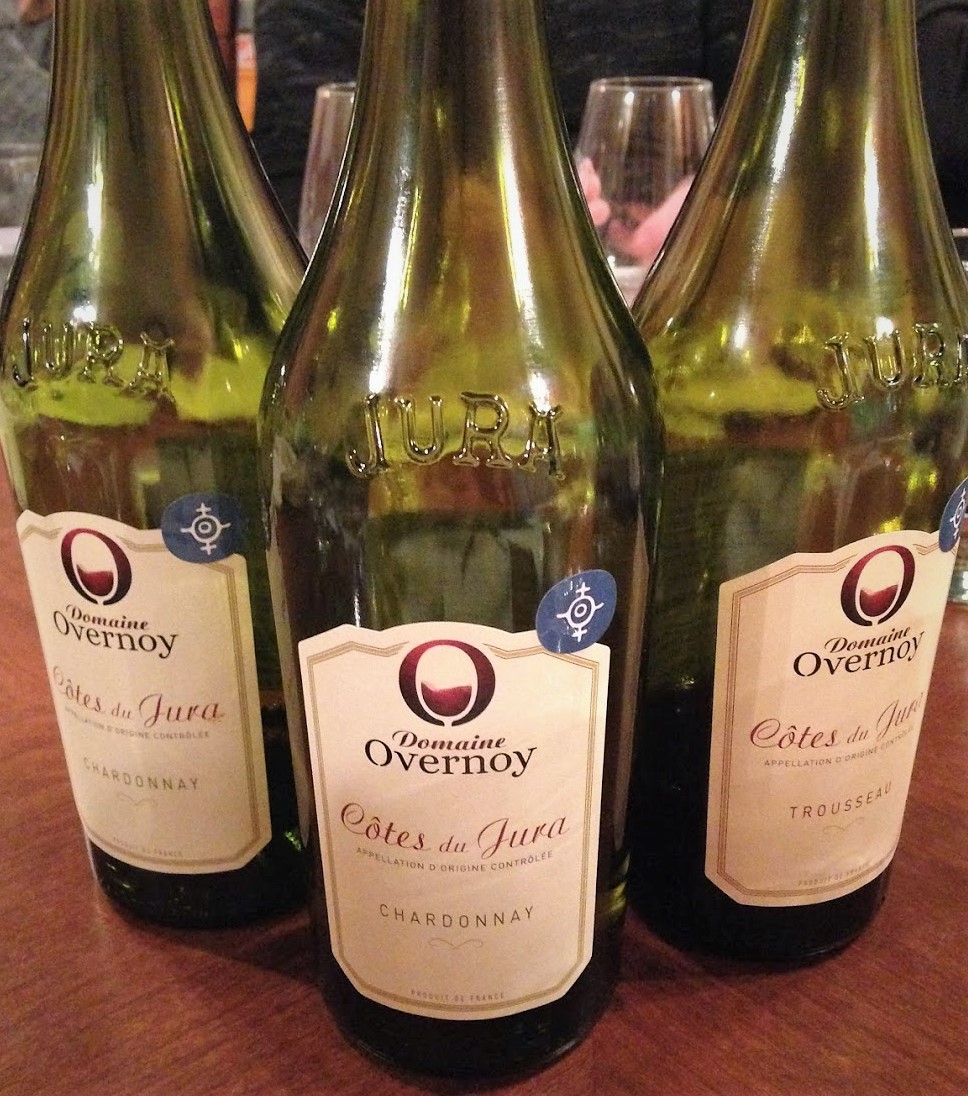
Côtes du Jura 2015, Chardonnay, Perce Neige, Domaine Overnoy ($32.75, private import, 6 bottles/case)
100% Chardonnay from vines in an historic parcel. May be fermented in tanks and may be prevented from undergoing malolactic fermentation. In any case, the winemaker’s aim is for a fresh wine to be drunk young and not necessarily with food. 13% ABV. Quebec agent: oenopole.
Engaging nose of yellow apple and straw with hints of pineapple and white flowers. Medium-bodied. Sweet-seeming on entry but actually quite dry. Ripe but hot heavy, in no small part due to the crisp acidity. The rich mid-palate is underlain with chalky minerals that last well into the long, drying finish. A clean, precise, refreshing wine with “lots of energy.” (Buy again? Yes.)
Côtes du Jura 2015, Chardonnay, Charmille, Domaine Overnoy ($37.25, private import, 6 bottles/case)
100% Chardonnay from the Charmille lieu-dit. Slow alcoholic fermentation (more than 10 months). Underwent malolactic fermentation. Matured in fifth- to sixth-fill fûts. 14.5% ABV. Quebec agent: oenopole.
More minerally, complex and serious than the Perce Neige, with notes of “curry,” “cumin seeds,” browning apple and crushed fresh herbs, especially chamomile. Rich and serious in the mouth (“like a Labet,” notes one taster). Clean and structured, fleet yet complex. There’s a load of minerals and great energy. Keeps its cool despite the alcohol. Savoury and dry, especially on the long finish. My favourite of the three. (Buy again? Def.)
Côtes du Jura 2015, Trousseau, Domaine Overnoy ($38.25, private import, 6 bottles/case)
100% Trousseau. Probably destemmed. Matured in neutral barrels. 13.5% ABV. Quebec agent: oenopole.
Red berries, boudoir, old wood, spice and eventually floral and earth notes. In the mouth, it’s “fruit-forward” and full of “ripe strawberry.” The acidity is pronounced but smooth. Round tannins and dark minerals stay in the background until the finish. While a bit atypical (richer, more fruit-driven and less structured than your average Trousseau, probably due to the vintage), it definitely works as a “vin plaisir.” Not sure it’s a long keeper, though. (Buy again? Yep.)
MWG November 10th tasting: flight 2 of 5
Lumpps in our throats
Givry Premier Cru 2015, A Vigne Rouge, Domaine François Lumpp ($58.75, 13366829)
100% Pinot Noir from a 2.45-hectare vineyard planted in the early 2000s. The soil is mainly limestone and clay. The farming is generally organic though synthetic products are sometimes used if warranted by the weather conditions. Manually harvested. Destemmed. Given five to 10 days’ cold maceration prior to fermentation, which takes place in stainless steel tanks with light punch-downs and lasts around three weeks. Matured in French oak barrels, around 70% of which are new. Racked and filtered before bottling. All wine-making operations are done according to the lunar calendar. 12% ABV. Quebec agent: Réserve & Sélection.
Fairly closed nosed of cherry, slate, spicy oak and dried leaves; it’s very true to type though it doesn’t yet pinote (sing like only Pinot can do). Medium-bodied and satin-textured. The pure fruit seems more cranberry- than cherry-like, partly a function of the tart acidity. The fine tannins show not a trace of greenness. An earthy depth provides ballast that lasts well into the bitter cherry-inflected finish. The combination of richness, structure, energy and precision seems more like a Côte de Beaune’s. It’s a bit austere for now but probably won’t be in a couple of years. (Buy again? Yes.)

Givry Premier Cru 2015, Crausot, Domaine François Lumpp ($59.50, 13061857)
100% Pinot Noir from a 0.92-hectare vineyard planted in the early 1990s. The soil tends to limestone interspersed with fine marl. The wine-making is more or less as for the A Vigne Rouge. 13% ABV. Quebec agent: Réserve & Sélection.
Even more closed and stemmy: oak, coconut and Christmas spice have the upper hand for now. In the mouth, it’s bigger, denser and even more primary. The beautifully pure fruit (mainly cherry) is overtoned with tea and brightened by acidity. The tannins are impressive but tight and unyielding from start through the long finish. “Dries your mouth right up,” notes one taster. Needs five or 10 years to knit together and open up. The $60 question: will the fruit still be vibrant when the tannins finally resolve? Probably but only time will tell. (Buy again? If in a gambling mood.)
MWG October 26th tasting: flight 6 of 6
Nativi di Lazio
Based in Cori, founded in 1947 and named after Lucius Quinctius Cincinnatus, Cincinnato is a well-run cooperative that makes a wide range of red, white, sparkling and dessert wines from local varieties as well as grappa and olive oil. The 255 members farm 550 hectares, 100 of which are worked organically.
Lazio 2014, Cesanese, Arcatura, Cincinnato ($21.70, 13096689)
100% Cesanese from vines rooted in volcanic-clay soil. The manually harvested grapes are destemmed and soft-pressed. Fermentation on the skins in temperature-controlled (24°C) tanks lasted around 11 days. Underwent malolactic fermentation. Half was matured in French oak barrels (first, second and third fill) for eight months and half in stainless steel tanks for nine months. Filtered before bottling. Aged in the bottle for six months before release. Reducing sugar: 4.8 g/l. 13.5% ABV. Quebec agent: Valmonti.
The first bottle is corked. The backup has an intriguing nose of “buckwheat honey,” cocoa, sweet spices, background plum, “copper, like pennies” and, eventually, leafmould. In the mouth, it’s fluid, medium-bodied and super smooth. The ripe fruit, soft acidity and round tannins. Decent finish. A little overshadowed by its flightmate, though that could be due to its being popped and poured. (Buy again? Sure.)

Lazio 2013, Nero Buono, Ercole, Cincinnato ($23.25, 12557754)
100% Nero Buono, a teinturier (red-fleshed) grape, from 15- to 20-year-old vines rooted in volcanic-clay soil. The manually harvested grapes were destemmed and soft-pressed. Fermentation on the skins in temperature-controlled (23°C) stainless steel tanks lasted around 15 days. Underwent malolactic fermentation. Matured in French oak barrels (first, second and third fill) on the lees for 12 months and in the bottle for eight months. Filtered before bottling. Reducing sugar: 4.8 g/l. 13.5% ABV. Quebec agent: Valmonti.
Not carafed but allowed to breath for a couple of hours before serving. Dark – verging on black – in the glass. Extroverted nose of dark berries, “dried banana,” “old leather,” tobacco, “baking spices” and a hint of orange chocolate. Richer than the Cesanese. The intense core of fruit is overtoned with spice. Smooth acidity and velvety tannins are pretty sotto voce yet present enough to provide buoyancy and tone. The oak is obvious but not obnoxious. Orange chocolate returns on the credible finish. A bit New Worldish and far from deep, complex or subtle but authentic and likeable all the same. (Buy again? Yes.)
MWG October 26th tasting: flight 4 of 6
Paarl jam
 Paarl 2015, Pinotage, Fairview ($17.55, 10678481)
100% Pinotage from older dryland bush vines and trellised vineyards on the Fairview farm in Paarl. The soils are mainly decomposed granite. Destemmed and lightly crushed. Fermented in stainless steel tanks and open top foudres. After malolactic fermentation was completed, the wine was transferred to new French and American oak barrels for 10 months’ maturation, then blended and bottled. Reducing sugar: 3.5 g/l. 14% ABV. Quebec agent: Vinicolor.
Plum, cherry, stale chocolate and scorched earth on the nose. Medium- to full-bodied. Integrated acidity keeps the forward, ripe fruit in check. Rustic tannins provide a welcome rasp, the earthy/leathery substrate a modicum of depth. Vanilla and chocolate are thankfully relegated to the background. The fair finish leaves a tarry aftertaste. Devoid of nuance and finesse so not very interesting on its own though downable with food, in this instance Lebanese takeout. Not opened for its original purpose – to accompany Latucca‘s most excellent barbecue – which I suspect it would have done passably well if not so well as, say, Leeuwenkuil’s Cinsault or Badenhorst’s Secateurs Red Blend. (Buy again? Only in the absence of more appealing alternatives.)
Istragram
Primorska 2013, Refošk, Rojac ($24.75, private import, 6 bottles/case)
Located on Slovenia‘s Istrian peninsula and just inland from the Adriatic coast, the Rojac estate has been making wine since the 17th century. The young Uroš Rojac took the reins in 2005, when his father unexpectedly passed away. 100% Refošk (aka Refosco d’Istria) from 13-year-old organically farmed vines rooted in sandy soil. Manually harvested. Fermented (with indigenous yeasts) and macerated in open vats for 10 to 15 days. Matured 18 months in oak and six months in stainless steel. Unfiltered and unfined. Vegan compatible. Around 20,000 bottles were produced. 13.5% ABV. Quebec agent: Vadim Fonta.

Fresh nose of blackberry, slate and distant spice. Medium-bodied. The very forward, juicy, sweet-tart red and black fruit is brightened by incandescent acidity, darkened by minerals. Pliable tannins add texture as much as structure. There’s not a lot of depth but good length. A few around the table were unenthusiastic but several of us found it had an earthy appeal. Would gladly make this straightforward and tasting wine a weeknight regular. (Buy again? Yes.)
MWG October 13th tasting: flight 8 of 9
Red devil
Vallée d’Aoste 2015, Enfer d’Arvier, Danilo Thomain ($37.75, private import, 6 bottles/case)
Located in a steep, south-facing ampitheatre in the Valle d’Aosta, the five-hectare Enfer d’Arvier subzone, which gained DOC status in 1971 but has since been incorporated into the valley-wide DOC, is named enfer (“hell” in French) due to the intensity of the light and summer heat and the aridity and hardness of the soil. The Thomain estate, which was founded in 1920 by Danilo’s grandfather, comprises one hectare and is the appellation’s only independent winemaker. Farming is not organic though use of chemicals is kept to a minimum. The wine-making is artisanal. Production averages around 5,000 bottles a year. This, the only wine made, is a blend of Petit Rouge (90%) with 10% Pinot Noir, Gamay and Gamaret from 35- to 40-year-old vines rooted in sandy glacial moraine. Manually harvested. Destemmed. Alcoholic fermentation with indigenous yeasts takes place in 1.5-ton fibreglass tanks and lasts around two weeks. The wine is then transferred to barrels for nine months for malolactic fermentation and maturation on the lees. Clarification is by settling; the wine is unfiltered and unfined. 13% ABV. Quebec agent: Vadim Fonta.

The first bottle seems lightly corked, which is confirmed when we open a backup. Appealing, earthy nose of sour cherry and choke cherry with hints of green and tarragon/licorice. In the mouth, it’s medium-bodied, dry and oh, so pure. The intense berry fruit tastes more wild than cultivated. Structure comes in the form of smooth but lively acidity, wiry tannins and a mineral underlay. The finish is long and a faint bitterness lingers. Tasty and very drinkable. Had this been available for purchase, we would have taken a case or two. (Buy again? Yes.)
MWG October 13th tasting: flight 7 of 9
L’Aietta trio
In 2001, Francesco Mulinari, then a 17-year-old high school student, decided to make wine from some abandoned Sangiovese vines growing on a 2.5-hectare plot of land that his parents had acquired as a picnicking spot and natural playground for their children. Located just outside the wall surrounding Montalcino, the spot, known as L’Aietta, had been the site of an army encampment during the 1555 siege of the city. When applying for a production permit, he – well, actually his mother, as he was underage – learned that the parcel lay within the Brunello di Montalcino appellation. His first vintage, the 2001 and officially a Brunello, consisted of 720 bottles.
In 2004, Mulinari replaced the old vines with bush vines, as the hard rock would have made installing posts difficult. The land is so steep – the tiny parcel is divided into 18 terraces – that all work is done by hand. In 2002, he acquired another hectare of Sangiovese vines in nearby Castelnuovo dell’Abate, eventually replacing them with bush vines too. He more recently took over a 2.5-hecatre plot in Monecucco, from whose grapes he makes a Chianti-style blend (Sangiovese, Canaiolo and Colorino) and a raisinated sweet white (Malvasia di Candia, Vermentino and Zibibbo). He works this last vineyard with a horse.
Farming is rigorously organic (certified in 2013); harvesting is manual; wine-making is non-interventionist. The winery, the smallest in Montalcino, has very little technology and only tanks and barrels. All farming and wine-making is done by Mulinari by himself. Current production is around 7,000 bottles a year.
Vino Spumante 2013, Brut, Metodo Classico, L’Aietta ($55.25, private import, 6 bottles/case)
100% Sangiovese Grosso from organically farmed vines averaging 15 years old and located in the Castelnuovo dell’Abate vineyard. The grapes are harvested based on their acidity, not their maturation, and before their colour is fully developed (green harvest fruit, in other words). Macerated and fermented (with indigenous yeasts) for 30 days in stainless steel tanks. The still wine is matured for one year in large Slavonian oak barrels. Secondary fermentation and one year’s maturation take place in the bottle. Unfiltered and unfined. 11.5% ABV. Around 700 bottles made. Quebec agent: Vadim Fonta.

Pale pink. Initially closed nose with notes of cheese, modelling clay, bread dough and eventually red berries. Light effervescence. Smooth despite the bright acidity. More savoury than fruity. The mineral underlay lasts well into the long, saline finish with its peekaboo berry notes. Elegant, tasty, unusual and rare, though is that enough to justify the champagne-rivaling price? (Buy again? If feeling flush.)
Rosso di Montalcino 2015, L’Aietta ($37.75, private import, 6 bottles/case)
100% Sangiovese Grosso from organically farmed vines averaging 15 years old and located in the Castelnuovo dell’Abate vineyard. The grapes are macerated and fermented (with indigenous yeasts) in stainless steel tanks for 30 days. Matured one year in large Slavonian oak barrels and one year in the bottle. Unfiltered and unfined. 2,600 bottles made. 14.5% ABV. Quebec agent: Vadim Fonta.
Classic nose of cherry, tobacco, herbs and graphite. Velvety smooth on the palate. The ripe fruit is illuminated by soft-glow acidity, shaded by minerals. Stealth tannins turn more assertive on the spicy finish. Will probably be even better in a year or two. Lovely though one of those wines that shows better at the dining table than at a tasting. (Buy again? Yes.)

Brunello di Montalcino 2012, L’Aietta ($71.25, private import, 6 bottles/case)
100% Sangiovese Grosso from organically farmed vines averaging 15 years old and located in the L’Aietta vineyard. The grapes are macerated and fermented (with indigenous yeasts) in stainless steel tanks for 21 days. Matured two years in large Slavonian oak barrels and one year in the bottle. Unfiltered and unfined. 2,200 bottles made. 14% ABV. Quebec agent: Vadim Fonta.
Complex, evolving nose of red and black berries, smoke, graphite, tobacco, leather, oak, spice and maybe mint. Fuller, rounder, deeper and longer than the Rosso. Satin-textured. The beautifully pure ripe fruit is structured by round, firm tannins and fluent acidity. Dark minerals, nose-echoing tertiary flavours and Asian spice overtones add complexity and interest. Very long. A noble wine that’s delicious now but still a youngster. Probably a stunner in five to 10 years. (Buy again? Yes.)
MWG October 13th tasting: flight 6 of 9

 Brett happens